
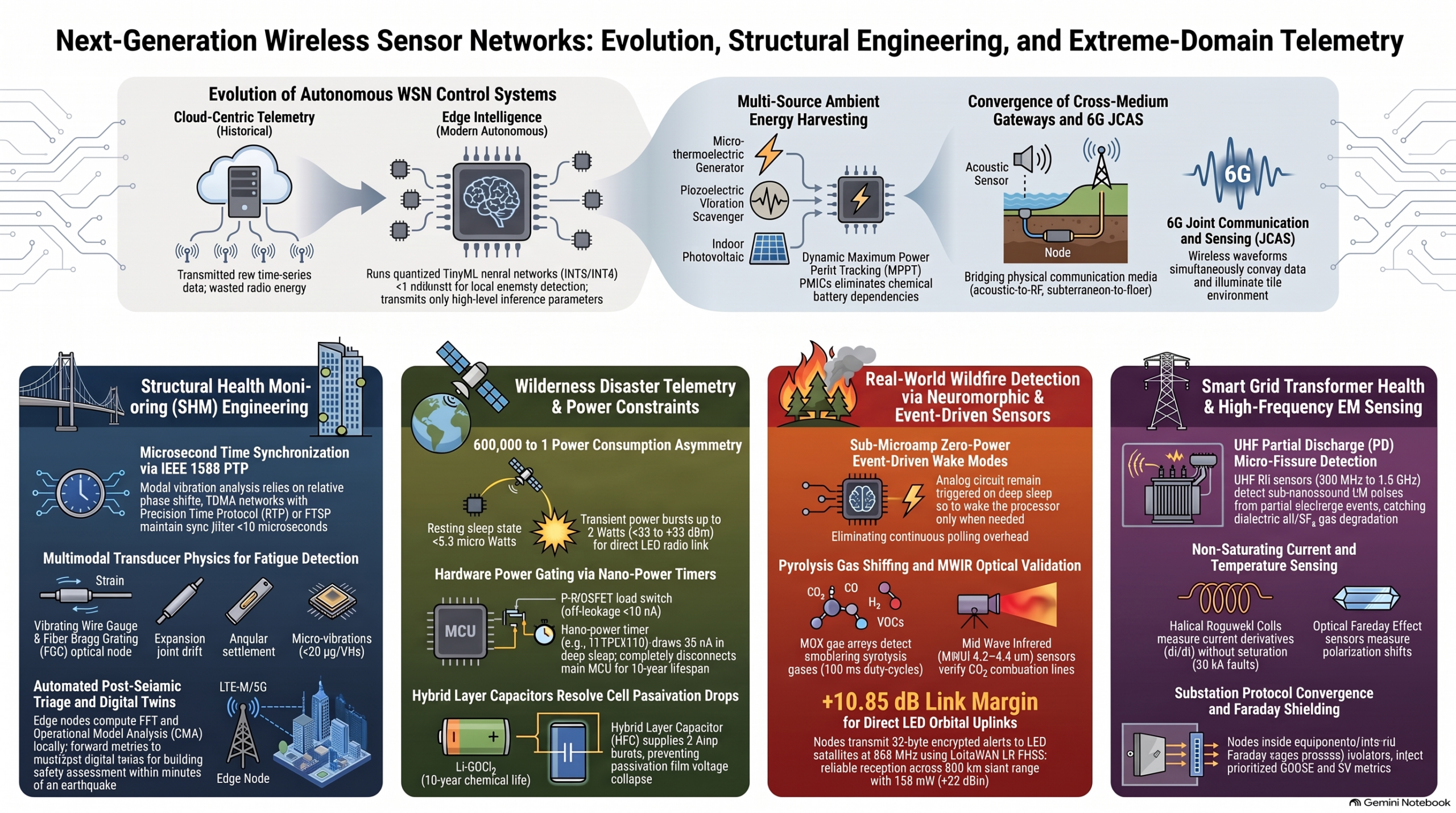
Beyond the Wi-Fi Horizon: 5 Mind-Bending Engineering Reality Checks from the Edge of Wireless Sensing
- Introduction: The Unseen Frontier of “Everywhere” Computing
We take for granted that our smartphones, smart plugs, and laptop transceivers can seamlessly push megabytes of data through clean, air-filled rooms over Wi-Fi and 5G. But step outside the controlled environment of homes and offices, and the physical world presents spaces where standard terrestrial wireless tech completely collapses.
When engineers deploy autonomous sensors into extreme environments—such as abyssal ocean trenches, active 765,000-volt power lines, miles deep inside solid rock mines, or frozen wildernesses—they are forced to throw out standard networking protocols. In these hostile domains, the underlying physical medium dictates every line of code, every microampere of current, and every architectural decision.
Surviving at this physical-digital boundary isn’t about fitting a sleeker chip into a smaller box. It requires solving extreme physics trade-offs at the intersection of energy storage chemistry, electrodynamics, material science, and thermodynamic limits. Here are five counter-intuitive reality checks from the engineers building the hidden networks that keep our world running.
- Takeaway 1: Underwater, Sound Beats Light (And Radio Waves Die in Centimeters)
In terrestrial environments, electromagnetic RF signals travel through the air at roughly the speed of light (3 \times 10^8\text{ m/s}). Try sending a standard Wi-Fi or cellular signal through seawater, however, and your communication link will fail almost instantly.
Seawater possesses a high electrical conductivity (\sigma \approx 4\text{ S/m}) due to its high concentration of dissolved salts. This conductivity causes electromagnetic radio waves to be absorbed within centimeters via severe Ohmic dissipation. Optical lasers might seem like a logical alternative, but they scatter rapidly in turbid coastal waters, collapsing useful optical ranges from 10 to 30 meters in clear deep water down to under 1 to 2 meters in turbid zones.
To transmit data across kilometers of ocean, Underwater Acoustic Sensor Networks (UWSNs) must abandon electromagnetic waves and rely on mechanical sound waves using piezoceramic transceivers. But this pivot introduces a massive physical trade-off: sound travels through water at roughly 1,500\text{ m/s}—five orders of magnitude slower than light.
“Because high salinity yields high electrical conductivity, electromagnetic waves are absorbed within centimeters. Underwater networks must rely on acoustic sound waves traveling at roughly 1,500 m/s—creating propagation delays five orders of magnitude higher than terrestrial systems.”
This sluggish propagation speed completely dismantles standard networking assumptions:
- Frequency-Dependent Absorption: Acoustic wave absorption increases rapidly with signal frequency due to chemical relaxation of dissolved boric acid (\text{B(OH)}_3) and magnesium sulfate (\text{MgSO}_4). Governed by Thorp’s attenuation formula, long-range communication (>5\text{–}10\text{ km}) is severely restricted to narrow acoustic bandwidths below 5\text{–}10\text{ kHz}.
- The “Hidden Terminal in Time” Problem: Terrestrial collision-avoidance handshakes (like CSMA/CA) break down when a one-way acoustic flight time across 1.5 kilometers takes a full second. While two nodes wait for an acknowledgment, hidden terminals across the channel can transmit simultaneously, creating delayed collisions at the receiver.
- Algorithmic Adaptations: To route data without global routing tables, subsea networks utilize Depth-Based Routing (DBR)—where nodes use hydrostatic pressure sensors to forward telemetry upward toward surface gateways—and Zero-Padded OFDM (ZP-OFDM) modulation to compensate for Doppler scaling caused by ocean currents.
- Takeaway 2: “Stealing” Power from 765,000-Volt Conductors (Without Exploding)
If surviving in the ocean requires acoustic engineering, operating directly on the electrical grid demands an entirely different masterclass in electrodynamics.
High-voltage grid assets operating between 115 kV and 765 kV are surrounded by massive electrostatic and magnetic fields. To monitor conductor sag, core temperature, and local wind cooling in real time (a practice known as Dynamic Line Rating), sensors are mounted directly on energized power lines in a “bird-on-a-wire” topology.
Because replacing batteries on live 765 kV lines is both hazardous and cost-prohibitive, these nodes harvest operating energy directly from the parasitic magnetic field generated by the conductor’s alternating current. Using split-core nanocrystalline current transformers (CTs), the sensor can scavenge operating milliwatts from line currents as low as 15 to 20 amperes.
Phase Conductor (10 A to 30 kA Surge)
═══════════════════════╦═══════════════════════
║
+———–╨———–+
| Nanocrystalline Core | (Split-Core)
+———–┬———–+
│
▼
+———————–+
| Active MOSFET Shunts | ──> Shorts core in
| & Solid-State Crowbar | nanoseconds
+———–┬———–+
│
▼
+———————–+
| Synchronous H-Bridge | ──> Active Rectifier
+———–┬———–+
│
▼
Regulated Rail / Storage (LTO / Cap)
However, this architecture presents a severe dynamic range paradox:
- Normal Operation: The line carries 10 to 1,000 amperes of current.
- Fault Conditions: A lightning strike or short-circuit surge forces line current to jump to 30,000 amperes within a quarter-cycle.
This represents a 3,000:1 current spike, which translates to a secondary energy surge exceeding 9,000,000:1. Unprotected, this surge would force secondary winding voltages into thousands of volts, causing explosive thermal failure of the onboard electronics.
“Operating at 400 kV to 765 kV line potential requires the chassis to act as an equipotential Faraday cage, paired with active MOSFET shunts that short the harvesting core within nanoseconds during 30 kA short-circuit faults.”
Engineers resolve this issue through active dynamic protection. When line currents are normal, the secondary power feeds an ultra-efficient synchronous active H-bridge rectifier. But the moment an over-voltage or short-circuit fault is detected, active depletion-mode MOSFET shunts and solid-state Triac crowbars engage within nanoseconds. By shorting the secondary winding, the back-electromotive force creates an opposing magnetic field that cancels the core flux, safely dropping internal power dissipation to manageable milliwatts while the fault clears.
- Takeaway 3: The Battery Paradox—Why 10-Year Wilderness Sensors “Freeze” Their Own Voltage
While high-voltage power lines offer ambient magnetic energy to harvest, remote wilderness deployments present the exact opposite challenge: operating for a decade on a single, sealed battery.
Remote wilderness sensors deployed for early wildfire detection, flood monitoring, or seismic tracking must operate unattended for up to a decade across extreme temperatures (-40^\circ\text{C} to +70^\circ\text{C}). Because solar panels are easily blocked by dense tree canopies or snow, engineers rely on primary Lithium Thionyl Chloride (\text{Li-SOCl}_2) bobbin batteries.
\text{Li-SOCl}_2 cells possess an energy density exceeding 650\text{ Wh/kg} and an ultra-low self-discharge rate of less than 1% per year. They achieve this long lifespan through a microscopic chemical phenomenon called passivation: the metallic lithium anode reacts with the electrolyte to form a thin, protective crystalline layer of Lithium Chloride (\text{LiCl}). This passivation layer halts internal chemical self-discharge, effectively freezing the battery’s energy state for years.
Herein lies the catch: the passivation layer acts as a high internal resistance barrier. When a wilderness node wakes up from a deep sleep to fire off a high-power Direct-to-Satellite radio pulse (drawing 1 A to 2 A for satellite uplinks like Iridium or LEO LR-FHSS), the cell’s internal terminal voltage drops precipitously:
V_terminal = V_OCV – (I_pulse × R_passivation)
Under severe passivation and cold temperatures, the supply rail drops from 3.6 V to below 2.0 V in microseconds, triggering a low-voltage brownout reset on the microcontroller before a single data packet is transmitted.
“The very chemical process that preserves a battery’s life for 10 years creates an internal resistance barrier that can collapse terminal voltage during high-power satellite transmissions—requiring parallel Hybrid Layer Capacitors to buffer high-current bursts.”
To bypass this chemical paradox, engineers connect a Hybrid Layer Capacitor (HLC) in parallel with the primary \text{Li-SOCl}_2 cell:
- Micro-Current Trickle Charging: The primary bobbin cell continuously trickle-charges the low-ESR (<100\text{ m}\Omega) capacitor at microampere rates.
- Pulse Buffering: When the satellite transmitter fires, the HLC supplies the entire 2-ampere peak current burst, keeping the system voltage steadily above 3.3 V.
- Chemical Protection: The primary cell never experiences extreme peak current demands, preserving its passivation layer and maintaining its 10-year operational lifecycle.
- Takeaway 4: Whispering Through Solid Rock with Intrinsic Safety Limits
When you move from open wilderness catchments into deep subterranean mines, even atmospheric satellite links disappear—replaced by solid rock barriers and explosive atmospheres.
In deep subterranean mining operations, high-frequency radio waves (433 MHz, 915 MHz, 2.4 GHz) are useless for long-distance communication through solid strata. Wet, conductive rock structures cause signal attenuation exceeding 1,000 dB per meter, absorbing standard RF energy within centimeters.
To send emergency telemetry or geotechnical monitoring data through hundreds of meters of solid overburden, Through-The-Earth (TTE) systems drop down to Very Low Frequencies (VLF: 300 Hz–3 kHz). At these ultra-low frequencies, the wave skin depth expands dramatically, allowing quasi-magnetostatic fields generated by large magnetic loop antennas or ferrite rods to penetrate dense rock layers.
However, underground coal mines contain dangerous atmospheric hazards: firedamp (methane gas, \text{CH}_4) and suspended coal dust clouds. These hazards introduce strict physical safety limits:
- Methane Gas Ignition Limits: A stoichiometric methane-air mixture has a Minimum Ignition Energy (MIE) of just 280\ \mu\text{J} (0.28\text{ mJ}). Applying safety derating factors under Intrinsic Safety (“Ex ia”) standards caps maximum allowable non-sparking circuit energy storage strictly below 150 microjoules.
- Coal Dust Layer Temperature Limits: Suspended coal dust clouds have a higher MIE (10\text{–}50\text{ mJ}), but coal dust layers deposited on components can auto-ignite at temperatures as low as 150^\circ\text{C}\text{–}225^\circ\text{C}. Consequently, component surface temperatures are strictly capped at 150^\circ\text{C} per IEC 60079-11.
“Intrinsic Safety (‘Ex ia’) does not try to contain an explosion—it fundamentally prevents the spark from ever possessing enough electrical or thermal energy to ignite methane gas, strictly capping stored circuit energy below 150 microjoules.”
This creates a fundamental engineering contradiction: TTE physics demands maximizing the antenna’s magnetic moment (m = N \cdot I \cdot A), which requires maximizing coil current (I) and inductance (L). Yet Intrinsic Safety strictly caps stored inductive energy (E = \frac{1}{2}LI^2 \le 150\ \mu\text{J}).
Engineers resolve this contradiction through series-resonant LC cancellation. By placing a precision capacitor in series with the large antenna coil tuned exactly to the carrier frequency (\omega_0 = 1/\sqrt{LC}), the inductive reactance (+j\omega L) and capacitive reactance (-j/\omega C) cancel out at resonance. The circuit sees only the tiny DC resistance of the wire (R_s), allowing high oscillating currents (amperes) to flow at very low voltages (3.3 V–5 V) without storing unsafe DC energy. This circuit is paired with triple-redundant Zener barriers, current-limiting metal oxide resistors, and inverse-parallel flyback diode arrays that clamp inductive discharge voltages within nanoseconds if an antenna wire is severed.
- Takeaway 5: Sleeping Through 99.99% of Life (Hard Power-Gating and Asynchronous Logic)
Whether listening underwater, harvesting from transmission lines, or whispering through rock, every extreme edge node shares one inescapable reality: it must master the art of ultra-low-power deep sleep.
For remote sensors monitoring alpine passes or dense forest watersheds, solar energy is often unavailable during long winters or beneath heavy canopies. Achieving a 10-year operational life on a small primary battery requires dropping average resting currents below 1 microampere.
[ Primary Battery ] ──> [ Nano-Timer ] ──> 35 nA (Always On)
│
▼ (Asserts DRV signal)
[ P-MOSFET Load Switch ] ──> Off-State < 10 nA
│
▼ (Power applied ONLY during active)
[ Microcontroller / Sensors / Radio ]
Many microcontrollers offer software-based “Deep Sleep” states (0.5–5\ \mu\text{A}). However, software sleep modes are vulnerable. In high-altitude or extreme wilderness environments, cosmic rays, thermal swings, or static discharges can cause microcontrollers to lock up in higher-power states (drawing several milliamperes), quietly draining a decade of battery capacity in a matter of weeks.
True long-life nodes rely on hardware power gating:
- Complete Component Disconnection: High-side P-MOSFET load switches with off-state reverse leakage below 10 nanoamperes physically disconnect the power rails of the microcontroller, sensors, and transceivers.
- External Nano-Power Timers: The main CPU clock is unpowered. Instead, an ultra-low-power external hardware timer (such as the TPL5110, drawing just 35 nanoamperes) counts down the sleep interval, asserting a hardware gate signal to power up the core only when an operational window opens.
- Asynchronous Analog Triggers: Instead of waking the MCU periodically to check raw sensor data, devices use zero-power passive triggers or sub-microamp analog comparators (such as the LPV802 or TLV7031, drawing <300\text{ nA}). For instance, a capacitive trace on a bridge support tower remains unpowered until rising floodwater bridges the circuit, firing a hardware interrupt that wakes the main processor to begin tracking river levels.
“Achieving a decade of autonomy requires dropping resting currents below 1 microampere. By completely unpowering the MCU core and using 35-nanoamp nano-timers with hard load switches, devices remain asleep for >99.99% of their operational lifecycle.”
By shifting processing tasks to asynchronous, event-driven hardware architectures, sensor nodes spend more than 99.99% of their operational lifespan completely powered down—reserving energy for actionable telemetry.
- Conclusion: The Rise of Pervasive Physical Computing
The real frontier of the Internet of Things isn’t consumer smart plugs or app-connected appliances. It is the steady expansion of autonomous, physics-informed edge nodes into the most hostile environments on the planet.
Moving computing off comfortable desk surfaces and into extreme spaces requires a total synthesis of engineering disciplines across three emerging frontiers:
- TinyML Edge Inference: Executing sub-milliwatt, quantized neural networks directly on Cortex-M or RISC-V microcontrollers allows nodes to filter false alarms locally—distinguishing the acoustic signature of a rockfall from a thunderclap—transmitting compressed insights rather than battery-draining raw data streams.
- Multi-Source Micro-Energy Harvesting: Next-generation nodes eliminate chemical batteries entirely by combining solid-state thermoelectric generators (TEGs) running on thermal gradients, vibrational piezoceramic strips, and low-lux indoor/canopy photovoltaics.
- Heterogeneous Cross-Medium Gateways: Specialized edge relays bridge isolated physical domains, converting acoustic ocean links directly to satellite RF at surface buoys, or translating subterranean magnetic induction to fiber optic networks at mine portals.
As we embed intelligence into the ocean floor, active power grids, and deep earth, are we ready to design software that adapts to the unyielding laws of physics rather than expecting physics to adapt to our software?


