
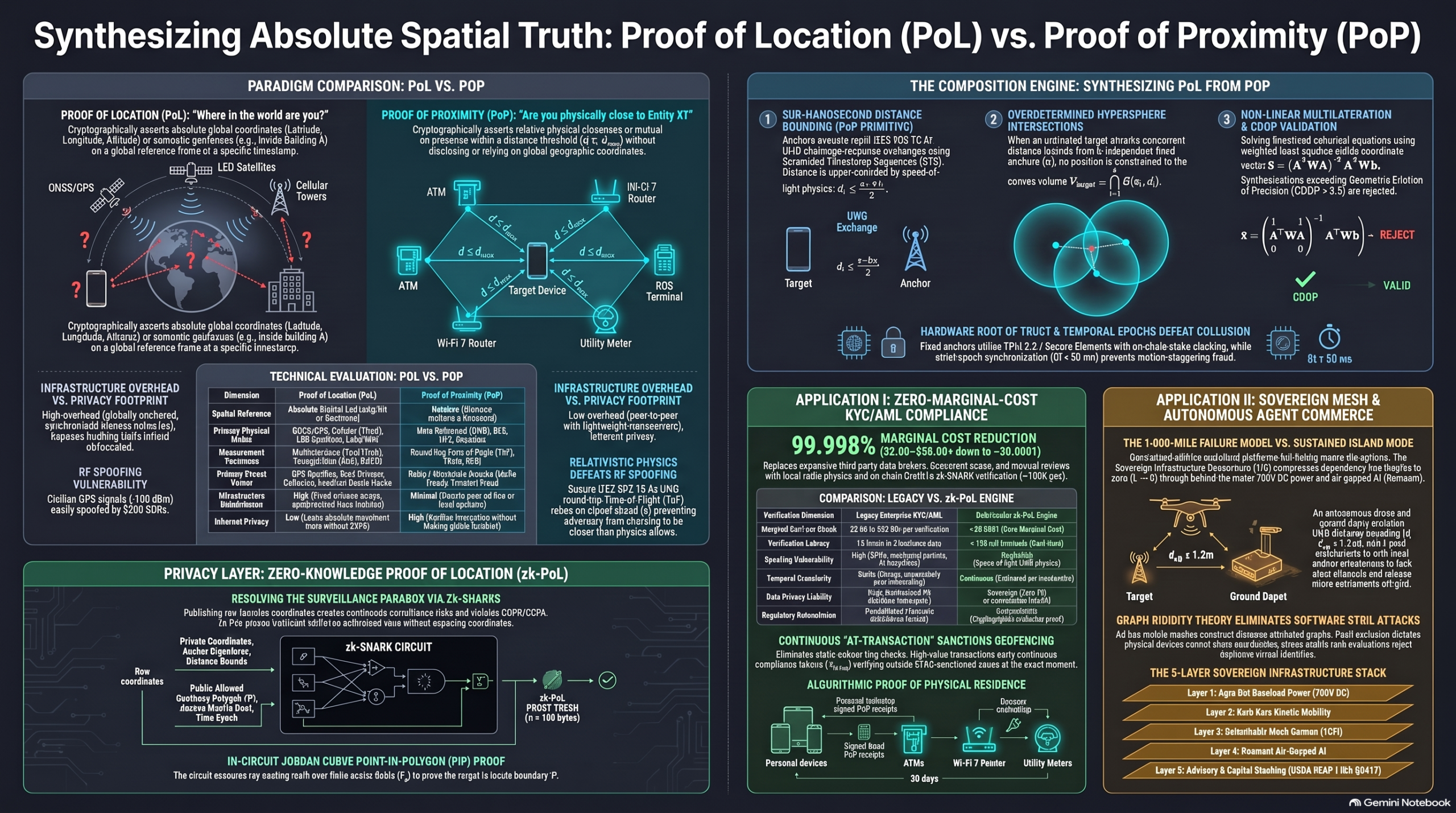
Technical Architecture Plan: Sovereign Municipal Islanding & Mesh Spatial Attestation Network
1. Executive Architecture Overview & System Imperative
1.1 Structural Vulnerability & The Municipal Islanding Imperative
Modern municipal governance, critical civilian infrastructure, and emerging autonomous system networks operate under profound systemic fragility. Centralized utility grids, hyperscaler cloud data centers, unauthenticated civilian satellite feeds, and fragile just-in-time logistics corridors create single-point failure vectors across entire regions. When macro-transmission lines fail or wide-area networks experience targeted disruptions, localized critical facilities—including water and wastewater supervisory control and data acquisition (SCADA) systems, emergency dispatch nodes, and administrative headquarters—experience rapid, cascading functional collapse. Mitigating this risk requires a fundamental paradigm shift away from centralized remote dependencies toward sustained municipal islanding.
This vulnerability is mathematically formalized by Noel’s Law of Structural Vulnerability, which proves that the structural risk of any operational node scales non-linearly with the length of its external dependency lines:
\mathcal{V}_{\text{system}} = \kappa \cdot \prod_{i=1}^n \left( \frac{\mathcal{L}_i}{\lambda_i} \right)^{\alpha_i} \cdot \exp\left( \sum_{j=1}^m \delta_j \right)
In this formulation:
- \mathcal{L}_i represents the physical or topological distance of dependency line i (such as kilometers of electrical transmission wire or data routing hops to remote cloud servers).
- \lambda_i represents the localized mean-time-between-failure (MTBF) attenuation coefficient of the medium (e.g., \lambda_{\text{grid}} \approx 85\text{ km} for unhardened overhead lines, \lambda_{\text{fiber}} \approx 350\text{ km} for long-haul optical trunks).
- \alpha_i \ge 1 is the hyper-coupling exponent reflecting cascading failure dynamics across linked infrastructure networks.
- \delta_j \ge 0 is the exogenous sovereignty deficit coefficient quantifying external administrative control, vendor lock-in, or regulatory exposure (\delta_j = \ln\left(\frac{1}{1 – \mu_{\text{external}}}\right), where \mu_{\text{external}} \in [0, 1) is the proportion of non-local control inputs).
- \kappa is the system normalization scalar.
Under the Poisson failure model governing long-distance dependency lines, the localized probability of survival P(\text{Survival}) across an operational epoch \tau > 0 is expressed as:
P(\text{Survival}) = \exp\left( -\tau \sum_{i=1}^n \alpha_i \frac{\mathcal{L}_i}{\lambda_i} \right) \cdot \exp\left( -\sum_{j=1}^m \delta_j \right)
Under the traditional “1,000-Mile Failure Model,” critical civic facilities rely on power grids extending hundreds of miles (\mathcal{L}_{\text{power}} \approx 300\text{–}500\text{ km}), cloud telemetry transiting thousands of miles (\mathcal{L}_{\text{compute}} \ge 1,000\text{ miles}), and long-haul fuel supply lines. As physical dependency lengths expand (\mathcal{L}_i \to \infty), the survival probability decays exponentially to zero:
\lim_{\mathcal{L}_i \to \infty} P(\text{Survival}) = \lim_{\mathcal{L}_i \to \infty} \left[ \frac{\exp\left( -\sum_{j=1}^m \delta_j \right)}{\exp\left( \tau \sum_{i=1}^n \alpha_i \frac{\mathcal{L}_i}{\lambda_i} \right)} \right] = 0
Furthermore, coupled linear networks do not degrade gracefully; they undergo abrupt structural collapse governed by Buldyrev-Parshani first-order discontinuous percolation dynamics. In a dual-layer interdependent system (such as electrical power coupled to telecommunications backhaul), the mutual giant connected component P_{\infty} satisfies:
P_{\infty} = p \cdot y^2 \quad \text{where } y = 1 – \exp\left( -\langle k \rangle p \cdot y \right)
where \langle k \rangle is the average node degree and p is the fraction of surviving nodes. Evaluating the derivative yields a critical percolation threshold:
p_c = \frac{2.4554}{\langle k \rangle}
At p = p_c, the giant component drops discontinuously from P_{\infty}(p_c) \ge 0.51 directly to zero (\lim_{\epsilon \to 0} P_{\infty}(p_c – \epsilon) = 0), mathematically proving that coupled linear distribution topologies suffer total downstream blackout upon a single critical interruption. Conversely, an omnidirectional spherical mesh architecture compresses physical dependency lengths to zero (\mathcal{L}_i \to 0) and eliminates external sovereignty deficits (\delta_j \to 0). Restoring these limits yields:
\lim_{\mathcal{L}_i \to 0, \; \delta_j \to 0} P(\text{Survival}) = \exp(0) \cdot \exp(0) = 1.0
By generating power, executing cognitive SCADA control, and verifying spatial trust strictly inside the local facility boundary, localized survival probability is restored to unity.
| Architecture Dimension | Legacy Centralized Utility Architecture | Sovereign Islanding Baseline |
| Operational Radius (L) | Long-Haul Extended (100 \text{ to } 1,000+\text{ miles}) | Zero-Length On-Premise Boundary (\mathcal{L} \to 0) |
| Control Loop Latency | High / Variable WAN Jitter (45\text{ms} \text{ to } 400+\text{ms}) | Deterministic (< 4ms SSIS Switch / < 16ms Control) |
| Power Topology | Linear Radial Feeders / Grid AC | Native 700V DC Common Busbar Microgrid |
| Failure Dynamics | Discontinuous First-Order Percolation Collapse | Localized, Graceful Spherical Degradation |
| Economic Friction | Recurring Utility Fees & High KYC/AML Taxes | Non-Dilutive Capital Stacking / Near-Zero Cost |
Overcoming this structural vulnerability requires a vertically integrated, multi-layered sovereign infrastructure stack capable of maintaining continuous operations in total physical isolation.
1.2 The Sovereign Infrastructure Consortium (SIC) 5-Layer Stack Integration
Sustained municipal islanding cannot be achieved through piecemeal hardware additions. Physical baseload power, kinetic mobility, edge wireless communications, cognitive artificial intelligence, and municipal financial structures must operate as a unified, vertically integrated system. The Sovereign Infrastructure Consortium (SIC) establishes a standardized 5-layer sovereign architecture (governed by standards such as SIC-SSOT-SOP-MASTER-2026-09-27) that eliminates external dependencies across all operational domains.
The functional breakdown and inter-layer cross-synthesis across the 5-layer stack are defined as follows:
- Layer 1: Power (Agra Dot Energy): Delivers continuous off-grid baseload energy utilizing thermochemical biomass pyrolysis/gasification and Pawnee rotary engines coupled directly to native 700V DC microgrid busbars, bypassing multi-year public utility transmission interconnect queues.
- Layer 2: Kinetic Mobility & Proving (Kurb Kars & DAOSRUS): Deploys autonomous utility EVs, nomadic battery skids, and tactical non-emergency medical transportation (NEMT) pods. Integrates DAOSRUS (Project Octagon) extreme-edge proving testbeds running
DAOS_A2A_M2M_v3offline machine-to-machine state channels. - Layer 3: Mesh Communications & Prime Authority (DeReticular Core): Acts as the prime authority and edge trust engine. Deploys the carrier-grade TriFi wireless suite (providing 15-mile Non-Line-of-Sight backhaul) and executes physical-layer Ultra-Wideband (UWB) distance bounding, Zero-Knowledge Proof of Location (zk-PoL), and Spatial Hash Time-Locked Contracts (S-HTLCs).
- Layer 4: SCADA & Cognitive Intelligence (DeReticular Energy): Runs high-density computational clusters cooled via liquid-dielectric immersion (
RIOS-CC-1000) hosting Remnant, an air-gapped, persistent AI silicon engine executing sub-16ms microgrid stabilization and automated SCADA governance. - Layer 5: Governance, Capital & Advisory (Biz Builder Mike, SIEA Academy, Venture Studio): Applies Noel’s Law executive triage, manages Federal Acquisition Regulation (FAR) Part 31 / DCAA SF 1408 accounting compliance, structures non-dilutive public-private partnership (P3) capital stacks, and provides 501(c)(3) workforce credentialing.
===============================================================================
THE 5-LAYER SOVEREIGN INFRASTRUCTURE CONSORTIUM (SIC) STACK WORKFLOW
===============================================================================

[LAYER 5: GOVERNANCE & CAPITAL STACKING]
  (Biz Builder Mike / SIEA Academy / Venture Studio)
  * Statutory Capital Stacking (USDA REAP + IRA §6417 + FEMA BRIC)
  * FAR Part 31 / DCAA SF 1408 Compliant Accounting Ledgers
        |
        v  (Capital Grants & Audit Authorization)
[LAYER 1: BASELOAD POWER GENERATION]
  (Agra Dot Energy)
  * Thermochemical Biomass Gasification & Pyrolysis (850°C - 1,050°C)
  * Pawnee Rotary Engine Rectified Directly to 700V DC Busbar
        |
        +-----------------------------------+
        |                                   |
        v (Direct 700V DC Feed)             v (700V DC Fast Charge)
[LAYER 4: SCADA & COGNITIVE AI]     [LAYER 2: KINETIC MOBILITY & PROVING]
  (DeReticular Energy / Remnant)      (Kurb Kars / DAOSRUS / Octagon)
  * RIOS-CC-1000 Immersion Racks      * Autonomous EVs & Nomadic Battery Skids
  * Sub-16ms SCADA Island Switch      * Kinetic Mesh Extenders (Far X Nodes)
  * Real-Time Lyapunov Control        * DAOS_A2A_M2M_v3 Offline State Channels
        |                                   |
        +-----------------+-----------------+
                          |
                          v (Telemetry, Encrypted State & Kinetic Routes)
[LAYER 3: MESH COMMUNICATIONS & SPATIAL TRUST ENGINE]
  (DeReticular Core - Prime Operational Authority)
  * TriFi Wireless Suite (15-Mile NLOS / Sub-16ms RF Channel Handoffs)
  * Relativistic IEEE 802.15.4z UWB Physical Distance Bounding
  * zk-PoL Compliance Engine & Off-Grid S-HTLC Micro-Settlements
===============================================================================
This integrated 5-layer interaction bridges macro-level system architecture directly to the physical baseload energy and compute hardware foundations of Layers 1 and 4.
2. Layer 1 & 4 Physical & Computational Foundation (Baseload Energy & Air-Gapped Intelligence)
2.1 Behind-the-Meter 700V DC Baseload Microgrid Integration
Conventional municipal installations attempting to integrate renewable generation routinely stall within Regional Transmission Organization (RTO/ISO) interconnect queues, which present average delays of 4.5 to 7 years. Furthermore, net-metered grid-following systems are required by UL 1741 and IEEE 1547 standards to disconnect during utility blackouts, rendering standard solar arrays non-functional during emergencies. Sovereign islanding bypasses the public grid entirely by establishing behind-the-meter (BTM) baseload generation directly connected to a high-voltage direct current (DC) distribution busbar.
Layer 1 anchors physical autonomy through continuous thermochemical biomass gasification and fast pyrolysis executed by Agra Dot Energy. Local agricultural waste, municipal green debris, and forestry thinnings undergo thermal conversion in reactors operating between 850^\circ\text{C} and 1,050^\circ\text{C} under sub-stoichiometric oxygen conditions. The conversion follows established multi-stage gasification pathways:
\text{Biomass} \xrightarrow{\Delta H} \text{Biochar} + \text{Tar} + \text{Gases (CO, H}_2\text{, CO}_2\text{, CH}_4\text{, H}_2\text{O)}
\text{Boudouard Equilibrium:} \quad \text{C} + \text{CO}_2 \rightleftharpoons 2\text{CO} \quad (\Delta H = +172.4 \text{ kJ/mol})
\text{Water-Gas Reaction:} \quad \text{C} + \text{H}_2\text{O} \rightleftharpoons \text{CO} + \text{H}_2 \quad (\Delta H = +131.3 \text{ kJ/mol})
\text{Methanation:} \quad \text{C} + 2\text{H}_2 \rightleftharpoons \text{CH}_4 \quad (\Delta H = -74.8 \text{ kJ/mol})
The process produces clean, tar-scrubbed synthesis gas (syngas) with a Lower Heating Value (LHV) of 12\text{ to }16\text{ MJ/Nm}^3. This syngas fuels specialized Pawnee rotary engines—high-displacement combustion engines that eliminate reciprocating valve-train components to achieve continuous baseload runtimes exceeding 24,000 hours between overhauls.
Traditional alternating current (AC) microgrids suffer significant efficiency losses due to multiple power inversion and rectification stages:
\text{AC Grid} \xrightarrow{\text{Rectification}} \text{DC Battery} \xrightarrow{\text{Inversion}} \text{AC Distribution} \xrightarrow{\text{Rectification}} \text{DC Server Power Supply}
\eta_{\text{total}} = \eta_{\text{conv1}} \cdot \eta_{\text{conv2}} \cdot \eta_{\text{conv3}} \cdot \eta_{\text{conv4}} \approx 0.94 \cdot 0.93 \cdot 0.95 \cdot 0.92 = 0.764 \quad (23.6\% \text{ loss})
Agra Dot Energy eliminates these conversion penalties by rectifying the permanent-magnet generator output directly onto a unified native 700V DC common busbar. By powering DC loads natively, the system eliminates AC/DC/AC transformation stages, saving 15% to 25% in total energy losses while discarding reactive power (\text{VAR}) management, phase imbalances, and grid frequency synchronization constraints.
Non-equilibrium internal entropy accumulation (\frac{dS_{\text{internal}}}{dt}) across an energy transport line of length \mathcal{L} with impedance Z(x) and thermal gradient T(x) is defined as:
\frac{dS_{\text{internal}}}{dt} = \int_0^{\mathcal{L}} \frac{J_q^2 Z(x)}{T(x)} dx
By compressing physical line length to zero (\mathcal{L} \to 0), entropy accumulation is suppressed. The 700V DC microgrid maximizes captive energy efficiency through Combined Cooling, Heating, and Power (CCHP) co-generation:
\eta_{\text{captive}} = \frac{W_{\text{electrical}} + Q_{\text{exhaust recovered}} + Q_{\text{jacket recovered}}}{H_{\text{biomass chemical input}}} = 84.8\%
System electrical and thermal recovery parameters encompass:
- Electrical Power Conversion: 34\%\text{–}38\% of syngas chemical energy converted directly to DC electricity at the busbar.
- Exhaust Heat Recovery: High-grade engine exhaust (450^\circ\text{C}\text{–}550^\circ\text{C}) passes through dual-pass counter-flow heat exchangers to dry high-moisture biomass feedstock, suppressing parasitic energy loads.
- Hydronic Jacket Recovery: Engine coolant jacket loops (85^\circ\text{C}) supply high-grade thermal energy directly to municipal district heating or wastewater sludge heating.
Native 700V DC baseload power directly feeds high-density, air-gapped compute infrastructure without transformation loss.
2.2 Air-Gapped Cognitive Computing & SCADA Microgrid Control
Supervisory Control and Data Acquisition (SCADA) systems tethered to hyperscaler cloud APIs introduce unacceptable operational vulnerabilities during islanded conditions. Cloud-dependent control loops exhibit wide-area network latencies ranging from 45\text{ms} to over 400\text{ms} with significant jitter—exceeding the < 16\text{ms} stability window required for dynamic power factor correction and transient fault suppression. Air-gapped, localized cognitive processing is essential to maintain microgrid stability without public internet connectivity.
Layer 4 operationalizes localized intelligence using the RIOS-CC-1000 liquid-dielectric immersion compute cluster. The system submerges an 8-GPU high-density tensor accelerator array directly inside a non-conductive, synthetic hydrocarbon fluid, completely eliminating fans, oxidation, and thermal throttling. The cluster operates with a Power Usage Effectiveness (PUE) of \le 1.028:
\text{PUE} = \frac{P_{\text{total}}}{P_{\text{compute}}} \le 1.028
Point-of-load (PoL) resonant buck converters step down the native 700V DC bus directly to 12V and 1.2V core rails at 98.4% efficiency. Residing on the RIOS-CC-1000 silicon is Remnant, an air-gapped, persistent artificial intelligence executing local tensor inference, contextual retrieval-augmented generation (RAG) over municipal telemetry, and Metacognitive Swarm Intelligence (MSI) workload management.
When an external utility blackout or line fault occurs, Remnant preserves microgrid integrity through a deterministic, sub-16ms islanding transition sequence:
- Fault Ingestion (< 2ms): High-speed edge sensors stream phase angle (\delta), voltage magnitude (V), and frequency derivative (df/dt) metrics into Remnant via Layer 3 mesh channels at 10\text{ kHz}.
- Predictive Isolation Trigger (< 4ms): Remnant anticipates bus collapse and issues an isolation command to the Solid-State Isolation Switch (SSIS), physically decoupling the BTM microgrid from the macro-grid.
- Closed-Loop Gate Modulation (< 12ms): Modulate gate driver arrays on the Pawnee rotary engine alternator and BESS DC-DC converters to adjust virtual capacitance and damping gains.
- Voltage Convergence Achieved (< 16ms): Microgrid bus voltage stabilizes strictly at 700\text{V DC} \pm 1.5\% under dynamic load steps of \Delta P = \pm 250\text{ kW}.
The system’s global asymptotic stability during dynamic load switching is proven using the candidate Lyapunov function \mathcal{V}(\mathbf{x}), where state vector \mathbf{x}(t) = [e_v(t), \; \dot{e}_v(t), \; e_{\text{thermal}}(t)]^T represents bus voltage error e_v(t) = V_{\text{bus}}(t) – 700\text{V} and dielectric thermal error e_{\text{thermal}}(t):
\mathcal{V}(\mathbf{x}) = \frac{1}{2} C_{\text{bus}} e_v(t)^2 + \frac{1}{2} L_{\text{eq}} \dot{e}_v(t)^2 + \frac{1}{2} M_{\text{fluid}} c_p e_{\text{thermal}}(t)^2
where C_{\text{bus}} is total bus capacitance, L_{\text{eq}} is equivalent line inductance, M_{\text{fluid}} is immersion fluid mass, and c_p is specific heat capacity. Taking the explicit time derivative yields:
\dot{\mathcal{V}}(\mathbf{x}) = C_{\text{bus}} e_v(t) \dot{e}_v(t) + L_{\text{eq}} \dot{e}_v(t) \ddot{e}_v(t) + M_{\text{fluid}} c_p e_{\text{thermal}}(t) \dot{e}_{\text{thermal}}(t)
Substituting the governor and buck-converter control laws enforced by Remnant:
L_{\text{eq}} \ddot{e}_v(t) = -R_{\text{virtual}} \dot{e}_v(t) – K_v e_v(t)
M_{\text{fluid}} c_p \dot{e}_{\text{thermal}}(t) = -K_{\text{hydronic}} e_{\text{thermal}}(t)
Substituting these control inputs back into the derivative equation yields:
\dot{\mathcal{V}}(\mathbf{x}) = C_{\text{bus}} e_v(t) \dot{e}_v(t) + \dot{e}_v(t) \left( -R_{\text{virtual}} \dot{e}_v(t) – K_v e_v(t) \right) – K_{\text{hydronic}} e_{\text{thermal}}(t)^2
Setting the virtual capacitor compensation gain K_v = C_{\text{bus}} cancels the cross-term C_{\text{bus}} e_v(t) \dot{e}_v(t), resulting in:
\dot{\mathcal{V}}(\mathbf{x}) = -R_{\text{virtual}} \dot{e}_v(t)^2 – K_{\text{hydronic}} e_{\text{thermal}}(t)^2 \le 0
Because \mathcal{V}(\mathbf{x}) > 0 for all \mathbf{x} \neq \mathbf{0} and \dot{\mathcal{V}}(\mathbf{x}) \le 0 globally, applying LaSalle’s Invariance Principle proves that the largest invariant set where \dot{\mathcal{V}}(\mathbf{x}) = 0 is the equilibrium point \mathbf{x} = \mathbf{0}. Thus, the 700V DC bus is globally asymptotically stable in the large.
Reliable cognitive microgrid control requires an un-jammable, low-latency wireless backhaul and physical spatial trust engine.
3. Layer 3 Mesh Communications & Spatial Trust Engine Architecture
3.1 TriFi Hardware Suite & Omnidirectional Spherical Mesh Topology
Conventional telecommunications architecture relies on fragile linear or tree topologies (\text{Core} \to \text{Distribution} \to \text{Access} \to \text{Edge}). A physical severance along any backhaul trunk isolates all downstream nodes. DeReticular Core operationalizes Layer 3 by deploying an omnidirectional, spherical RF mesh topology (“The Death of the Line”). Every node functions simultaneously as an edge terminal, dynamic packet router, and cryptographic witness. If a primary transmission mast is severed, packets dynamically re-route across peer-to-peer mesh paths within \le 16\text{ ms}, preserving network availability even if up to 60% of regional nodes are rendered non-operational.
The DeReticular Core hardware footprint is standardized across the carrier-grade TriFi product suite:
| TriFi Terminal Model | Operational Range & Frequency Bands | Power Input & Enclosure Rating | Cryptographic Hardware | Civic Deployment Role |
| Signal Pro 8355 | Multi-Band; Integrated 4\times 4 cross-polarized directional patch array | 48V Passive Gigabit PoE; IP67 Cast Aluminum | TPM 2.0 Security Module | Fixed critical facilities (City Hall, Water SCADA, 911 EOC) |
| WISP-in-a-Box Lite 100 | 15-Mile NLOS Radius; 900MHz, 2.4GHz, 3.5GHz (CBRS), 5.8GHz | 100\text{–}240\text{V AC} / 48\text{V DC}; IP67 Aluminum with 40kA surge arrestors | STMicroelectronics TPM 2.0 (IEEE 802.1AR DevID) | Commercial district base station & regional backhaul hub |
| Far X X1271 | Wi-Fi 6 (802.11\text{ax}) bubble with sub-GHz long-range backhaul | Native 9V–36V DC wide-range vehicular power | Hardware Secure Element | Kinetic fleet integration (Kurb Kars EVs, field response units) |
| Rover SLG-06 | Tactical mesh / LTE hotspot; Multi-band coverage | 4,000 mAh \text{LiFePO}_4 battery (stable to 140^\circ\text{F}/60^\circ\text{C}) | Encrypted Secure Enclave | Field engineering units, first responders, handheld ops |
Dynamic packet routing across unlicensed Sub-GHz, 2.4GHz, CBRS (3.5GHz), and 5.8GHz spectrum is managed using an optimized variant of the B.A.T.M.A.N. protocol coupled with physical-layer Link Quality Estimators (LQE), supporting sub-16ms RF carrier channel handoffs and dynamic multi-carrier auto-failover.
Connecting network transport layers to physical presence attestation requires speed-of-light distance-bounding protocols.
3.2 Relativistic Physical-Layer Distance Bounding (IEEE 802.15.4z UWB)
Client-reported positioning models—including GNSS/GPS receivers, cellular tower triangulation, IP geolocation, and Bluetooth Received Signal Strength Indicators (RSSI)—fail under adversarial conditions. Civilian GPS broadcasts arrive at the Earth’s surface at extremely low power levels (-130\text{ dBm} to -160\text{ dBm}) and can be easily spoofed using a $200 Software-Defined Radio (SDR). Operating system location APIs are vulnerable to OS-level mock location injection and jailbreak exploits. Furthermore, RSSI measurements are easily manipulated by adjusting transmit amplifiers or employing high-gain directional antennas.
To establish secure Proof of Proximity (PoP), DeReticular standardizes on IEEE 802.15.4z Ultra-Wideband (UWB) distance bounding operating on Channel 5 (6.4896\text{ GHz}) and Channel 9 (7.9872\text{ GHz}) with a signal bandwidth of 499.2\text{ MHz}. Utilizing Root-Raised Cosine (RRC) pulse shaping and hardware Time-to-Digital Converters (TDC) exhibiting sub-15.65 picosecond resolution, time-of-flight measurements achieve centimeter spatial accuracy. Because electromagnetic radiation propagates through space at the speed of light (c \approx 299,792,458 \text{ m/s} \approx 0.3 \text{ m/ns}), physical latency establishes an unforgeable upper bound on distance:
d \le \frac{c \cdot \Delta t}{2} \quad \text{where } \Delta t = (t_1 – t_0) – t_{\text{proc}}
An adversary cannot make its physical distance appear shorter than it actually is (d_{\text{fake}} < d_{\text{true}}) without predicting the verifier’s challenge sequence prior to its physical arrival. IEEE 802.15.4z integrates physical-layer Scrambled Timestamp Sequences (STS)—pseudo-random binary sequences keyed with ephemeral session keys—directly into the RF frame, making preamble injection and relay attacks cryptographically infeasible.
VERIFIER / ANCHOR (s_i)                               PROVER / TARGET (x)
[Certified Root of Trust]                                 [Untrusted]
        |                                                      |
        | ----------- Phase 1: Commitment & Nonce Exchange ----> |
        |             (Session Nonce N_v, Target Nonce N_p)    |
        |                                                      |
 Timestamp t_0 | ===== Phase 2: Rapid STS Challenge-Response ===== |
(Transmit STS) | ----------- Cryptographic Challenge C -------> | Process
        |                                                      | Delay t_proc
 Timestamp t_1 | <---------- Physical-Layer Response R ------- |
(Receive STS)  |                                                      |
        |                                                      |
        | ----------- Phase 3: Hardware Timestamping ---------> |
        |             Compute: Δt = t_1 - t_0 - t_proc         |
        |             Bound:   d_i <= (c * Δt) / 2             |
        |                                                      |
        | ----------- Phase 4: Signed PoP Receipt Issuance ---> |
        |             Emit: PoP_i = (ID_A, ID_T, s_i, d_i, t, σ) |
        v                                                      v
The 4-phase cryptographic protocol proceeds as follows:
- Commitment & Nonce Exchange: Verifier anchor A_i and target T exchange ephemeral nonces N_v, N_p \in_R \{0,1\}^{128} and derive session key K_{\text{session}} = \text{HKDF}(N_v \parallel N_p).
- Rapid STS Challenge-Response: A_i transmits cryptographic challenge bits c_j \in C modulated via UWB STS. T reflects response bits r_j = c_j \oplus k_j at the physical layer over processing delay t_{\text{proc}}. A_i records precise transmission timestamp t_{0,j} and reception timestamp t_{1,j}.
- Hardware Timestamping: A_i computes the maximum distance upper bound \hat{d}_i = \frac{c}{2} \left( \frac{1}{m} \sum_{j=1}^m (t_{1,j} – t_{0,j} – t_{\text{proc}}) \right).
- Signed PoP Receipt Issuance: A_i generates and signs a cryptographic PoP receipt:
\text{PoP}_i = \left( \text{ID}_{A_i}, \text{ID}_T, \mathbf{s}_i, \hat{d}_i, t_{\text{epoch}}, \sigma_{A_i} \right)
\sigma_{A_i} = \text{Sign}_{sk_{A_i}}\Big( \mathcal{H}\big( \text{ID}_{A_i} \parallel \text{ID}_T \parallel \mathbf{s}_i \parallel \hat{d}_i \parallel t_{\text{epoch}} \parallel N_v \parallel N_p \big) \Big)
Atomic, relative distance-bounding claims are mathematically composed into absolute spatial coordinates.
3.3 Overdetermined Multilateration & Geometric Rigidity (PoP to PoL Synthesis)
Sovereign spatial attestation inverts the traditional positioning paradigm: coordinate awareness is removed entirely from the untrusted client target and delegated to an infrastructure perimeter of fixed, authenticated anchor nodes (\mathbf{s}_i = [x_i, y_i, z_i]^T). The lightweight target device is required only to participate in rapid, physical-layer distance-bounding exchanges.
When a target device collects k independent PoP receipts from non-collinear anchors within a synchronized epoch window (\Delta t < 50\text{ms}), its position is constrained to the convex spatial intersection volume:
\mathcal{V}_{\text{target}} = \bigcap_{i=1}^k \mathcal{B}(\mathbf{s}_i, \hat{d}_i) \quad \text{where } \mathcal{B}(\mathbf{s}_i, \hat{d}_i) = \left\{ \mathbf{x} \in \mathbb{R}^3 \;\middle|\; \|\mathbf{x} – \mathbf{s}_i\|_2 \le \hat{d}_i \right\}
If epoch synchronization drifts beyond \Delta t > 50\text{ms}, target movement introduces temporal staggering fraud, expanding the effective intersection volume and degrading spatial precision.
To collapse this intersection volume into a definitive spatial coordinate estimate \hat{\mathbf{x}} = [x, y, z]^T, the non-linear system is linearized relative to reference anchor 1 and solved via weighted least-squares:
\mathbf{A} \mathbf{x} = \mathbf{b}
\mathbf{A} = 2 \begin{bmatrix} x_2 – x_1 & y_2 – y_1 & z_2 – z_1 \\ x_3 – x_1 & y_3 – y_1 & z_3 – z_1 \\ \vdots & \vdots & \vdots \\ x_k – x_1 & y_k – y_1 & z_k – z_1 \end{bmatrix}, \quad \mathbf{b} = \begin{bmatrix} (\hat{d}_1^2 – \hat{d}_2^2) + (r_2^2 – r_1^2) \\ (\hat{d}_1^2 – \hat{d}_3^2) + (r_3^2 – r_1^2) \\ \vdots \\ (\hat{d}_1^2 – \hat{d}_k^2) + (r_k^2 – r_1^2) \end{bmatrix}
\hat{\mathbf{x}} = (\mathbf{A}^T \mathbf{W} \mathbf{A})^{-1} \mathbf{A}^T \mathbf{W} \mathbf{b}
Deterministic solvability requires k \ge 3 non-collinear anchors for 2D surface resolution (\text{rank}(\mathbf{A}) = 2) and k \ge 4 non-coplanar anchors for 3D volumetric resolution (\text{rank}(\mathbf{A}) = 3).
Spatial precision is governed by Geometric Dilution of Precision (GDOP). Using unit direction vectors \mathbf{u}_i = \frac{\hat{\mathbf{x}} – \mathbf{s}_i}{\|\hat{\mathbf{x}} – \mathbf{s}_i\|_2}, the design matrix \mathbf{H} and covariance tensor \mathbf{Q} are formulated as:
\mathbf{H} = \begin{bmatrix} \mathbf{u}_1^T & 1 \\ \mathbf{u}_2^T & 1 \\ \vdots & \vdots \\ \mathbf{u}_k^T & 1 \end{bmatrix}, \quad \mathbf{Q} = (\mathbf{H}^T \mathbf{H})^{-1} = \begin{bmatrix} \sigma_x^2 & \cdot & \cdot & \cdot \\ \cdot & \sigma_y^2 & \cdot & \cdot \\ \cdot & \cdot & \sigma_z^2 & \cdot \\ \cdot & \cdot & \cdot & \sigma_t^2 \end{bmatrix}
\text{GDOP} = \sqrt{\text{Tr}(\mathbf{Q})} = \sqrt{\sigma_x^2 + \sigma_y^2 + \sigma_z^2 + \sigma_t^2}
Here, \sigma_t^2 in the covariance tensor \mathbf{Q} explicitly represents receiver clock offset variance relative to network time reference. Synthesized location claims exhibiting \text{GDOP} > 3.5 are automatically rejected to eliminate geometric collinearity fraud and prevent directional ambiguity.
Absolute location coordinates must be wrapped in zero-knowledge proofs to preserve user privacy and operational security.
4. Zero-Knowledge Spatial Compliance & Cryptographic Settlement (zk-PoL / zk-AML)
4.1 Zero-Knowledge Location Proof Pipeline (zk-PoL Circuit Architecture)
Directly broadcasting unencrypted absolute location coordinates creates severe surveillance risks, leaks logistical patterns, and violates data privacy standards such as Article 4(1) of the European Union General Data Protection Regulation (GDPR). This creates the “Surveillance Paradox”: digital systems must verify physical jurisdiction without exposing coordinate metadata.
DeReticular resolves this by wrapping synthesized multilateration bounds inside a Zero-Knowledge Proof of Location (zk-PoL) arithmetic circuit. The target proves that its private physical coordinates reside within an authorized geofenced polygon \mathcal{P} without revealing its exact location or anchor identifiers. Continuous rolling residency verification is executed via Incrementally Verifiable Computation (IVC) using Nova folding over Pasta curves (Pallas/Vesta). The accumulator state transition function \mathbb{F}_{\text{step}} updates running state z_i:
z_{i+1} = \mathbb{F}_{\text{step}}(z_i, \omega_i) = \left( i + 1, \; \text{AccTime}_{\text{inside}} + b_{\text{inside}} \cdot \Delta t, \; \mathcal{H}_{\text{poseidon}}(\mathbf{x}_{i+1}), \; \mathcal{R}_{\text{anchors}}, \; E_{i+1} \right)
where b_{\text{inside}} \in \{0, 1\} is verified inside the arithmetic circuit via Jordan Curve ray-casting over finite field \mathbb{F}_p:
\text{EdgeIntersect} \iff \Big( (y_j > y) \neq (y_{j+1} > y) \Big) \land \left( x < \frac{(x_{j+1} – x_j)(y – y_j)}{y_{j+1} – y_j} + x_j \right)
  PRIVATE WITNESSES (Secret Inputs)
  * Target Coordinates: x = (x, y, z)
  * Anchor Positions:  {s_1, ..., s_k}
  * Distance Bounds:   {d_1, ..., d_k}
  * Anchor Signatures: {σ_1, ..., σ_k}
                 |
                 v
  +-----------------------------------------------------------------------+
  |                 ARITHMETIC CIRCUIT CONSTRAINTS (R1CS)                 |
  |                                                                       |
  | 1. Merkle Membership Proof:                                           |
  |    VerifyMerkleBranch(Root_R, Hash(pk_A_i), Path_i) == 1              |
  |                                                                       |
  | 2. Anchor Signature Verification:                                     |
  |    VerifyEdDSA(pk_A_i, σ_i, Hash(s_i || d_i || E_n)) == 1             |
  |                                                                       |
  | 3. Relational Distance Bounding:                                      |
  |    ||x - s_i||^2 + Slack_i == d_i^2,  forall i                        |
  |                                                                       |
  | 4. Point-in-Polygon (Jordan Curve Ray-Casting Arithmetic Constraint): |
  |    EdgeIntersect <=> ((y_j > y) != (y_{j+1} > y)) &&                 |
  |                      (x < (x_{j+1}-x_j)*(y-y_j)/(y_{j+1}-y_j) + x_j)   |
  +-----------------------------------------------------------------------+
                 |
                 v
  PUBLIC INSTANCE INPUTS
  * Epoch Identifier: E_n
  * Anchor Registry Merkle Root: Root_R
  * Approved Geofence Boundary: Polygon_P
                 |
                 v
  OUTPUT: Succinct Proof π (Groth16: ~130 bytes, O(1) Verification)
| Circuit Variable Category | Parameter Description | Field Assignment / Primitive | R1CS Computational Scaling |
| Private Witness Variables (\mathbf{w}) | Target coords \mathbf{x}, Anchor coords \mathbf{s}_i, Bounds \hat{d}_i, Signatures \sigma_i, Merkle paths \text{Path}_i | Scalar Field \mathbb{F}_p^3, Signature elements | Bound internally; hidden from public verifier |
| Public Instance Variables (\mathbf{x}_{\text{pub}}) | Temporal Epoch E_n, Anchor Registry Root \mathcal{R}_{\text{anchors}}, Geofence Polygon \mathcal{P} | Field elements \mathbb{F}_p, Poseidon root | Publicly exposed for settlement verification |
| In-Circuit Constraints | 1. Merkle Membership (Poseidon)<br>2. EdDSA Signature Validation<br>3. Range-Checked Euclidean Distances<br>4. Jordan Curve Ray-Casting PiP | Rank-1 Constraint System (R1CS) primitives | O(1) verification complexity; Groth16 proof size \approx 130 bytes |
zk-PoL transforms legacy financial compliance economics.
4.2 Continuous Transaction-Time Geofencing & Zero-Marginal-Cost Compliance
Traditional identity verification (KYC/AML) enforced by FATF, FinCEN, and OFAC regulations relies on fee-per-query business models operated by third-party data brokers ($2.00 to $35.00+ per check). These legacy mechanisms suffer from severe flaws: high marginal costs, static point-in-time validity decay, centralized data honeypots, and susceptibility to IP masking via residential proxies or VPNs.
DeReticular’s zk-PoL compliance engine reduces the marginal cost (MC = \frac{\partial TC}{\partial Q}) of regulatory compliance to near-zero:
MC = C_{\text{bandwidth}} + C_{\text{prover}} + C_{\text{verifier}} \approx \$0.0001
The microeconomic variable breakdown is defined as follows:
- C_{\text{prover}} \approx \text{Local energy consumption of client proof generation} \approx 0.002\text{ mAh} \approx \$0.0000004
- C_{\text{verification}} \approx \text{Layer-2 on-chain verifier execution} \approx 150,000\text{ gas} \times 0.05\text{ Gwei/gas} \times \$0.000001 \approx \$0.000075
- C_{\text{bandwidth}} \approx \text{Transport of 130-byte Groth16 proof} \approx \$0.0000246
Summing these terms yields MC \approx \$0.0001.
Beyond operational savings, continuous zk-PoL attestation directly enables Layer 5 municipal capital stacking. By providing automated, cryptographically unforgeable proof of domestic hardware assembly and regional energy community presence, zk-PoL satisfies the statutory verification criteria required to claim the +10% Domestic Content Bonus and +10% Energy Community Bonus under Inflation Reduction Act (IRA) Section 6417 Direct Pay elective tax credits.
| Verification Dimension | Legacy Identity Verification | DeReticular zk-PoL Engine |
| Marginal Cost per Check | \$2.00 \text{ to } \$35.00+ per query | \approx \$0.0001 (Zero Marginal Cost) |
| Verification Latency | 12 hours to 5 business days | < 150 \text{ milliseconds} |
| Physical Spoof Resistance | Low (VPNs, GPS Spoofers, Synthetic PII) | High / Physics-Enforced (UWB STS Time-of-Flight) |
| Temporal Granularity | Static (Decays instantly post-onboarding) | Continuous (Evaluated per transaction) |
| Data Liability | Centralized PII Honeypots (GDPR risk) | Zero PII / Zero Coordinate Exposure |
| Regulatory Determinism | Probabilistic (Heuristic confidence scores) | Deterministic (Cryptographic proof of inclusion) |
Zero-knowledge compliance seamlessly integrates with off-grid machine-to-machine state channels.
4.3 Off-Grid Agent-to-Agent Commerce & Spatial Hash Time-Locked Contracts (S-HTLCs)
In contested, off-grid, or GNSS-denied environments, autonomous machine agents (such as delivery drones, utility EVs, and automated depots) must establish trust, execute handovers, and clear payments without internet connectivity.
Agents construct ad-hoc Relational Spatial Trust Graphs \mathcal{G} = (\mathcal{V}, \mathcal{E}) with edges e_{ij} = (\Delta t_{ij}, \hat{d}_{ij}) derived from mutual peer-to-peer UWB ranging. To prevent software Sybil clones (where a single physical adversary virtualizes multiple software agents), nodes apply graph rigidity theory. By evaluating the Laman Theorem (|\mathcal{E}| = 2|\mathcal{V}| – 3) and stress matrix rank bounds, agents confirm whether their relative distance topology is generically rigid. Duplicate virtual identities exhibiting identical spatial vectors are identified and rejected.
Off-grid micro-settlements execute using Spatial Hash Time-Locked Contracts (S-HTLCs), where channel funds are unlocked strictly upon cryptographic proof of physical co-presence inside an authorized spatial polygon \mathcal{P}.
The numbered execution lifecycle proceeds as follows:
- Spatial Locking: Drone A and Depot B execute a mutual IEEE 802.15.4z UWB ranging session, establishing relative proximity d_{AB} \le 1.2\text{ meters}.
- Local Multi-Party Witnessing: Stationary mesh anchors C and D ping both agents, generating signed attestations confirming \mathbf{x}_A, \mathbf{x}_B \in \mathcal{P}_{\text{LoadingBay}}.
- Escrow Challenge Issuance: Agent B generates escrow challenge \text{Challenge}_{\text{escrow}} = \mathcal{H}(\text{InvoiceID} \parallel \text{PoP}_{AB} \parallel \text{PoL}_{\text{LoadingBay}}).
- Physical Handover: Drone A triggers its payload latch, delivering cargo into the depot container. Internal depot sensors confirm physical delivery.
- State-Channel Micro-Settlement: Agent B signs a state-channel payment receipt off-chain using the
DAOS_A2A_M2M_v3specification:
\text{Payload}_{\text{state}} = \Big\{ \text{ID}_{\text{MachineA}}, \; \text{ID}_{\text{MachineB}}, \; \Delta \text{Energy}_{\text{delivered}}, \; \mathcal{H}(\text{Challenge}_{\text{escrow}}), \; \pi_{\text{zk-PoL}} \Big\}
This payload is transferred over local peer-to-peer radio (Wi-Fi HaLow/BLE) for deferred on-chain settlement.
These technologies are organized within municipal public safety infrastructure.
5. Municipal Deployment Blueprint: The Civic Island Triad
5.1 Architecture & Interconnects of the Civic Island Triad
Municipal operational continuity during macro-grid collapse depends on preserving three essential pillars: executive governance, public health/environmental control, and emergency communications. The Civic Island Triad organizes these functions into three geographically distinct, self-sustaining nodes interlinked via redundant wireless mesh paths.
The spatial distribution and physical infrastructure of the Triad comprise:
- Node 1: Administrative & Executive Headquarters (City Hall / County Seat): Serves as the primary executive command center. Hosts an interactive Remnant cognitive terminal, manages municipal ledgers, maintains legal registries, and executes local emergency governance.
- Node 2: Environmental SCADA (Water & Wastewater Treatment Plant): Serves as the critical utility node. Powered directly by an Agra Dot Energy biomass gasification plant running on local agricultural and wood waste, maintaining water purification and lift station pumps independently of the utility grid.
- Node 3: Public Safety & Emergency Operations Center (911 Dispatch / EOC): Serves as the emergency response hub. Houses a
RIOS-CC-1000compute cluster running Remnant AI silicon, deploying a TriFi WISP-in-a-Box Lite 100 array to manage first responders and maintain civilian communications.
+-----------------------------------------------------------------------------+
|                     THE CIVIC ISLAND TRIAD ARCHITECTURE                     |
|                                                                             |
|            NODE 1: ADMINISTRATIVE & EXECUTIVE MUNICIPAL HEADQUARTERS        |
|            * City Hall / County Courthouse                                  |
|            * Remnant Executive Advisory Terminal                            |
|            * TriFi Signal Pro 8355 Primary Gateway                          |
|                                     ^                                       |
|                                    / \                                      |
|            15-Mile NLOS           /   \         15-Mile NLOS                |
|            TriFi RF Backhaul     /     \        TriFi RF Backhaul           |
|            (Sub-16ms Handoff)   /       \       (Sub-16ms Handoff)          |
|                                v         v                                  |
|  NODE 2: WATER & WASTEWATER SCADA       NODE 3: 911 EMERGENCY DISPATCH      |
|  * Water Treatment Plant / Pumping Stn  * Emergency Operations Center (EOC) |
|  * Agra Dot 700V DC Baseload Generator  * TriFi WISP-in-a-Box Lite 100 Array|
|  * Autonomous SCADA Actuation Engine    * Tactical Fleet Dispatch (Kurb Kars|
|  * Behind-the-Meter Power Isolation     * Direct Emergency Comms Link       |
+-----------------------------------------------------------------------------+
Inter-node links utilize TriFi Signal Pro 8355 and WISP-in-a-Box Lite 100 terminals operating over 15-mile Non-Line-of-Sight (NLOS) paths, executing sub-16ms channel failovers to maintain continuous communication with the central Remnant compute engine.
Kinetic vehicle fleets extend the static spatial footprint of the Civic Island Triad.
5.2 Dynamic Fleet Extensions & Mobile Energy Routing
Static microgrids can experience localized energy or communications deficits during extended emergency events. Mobile kinetic assets dynamically bridge these gaps by functioning as mobile energy routers and mesh extenders across the municipal footprint.
Layer 2 integrates Kurb Kars autonomous utility EVs and nomadic mobile battery skids (120\text{ kWh to } 500\text{ kWh}). Equipped with TriFi Far X terminals, these vehicles function as dynamic spatial anchors and mobile mesh extenders as they transit the region. Hardware durability and off-grid transaction capabilities are validated at the DAOSRUS (Project Octagon) extreme-edge proving grounds under severe vibration, thermal stress, and electromagnetic interference (EMI) conditions.
The operational procedure for nomadic battery skids executing dynamic energy routing follows a four-step lifecycle:
- Dispatch & Proximity Coupling: Upon dispatch to an isolated municipal load (e.g., remote water pump), the mobile unit executes an IEEE 802.15.4z UWB distance-bounding exchange (d \le 2.0\text{ meters}).
- Physical Connection: Heavy-duty bi-directional DC couplers connect the skid directly to the facility’s 700V DC busbar.
- State Channel Initialization: The skid opens an offline state channel using the standardized
DAOS_A2A_M2M_v3data schema:
\text{Payload}_{\text{DAOS}} = \Big\{ \text{ID}_{\text{Skid\_04}}, \; \text{ID}_{\text{Pump\_Station\_B}}, \; \Delta\text{Energy}_{\text{delivered\_kWh}}, \; \mathcal{H}(R_{\text{escrow}}), \; \pi_{\text{zk-PoL}} \Big\}
- Energy Dispatch & Telemetry: High-current DC energy transfer commences while encrypted telemetry streams back to Remnant via the Far X vehicle mesh.
Technical viability must be paired with turnkey federal financing and compliant municipal procurement.
6. Capital Stacking, Federal Procurement & Financial Execution Model
6.1 Non-Dilutive Capital Stacking Engine
Municipal infrastructure deployments frequently stall due to municipal debt limits and local tax constraints. Layer 5 resolves capital formation challenges by structuring non-dilutive capital stacks that combine federal grant allocations, direct tax credits, and disaster resilience funding.
The capital stacking model combines three primary federal funding streams:
- USDA Rural Energy for America Program (REAP): Grants covering up to 50% of total eligible CapEx for agricultural producers and rural municipalities deploying baseload biomass energy systems.
- Inflation Reduction Act (IRA) Section 6417 Direct Pay: Elective payment mechanics allowing tax-exempt civic entities (municipalities, counties, 501(c)(3) entities) to receive direct cash refunds from the US Treasury. Combines a 30% base Investment Tax Credit (ITC), a +10% Domestic Content Bonus (met via US-assembled TriFi enclosures and Pawnee engines), and a +10% Energy Community Bonus.
- FEMA Building Resilient Infrastructure and Communities (BRIC): Disaster resilience grants covering 75% to 90% of eligible costs for hardening lifelines (Water SCADA and 911 dispatch lines).
| Capital Source | Primary Statutory Authority | CapEx Coverage Percentage | Targeted Infrastructure Assets |
| USDA REAP Grant | Farm Security / Energy Act | Up to 50% CapEx | Layer 1 Biomass Gasifiers & 700V DC Microgrids |
| IRA §6417 Direct Pay | Inflation Reduction Act §6417 | 30% to 50% Direct Cash | Microgrids, Energy Storage, Immersion Compute |
| FEMA BRIC Grant | Disaster Recovery Reform Act | 75% to 90% Match | Lifeline Hardening (Water SCADA, 911 EOC, Comms) |
| Net Municipal Outlay | Performance Contracting | \le 0\% \text{ to } 10\% Net CapEx | Fully amortized via self-funding energy savings |
Capital stacking eligibility depends directly on federal cost-accounting compliance.
6.2 B2G Accounting Standards & Turnkey Forensic Audit SOWs
Federal grant absorption and public-private partnerships require strict adherence to federal acquisition regulations. Consortium projects implement job-costed ledger isolation meeting Federal Acquisition Regulation (FAR) Part 31 contract cost principles and Defense Contract Audit Agency (DCAA) Standard Form 1408 qualification standards, ensuring federal grant allocations remain fully isolated from commercial funds during audits.
Local governments engage the Consortium through two standardized Statements of Work (SOWs):
| Audit Dimension | AUDIT_SINGLE ($25,000 SOW) | AUDIT_TRIAD ($75,000 SOW) |
| Facility Scope | Single Critical Asset (e.g., Water SCADA Plant) | Complete Civic Triad (City Hall, SCADA, 911 EOC) |
| Baseload Sizing | BTM 700V DC Sizing & Feedstock Logistics | Multi-Node Unified 700V DC & District Thermal |
| Transient Modeling | Sub-16ms ATS Transient Response Analysis | Full TriFi 15-Mile NLOS RF Propagation Mapping |
| Grant Packaging | Initial REAP / IRA §6417 Feasibility | Staked REAP, FEMA BRIC, & IRA §6417 Bundles |
| Accounting Setup | FAR Part 31 Job-Costed Ledger Setup | Full DCAA SF 1408 Ledger System & Audit Isolation |
| Legislative Deliverable | Preliminary Resiliency Evaluation | Certified Legislative Petition Pack for Infrastructure District |
Municipal adoption requires explicit mathematical verification of system stability and self-defense against adversarial attack vectors.
7. System Resilience, Fault Tolerance & Security Analysis
7.1 Electronic Warfare, Physical Anti-Tamper & Security Analysis
Operating critical infrastructure in sustained island mode requires defense against sophisticated physical intrusions, electronic warfare (EW), high-altitude electromagnetic pulses (HEMP), geomagnetic storms (CME), and signal-relay attacks. DeReticular Core hardware integrates multi-layered physical and cryptographic countermeasures to preserve operational integrity under contested conditions.
+-----------------------------------------------------------------------------+
|                     SYSTEM THREAT & ATTACK MATRIX                           |
|                                                                             |
|  THREAT VECTOR                 SYSTEM RESPONSE / HARDWARE DEFENSE           |
|  -------------------------------------------------------------------------  |
|  High-Altitude EMP (HEMP) /    * Faraday-Isolated Liquid Immersion Tank     |
|  Geomagnetic Storm (CME)       * Gas-Discharge Lightning Suppression (40kA) |
|                                * Isolated Native 700V DC Bus Topology       |
|                                                                             |
|  Electronic Warfare (EW) /     * Dynamic Frequency Hopping (900MHz - 5.8GHz)|
|  Active RF Jamming             * Sub-16ms Multi-Carrier Automatic Failover  |
|                                * Directional High-Gain Cross-Polarized Patch|
|                                                                             |
|  Physical Enclosure Breach /   * Chassis Mesh Sensor Circuit Triggered      |
|  Hardware Tampering            * TPM 2.0 Physical Silicon Zeroization       |
|                                * Ephemeral Cryptographic Key Destruction    |
|                                                                             |
|  Macro-Grid Transmission Cut / * Remnant Sub-4ms SSIS Islanding Decouple    |
|  Cascading Blackout            * Pawnee Rotary Engine Ramps Output in Real-Time|
|                                * Lyapunov-Stable DC Microgrid Bus Regulation|
+-----------------------------------------------------------------------------+
| Threat Vector | Physical / Logical Mechanism | Systems Impact | Cryptographic & Hardware Defense Invariant |
| High-Altitude EMP (HEMP) / Geomagnetic Storm (CME) | E1/E2/E3 electromagnetic pulse injection; geomagnetically induced currents (GICs) | DC bus overvoltage, induction spikes, semiconductor destruction | Sealed Faraday liquid-dielectric immersion tank; 40kA gas-discharge lightning arrestors; native ungrounded 700V DC bus topology. |
| Physical Chassis Breach | Mechanical penetration, enclosure drill-through, or cryogenic cooling attack | Attempted extraction of signing keys (sk_A) or decrypted AI model weights | Micro-fine conductive mesh envelope embedded in chassis; physical trace severance breaks sensor loop, triggering TPM 2.0 key zeroization in < 10\text{ ns}. |
| Electronic Warfare (EW) Jamming | High-power broadband RF noise injection across single frequency bands | Targeted degradation of wireless mesh packet transmission | Spread-spectrum frequency hopping (900\text{MHz to } 5.8\text{GHz}) at 1,000\text{ hops/sec}; 4\times 4 MIMO patch array null-steering. |
| Relay / Wormhole Attacks (Mafia Fraud) | Tunneling RF signals over high-speed fiber links to fake proximity | Attempted bypass of spatial access bounds from remote locations | Sub-nanosecond UWB STS Time-of-Flight physics; propagation latency increases \Delta t_{\text{measured}} \gg \Delta t_{\text{max}}, triggering immediate rejection. |
| Sybil Anchor Virtualization | Software emulation of multiple virtual anchors on a single physical machine | Attempted forgery of multilateration coordinates | On-chain anchor staking with automated cross-auditing; inter-anchor timing checks slash stakes of virtualized clusters exhibiting \Delta t_{ij} \approx 0. |
Hardware security protocols ensure absolute system mathematical convergence during operation.
7.2 Microgrid Stability Proofs & System Convergence
The Sovereign Infrastructure Consortium stack integrates behind-the-meter thermochemical power generation, air-gapped cognitive intelligence, and speed-of-light spatial trust into a unified, self-healing architecture. By compressing dependency line lengths to zero (\mathcal{L}_i \to 0) and eliminating sovereignty deficits (\delta_j \to 0), the structural vulnerability index collapses to its scalar baseline:
\lim_{\mathcal{L}_i \to 0, \delta_j \to 0} \mathcal{V}(\mathcal{S}) = \kappa \cdot \prod_{i=1}^n (0)^{\alpha_i} \cdot \exp(0) = \kappa
System convergence and stability are maintained through three core invariants:
- Thermodynamic Invariant: Localized CCHP biomass conversion maintains captive thermal efficiency at \eta_{\text{captive}} = 84.8\%, suppressing non-equilibrium internal entropy generation (\frac{dS_{\text{internal}}}{dt} \to 0).
- Electrical Invariant: Remnant‘s closed-loop control enforces Lyapunov stability (\dot{\mathcal{V}}(\mathbf{x}) \le 0) over the native 700V DC busbar, bounding voltage transients within \pm 1.5\% during dynamic load shifts.
- Spatial Invariant: Relativistic speed-of-light physics (d \le \frac{c \cdot \Delta t}{2}) governs all location attestation, preventing spatial spoofing and enabling zero-marginal-cost (MC \approx \$0.0001) compliance verification.
===============================================================================
MUNICIPAL SOVEREIGN CONVERSION TIMELINE
===============================================================================

PHASE I: FORENSIC AUDITING & CAPITAL STRUCTURING (Days 1 - 60)
  * Execute SOW-AUDIT_TRIAD ($75k) across City Hall, SCADA, and 911 EOC.
  * Compute Noel's Law Structural Vulnerability Index V_system.
  * Establish FAR Part 31 / DCAA SF 1408 job-costed accounting ledgers.
  * Package & submit USDA REAP, FEMA BRIC, and IRA §6417 Direct Pay applications.

PHASE II: BEHIND-THE-METER BASELOAD GENERATION (Days 61 - 180)
  * Deliver Agra Dot continuous biomass gasification unit & Pawnee rotary engine.
  * Install native 700V DC common busbar and Solid-State Isolation Switch (SSIS).
  * Pipe engine thermal exhaust to municipal district hydronic heating loop.
  * Complete BTM islanding capability (Compress L_power -> 0).

PHASE III: AIR-GAPPED COMPUTE & RF MESH DEPLOYMENT (Days 181 - 270)
  * Install RIOS-CC-1000 liquid immersion rack running Remnant AI at 911 EOC.
  * Erect TriFi WISP-in-a-Box Lite 100 array and Signal Pro fixed terminals.
  * Commission sub-16ms RF peer routing and IEEE 802.15.4z spatial trust engine.
  * Eliminate cloud latency and telco backhaul dependencies (Compress L_compute, L_comms -> 0).

PHASE IV: FLEET INTEGRATION & LIVE ISLAND COMMISSIONING (Days 271+)
  * Deploy Kurb Kars autonomous utility EVs with TriFi Far X mobile nodes.
  * Activate DAOS_A2A_M2M_v3 state channels (Payload schema verified) for off-grid M2M commerce.
  * Execute scheduled 72-hour full-scale civic utility separation test.
  * Issue operational certification under SIC-SSOT-SOP-MASTER-2026-09-27.
===============================================================================
By compressing dependency lines to zero (\mathcal{L} \to 0) across energy, compute, communications, and finance, the Sovereign Infrastructure Consortium establishes an operational blueprint for absolute municipal sovereignty. When macro-grids disconnect and centralized networks go dark, sovereign municipal islands remain powered, connected, intelligent, and secure indefinitely.


