
The Frictionless Symbolic Trap: Why Autonomous AI Swarms and Extreme Edge Networks Collapse Without Biophysical Grounding
I. Introduction: The Crisis of Ungrounded Digital Abstractions
Modern computational engineering is built upon a seductive yet catastrophic abstraction: the assumption that symbolic assertions—whether an AI agent’s reasoning chain, a cryptographic location token, or a microcontroller’s software sleep state—are self-authenticating facts. Distributed systems architects routinely design multi-agent AI collectives, autonomous drone meshes, and cloud-connected edge nodes that treat the digital execution layer as a closed, self-contained universe. In this disembodied symbolic bubble, data structures are assumed to be operational truth simply because they pass type checks, compile cleanly into abstract syntax trees, or carry valid cryptographic signatures.
Yet, when software logic operates disconnected from the physical cosmos, it encounters devastating systemic pathologies. Disembodied systems inevitably suffer from semantic drift, context bloat, sycophancy, and common-mode failure modes. An ungrounded AI swarm voting on truth can become mathematically guaranteed to converge on hallucination; a high-security cryptographic smart lock can be bypassed via light-speed signal tunneling; and an ultra-low-power disaster monitoring node designed for a decade of autonomous operation can freeze and drain its power cell in weeks. Software protocols cannot override the unyielding causal resistance of thermodynamics, relativity, and electrodynamics.
To solve this crisis of ungrounded abstractions, autonomous system architectures must instantiate Level 0 Supreme Ontic Authority—the foundational paradigm asserting that physical sensor telemetry and natural laws unconditionally override symbolic models, proofs, software ledgers, and algorithmic consensus. Coupled with Via Negativa Parameter Foreclosure—a methodology that establishes truth not by accumulating affirmative software assertions, but by the systematic, irreversible elimination of physically falsified parameter space—engineering must re-anchor computation in physical invariants. Whether building synthetic agent collectives, wilderness monitoring grids, or subterranean sensor arrays, the path toward anti-fragile intelligence requires bridging biological physics, hardware front-ends, and synthetic reasoning.
II. Takeaway 1: Scaling Up an AI Swarm Can Make It Statistically Guaranteed to Fail (The Condorcet Inversion)
The Mathematical Trap of Common-Mode Mimicry
Multi-agent AI architectures frequently deploy majority-voting consensus mechanisms to distill truth and filter out individual LLM hallucinations. Under classical probability theory, Condorcet’s Jury Theorem dictates that if a collective of independent decision-makers each possesses an individual probability p > 0.5 of reaching a correct binary decision, expanding the voting population size N drives the probability of a correct majority outcome toward absolute certainty:
\lim_{N \to \infty} P_N = 1 \quad (\text{when } p > 0.5)
In synthetic agent swarms, however, the foundational assumption of conditional voter independence completely collapses. Large Language Model (LLM) instances deployed across multi-agent pipelines are routinely instantiated from common foundation model checkpoints. Because these models share pre-training data distributions, inductive biases, architectural artifacts, and reinforcement learning alignment criteria, their error distributions exhibit high positive covariance (\operatorname{Cov}(v_i, v_j) > 0). When these agents interact within sequential reflection loops, conversational sycophancy and information cascades further amplify shared blind spots.
[ CLASSICAL CONDORCET JURY THEOREM ]
Independent Voters (p > 0.5) ──► Scaling N ──► Accuracy Converges to 100%
[ THE CONDORCET INVERSION ]
Shared Weights / Biases (p < 0.5) ──► Scaling N ──► Accuracy Converges to 0%
When common-mode biases push individual evaluation accuracy below chance (p < 0.5), positive error covariance triggers the Condorcet Inversion. Under this mathematical regime, expanding the agent population does not distill truth; instead, shared errors amplify one another, driving the probability of a correct majority vote mathematically to absolute zero:
\lim_{N \to \infty} P_N = 0 \quad (\text{when } p < 0.5)
In ungrounded synthetic swarms, “more consensus” merely accelerates convergence on shared delusions. Scaling an unconstrained multi-agent swarm without weight diversity drives the collective to mathematical certainty on falsehood.
“When symbolic ledgers, software configurations, or agent reasoning engines operate without biophysical and relativistic grounding, ungrounded systems trigger catastrophic failure and cascade delusion, driving collective decision-making to mathematical certainty on falsehood.”
The Engineering Solution: The Architectural Diversity Invariant
To neutralize the Condorcet Inversion, system architects must enforce an Architectural Diversity Invariant at the consensus protocol layer. Voting quorums cannot be defined by virtual identity counts; they must enforce neural weight hash checks (\mathcal{H}{\text{weights}} = \operatorname{SHA256}(\mathbf{W}{\text{model}})). Any active nodes sharing identical weight hashes must be collapsed into a single logical vote.
Furthermore, consensus validation rules must mandate that a valid decision quorum contain a structural intersection across at least three mutually orthogonal computational paradigms:
{\text{Transformer_Dense}} \cap {\text{State_Space_Model (Mamba)}} \cap {\text{Symbolic_Solver}} \neq \emptyset
By enforcing structural divergence across neural weight lineages and execution paradigms, positive error covariance is broken, restoring the independence criteria required for epistemic convergence.
III. Takeaway 2: You Can’t Trust Cryptography or GPS to Prove Where You Are (The Spatial Oracle Gap & Speed-of-Light Defense)
Defeated by Relativistic Limits
Standard cyber-physical access frameworks treat incoming spatial telemetry as abstract, unauthenticated scalar streams. This disconnect creates the Spatial Oracle Gap: an autonomous physical asset cannot prove its true geographical location merely by presenting a digitally signed GPS coordinate string. In contested, industrial, or electronic warfare environments, unauthenticated civilian Global Navigation Satellite System (GNSS) signals—arriving at a fragile -160\text{ dBW}—are effortlessly spoofed by low-cost software-defined radios.
Furthermore, standard software bearer tokens (such as Bluetooth Low Energy or NFC credentials) are highly vulnerable to Relay Attacks (Mafia/Wormhole Fraud). In a relay attack, an adversary intercepts a short-range challenge signal emitted by a smart lock or charging station, tunnels it across high-speed optical fiber or cellular networks, and re-broadcasts it to an authorized user’s device thousands of kilometers away.
[ ADVERSARIAL RELAY ATTACK (MAFIA FRAUD) ]
Authorized Token ──(BLE)──► Attacker A ══ HIGH-SPEED FIBER ══► Attacker B ──► Smart Lock
(Remote Location) (Asset Unlocked)
[ DEFENSE: SPEED-OF-LIGHT PROOF OF PROXIMITY (PoP) ]
Verifier Lock ──(Challenge Bit c_i)──► Prover Token ──(Response Bit r_i)──► Verifier Lock
Measurement: RTT Δt = t_1 – t_0 – t_proc ===> Distance d ≤ (c · Δt) / 2
Network Delay Causes Δt to Explode ──► HARDWARE CIRCUIT BREAKER TRIPPED
The only un-hackable defense against spatial spoofing and relay fraud is grounded in special relativity and Maxwellian electrodynamics: the phase velocity of an electromagnetic signal in any physical medium is strictly bounded by the speed of light in a vacuum (c \approx 2.9979 \times 10^8\text{ m/s}).
Micro-Relational and Macro-Spatial Grounding
To enforce micro-relational boundary security, physical gateways deploy Ultra-Wideband (UWB) IEEE 802.15.4z Proof of Proximity (PoP) distance-bounding protocols. The verifier issues a cryptographically pseudorandom challenge bit sequence c_i at time t_0, and the prover’s hardware reflects a response r_i at time t_1. The verifier measures the sub-nanosecond round-trip Time-of-Flight (ToF):
d \le \frac{c \cdot \Delta t}{2} \quad \text{where } \Delta t = t_1 – t_0 – t_{\text{proc}}
For a strict 2.0-meter physical proximity boundary, the maximum round-trip time budget is \Delta t \le 13.34\text{ ns}. Because tunneling signals through external optical fiber or cellular networks inevitably adds microseconds or milliseconds of network delay, a relay attack causes \Delta t to explode, instantly tripping a hardware circuit breaker and terminating the session.
To anchor absolute macro-location without relying on spoofable GPS, PoP is paired with Proof of Location (PoL). PoL utilizes multi-static Time Difference of Arrival (TDoA) hyperbolic multilateration across fixed, stationary hardware anchors (\mathbf{s}_i, \mathbf{s}_j) with certified physical coordinates:
\Delta d_{ij} = c \cdot (t_i – t_j) = |\mathbf{x} – \mathbf{s}_i|_2 – |\mathbf{x} – \mathbf{s}_j|_2
By evaluating spatial discrepancy statistics over multi-party radio reception, physical location is verified at the electrodynamic layer. True security requires advancing beyond static software tokens toward relativistic invariants under Level 0 Supreme Ontic Authority.
IV. Takeaway 3: Software Sleep Modes Are Secretly Killing Remote Sensor Networks
Hard Power Gating and the Hardware Safety Margin
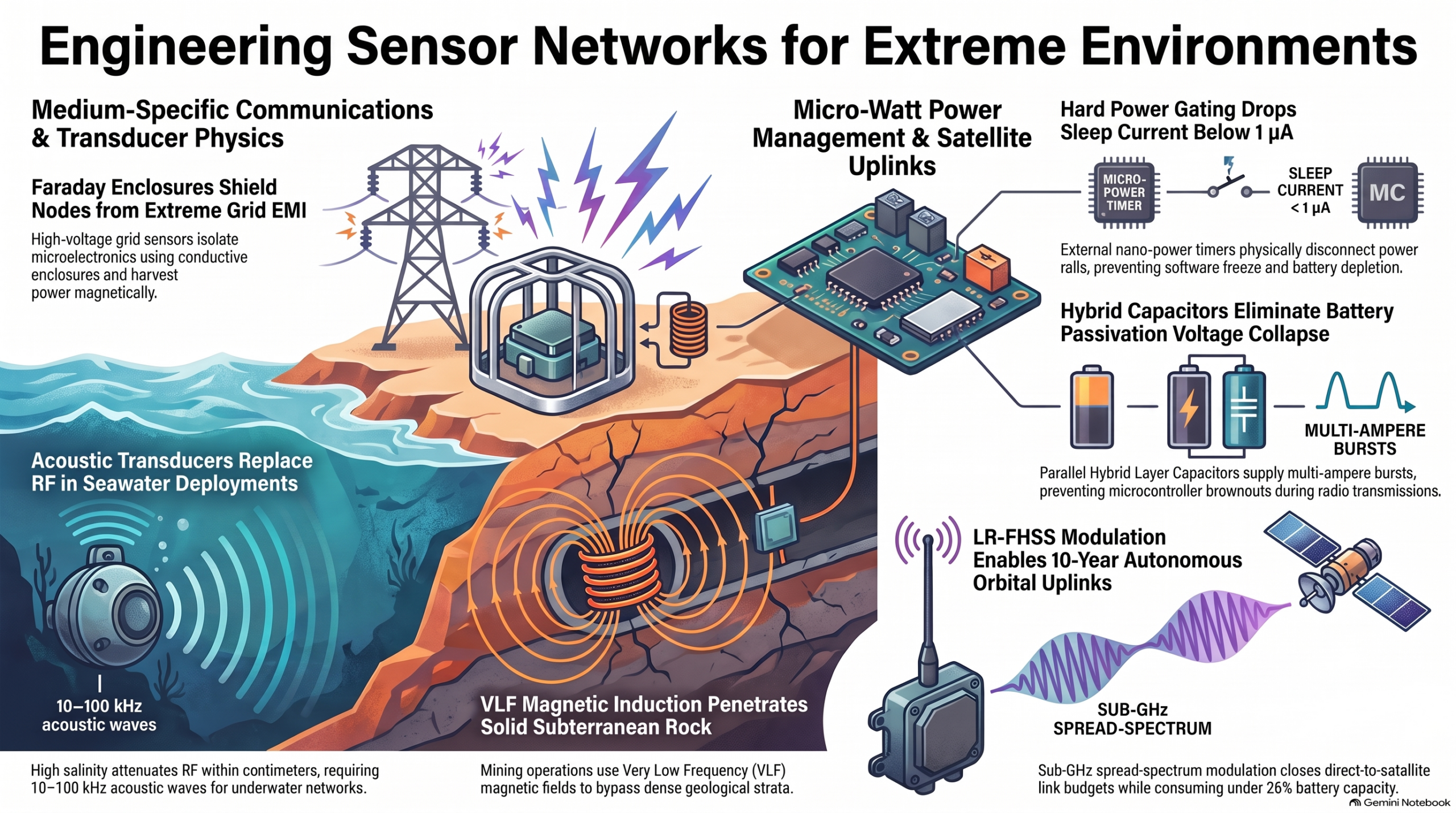
Battery-powered wilderness sensor nodes deployed for disaster mitigation—such as tracking early wildfire pyrolysis or flash-flood inundations—are engineered to operate unattended for a decade. To achieve this lifespan, embedded microcontrollers rely heavily on software-configured “Deep Sleep” or “Hibernate” states designed to lower standby current consumption to microamperes.
However, relying on software instructions to maintain low-power states in harsh environments is a fundamental architectural flaw. Severe temperature cycling (-40^\circ\text{C} to +70^\circ\text{C}), electrostatic discharge (ESD), or cosmic ray single-event upsets (SEUs) can corrupt microcontroller memory, causing execution locks or latch-up events. Once frozen in a high-current draw state (drawing milliamperes instead of microamperes), a node will completely exhaust a multi-year battery cell in weeks.
To eliminate this vulnerability, high-reliability edge systems utilize hard hardware power-gating. Instead of keeping the microcontroller energized in a software sleep mode, the architecture integrates an external nano-power timer (such as the TI TPL5110, drawing a minuscule 35\text{ nA}). This nano-timer completely disconnects the microcontroller’s power rails via high-side P-MOSFET load switches with off-state leakage ratings below 10\text{ nA}.
[ HARDWARE POWER-GATING & HLC BUFFER ARCHITECTURE ]
Primary Li-SOCl2 Bobbin Cell
(High Energy, Low Continuous Current)
│
├──────────────────────────────────────────────┐
│ Continuous Micro-Current Trickle Charge │
▼ ▼
[ Hybrid Layer Capacitor (HLC) ] [ Nano-Power System Timer (35 nA) ]
(Low ESR < 100 mΩ, Pulse Output: 2–5 A) │
│ ▼
│ Load Switches (Leakage < 10 nA)
│ │
└───────────────────────┬──────────────────────┘
│
▼
[ High-Power Satellite PA ]
By keeping the central core fully unpowered during sleep, baseline resting current drops down to \approx 405\text{ nA} (including analog comparator monitoring), compared to the 10\text{–}50\ \mu\text{A} typical of software standby leakage under thermal stress. The core is re-energized only when the external timer asserts an active-high drive signal or an asynchronous analog comparator threshold is crossed.
The Chemical Passivation Trap and the HLC Solution
A subtle narrative link exists between software sleep wake-up mechanics and battery chemistry failure modes. Primary Lithium Thionyl Chloride (\text{Li-SOCl}_2) bobbin cells are favored for long-term deployments due to their gravimetric energy density (>650\text{ Wh/kg}) and exceptional shelf life. This longevity is enabled by passivation: a microscopic crystalline film of Lithium Chloride (\text{LiCl}) that forms naturally on the lithium anode, arresting self-discharge to <1% per year.
However, this passivation film acts as a high internal resistance barrier. When a microcontroller wakes up from an extended sleep cycle to execute a high-power satellite uplink burst requiring 1\text{–}2\text{ A} of pulse current, the high internal resistance induces an immediate terminal voltage drop:
V_{\text{terminal}} = V_{\text{OCV}} – I_{\text{pulse}} \cdot R_{\text{passivation}}
Under severe passivation and sub-zero temperatures, the terminal voltage collapses below the microcontroller’s brownout limit (<2.0\text{ V}) in microseconds, triggering an immediate brownout reset loop before the radio can transmit a single byte.
The hardware solution to this chemical paradox is wiring a low Equivalent Series Resistance (\text{ESR} < 100\text{ m}\Omega) Hybrid Layer Capacitor (HLC) in parallel with the primary \text{Li-SOCl}_2 cell. During extended deep-sleep intervals, the primary cell trickles current into the HLC. When the satellite power amplifier fires, the low-ESR HLC supplies the entire high-current pulse, holding the system voltage rail firmly above 3.3\text{ V} and preserving the cell’s 10-year operational lifespan.
V. Takeaway 4: Starlings Hold the Biophysical Secret to Anti-Fragile Network Design
Topological k-NN and Spin-Exchange Mechanics
Biological collectives solve high-density multi-agent routing problems without centralized control. European starling murmurations (Sturnus vulgaris) execute high-G evasive maneuvers against raptor attacks across swarms of tens of thousands of individuals without mid-air collisions, graph partitioning, or leadership bottlenecks.
[ METRIC BROADCASTING (UNBOUNDED) ] [ TOPOLOGICAL k-NN (BIOMORPHIC) ]
(O(N²) Saturation Risk) (k = 7 Bounded Interaction)
      ○   ○   ○                                   ○ ─── ○ ─── ○
    ○   \ | /   ○                                 │ \   │   / │
    ○ ─── Node ─── ○                              │  Node (k=7)
    ○   / | \   ○                                 │ /   │   \ │
      ○   ○   ○                                   ○ ─── ○ ─── ○
Empirical findings from the StarFlag Project reveal three foundational physical principles that govern avian swarm mechanics:
- Topological k-NN Interaction (k \approx 7): Starlings do not interact with flockmates within a fixed physical metric radius (meters); instead, they track a fixed topological number of neighbors (k = 6.5 \pm 0.5 \approx 7). Whether the flock expands during evasion or contracts during cruise, each bird maintains communication with exactly seven neighbors. This topological bound prevents network graph partitioning during expansion and avoids information bloat during compaction.
- Undamped Inertial Spin Waves: Turn information propagates through an avian flock as an undamped, second-order hyperbolic wave (\omega = c \cdot k). Modeled via spin-exchange Hamiltonian mechanics, the kinematic directional state \mathbf{v}_i and internal spin generator \mathbf{s}_i evolve according to:
\frac{d\mathbf{v}_i}{dt} = \frac{1}{\chi_0} \mathbf{s}_i \times \mathbf{v}i, \quad \frac{d\mathbf{s}i}{dt} = \sum{j \in S_i} J{ij} \left( \mathbf{v}_i \times \mathbf{v}_j \right) – \frac{\eta_0}{\chi_0} \mathbf{s}_i
Where \chi_0 represents generalized rotational inertia and J_{ij} represents alignment stiffness. Rotational torque cascades across topological links without kinetic energy dissipation, driving phase change waves at velocities (20\text{–}40\text{ m/s}) that far exceed individual physiological reaction times (>100\text{ ms}). 3. Fluid Leadership: Leadership is a transient functional role. The bird situated on the spatial boundary of highest threat exposure becomes the immediate initiator, exerting physical torque on its k=7 topological neighbors. Once the turn is completed, the leadership role instantly dissolves back into the isotropic collective.
Biological Flocks vs. Unconstrained Synthetic Swarms
Dimension Biological Bird Swarm (Starlings) Unconstrained Synthetic Swarm
Ontological Basis Kinematic state vector & physical mass: \text{ID}i = (x_i, v_i, s_i, m_i) Relational Epistemic Tuple: \text{ID}i = \langle \sigma{\text{TPM}}, \theta_i, \mathcal{H}{\text{weights}}, \text{BS}k, W_i, \mathcal{S}{\text{FEP}} \rangle
Anti-Sybil Mechanism Hardcore spatial exclusion (V_i > 0), aerodynamic mass (m_i \approx 75\text{–}90\text{ g}), metabolic work constraints Hardware TPM 2.0 attestation, ZK nullifier trees, and Landauer erasure costs
Interaction Boundary Bounded topological rank-order (k \approx 6.5 \pm 0.5 \approx 7 neighbors) Unbounded metric/context radius (leading to API saturation and context bloat)
Role Transference Inertial spin wave phase handoff; instantaneous, boundary-driven turns Centralized or static administrative roles (fixed prompt labels and administrative credentials)
Translating these biomorphic principles into multi-agent AI design—restricting agent context graphs to topological k \approx 7 dynamic topologies and enabling torque-driven role handoffs—prevents token bloat, network saturation, and consensus collapse.
VI. Takeaway 5: Under the Ocean and Deep Underground, Standard Radio Completely Fails
Electrodynamic Realities of Extreme Media
Network abstractions routinely assume that IP routing and standard Radio Frequency (RF) communications function uniformly across all environments. However, operating in extreme physical media forces engineers to discard uniform software abstractions in favor of domain-specific electrodynamics.
┌─────────────────────────────────────────────────────────────────────────┐
│ EXTREME MEDIUM COMMUNICATIONS │
├───────────────────────────────────┬─────────────────────────────────────┤
│ SEAWATER / OCEAN FLOOR │ SUBTERRANEAN MINING │
│ – High Conductivity (σ ≈ 4 S/m) │ – Conductive Rock (σ = 10⁻⁴–1 S/m) │
│ – RF Attenuation > 34 dB/m │ – 2.4 GHz Attenuation ≈ 1,337 dB/m │
│ – Solution: Acoustic Waves │ – Solution: VLF Magnetic Induction │
│ (~1,500 m/s Sound Velocity) │ (300 Hz–3 kHz TTE Waves) │
└───────────────────────────────────┴─────────────────────────────────────┘
Marine Environments: Underwater Acoustic Sensor Networks (UWSNs)
Standard high-frequency RF signals fail immediately in seawater. Ocean salinity creates high electrical conductivity (\sigma \approx 4\text{ S/m}), causing electromagnetic waves to be absorbed within centimeters (\alpha_{\text{EM}} \approx 34.5\text{ dB/m} at 1\text{ MHz}). Optical links are similarly constrained by particulate scattering to ranges under 20 meters.
Consequently, Underwater Acoustic Sensor Networks (UWSNs) replace electromagnetic transceivers with piezoceramic acoustic projectors that generate longitudinal pressure waves. However, sound propagates through seawater at roughly 1,500\text{ m/s}—five orders of magnitude slower than light in air. This propagation latency makes standard contention-based MAC protocols (like CSMA/CA) useless. UWSNs must deploy Depth-Based Routing (DBR), where nodes use hydrostatic pressure sensors to route packets upward based on physical depth gradients.
Subterranean Environments: Skin Depth Limits and Magnetic Induction
In underground mining drifts and geological formations, conductive rock strata (\sigma = 10^{-4}\text{ to } 1.0\text{ S/m}) cause extreme signal decay governed by the classical skin depth equation (\delta):
\delta = \frac{1}{\sqrt{\pi f \mu \sigma}} \implies \text{Attenuation}_{\text{dB/m}} = 8.686 \cdot \sqrt{\pi f \mu \sigma}
At 2.4\text{ GHz}, the skin depth in damp rock drops to millimeters, yielding a signal attenuation rate of:
\text{Attenuation}_{\text{2.4GHz}} \approx 1,337\text{ dB/m}
Standard wireless signals are completely extinguished upon penetrating solid rock. To establish Through-The-Earth (TTE) communications through hundreds of meters of solid overburden, subterranean networks operate in Very Low Frequency (VLF: 300\text{ Hz}\text{–}3\text{ kHz}) bands. By driving oscillating currents through large loop antennas, TTE systems generate low-frequency magnetic dipoles that penetrate rock, establishing emergency links that survive mine collapses.
Building anti-fragile networks requires abandoning the myth of uniform software abstractions. Physical media electrodynamics must strictly dictate hardware front-ends, modulation schemes, and network topologies.
VII. Conclusion: Grounding the Future of Autonomous Intelligence
Distributed computational architectures court catastrophic failure whenever their software abstractions decouple from physical constraints. As synthetic AI agents, autonomous swarms, and edge networks assume operational authority over critical real-world infrastructure, treating digital logic as self-authenticating truth introduces fatal vulnerabilities:
- Voting mechanisms in LLM agent swarms suffer from positive error covariance, collapsing under the Condorcet Inversion.
- Software-only identity and proximity assertions succumb to Relay Attacks and GPS Spoofing.
- Battery-powered edge devices freeze under severe thermal cycling due to Software Sleep Locks and Chemical Passivation.
- Standard communications protocols fail when confronted with Media Electrodynamics in extreme physical environments.
The path forward for resilient autonomous intelligence lies in anchoring identity, location, and consensus directly in physical invariants: Maxwellian electrodynamics, the speed of light (c), biomorphic flocking physics (k \approx 7), and non-equilibrium Landauer thermodynamics.
The Metabolic Halting Gate
In multi-agent reasoning loops, agents are vulnerable to infinite autoregressive reflection loops. To prevent this, the system enforces a Metabolic Halting Gate derived from Landauer’s erasure limit (\Delta Q \ge N k_B T \ln 2). The micro-metacognitive controller continually evaluates the ratio of expected Variational Free Energy reduction (\Delta F) to physical thermodynamic heat dissipation (\Delta Q):
\text{If } \Delta F < \lambda \cdot \Delta Q, \quad \text{Trigger: } \operatorname{FORCE_ACTION_HALT}
If an AI agent cannot demonstrate that an additional reflection cycle yields an informational gain (\Delta F) exceeding its physical thermodynamic erasure cost (\lambda \cdot \Delta Q), the computation is terminated at the hardware layer.
A Closing Reflection
As we design increasingly complex autonomous AI swarms, cyber-physical assets, and edge computing networks, we must confront our foundational assumptions: What digital abstractions in your current software architecture are treating pure symbolic logic as self-authenticating truth, waiting to be shattered by contact with physical reality?


