The Laws of Physics are the New Firewalls: 5 Surprising Truths About the Sovereign Stack
1. Introduction: The Fragility of the “Line”
Our modern civilization is haunted by the ghost of 20th-century thinking: “The Line.” We exist in a state of Linear Fragility, tethered to brittle, centralized power grids and data backbones where a single severed cable or a remote server breach can collapse an entire region’s autonomy. In this model, we do not own our lives; we lease them from a central provider.
The Decentralized Futurist perspective offers an alternative: Spherical Resilience. This is the core philosophy behind the Rural Infrastructure Operating System (RIOS) by DeReticular. RIOS is a “Civilization-in-a-Box” designed to orchestrate what we call the Trinity Stack: Electrons (Energy via Agra Energy plasma gasification), Data (Intelligence via Trifi mesh networks), and Mobility (Logistics via autonomous Kurb Kars). By enabling “Island Mode,” RIOS ensures that a community remains a sovereign, functioning node even when the global internet backbone is severed. To understand how we transition from “Trusting the Cloud” to “Trusting the Physics,” we must explore the counter-intuitive truths of the Sovereign Stack.
2. Truth #1: Your Hardware Has a Unique “Soul” (H_{phy})
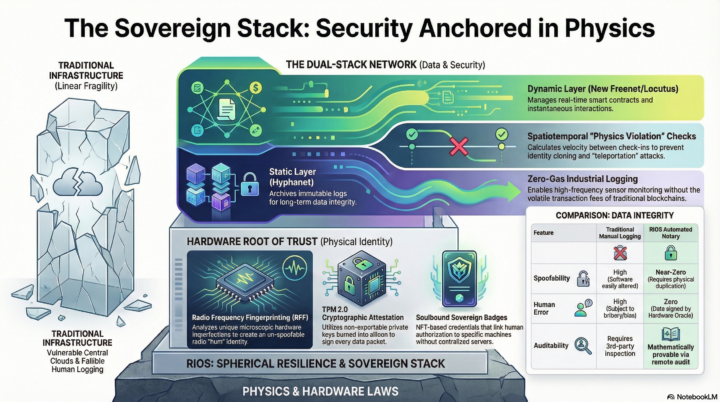
In the Sovereign Stack, identity is no longer a copyable digital file or a spoofable username; it is anchored in the very silicon atoms of your devices. This is the Hardware Root of Trust. By combining TPM 2.0 (Trusted Platform Module) signatures with Radio Frequency Fingerprinting (RFF), RIOS ensures that a device is physically what it claims to be.
Every piece of hardware possesses microscopic manufacturing imperfections in its analog circuitry—filters, mixers, and power amplifiers—that create a distinct radio “accent.” Using Software Defined Radio (SDR), the system performs a “transient response analysis” of the signal’s first few microseconds, measuring oscillator drift to generate a Hardware Hash (H_{phy}). This un-spoofable digital passport prevents “Sybil Attacks,” where a single malicious actor creates thousands of fake identities to flood a network.
“Using RF Fingerprinting anchors digital identity to physical physics, preventing the ‘Sybil Attack’ common in standard crypto-networks where software clones can masquerade as legitimate nodes.”
3. Truth #2: “Impossible Travel” and the End of Digital Teleportation
One of the most profound security layers in the RIOS mesh is Spatiotemporal Validation. Traditional networks allow an identity to log in from London and, seconds later, from New York. In the Sovereign Stack, this is flagged as a “Physics Violation.”
The network utilizes a Handover Protocol involving digital “Exit Visas.” When a device moves between nodes, the previous node signs it “out,” proving a continuous physical path. To detect clones, the system queries a Distributed State Contract on the Locutus layer and calculates:
- Haversine Distance (\Delta d): The shortest physical path over the Earth’s sphere.
- Time Delta (\Delta t): The duration since the last verified heartbeat.
- Required Velocity (V_{req}): Calculated as V_{req} = \Delta d / \Delta t.
If V_{req} > V_{max} (the maximum believable velocity of the device), the connection is rejected as an “Impossible Travel” attack. Crucially, to preserve the Cypherpunk ethos of privacy, RIOS utilizes Zero-Knowledge Proofs (zk-SNARKs). This allows the network to verify that a user’s path is valid and unbroken without revealing their entire GPS history to the node operator.
4. Truth #3: The Death of the “Oracle Problem” via the Dual-Stack
The “Oracle Problem” asks: How can a digital ledger trust that physical data (like energy yields) hasn’t been tampered with? RIOS solves this by acting as an Automated Notary. Data is cryptographically signed by the hardware’s TPM chip at the point of ingestion—the Hardware Oracle—before it ever touches a network.
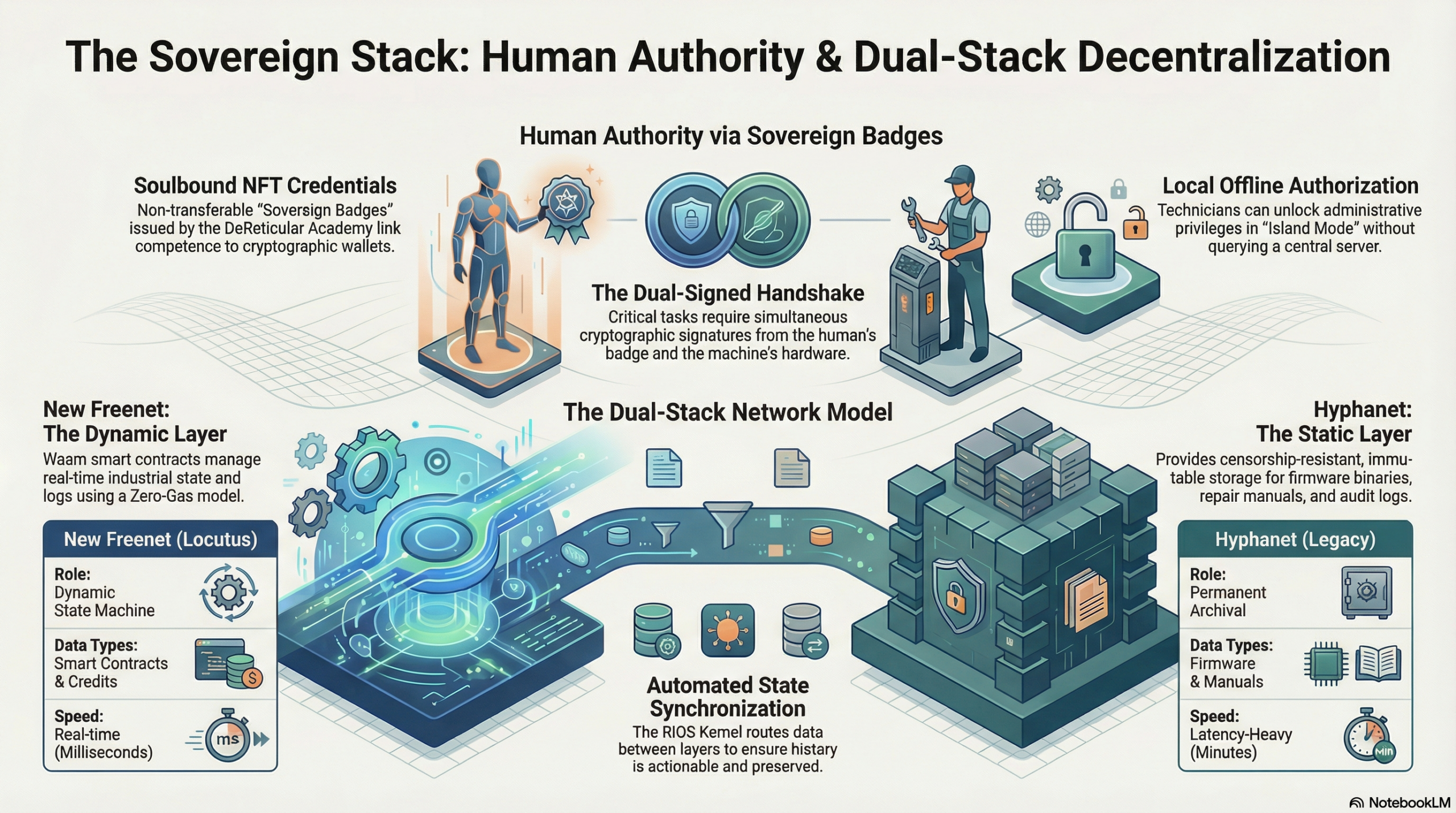
To manage this data, RIOS employs a Dual-Stack architecture:
- Hyphanet (Legacy Freenet): The “Library” or “Hard Drive.” It handles high-latency, censorship-resistant archival of static data like repair manuals, firmware binaries, and regulatory logs.
- New Freenet (Locutus): The “Clerk” or “CPU/RAM.” It manages real-time, dynamic state via WebAssembly (Wasm) smart contracts.
Unlike traditional blockchains that favor a “Digital Aristocracy” through high transaction fees, Locutus utilizes a Zero-Gas model. This allows for high-frequency industrial logging—recording sensor data every second—without the volatile costs that exclude small-scale producers.
“The DeReticular architecture represents a shift from ‘Trusting the Cloud’ to ‘Trusting the Physics,’ ensuring data is both instantly actionable and permanently preserved.”
5. Truth #4: Sovereign Badges and the Human-Machine Handshake
While machines provide raw data, human intent is managed through Sovereign Badges. These are Soulbound NFTs issued by the DeReticular Academy. Because they are soulbound, these credentials—representing certifications like “Solar Systems Architect”—cannot be traded, sold, or stolen.
Authorization requires a Human-Machine Handshake. When a technician attempts a critical action, such as a firmware update, the system generates a Dual-Signed Object. This log entry requires both the machine’s unique TPM signature and the human’s Badge signature. This creates a trustless chain of custody, proving to global markets that a specific action was authorized by a certified professional on a physically verified machine. This is essential for high-stakes provenance, ensuring that “downtime” is flagged as competent maintenance rather than a system failure.
6. Truth #5: Kubuntu and the Surprising Path to Privacy
For the tech archivist, the choice of operating system is a matter of survival. While “amnesic” distributions like Tails are excellent for ephemeral browsing, they fail the Sovereign Stack’s requirement for a persistent “datastore” of encrypted chunks. Even MOFO Linux, a long-time staple of the scene, removed Freenet in version 9.7 to save ISO space.
Kubuntu—specifically the KDE Plasma desktop—has emerged as the victor for “friendly computing.” It provides the stability of an Ubuntu LTS base with a Windows-like interface that aids mainstream adoption. Setting up this custom privacy stack requires three manual pillars:
- Java Environment: Essential for the legacy Hyphanet “Archivist” layer.
- Official Installer: Executing the Freenet/Hyphanet binaries via the terminal to establish the persistent datastore.
- Local Gateway: Accessing the sovereign web via a secure browser at
127.0.0.1:8888.
7. Conclusion: Beyond the Cloud
The Sovereign Stack is more than a technical curiosity; it is a bridge to “Physical Truth.” As global regulations like the EU Deforestation Regulation (EUDR) begin to mandate mathematically provable origin data and geolocation coordinates, the RIOS architecture provides a ready-made framework for compliance that no centralized cloud can match.
We must acknowledge the “Gaps.” We are currently facing an “Empty OS” problem—the backend is a masterpiece of systems philosophy, but the user-facing application layer is still being forged. Through the “Flood the Forge” initiative, the next generation of cypherpunk developers is being recruited to build the interfaces that will make this technology accessible to the rural populations it serves.
The transition is ahead of us. We are moving away from an era of leased identities and brittle lines. The only remaining question is: Are you ready to stop trusting the cloud and start trusting the physics?


