Strategic Revenue Analysis: Project Quartzsite Generation 5 Infrastructure
- Strategic Market Context: The Quartzsite Demographic Lifecycle
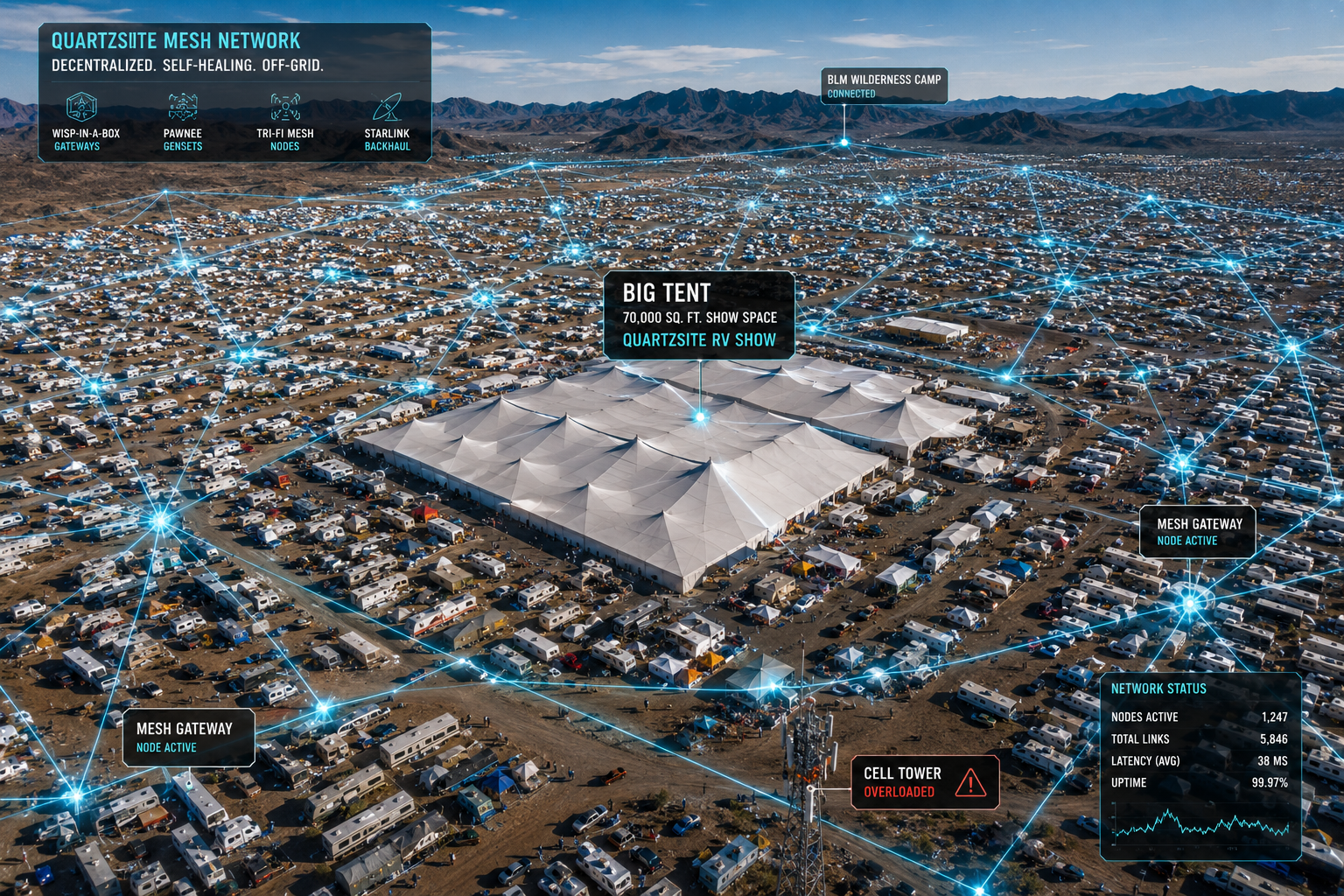
The 7-month Bureau of Land Management (BLM) Long-Term Visitor Area (LTVA) season, spanning September 15 to April 15, represents a tiered liquidity surge within a high-density, off-grid macroeconomic environment. Traditional “Line” infrastructure—the fragile, centralized power grids and cellular backhauls—systemically fails under the pressure of over 1.2 million seasonal migrants. Project Quartzsite de-risks this environment through “Spherical Resilience,” deploying self-healing, autonomous Generation 5 (Gen 5) nodes that operate in complete “Island Mode.” This strategy establishes a sovereign operational moat, ensuring utility continuity when national networks inevitably buckle.
The market experiences four distinct demographic waves, each presenting specific infrastructure friction and commercial opportunities:
Phase / Timeline Estimated Population Critical Infrastructure Friction
Phase 1: Setup (Sept 15 – Oct 31) 15,000 – 45,000 Site comms, initial power setups, and long-term WISP link optimization.
Phase 2: Build-Up (Nov 1 – Dec 31) 150,000 – 400,000 High-speed streaming demand, remote-work bandwidth, and caravan mesh requirements.
Phase 3: Peak Show (Jan 1 – Feb 28) 1,000,000 – 1.5M+ Severe cellular blackouts, POS terminal failure, and high-density compute demand.
Phase 4: Wind-Down (Mar 1 – Apr 15) 50,000 – 120,000 Field maintenance, equipment updates, and gear storage security.
Capturing the “Phase 1 Pioneers” is the foundational requirement for network topology optimization. By establishing the Tri-Fi mesh backbone during this window, we secure optimal frequency planning and land selection before the surge, ensuring a stable infrastructure foundation for the high-revenue waves to follow.
- Demographic Target Segmentation & High-ARPU Profiles
In the Sonoran Desert’s temporary metropolis, precise demographic targeting is the primary driver of capital efficiency. We capitalize on three high-value sub-segments whose mission-critical requirements allow for premium pricing and sustained recurring revenue.
- Remote Executives & Digital Nomads: Approximately 45,000 high-intent targets earning between $120,000 and 350,000+. For these individuals, reliable broadband for trade execution, VPNs, and video conferencing is a mission-critical utility. We specifically target this segment with the WISP Agentic AI Gateway (9,997) to facilitate sovereign Executive Command & Control (C2).
- Commercial Show Vendors: Over 2,000 businesses operating at venues like Tyson Wells and Desert Gardens. These vendors experience catastrophic revenue loss when cellular networks throttle to <1Mbps, causing Point-of-Sale (POS) terminal failure. Their core requirement is “Unbreakable POS” connectivity with guaranteed uptime.
- Luxury Expedition & Overland Community: A segment of ~3,500 rigs valued between $200,000 and $1.5M+. This community demands total digital and physical sovereignty, requiring quiet microgrid power, autonomous kinetic mobility support, and military-grade digital security.
These specific requirements for reliability and air-gapped compute dictate the multi-stream architecture of DeReticular’s revenue engine.
- Revenue Stream Architecture: The Gen 5 Product Ecosystem
The Gen 5 product suite functions as “Civilization in a Box,” a diversified commercial engine engineered to provide resilient infrastructure where traditional utilities fail. This ecosystem is monetized through four integrated streams that combine high-margin hardware sales with high-retention service fees.
- Stream 1: Consumer Hardware & Subscriptions: RIOS Mobile connectivity units providing multi-carrier bonding. Users access the desert-wide Tri-Fi mesh via Sovereign Network Passes ($120/month or $650/season), creating a recurring “network effect” as node density increases.
- Stream 2: Commercial Vendor Packages: The “Unbreakable POS” value proposition for 2,000+ businesses. We offer leased network kits at $499/month or flat purchases at $3,497, both backed by Service Level Agreements (SLAs) to eliminate revenue loss from network drops.
- Stream 3: Kinetic & Power Microgrids: Centered on the Pawnee 45kW GenSet, we sell whisper-quiet microgrid power at $0.45/kWh or $150/day flat rates. This stream is supplemented by off-road recovery and rapid field support services for remote camp enclaves.
- Stream 4: Edge Compute & DePIN Services: We leverage modular containers housing 320 H100 Equivalent GPU clusters for local AI inferencing. Revenue is generated through high-density compute rentals and Locutus Ledger verification fees, which facilitate peer-to-peer telemetry sync and transaction verification without cloud dependency.
Core Gen 5 Product Catalog (MSRP)
- WISP-in-a-Box Base Gateway: $1,497
- WISP-in-a-Box LTE Gateway: $5,887
- WISP Agentic AI Gateway: $9,997
- Pawnee Power GenSet (45kW): $49,997
- Pawnee Hybrid Dune Buggy: $99,000
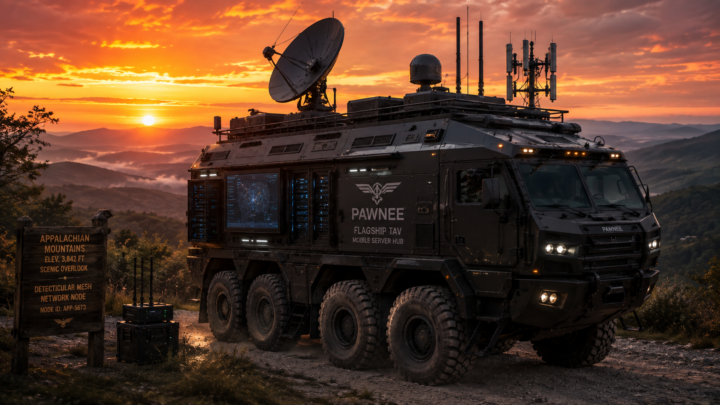
- Pawnee Flagship TAV: $797,000
The synergy between hardware sales and recurring subscription models ensures that each hardware unit deployed serves as a gateway for continuous network and power consumption revenue.
- Consolidated Financial Projections (Sept 15 – April 15)
Strategic forecasting in an emerging technology market requires multi-scenario modeling to validate commercial viability against varying adoption rates. The following master model consolidates all revenue lines across the seven-month LTVA window.
Master Consolidated Seasonal Revenue Model
Revenue Source Conservative Case Moderate Case Aggressive Case
Direct Gen 5 Hardware Sales $1,328,146 $4,211,571 $10,167,956
Sovereign Network Subscriptions $260,000 $780,000 $1,950,000
Pop-Up Vendor POS Leases $299,400 $898,200 $2,245,500
Pawnee GenSet Power Sales $180,000 $450,000 $900,000
Edge GPU Compute & DePIN $150,000 $500,000 $1,200,000
Pawnee Off-Road/Field Services $90,000 $250,000 $360,000
Consolidated Gross Revenue $2,307,546 $7,089,771 $16,823,456
The Moderate Case target of $7,089,771 is established as the primary KPI for the seasonal deployment. Achieving this benchmark requires a hardware conversion rate of 1.6% (748 units) on qualified overlander and vendor foot traffic—a highly conservative penetration rate given the total absence of competing high-bandwidth alternatives during peak cellular blackouts.
- Operational Execution Roadmap: A Four-Phase Deployment
Operational success is predicated on a phased rollout that matches infrastructure capacity to the arriving demographic waves, ensuring maximum capture of commercial contracts.
- Phase 1 (Infrastructure Anchor): Sept 15 – Oct 31. Deployment of primary RIOS Mobile WISP towers at key BLM access points (La Posa North, South, West). We initiate the “early-bird” campaign for $650 full-season network passes to secure the long-term nomad demographic.
- Phase 2 (Commercial Onboarding): Nov 1 – Dec 31. Transition to B2B operations by pre-installing WISP LTE Gateways for gem show vendors and positioning Pawnee 45kW GenSets at central plazas. This phase de-risks the season by securing “Unbreakable POS” contracts prior to the peak surge.
- Phase 3 (Community Scale): Jan 1 – Jan 15. Integration with the Rubber Tramp Rendezvous (RTR) serves as a critical “Network Density Test” for the Tri-Fi mesh. We commission modular Edge GPU racks to support remote tech teams and content creators.
- Phase 4 (Peak Show Execution): Jan 16 – Feb 28. Focus on 100% SLA uptime for vendors during the “Big Tent” RV and Gem shows. We leverage a high-visibility showcase booth to drive direct sales for Pawnee off-road vehicles and high-tier WISP gateways.
This phased timeline minimizes execution risk by anchoring the network backbone and securing commercial commitments before the arrival of the massive migrant surge.
- Risk Mitigation and Strategic Conclusion
Operating in the Sonoran Desert requires an engineering-first approach to risk management. Environmental extremes and regulatory land-use constraints are mitigated through the inherent resilience of Gen 5 hardware.
Strategic Risk Register
Risk Factor Severity Mitigation Strategy
Environmental Heat/Dust High Industrial 3D-printed, battery-free chassis with passive cooling and IP67 sealing.
Backhaul Throttling High Multi-carrier bonding engine balancing Starlink sat-links with 5G/LTE failover priority.
Regulatory Land Use Medium Operating primary hubs on private land leases (Tyson Wells); mobile nodes comply with LTVA rules.
Supply Chain Bottlenecks Medium Buffer stock of 150+ WISP units pre-staged in Phoenix warehouses by September 1.
Strategic Summary
Project Quartzsite serves as a highly profitable blueprint for Sovereign Infrastructure, validating the commercial viability of Generation 5 technology in the world’s most demanding off-grid environment. By solving the systemic failures of traditional connectivity and power for a population of 1.2 million, we have established a model that produces over $7M in seasonal revenue while demonstrating the superiority of decentralized, air-gapped systems. This deployment proves that DeReticular’s infrastructure stack is not merely a technical innovation, but a premier commercial utility for the modern nomadic economy.


