

The Making of a “Quasi-Democracy”: How Bipartisan Gerrymandering Shapes Electoral Outcomes

A political landscape where the majority is effectively chosen not by the will of the people on election day, but through a series of strategic decisions made by both dominant political parties regarding the boundaries of voting districts, can be described as a “quasi-democracy.” This system, while maintaining the outward appearance of democratic elections, is fundamentally shaped by the practice of gerrymandering, a process that allows politicians to select their voters rather than the other way around.[1]
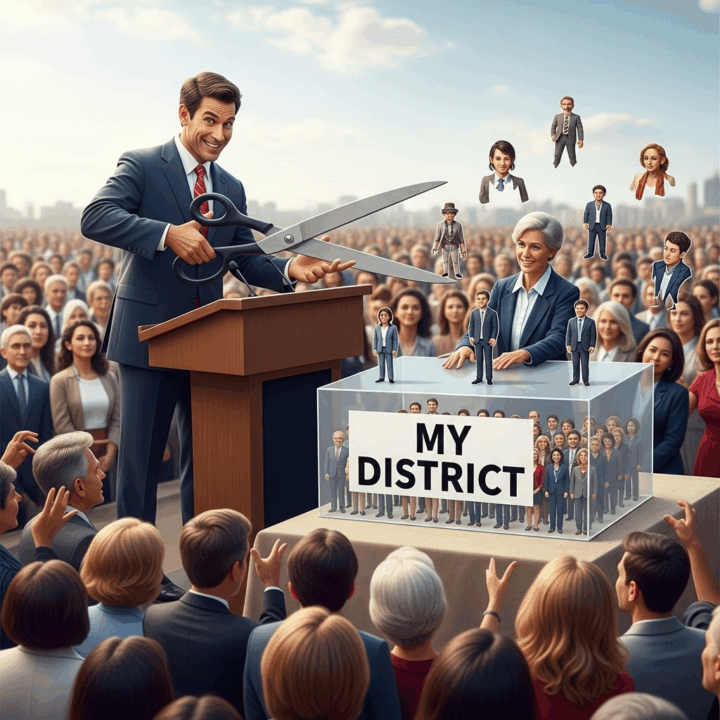
Gerrymandering is the intentional manipulation of electoral district boundaries to give one political party or group an unfair advantage.[2][3] This is typically achieved through two primary techniques: “cracking” and “packing.” “Cracking” involves splitting a particular group of voters across multiple districts to dilute their voting power, while “packing” concentrates a group of like-minded voters into a single district to reduce their influence in other districts.[4][5]

While often viewed as a tool for one party to dominate another, gerrymandering can also be a bipartisan endeavor, leading to what is sometimes called a “sweetheart gerrymander.”[4][6] In this scenario, the two major parties tacitly agree to draw district lines in a way that protects their respective incumbents.[4][6] This results in the creation of “safe” districts for both parties, where the electoral outcome is all but guaranteed.[6][7]
This practice of bipartisan gerrymandering contributes significantly to the erosion of democratic principles and the establishment of a quasi-democratic state. Here’s how:
- Reduced Competition and Voter Choice: By creating safe seats for incumbents of both parties, bipartisan gerrymandering drastically reduces the number of competitive elections.[8][9] With the outcome predetermined, voters in these districts have little to no real choice, and their votes have a diminished impact on the overall composition of the legislature.[10] This lack of competition can lead to voter apathy and a sense that their participation in the democratic process is meaningless.[11]
- Entrenchment of Incumbents: When both parties agree to protect their own, it becomes exceedingly difficult to vote out an incumbent, regardless of their performance or the shifting views of the electorate.[12][13] This entrenchment of power undermines the accountability that is central to a healthy democracy.[13]
- Manufactured Majorities: In a system where both parties manipulate district boundaries, the “majority” in the legislature may not reflect the overall will of the population. Instead, it becomes a product of the agreements and strategic calculations made during the redistricting process.[14] The focus shifts from appealing to a broad base of voters to securing a pre-ordained number of seats for each party.
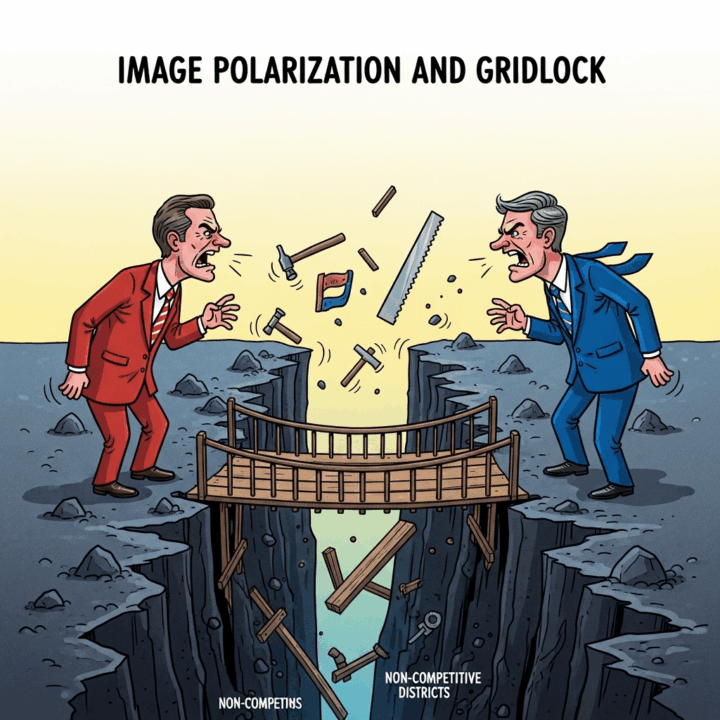
- Polarization and Gridlock: With fewer competitive districts, elected officials have less incentive to compromise or appeal to moderate voters.[8] Their primary concern becomes appeasing their base and avoiding a primary challenge from within their own party. This can lead to increased political polarization and legislative gridlock.
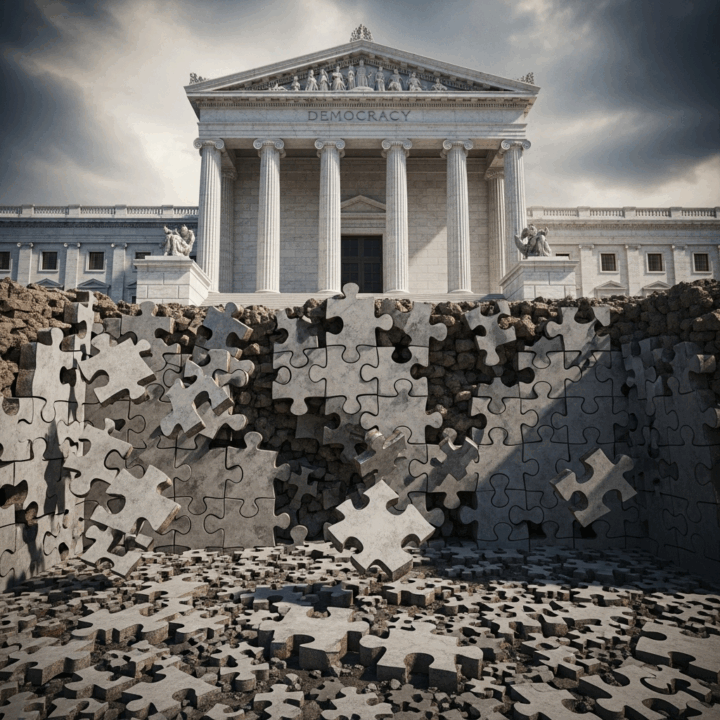
In essence, a quasi-democracy born from bipartisan gerrymandering is a system where the foundational principle of “one person, one vote” is undermined.[8] While elections are held and votes are cast, the significant decisions that shape the political landscape have already been made behind closed doors, in the drawing of district lines. This creates an illusion of democratic choice while concentrating power in the hands of the political establishment of both parties, ultimately disenfranchising the very people they are meant to represent.
Sourceshelp
- wikipedia.org
- wikipedia.org
- brennancenter.org
- fairdistrictspa.com
- brennancenter.org
- fairvote.org
- represent.us
- house.gov
- harvard.edu
- uab.edu
- lwv.org
- njappleseed.org
- upenn.edu
- quora.com
Here are 12 image descriptions that capture the key components of the article on quasi-democracy and gerrymandering.
Image 1: The Illusion of Choice
- Description: A voting booth is shown with the curtain partially drawn back. Instead of a ballot with multiple candidates, the voter sees a mirror reflecting their own image, symbolizing that their choice is merely an illusion. In the background, shadowy figures representing both political parties are seen shaking hands over a map of voting districts. The overall mood is somber and cynical.
Image 2: The Bipartisan Handshake
- Description: A close-up shot of a handshake between two figures. One sleeve is clearly Republican red, and the other is Democratic blue. Below their clasped hands, a distorted map of electoral districts is visible, with unnaturally jagged and winding boundaries. This image represents the “sweetheart deal” or bipartisan cooperation in gerrymandering.
Image 3: The Gerrymandering Maze
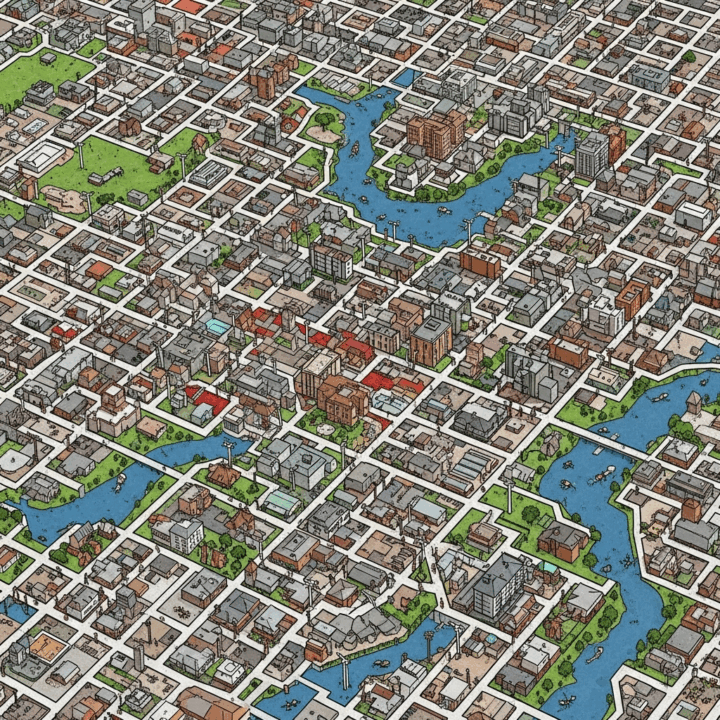
- Description: An aerial view of a city where the streets and neighborhoods are contorted into a complex and illogical maze. These maze walls represent the gerrymandered district lines. Tiny, confused people are seen trying to navigate the labyrinth, illustrating how communities are carved up and disoriented by the process.
Image 4: “Cracking” – The Community Divided
- Description: A symbolic image showing a cohesive community, represented by a group of similar-colored houses, being shattered like glass. A large, jagged line (the district boundary) cuts directly through the middle of the community, splitting it into several different pieces. This visually explains the “cracking” technique.
Image 5: “Packing” – Concentrated Powerlessness
- Description: A stylized map showing one voting district crammed to the brim with houses of a single color, representing a specific voting bloc. Surrounding this “packed” district are several other districts with only a sparse scattering of that same color, illustrating how their influence has been contained and minimized elsewhere.
Image 6: Politicians Choosing Voters
- Description: A politician stands in front of a large crowd of diverse people. Instead of addressing them, the politician is using a giant pair of scissors to literally cut out sections of the crowd to place into a neatly defined box labeled “My District.” This image captures the core idea of politicians selecting their electorate.
Image 7: The “Safe District” Fortress
- Description: An illustration of a castle-like fortress flying a party flag (can be neutral or split between red and blue). The fortress is labeled “Incumbent’s Seat” and is surrounded by a wide, deep moat representing the gerrymandered district boundary. This symbolizes the security and lack of competition for politicians in “safe” districts.
Image 8: Reduced Voter Choice
- Description: A voter stands at a crossroads. Both paths ahead lead to nearly identical destinations, one labeled “Party A Incumbent” and the other “Party B Incumbent,” both shown as fortified castles in the distance. The voter looks frustrated and powerless, highlighting the lack of meaningful choice.
Image 9: The Entrenched Incumbent
- Description: A politician is depicted sitting on a throne-like chair that has roots growing deep into the ground of their legislative chamber. The roots are intertwined and thick, symbolizing how difficult it is to unseat an incumbent protected by a gerrymandered district.
Image 10: The Manufactured Majority
- Description: A legislative chamber is filled with representatives. On one side, a small group of figures holds up a large, ornate banner that reads “MAJORITY,” even though they are clearly outnumbered by the figures on the other side. This illustrates how a legislative majority can be an artificial construct of gerrymandering, not a reflection of the popular will.
Image 11: Polarization and Gridlock
- Description: Two politicians, one red and one blue, are shown on opposite sides of a deep chasm. They are shouting at each other with their backs turned to a bridge-building set in the middle. The chasm represents the political divide, widened by the lack of need for compromise in non-competitive districts.
Image 12: Erosion of Democracy
- Description: A classical-style building representing “Democracy” is shown with its foundation crumbling away. The crumbling bricks are shaped like puzzle pieces, representing the manipulated voting districts. This final image conveys the ultimate consequence: the foundational principles of democracy being weakened by gerrymandering.


