

White Paper The Death of the Line: Scaling “Spherical Resilience” via DePIN and “Island Mode” Node Architectures
White Paper The Death of the Line: Scaling “Spherical Resilience” via DePIN and “Island Mode” Node Architectures
Author: Principal Systems Engineer, Infrastructure Economist, and Lead Architect Organization: DeReticular Target Audience: Municipal Leaders, Regional Infrastructure Planners, Utility Commission Members, and Telecom Executives Date: May 2026
Introduction June 2026
Introductions
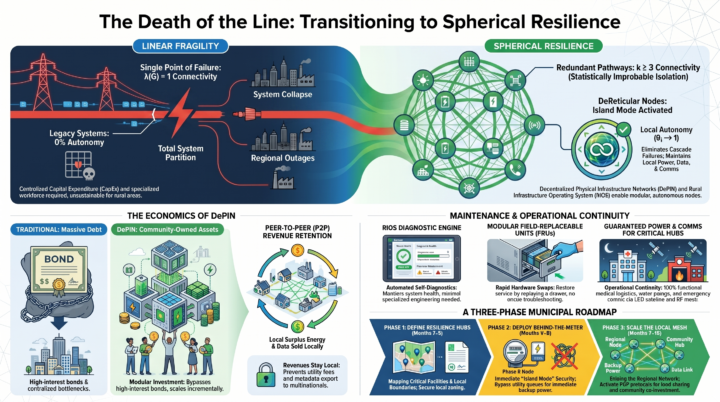
Transitioning from legacy linear infrastructure to spherical resilience shifts public services from fragile, single-path corridors to highly redundant, k-connected mesh graphs
. By moving away from centralized corridors, regional communities can secure persistent utility, communication, and energy services
.
- The Graph Theory of Spherical Resilience
Traditional infrastructure is designed around linear concentration, which creates linear fragility
. Mathematically, traditional utility networks are represented as a graph G=(V,E) where the edge connectivity is λ(G)=1
. The shortest path d(u,v) between any two nodes relies on a single, non-redundant route
. Under a random link failure rate p, the probability of a systemic partition is calculated as:
P partition =1−(1−p) ∣E∣
As the geographical scale of the network grows (∣E∣→∞), the probability of partition approaches 1, making long-haul linear transmission systems statistically guaranteed to suffer downstream interruptions
.
Spherical resilience models networks as k-vertex-connected and k-edge-connected graphs, where k≥3 . The probability of any node v becoming completely isolated is drastically reduced to:P isolation = j=1∏k p j where p is the failure probability of the j-th independent ingress/egress path To isolate any single node or cluster, at least k independent paths must fail simultaneously
.
Furthermore, spherical resilience prevents cascading failures In traditional coupled networks, when a node v x fails, its load L(v x ) redistributes to adjacent nodes . If this exceeds their operating capacity, a cascade failure occurs . The probability of cascading failure is:
P cascade
∝ i=1 ∏ m (1−θ)
where θ i represents the local autonomy factor Legacy networks suffer because θ ≈0, as nodes cannot function without real-time synchronization signals or high-voltage reference lines from the centralized macro-grid
. DeReticular’s architecture implements Island Mode, which triggers an internal control loop to set the autonomy factor θ i →1 when upstream connectivity drops . By isolating local electrical and data systems via solid-state transfer switches and localized routing protocols, failures are bounded to the zone of origin, eliminating cascading system failure: θ i →1 lim P cascade =0
.
- Shifting from Capital-Intensive CapEx to Modular DePIN Investments
Traditional municipal infrastructure requires massive upfront Capital Expenditures (CapEx) funded by sovereign debt, municipal bonds, or multi-billion-dollar utility conglomerates
. This creates a central planning bottleneck that systematically deprioritizes low-density, rural, and semi-rural regions
.
Decentralized Physical Infrastructure Networks (DePIN) shift this paradigm by democratizing funding, deployment, and operations through two main mechanisms
:
Capital Democratization & Co-Investment: Ownership of a physical node is fractionalized and represented on transparent, tamper-resistant ledgers
. Local community members, agricultural cooperatives, and public-private partnerships can directly crowdsource capital to purchase and deploy modular infrastructure nodes, aligning local financial incentives with operational resilience
.
Modular Expansion (CapEx-to-OpEx Substitution): Instead of building an entire multi-megawatt centralized facility, a municipality can deploy a single “Phase 0” node to secure one critical facility (e.g., a water treatment plant)
. Adjacent nodes (for hospitals, emergency communication towers, or agricultural processing facilities) are added incrementally as funds become available, with each node increasing the network’s overall redundancy and k-connectedness
.
Microgrid-as-a-Service (MaaS): Local cooperatives, regional public-private partnerships, or institutional investors purchase the Phase 0 hardware assets and lease them to the municipality under long-term power purchase agreements (PPAs) or capacity service contracts
. The municipality pays a predictable, fixed utility fee equivalent to—or lower than—their historical macro-utility expenditures, bypassing upfront CapEx hurdles
. Over time, as surplus power or local network data is traded within the mesh, the municipality can purchase shares of the local node, eventually transferring complete asset ownership to the community
. - Retaining Utility Revenue and Data Sovereignty Locally
Under centralized utility models, utility fees and operational metadata exit the community, flowing to multinational corporations or distant state capitals
. The DeReticular model reverses this extraction
:
Local Management & Transactions: Localized data processing, telecommunication routing, and surplus energy generation are managed and transacted entirely locally
.
Peer-to-Peer (P2P) Trading: Surplus energy or compute cycles generated by a node can be traded peer-to-peer within the local mesh network, keeping economic value circulating within regional borders
.
Community Monetization: Local governments and agricultural cooperatives can monetize surplus energy and localized telecommunication capacity by selling them directly within their mesh networks
. This prevents valuable transactional revenues from leaving the region
. - Automated RIOS Diagnostics and Maintenance for Rural Operators
Rural municipalities face a significant deficit of advanced electrical, battery chemical, and edge-compute maintenance skills
. To bridge this technical skills gap, DeReticular standardizes hardware and integrates intelligent automated diagnostics
:
Field-Replaceable Units (FRUs): Server racks, Battery Energy Storage System (BESS) modules, and solar controllers are designed as sealed, field-replaceable units (FRUs) inside the node chassis
.
RIOS Internal Diagnostics: When the Rural Infrastructure Operating System (RIOS) internal diagnostic engine detects a component anomaly (such as a failing inverter phase or a degrading battery cell string), it automatically issues an encrypted alert over a LEO satellite or RF mesh link
.
Simplified Maintenance Dispatch: Because of the FRU design, a regional technician can be dispatched to simply swap out the modular FRU drawer
. This requires no complex onsite troubleshooting or specialized engineering expertise
.
Remote Over-the-Air (OTA) Support: The RIOS software stack supports remote OTA diagnostic support via satellite, further simplifying physical maintenance
.
Minimal Preventative Schedules: Preventative maintenance is limited to a biannual cycle consisting of cleaning solar arrays, testing the automated fire suppression systems, and verifying the state-of-charge capacity of the BESS
. Technicians can easily replace components trained via DeReticular’s open-source manuals
. - Three-Phase Deployment Timeline for Municipal Leaders
Municipal planners can deploy resilience hubs incrementally using a structured, three-phase approach designed to build system redundancy while minimizing upfront fiscal risk
:
[Phase 1: Identify & Map] —> [Phase 2: BTM Phase 0 Nodes] —> [Phase 3: Mesh Scaling & P2P]
(Months 1-3) (Months 4-6) (Months 7-18)
Phase 1: Identify and Prioritize Resilience Hubs (Months 1–3): Leaders map regional critical facilities (such as water pumps, communication towers, and emergency shelters)
. They identify legacy interconnection points, local regulatory boundaries, and obtain necessary permits
.
Phase 2: Deploy Behind-The-Meter (BTM) Phase 0 Nodes (Months 4–6): Standard “Infrastructure-in-a-Box” units are installed directly behind facility service meters
. During normal operations, they offset local loads without exporting power to the grid
. This immediately establishes localized energy and telecommunications “Island Mode” security, bypassing lengthy utility connection reviews and interconnection backlogs
.
Phase 3: Scale the Local Mesh and P2P Network (Months 7–18): As multiple adjacent nodes are deployed, local DeReticular Mesh Network protocols are activated
. Municipal assets are linked together to allow local data routing and load-sharing, incrementally scaling toward a fully k-connected, spherically resilient regional network
. - Operational Continuity During Regional Disaster Events
When extreme weather anomalies, physical sabotage, or cyberattacks cause regional disasters, centralized grids and telecommunication networks suffer from systemic vulnerabilities
. Under-resourced regions can lose banking access, telecom infrastructure, and cloud connectivity
. DeReticular’s autonomous systems ensure operational continuity through several key mechanisms
:
Instantaneous Islanding: During grid anomalies or outages, a physical isolation switch triggers “Island Mode” within milliseconds, isolating the facility’s local electrical and data systems using solid-state transfer switches
. This protects utility workers from hazardous line backfeeding while ensuring immediate localized resiliency
.
Edge-Autonomous Power Orchestration: The node operates reliably under air-gapped conditions
. RIOS’s Autonomous Machine Coordination (AMC) engine assumes localized industrial control, implementing machine learning to balance generation from the 150 kW bifacial solar array, 400 kWh BESS, and 30 kW variable-speed hydrogen-ready thermal generator against critical municipal loads (e.g., maintaining water tower hydrostatic pressure while shedding non-essential residential circuits)
.
Resilient Signal Fusion: The RIOS Signal Fusion Engine continuously monitors and evaluates signal-to-noise ratio, packet loss, jitter, and link cost across LEO satellite backhaul, local LTE transceivers, and long-range RF mesh interfaces
. Packets are dynamically fragmented, prioritized, and routed over the optimal active interface
.
Peer-to-Peer Mesh Routing: Deployed nodes self-organize into a peer-to-peer network utilizing dynamic routing protocols (such as Babel or OLSRv2) where every node serves as an autonomous relay
. If a node’s satellite uplink is damaged, it automatically routes telemetry and communications through adjacent nodes
. Even if the entire region is physically isolated from upstream national backhauls, the local mesh retains 100% functionality for intranodal services, ensuring local telephony, municipal database synchronization, and emergency service dispatch operations remain uninterrupted
.
Offline Database State Engines: RIOS operates with localized, cryptographically verified database state engines
. This ensures that administrative actions, local transactions, and access control lists remain fully functional even when disconnected from the global internet
.
PART 1: Executive Summary & The Problem of the Line
Modern public infrastructure is defined by a historical design choice: linear concentration. For over a century, civil engineering and regional planning have relied on high-capacity, centralized corridors—such as high-voltage transmission lines, long-haul fiber-optic backbones, and single-source municipal water mains—to deliver services from centralized production nodes to distributed consumer endpoints. While economically efficient under stable, predictable conditions, this “Linear Fragility” exposes modern society to unprecedented vulnerabilities.
[Centralized Source] —-> [Node A] —-> [Node B] —-> [Node C] —-> [Node D] _ (Physical or Digital Severance) _/ [SYSTEM COLLAPSE]
In a linear configuration, a single physical disruption (e.g., a downed transmission tower, a severed fiber line) or digital breach (e.g., a localized cyberattack on a transit router) cascades downstream, isolating entire regions. The economic consequences of grid and telecommunications downtime are no longer speculative; they are measurable and rising. According to empirical insurance and utility data, prolonged power and communication outages caused by extreme weather anomalies, cyber-physical sabotage, and supply chain fragmentation cost municipal economies millions of dollars per day in lost productivity, disrupted emergency services, and supply chain stagnation.
To mitigate these systemic vulnerabilities, DeReticular proposes a transition from linear vulnerability to Spherical Resilience utilizing “Island Mode” node architectures. Spherical Resilience is an engineering framework wherein physical and digital networks are organized as highly dense, localized multi-directional meshes.
Under this model, the loss of an upstream link does not result in downstream failure. Instead, regional infrastructure assets dynamically partition into self-sustaining, localized operational units—or “islands.” These islands continue to generate and distribute power, process local data, maintain municipal communications, and coordinate resource allocation independently of the macro-grid.
By leveraging Decentralized Physical Infrastructure Network (DePIN) economics, municipal planners can deploy these self-healing nodes incrementally, transforming capital-intensive, multi-decade infrastructure projects into modular, community-financed assets that reduce systemic risk from day one.
PART 2: The Graph Theory of Spherical Resilience
To mathematically evaluate the advantages of Spherical Resilience, we must analyze modern infrastructure through graph theory.
Let the infrastructure network be represented as a graph G = (V, E), where V represents the set of operational nodes (such as substations, data centers, and water treatment plants) and E represents the set of physical or digital communication links connecting them.
Linear/Tree Topology Vulnerability
In traditional linear or tree-structured utility networks, the edge connectivity \lambda(G) = 1. The shortest path d(u, v) between any two nodes u, v \in V relies on a single, non-redundant route.
If any critical link e \in E experiences an outage, the graph is partitioned into disconnected subgraphs G_1 and G_2. The probability of a systemic partition event under a random link failure rate p is calculated as:
P_{\text{partition}} = 1 – (1 – p)^{|E|}
As the geographical scale of the network grows (|E| \to \infty), the probability of partition approaches 1, rendering long-haul linear transmission systems statistically prone to interruption.
K-Connected Mesh (Spherical Resilience)
Conversely, a spherically resilient network is modeled as a k-vertex-connected and k-edge-connected graph, where k \ge 3.
[Node A] ——— [Node B]
/ | \ / | \
/ | \ / | \
[Node C]–|——[Node D]—–|—[Node E]
\ | / \ | /
\ | / \ | /
[Node F] ——— [Node G] Every node maintains multiple redundant pathways (k >= 3)
In this architecture, the isolation of any single node or cluster requires the simultaneous failure of at least k independent paths. The probability of any node v_i becoming completely disconnected from the surviving network is drastically reduced to:
P_{\text{isolation}} = \prod_{j=1}^{k} p_j
where p_j is the failure probability of the j-th independent ingress/egress path.
Cascade Failure Mitigation under “Island Mode”
In traditional grids, when a node v_x fails, its operational load L(v_x) is immediately redistributed to adjacent nodes. If the redistributed load exceeds the operating capacity C(v_y) of a neighboring node v_y, a cascade failure occurs.
We define the probability of cascading system failure (P_{\text{cascade}}) in a traditional coupled network as a function of propagation steps:
P_{\text{cascade}} \propto \prod_{i=1}^{m} (1 – \theta_i)
where \theta_i represents the local autonomy factor of node i. In legacy networks, \theta_i \approx 0 because nodes cannot function without real-time inputs (such as synchronization clock signals or high-voltage reference lines) from the centralized macro-grid.
By contrast, the DeReticular architecture implements “Island Mode” operation. When upstream connectivity drops below acceptable quality-of-service (QoS) thresholds, the local node activates its internal control loop, setting its autonomy factor \theta_i \to 1.
The node immediately isolates its local electrical and data systems using solid-state transfer switches and localized routing protocols. By containing its load locally and generating its own reference voltage and data synchronization signals, the node eliminates external dependencies:
\lim_{\theta_i \to 1} P_{\text{cascade}} = 0
Through this mechanism, failures are physically and digitally bounded to the localized zone of origin, preventing regional collapses.
PART 3: DePIN as the Economic Catalyst for Municipal Deployments
Historically, building resilient public infrastructure required massive, centralized Capital Expenditure (CapEx) funded by sovereign debt, municipal bonds, or multi-billion-dollar utility conglomerates. This model creates a central planning bottleneck: rural, semi-rural, and marginalized municipal areas are systematically deprioritized due to low density and unfavorable return-on-investment (ROI) projections.
Decentralized Physical Infrastructure Networks (DePIN) shift this paradigm by democratizing the funding, deployment, and operation of physical assets.
+————————————————————————+ | MUNICIPAL DEPIN ECONOMIC CYCLE | +————————————————————————+ | | | [Local Investors / Co-ops] —-(Capital / Node Purchase)—-> [Node] | | ^ | | | | | | | (Token Rewards & (Localized | | Utility Revenue) Services) | | | | | | +———- [Municipal Grid / Consumers] <———-+ | | | +————————————————————————+
Capital Democratization and Co-Investment
Rather than waiting for federal grant allocations or multi-decade utility expansion plans, local governments, agricultural cooperatives, and public-private partnerships can crowdsource capital to purchase and deploy modular infrastructure nodes.
By utilizing DePIN protocols, ownership of a physical node is fractionalized and represented on transparent, tamper-resistant ledgers. Local community members can directly co-invest in the hardware deployed in their own districts, aligning economic incentives with regional operational resilience.
Modular CapEx-to-OpEx Substitution
Deploying a single, centralized multi-megawatt generation plant and its associated transmission infrastructure demands upfront CapEx that often paralyzes municipal budgets.
DeReticular’s architecture allows municipalities to transition to an incremental, modular expansion model. A city can deploy a single “Phase 0” node to secure its water treatment plant, subsequently adding adjacent nodes for the hospital, emergency communications tower, and agricultural processing facilities as funds become available. Each node adds capacity and increases the overall redundancy (k-connectedness) of the regional network.
Retention of Local Utility Revenue and Data
Under the centralized model, utility fees and metadata exit the community, flowing to multinational corporations or distant state capitals.
With DeReticular nodes, localized data processing, telecommunication routing, and surplus energy generation are managed and transacted locally. Surplus energy or compute cycles generated by a node can be traded peer-to-peer within the local mesh network, keeping economic value circulating within regional borders.
PART 4: Technical Deep Dive into DeReticular’s Deployable Architecture
The DeReticular deployment stack comprises three tightly integrated layers: the physical hardware envelope, the edge-native operating system, and the localized peer-to-peer communication protocols.
+————————————————————————–+ | DERETICULAR SOVEREIGN AUTONOMOUS STACK | +————————————————————————–+ | [ LAYER 3: NETWORK ] DeReticular Mesh (Babel/OLSRv2, LEO, Mesh, LTE) | +————————————————————————–+ | [ LAYER 2: OS ] RIOS (Signal Fusion, AMC Engine, Local Consensus) | +————————————————————————–+ | [ LAYER 1: PHYSICAL ] Infrastructure-in-a-Box (150kW Solar, 400kWh BESS) | +————————————————————————–+- The Physical Seed: Infrastructure-in-a-Box (Phase 0)
The physical foundation of each node is housed within a ruggedized, standardized Intermodal ISO 20-foot High-Cube shipping container. This form factor allows for rapid transit via rail, cargo vessel, or flatbed truck, enabling rapid deployment in under-resourced, rural, or disaster-recovery zones.
+————————————————————————+ | ISO 20′ HIGH-CUBE “INFRASTRUCTURE-IN-A-BOX” LAYOUT | +————————————————————————+ | [Deployable Solar Rack] | [Liquid-Cooled BESS] | [Aux Thermal Gen] | | 150 kW Bifacial Arrays | 400 kWh LiFePO4 | 30 kW (H2-Ready) | | (Stored & Extended) | with Aerosol FSS | with Fuel Storage | |————————–+————————+——————–| | [HVAC & Environmental] | [IP67 Compute Rack] | [Comms Mast] | | Dual-Redundant Closed | 3x RIOS Edge Servers | LEO Sat, LTE, | | Loop Cooling Systems | with HSM Cryptography | 900MHz Mesh | +————————————————————————+
Physical Specifications
• Power Generation: A deployable 150 kW bifacial monocrystalline solar array utilizing an integrated, mechanical scissor-jack mounting system that folds flat against the container exterior during transit.
• Energy Storage System (BESS): A 400 kWh Lithium Iron Phosphate (LiFePO_4) battery system. LiFePO_4 chemistry is selected for its thermal stability, low toxicity, and operational lifespan (>6,000 charge cycles at 80% Depth of Discharge). The BESS includes integrated liquid-loop thermal management and an automated aerosol-based fire suppression system (FSS).
• Auxiliary Generation: A 30 kW variable-speed, low-emission, hydrogen-ready thermal generator, providing baseload support during extended multi-day solar anomalies.
• Climate Controls: Dual-redundant, closed-loop HVAC systems rated for external operating temperatures ranging from -30^\circ\text{C} to +55^\circ\text{C}. - The Operating System: RIOS (Rural Infrastructure Operating System)
RIOS is an edge-native, real-time microkernel operating system developed specifically to manage local resources under degraded or fully air-gapped conditions.
+—————————-+
| RIOS MICROKERNEL |
+—————————-+
/ | \
/ | \
v v v
[Signal Fusion] [AMC Engine] [Local Consensus]
LEO/LTE/RF/Mesh Load Balancing RAFT / PBFT
• Signal Fusion Engine: RIOS continuously monitors all physical communication interfaces. It evaluates signal-to-noise ratio (SNR), packet loss, jitter, and link cost across LEO satellite backhaul, local LTE transceivers, and long-range RF mesh interfaces. Packets are dynamically fragmented, prioritized, and routed over the optimal interface on a millisecond-by-millisecond basis.
• Autonomous Machine Coordination (AMC): When the node enters “Island Mode,” the AMC engine assumes responsibility for localized industrial controls. It implements machine-learning models trained to balance local power generation against critical municipal loads (e.g., maintaining water tower hydrostatic pressure while load-shedding non-essential residential circuits).
• Local Compute & Hardened Storage: The container houses an IP67-rated, three-node high-availability compute cluster. Crucially, RIOS operates with localized, cryptographically verified database state engines, ensuring that administrative actions, local transactions, and access control lists remain functional even if connection to the global internet is completely lost. - The Network: DeReticular Mesh Networks
When multiple Phase 0 nodes are deployed across an agricultural region or municipal cluster, they self-organize into a peer-to-peer network utilizing dynamic routing protocols (such as optimized Babel or OLSRv2).
(Legacy Backhaul Severed)
=========================== X ===========================
| |
+———+ +———+ +———+ | | Node 1 | <— Mesh -> | Node 2 | <— Mesh -> | Node 3 | | | (Island | | (Island | | (Island | | | Mode) | | Mode) | | Mode) | | +———+ +———+ +———+ | | | | v [Local Power [Municipal [Regional [Internet] & Telephony] Water Pumps] Emergency]
Every node serves as an autonomous relay. If Node 3’s satellite uplink is obstructed or damaged, it automatically routes its telemetry and communications through Node 2 to Node 1, which retains an active link.
Even if the entire region is physically isolated from upstream national backhauls, the local mesh retains 100% functionality for intranodal services: local telephony, municipal database synchronization, and emergency service dispatch operations remain uninterrupted.
PART 5: Operational Blueprint & Feasibility Analysis
For a municipal leader, transitioning to decentralized infrastructure is as much an operational and financial challenge as it is a technical one. The following blueprint outlines a pragmatic pathway to deployment, addressing regulatory compliance, maintenance, and risk mitigation.
Phase-by-Phase Deployment Roadmap
The deployment process is designed to minimize upfront fiscal risk while continuously building system redundancy.
[Month 1-3: Feasibility & Permitting] —> [Month 4-5: Site Prep & Foundation] | [Month 7-12: Mesh Scaling & DePIN Engine] <— [Month 6: Delivery & Commissioning] - Phase 1: Feasibility and Permitting (Months 1–3): Identify critical civil nodes (e.g., water treatment plants, emergency shelters, administrative offices). Obtain local zoning permits for standard ISO shipping containers and electrical interconnection agreements for microgrid operations.
- Phase 2: Site Preparation (Months 4–5): Pour a level concrete pad or install screw-pile foundations to support the 25,000 lbs (approx. 11,300 kg) loaded weight of the Phase 0 container. Install transfer switches at the target facility to allow for physical isolation from the utility grid.
- Phase 3: Delivery and Commissioning (Month 6): Deliver the container via flatbed trailer. Extend the integrated solar array, connect the electrical outputs to the facility’s transfer switch, and initialize the RIOS operating system. The node begins saving fuel and offset energy costs immediately.
- Phase 4: Mesh Scaling and DePIN Integration (Months 7–12): Deploy subsequent adjacent nodes. Enable peer-to-peer communication protocols to link municipal assets and open up co-investment pools for local cooperative ownership.
Maintenance, Compliance, and Operations
• Preventative Maintenance Cycles: Designed for low human intervention, DeReticular nodes utilize solid-state power electronics and brushless thermal generators. Preventive maintenance is limited to a biannual schedule: cleaning solar arrays, testing the automated fire suppression systems, and verifying the state-of-charge capacity of the BESS.
• Regulatory Compliance: RIOS is designed to comply with critical energy and telecom regulations, including IEEE 1547 (standards for interconnecting distributed resources with electric power systems) and UL 1741 (inverters, converters, controllers, and interconnection system equipment). This ensures safe, compliant grid disconnection during “Island Mode” events, protecting utility workers from hazardous line backfeeding.
• Physical Security: The physical hardware is enclosed in an 8-gauge corten steel intermodal shell, which is highly resistant to both environmental wear and unauthorized entry. Access panels are secured with heavy-duty physical locking mechanisms, and the external perimeter is monitored by integrated optical and thermal cameras linked directly to the RIOS edge server, which issues alerts via the local mesh network.
Pragmatic Risk and Cost-Benefit Matrix
While “Island Mode” node architectures substantially reduce systemic vulnerability, regional planners must carefully balance their benefits against operational realities:
Operational Parameter Legacy Centralized Infrastructure DeReticular “Island Mode” Architecture Planning & Mitigation Strategy
Initial Capital Expense (CapEx) Lower localized cost; amortized over massive regional customer bases. Higher initial per-unit hardware acquisition costs. Utilize DePIN co-investment models to distribute initial costs; offset CapEx against localized energy generation savings.
Operational Lifetime & Upkeep Maintenance managed by centralized, specialized utility workforce. Distributed maintenance requires localized training or contracted support. Standardize hardware interfaces and utilize modular hot-swappable components; train local municipal technicians via DeReticular’s open-source manuals.
Resource Dependability Highly dependent on stable, long-distance supply lines and macro-grid health. Highly self-sufficient; bounded only by local solar incidence and battery capacity. Maintain auxiliary dual-fuel/hydrogen generators to ensure continuous operations during multi-week low-solar events.
Regulatory & Utility Interconnection Established, streamlined permitting frameworks. Complex microgrid and localized spectrum licensing regulations. Engage early with state utility commissions; deploy nodes initially as off-grid backup systems, bypassing grid connection bottlenecks.
- The Physical Seed: Infrastructure-in-a-Box (Phase 0)
Conclusion
The vulnerabilities of modern public infrastructure are structural, born of a design paradigm that prioritizes linear centralization over distributed resilience. As physical, environmental, and cyber threats continue to evolve, the cost of maintaining this “Linear Fragility” will become increasingly unsustainable for local governments.
By transitioning to Spherical Resilience through DeReticular’s DePIN-driven, “Island Mode” node architectures, municipalities can systematically decouple their critical services from the fragile macro-grid. Through modular hardware like Infrastructure-in-a-Box, edge orchestration via RIOS, and peer-to-peer Mesh Networks, regional planners can secure energy, communications, and data sovereignty for their communities—one resilient island


