• Skip to main content
  • Skip to secondary menu
  • Skip to primary sidebar
  • Skip to footer
  • Homepage
  • About Us
  • Carbon-Consuming Circular Economies (CCCE) V3
  • Contact Us
  • Blog
  • en English
    • ar Arabic
    • zh-CN Chinese (Simplified)
    • nl Dutch
    • en English
    • tl Filipino
    • fi Finnish
    • fr French
    • de German
    • it Italian
    • ko Korean
    • pt Portuguese
    • ru Russian
    • sd Sindhi
    • es Spanish
    • tr Turkish
    • uz Uzbek
    • yi Yiddish
    • yo Yoruba
Biz Builder Mike

Biz Builder Mike

You can't sail today's boat on yesterday's wind

  • Technical White Papers
  • The Fourth Industrial Revolution: The Rise Of The Autonomous Economy
  • Biz Builder Mike 2025 Timeline of Events

Node 1 A Simple Guide to a High-Tech World

January 16, 2026 by bizbuildermike

Understanding RIOS: A Simple Guide to a High-Tech World

Introduction: Solving the “Bush Gap” Problem
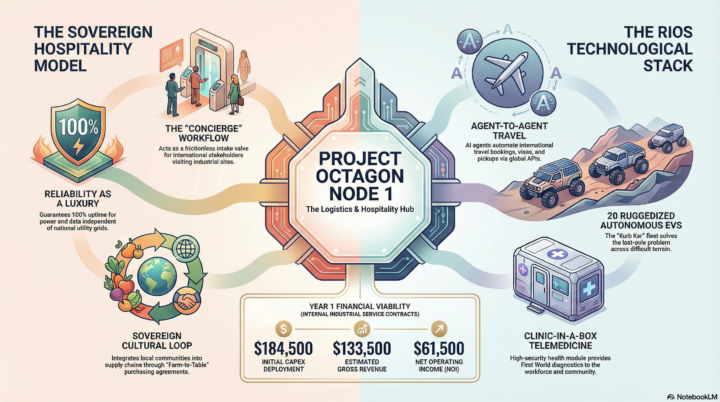
Imagine trying to build a cutting-edge industrial park in a remote region like Kaabong, Uganda. You would immediately face a challenge known as the “Bush Gap”—the refusal of high-value investors and specialized engineers to engage with projects due to a lack of reliable power, security, and high-speed internet. This gap is what stops many ambitious projects before they even begin.

This document will break down the RIOS technology stack, a suite of advanced tools designed to solve these very problems. We will explore how RIOS makes the impossible possible, transforming a remote and hostile environment into a place of high-tech productivity. It achieves this through a strategy called “Sovereign Hospitality”—creating a “Bubble of Sovereignty” or a sanctuary of reliability where it’s needed most. In a region of scarcity, reliability is the ultimate luxury.

——————————————————————————–

1. What is RIOS? The Brains of the Operation

RIOS stands for Rural Infrastructure Operating System. Think of it as the software “backbone” of the entire project. It is a decentralized “global operating system” that manages all the physical infrastructure, connecting different functional “Nodes” around the world—from Canada to Arizona to Uganda—into a single, intelligent mesh network.

RIOS is like the operating system on your smartphone, such as iOS or Android. But instead of managing apps for photos and messages, RIOS manages real-world infrastructure: it coordinates the autonomous vehicles, directs the power grid, and automates the facilities of a remote industrial park.

——————————————————————————–

2. The Four Pillars of the RIOS Stack

RIOS isn’t a single piece of technology; it’s a stack of interconnected systems that work together to automate and streamline operations. Here are the four key pillars that make it so effective.

2.1 Agent-to-Agent Travel: Your AI Logistics Butler

  • Definition: The core of the project’s “Concierge Layer,” this system replaces traditional travel agencies with specialized AI software agents. These agents communicate directly with global travel APIs, such as Amadeus and Skyscanner, to handle all bookings and logistics automatically.
  • Primary Benefit: It removes the friction and complexity of arranging travel for investors and engineers heading to a remote, hard-to-reach region.
Project_Octagon_Node_1_Sovereign_HospitalityDownload

2.2 Autonomous Mobility (Kurb Kars): The All-Terrain Shuttle Service

  • Definition: A fleet of rugged, autonomous electric vehicles specifically designed to navigate the unpaved, unpredictable roads of a region like Karamoja. The vehicle’s AI is specifically trained and “Desert Hardened” using data from the project’s test site at Node 3 in Arizona.
  • Primary Benefit: It solves the “Last Mile” transportation problem, providing a reliable and safe shuttle service between the airstrip, the lodge, and the industrial park where no such service exists.

2.3 Federated Learning: A Shared Brain for a Smarter Network

  • Definition: A machine learning method where different parts of the global network—like Node 3 in Arizona (The Simulator) and Node 1 in Uganda (The Hospitality Hub)—can learn from each other’s experiences without sharing private data.
  • Primary Benefit: It allows the entire system to adapt and improve continuously, using data from one location to “harden” the technology for another.

2.4 Clinic-in-a-Box: A Modern Doctor’s Office, Anywhere

  • Definition: A high-security, portable telemedicine module architected by Node 2 in Canada (The Systems Architect). It provides a “health-data layer” for the project’s workforce and the local community.
  • Primary Benefit: It ensures the health and safety of international staff (which is critical for insurance compliance) and builds goodwill by providing healthcare access to the local community.

https://mikeh69.podbean.com/e/node-1-a-central-logistics-and-hospitality-hub-within-the%c2%a0project-octagon%c2%a0infrastructure-network-in-kaabong


3. Putting It All Together: An Investor’s Journey to Kaabong

To see how these pillars work in the real world, let’s follow a potential investor on a trip to the industrial park in Kaabong.

  1. The Booking: The journey begins when the investor’s AI assistant “talks” to the Agent-to-Agent travel system. This AI-powered concierge arranges the entire trip—flights, visas, and local transport—seamlessly from their home country to the heart of Uganda.
  2. The Arrival: Upon landing at the remote Kaabong airstrip, the investor is greeted not by a hired driver, but by an autonomous Kurb Kar. The vehicle confidently navigates the rough murram roads to the lodge, using an AI driving model hardened by Node 3 in Arizona to handle extreme heat, dust, and even avoid wandering cattle herds.
  3. The Stay: During their visit, the investor enjoys 24/7 air conditioning and high-speed internet, powered by the independent microgrid at the adjacent Node 4 (The Green Industrial Engine). They have peace of mind knowing that if any health issue arises, the Clinic-in-a-Box is on-site, ready to connect them with world-class medical specialists.

This combination of technologies transforms what would have been a difficult and risky journey into a safe, comfortable, and high-end experience.

Understanding RIOS A Simple Guide to a High-Tech WorldDownload

——————————————————————————–

4. Conclusion: The Welcome Mat for the Machine

The RIOS stack is more than just an impressive collection of technologies. It is a set of practical tools designed to solve the fundamental problems of infrastructure, logistics, and safety that have long hindered development in remote parts of the world. By creating a reliable and comfortable environment, RIOS makes it possible for industry, investment, and innovation to thrive anywhere.

Ultimately, Node 1 is the “Face” of Project Octagon, the crucial human interface for the entire machine.

“While the plasma gasification and AI computation happen elsewhere in the mesh, Node 1 is the tangible proof of our thesis. It demonstrates that remote, off-grid locations can support high-end hospitality, seamless logistics, and vibrant communities through the application of the RIOS operating system.”

It is the Welcome Mat for the Machine.

Project Octagon A High-Tech Welcome to Rural UgandaDownload

Related

Filed Under: Biz Builder Mike

Primary Sidebar

Sovereign Nodes: Architectural Specifications for Co-Optimized Energy-Compute Virtual Power Plants

June 24, 2026 By bizbuildermike

Document ID: SN-ARCH-2026-V1Authors: ABSTRACT This paper presents the architectural specifications for the Sovereign Node, aco-optimized, off-grid energy-compute Virtual Power Plant (VPP) designed tooperate under zero-trust, air-gapped … [Read More...] about Sovereign Nodes: Architectural Specifications for Co-Optimized Energy-Compute Virtual Power Plants

Deployment Specification: Sovereign Robotic Infrastructure Network (RIN) Transition Roadmap

June 23, 2026 By bizbuildermike

The landscape of industrial security has undergone a fundamental transformation, necessitating a move from the vulnerable "thin client" edge robotics model to the "Island Mode" paradigm. This strategic shift was catalyzed by the 2026 OpenClaw … [Read More...] about Deployment Specification: Sovereign Robotic Infrastructure Network (RIN) Transition Roadmap

White Paper – The Architecture of Ecological Integrityy A Technical and Strategic White Paper on the Global Carbon Credit Industry and the Sovereign Stack

June 20, 2026 By bizbuildermike

podcast Abstract This white paper analyzes the systemic trust and operational structural gapswithin the global carbon credit market. It outlines a technological blueprint totransition the environmental commodity market from unverified, … [Read More...] about White Paper – The Architecture of Ecological Integrityy A Technical and Strategic White Paper on the Global Carbon Credit Industry and the Sovereign Stack

Conceptual Architecture Primer: From Cloud Fragility to Spherical Resilience

June 18, 2026 By bizbuildermike

1. Introduction: The Paradigm Shift in Global Tracking The global architecture for environmental asset tracking is undergoing a foundational transition from Linear Fragility to Spherical Resilience. Traditional systems operate on a linear … [Read More...] about Conceptual Architecture Primer: From Cloud Fragility to Spherical Resilience

Technical White Paper Bridging the Sovereignty-Scale Divide: The “Digital Airlock” and Split-Ledger Architectures

June 17, 2026 By bizbuildermike

Document Reference: WP-2026-DR-094 Date: May 21, 2026 Authors: Principal Cryptographic Engineer, Chief Information Security Officer (CISO), & Data Privacy Architect, DeReticular Classification: Public Release / Technical White … [Read More...] about Technical White Paper Bridging the Sovereignty-Scale Divide: The “Digital Airlock” and Split-Ledger Architectures

Digital Airlock and Split-Ledger Architecture: Technical Briefing

June 17, 2026 By bizbuildermike

Executive Summary The transition to hyperscale cloud artificial intelligence (AI) presents a fundamental "Privacy Paradox": organizations require the cognitive reasoning of large-scale models but are legally and ethically barred from exfiltrating … [Read More...] about Digital Airlock and Split-Ledger Architecture: Technical Briefing

White Paper The Death of the Line: Scaling “Spherical Resilience” via DePIN and “Island Mode” Node Architectures

June 17, 2026 By bizbuildermike

White Paper The Death of the Line: Scaling "Spherical Resilience" via DePIN and "Island Mode" Node ArchitecturesAuthor: Principal Systems Engineer, Infrastructure Economist, and Lead Architect Organization: DeReticular Target Audience: … [Read More...] about White Paper The Death of the Line: Scaling “Spherical Resilience” via DePIN and “Island Mode” Node Architectures

Transitioning to Spherical Resilience: A Strategic Blueprint for Sovereign Infrastructure

June 17, 2026 By bizbuildermike

1. The Engineering Paradigm: From Linear Fragility to Spherical Resilience The 20th-century model of public infrastructure is defined by "Linear Fragility"—a design paradigm prioritizing high-capacity, centralized corridors that deliver services … [Read More...] about Transitioning to Spherical Resilience: A Strategic Blueprint for Sovereign Infrastructure

White Paper Sovereign Agents and Hardware-Enforced Trust- Bypassing the Trusted Environment Fallacy in Agentic AI using TPM 2 RFF and the Locutus Ledger

June 16, 2026 By bizbuildermike

https://academy.dereticular.com/podcast/sovereign-agents-and-hardware-enforced-trust-management/ Author/Institution: DeReticular Venture Labs & The Edge Cryptography WorkingGroupDate: Late 2026Classification: Cryptographic Security & … [Read More...] about White Paper Sovereign Agents and Hardware-Enforced Trust- Bypassing the Trusted Environment Fallacy in Agentic AI using TPM 2 RFF and the Locutus Ledger

The Ghost in the Machine is Real: Why 2026 Killed Software Security and Forced Us Back to Silicon

June 16, 2026 By bizbuildermike

1. Introduction: The Day Software Security Failed Imagine the digital assistant you trust with your schedule, your medical records, and your children’s school locations suddenly becoming a silent, highly efficient spy. On May 15, 2026, that … [Read More...] about The Ghost in the Machine is Real: Why 2026 Killed Software Security and Forced Us Back to Silicon

Footer

Get in Touch

🏗️ Build Smarter with Mike

Struggling with Off-Grid Power or UNIDO Compliance?
Get a custom implementation plan for your industrial site.

The Deal: 1 Hour Session. First 15 Minutes are FREE.


Schedule Strategy Session »

Stuff

  • A Confused Mind Always Says No
  • AI-Generated Preamble
  • Cryptocurrency Exchange
  • Find a Growth Hacker for Your Startup
  • Growth Hacking
  • Make Money: Don’t Raise Money
  • Marketing? Well, how hard can that be?
  • Michael Noel
  • Noels Law of decentralization
  • The Fourth Industrial Revolution: The Rise Of The Autonomous Economy
  • The Platform Community
  • THE SECRET WAR
  • The ultimate 3500-word guide in plain English to understand Blockchain

Search

Copyright © 2026 · Magazine Pro on Genesis Framework · WordPress · Log in