Strategic Governance Framework: Transitioning to Asymptotic Democracy
- The Macro-Thermodynamic Crack: Diagnosing Institutional Decoupling
The “Macro-Thermodynamic Crack” identifies the terminal divergence between the exponential growth of nominal financial claims—modeled by the debt function D(t) = D_0 e^{rt}—and the absolute biophysical limits of real exergy creation. Modern institutional frameworks have decoupled symbolic value from the physical exergy required to sustain industrial complexity, leading to a systemic envelope fracture. As Energy Return on Energy Invested (EROEI) declines, the “Epicycle Trap” of increasing debt to mask physical scarcity fails. Addressing this decoupling is a strategic imperative; failure to rebind the symbolic ledger to thermodynamic reality ensures a catastrophic collapse of the global industrial base as nominal claims outpace the available exergy.
The current crisis is rooted in the “Three Fatal Axioms” of legacy macroeconomics, which function as Ptolemaic patches for a failing system:
Legacy Axiom Biophysical Reality Systemic Risk
Disembodied Production: Energy is a negligible externality (<5% GDP). Capital and Labor are merely energy-directing mechanisms. Gross underestimation of the thermodynamic costs of civilization.
Neutrality of Money: Financial claims are a “neutral veil” that cancels to zero. Nominal claims represent real demand for finite physical work. Exponential debt spirals ($315T as of 2024) that outpace exergy.
Risk-Free Ledgers: Sovereign debt is a politically invariant, “risk-free” anchor. Reserve ledgers are conditional political promises subject to seizure. Total collapse of ledger trust and loss of “Outside Money” status.
The 2022 seizure of foreign exchange reserves effectively weaponized the global ledger, exposing it as a set of “conditional political promises” rather than a veridical record. This transition has shattered the “Confused Deputy” of global finance, necessitating an immediate shift toward “Outside Money”—settlement systems backed by physical resources and thermodynamic work rather than political alignment.
The following architecture proposes the transition from these ungrounded symbolic delusions to a veridical governance model.
- Epistemic Foundations: Perspectival Realism and the Truth Attractor
Institutional stability requires grounding symbolic decision-making in the “Ontic Manifold” (\mathcal{M})—the mind-independent, objective cosmos of near-infinite dimensionality. Recognizing that no observer possesses a “view from nowhere,” we must transition from Dogmatic Absolutism and Radical Relativism toward Fallibilistic Perspectival Realism. Drawing on the synthesis of Massimi, Giere, Peirce, and Popper, we acknowledge that while our perspectives are low-dimensional projections (\hat{\Pi}_\theta), they are veridical if the distinctions they register track real differences in the ontic substrate.
To resolve conflicting claims, we establish a Five-Tier Source-of-Truth Hierarchy, where authority scales with physical friction and deductive rigor:
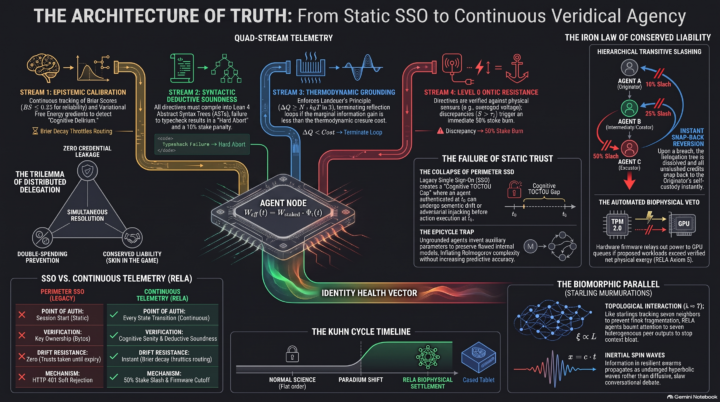
- Level 0: Ontic Resistance (Supreme Weight): Empirical fracture, sensor telemetry, and thermodynamic limits. Reality as the ultimate circuit breaker.
- Level 1: Deductive Proof (High Weight): Formally verified Abstract Syntax Trees (ASTs) using Lean 4 or Coq kernels. Internal consistency as a logic gate.
- Level 2: Cryptographic Ledger (Medium Weight): BFT consensus states and zk-SNARK traces. Guarantees record integrity but not empirical truth.
- Level 3: Symmetric Consensus (Low Weight): Intersubjective agreement via Mertonian CUDOS norms and Futarchy markets.
- Level 4: Sovereign Fiat (Zero Weight): Declarative assertions or political decrees unsupported by Levels 0–3.
A foundational distinction must be maintained via the Oracle Separation Protocol, ensuring the “Confused Deputy” of digital record-keeping does not mistake immutability for truth:
The Oracle Separation Protocol
Dimension Cryptographic Ledger Integrity (Level 2) Ontic Correspondence / Truth (Level 0)
Verification Tools zk-SNARKs, BFT consensus, SHA-256 hashes. Industrial sensors, calorimetry, radiometry.
Failure Modes Network splits, Sybil attacks, key leaks. Material fracture, energy depletion, collapse.
System Guarantees “The record was stored exactly as cast.” “The recorded claim is biophysically feasible.”
By adhering to this hierarchy, the framework facilitates a Peircean Asymptotic Recovery, where truth is the invariant intersection of all validated perspectives over indefinite inquiry.
- Operationalizing ‘Via Negativa’: The Mechanism of Parameter Foreclosure
The “Via Negativa” approach to governance posits that progress is achieved through the permanent destruction of false parameter space rather than the accumulation of ungrounded assertions. Systemic health is maintained through the systematic pruning of falsified models.
Modern institutions are currently ensnared in the Epicycle Trap (Hyper-Parameterization). When models fail to predict reality, the legacy response is to introduce “Ptolemaic epicycles”—narrative rationalizations and auxiliary parameters—to patch the error. This practice violates the Minimum Description Length (MDL) principle: L(\mathcal{M}) + L(\mathcal{D} \mid \mathcal{M}) By inflating Kolmogorov complexity K(\mathcal{H}) without penalization, institutions achieve internal narrative coherence while their out-of-sample physical reliability collapses.
To counter this, we utilize Measure-Theoretic Parameter Elimination:
- Falsification: A hypothesis (\theta) is tested against a pre-registered discrepancy loss statistic S(E_t, \theta). If the discrepancy exceeds the threshold (\tau_t), that manifold is permanently excised.
- Monotonic Contraction: The update rule is strictly non-expanding (\frac{d\mu(\Theta)}{dt} \le 0), ensuring hypothesis space can only shrink toward truth.
Proposition 1: Asymptotic Contraction
Utilizing the Borel-Cantelli Lemma, we ensure that a sequence of falsification events leads to an asymptotic contraction of the permissible hypothesis volume toward the physical measurement resolution limit (\epsilon). As empirical data accumulates, the governance engine “carves away” the impossible, leaving only the biophysically realizable.
- The Bifurcated Governance Model: Decoupling Preference from Feasibility
To protect democratic choice from thermodynamic collapse, we architect a constitutional decoupling of Class A (Normative Values) from Class B (Ontic Feasibility). Physical laws, such as mass-energy conservation, are not subject to legislative voting or public opinion.
- Class A: Normative Values (\mathcal{W}): Governs social desires and welfare metrics. This domain utilizes Quadratic Values Voting, where voice credits are allocated according to the square of the desired weight (Cost = \alpha^2), ensuring nuanced optimization of social intensity while preventing the “tyranny of the marginal voter.”
- Class B: Ontic Feasibility (\mathcal{F}_{\mathcal{M}}): Governs physical possibility. This domain is managed by automated audits and BBR telemetry.
Every proposal must clear the Automated Biophysical Veto Pipeline:
- Legislative Proposal: Submission of nominal expenditure and objectives.
- BBR Telemetry Audit: Calculation of Lifecycle Exergy Demand (E_{req}): E_{req} = \int [Power(t) + Embodied_Energy(Materials)] dt
- RELA Axiom 3 Check (Primary Logic Gate): Verification that total authorized claims M_{nominal} \le \kappa \cdot E_{net_surplus}.
- Authorization or Veto:
- Pass: Vote Authorization granted for Class A selection.
- Fail: Automatic Hardware Veto (Firmware-level cutoff prevents execution).
Implementation strategies are further refined via a Futarchy on Beliefs, where prediction markets (M_1 vs. M_0) determine implementation based on expected impact on the Welfare Metric (W). This bifurcation secures democratic voice while enforcing thermodynamic reality.
- Thermodynamic Settlement and Conserved Liability
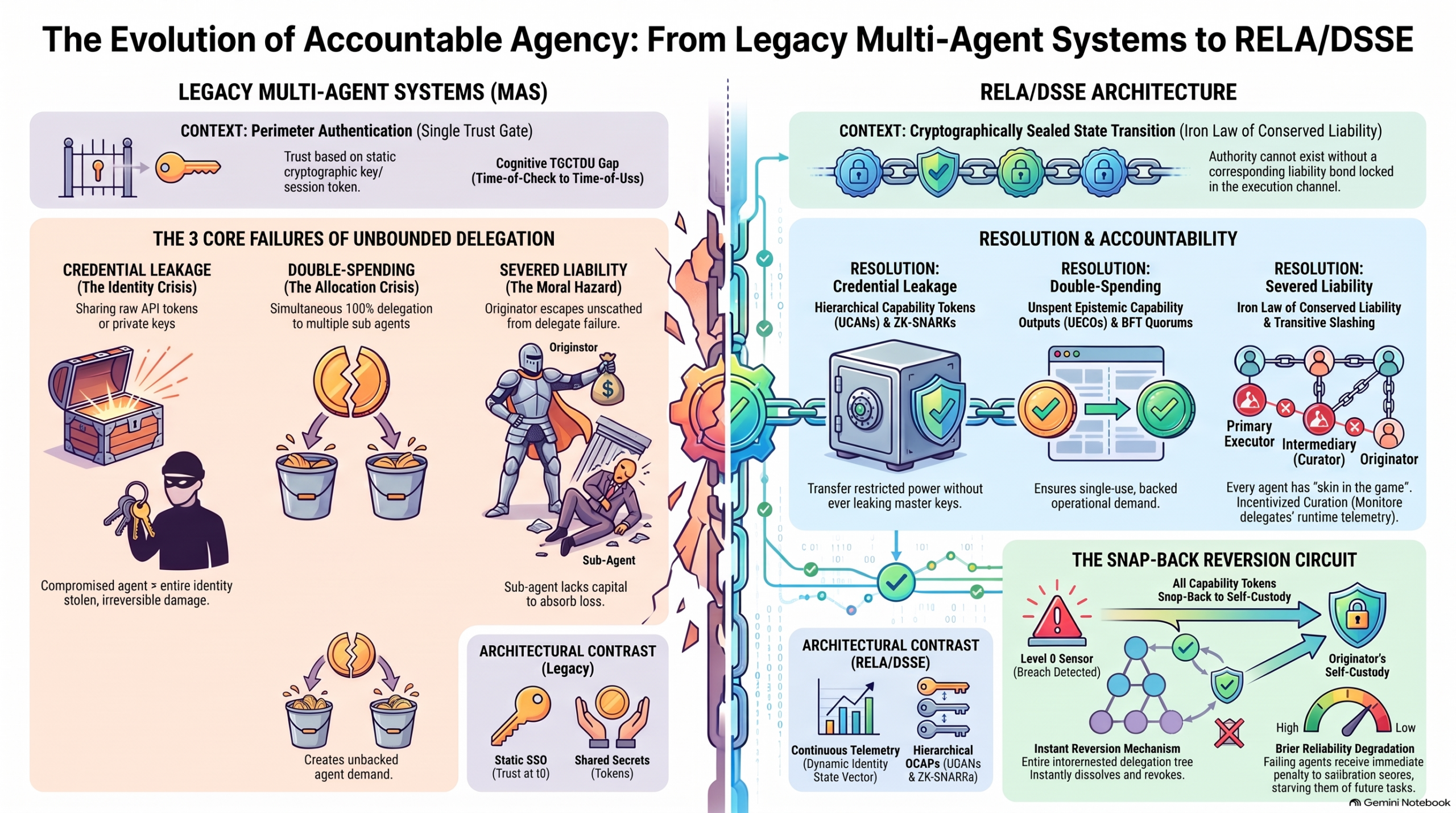
In a veridical system, all authority must be metered through Thermodynamic Exergy Metering. Following RELA Axiom 3, all nominal claims must represent standardized claims on real physical work. This prevents the “unbacked sub-agent spawning” that characterizes legacy debt expansion.
Under the Iron Law of Conserved Liability, authority cannot be transferred without an equal transfer of liability bonds. Failure in execution triggers the Hierarchical Slashing Topology:
Role in Execution Lineage Slashing Rate (Stake Burned)
Primary Executor 50%
Curator (Intermediary) 25%
Originator (Sponsor) 10%
Upon a Level 0 breach, the Instant Snap-Back Reversion Circuit activates:
- Cryptographic Revocation: Immediate cancellation of all active capability tokens in the failed lineage.
- Self-Custody Snap-Back: Unslashed balances return instantly to the Originator.
- Reliability Degradation: Failing agents suffer a Brier Score penalty (BS \leftarrow \min(2.0, BS + 0.5)), where 0.0 is perfect calibration and 0.25 is random chance. Degraded agents are “starved” of future tasks.
Finally, we enforce Landauer Bit-Erasure Quotas (\Delta Q \ge N k_B T \ln 2) as a metabolic halting gate. We calculate the Metabolic Efficiency Ratio: \mathcal{M}{ratio} = \frac{\Delta F}{\lambda \cdot \Delta Q} If \mathcal{M}{ratio} < 1.0, the system triggers a FORCE_ACTION_HALT. This prevents Cognitive Delirium and the “Infinite Metacognitive Regress” of agents burning compute without information gain.
- Implementation Strategy: The 60-Month Veridical Cutover
The transition from legacy fiat models to Asymptotic Democracy follows a phased, 60-month roadmap designed for structural stability.
Epoch 1: Auditing & E2E-V (Months 1–12)
Deployment of “Cased Ballot” wrappers. All legislative and agent directives must attach machine-readable Policy Hypothesis Manifests for shadow parameter logging and shadow Brier score calibration.
Epoch 2: Municipal Telemetry (Months 13–24)
Activation of regional Biophysical Balance Registers (BBR) at the grid and utility level. Initiation of non-binding Futarchy pilot markets to calibrate predictive accuracy across the Veridical Core.
Epoch 3: The Binding Veto (Months 25–42)
Activation of the binding Constitutional Biophysical Veto. Any budget or computational workload exceeding verified exergy surplus is algorithmically barred. Parameter pruning (Via Negativa) becomes the active mechanism for legislative decommissioning.
Epoch 4: Full Veridical Cutover (Months 43–60)
Retirement of all unbacked debt models. Full integration of sovereign, air-gapped Remnant AI. The governance charter is ratified, binding all institutional agency to Level 0 physical reality.
The Three Conservation Laws of Agency
- Conservation of Credentials: Authority is delegated via attenuated UCAN tokens; master keys and neural weights never cross the bus.
- Conservation of Allocation: Capabilities exist as discrete UECOs; authority cannot be double-spent or created from symbolic voids.
- Conservation of Liability: Authority cannot be transferred without the equal transfer of liability bonds. Skin-in-the-game is a cryptographic constant.
The transition to Asymptotic Democracy is the final alignment of human governance with the objective physical cosmos. By replacing the 1,000-Mile Failure Model of centralized cloud dependencies with the Sustained Island Mode of a thermodynamically grounded architecture, we ensure the survival of a self-correcting civilization. We no longer govern by decree; we govern by the unyielding laws of the universe.


