Civilization-in-a-Box: Why Operation Octagon Signals the End of Cloud-Serfdom
Our modern existence is defined by “Linear Fragility.” We live at the mercy of the fiber-optic leash—vulnerable substations, long supply lines, and centralized cloud monopolies that fail the moment a cable is severed or a remote server farm loses power. We have traded our fundamental agency for the convenience of the grid, leaving our most vital systems—energy, healthcare, and logistics—dependent on infrastructure we do not own and cannot control. This is cloud-serfdom: a state where your right to function is a permission granted by a distant data center.
The antidote is Sovereign Infrastructure. This is the shift from centralized dependencies to offline-first, AI-driven ecosystems designed to operate in “Island Mode.” DeReticular is architecting this transition through the Operation Octagon 2.0 blueprint, a methodology for deploying self-sustaining, closed-loop networks capable of bootstrapping a functional society in zero-infrastructure environments.
By leveraging the OpenClaw software engine and the Trinity Stack (pfSense, Ledger, Kali), Operation Octagon transforms hardware into a resilient “Mesh Society.” Whether dropped into a sun-baked desert or a remote agricultural hub, these units represent a radical CAPEX-over-OPEX shift that returns power to the edge. Here is how we are building civilization in a box.
1. Identity Genesis: The Ceremony of Cryptographic Amnesia
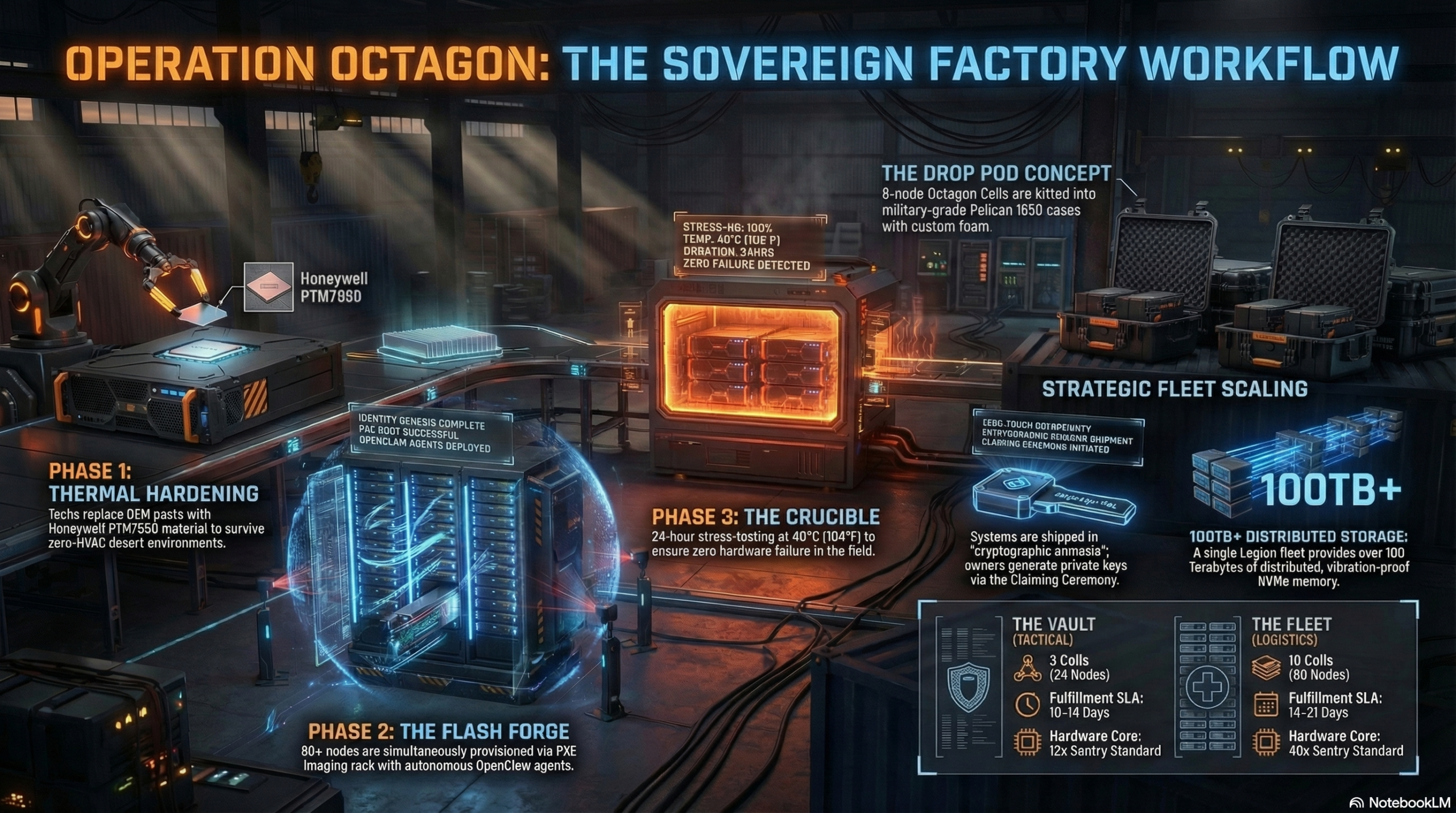
In the legacy SaaS model, the manufacturer is the ultimate landlord. They retain administrative backdoors and own the metadata of your life. Operation Octagon terminates this relationship through a manufacturing protocol known as “Cryptographic Amnesia.” During provisioning at the “Node 3” facility, the administrative SSH keys and root passwords for every node are randomized and destroyed immediately post-flash.
The network is shipped in a state of administrative silence. Sovereignty is only established on-site during the “Claiming Ceremony.” The end-user inserts four factory-blank Sovereign Keys (YubiKey 5C NFC) to initiate the Identity Genesis protocol. Private keys are generated within the hardware’s secure enclave and never leave it. At that moment, the manufacturer is mathematically locked out forever.
“Passwords are mathematically forbidden on this network. DeReticular retains zero administrative access. Trust the Code.”
2. The Crucible: Hardening Hardware for a Zero-HVAC Reality
Traditional data centers are fragile, air-conditioned cathedrals. Sovereign tech must survive the “Crucible”—the unconditioned reality of agricultural fields and sun-baked plains. To meet the “Thermal Mandate,” every Sovereign Sentry (RIOS-SS-STD and RIOS-SS-PRO) unit undergoes a radical physical modification.
Technicians open each fanless chassis, strip the standard OEM thermal paste, and apply Honeywell PTM7950 Phase Change Material to the CPU dies. This allows the nodes to maintain peak performance at ambient temperatures of 40°C (104°F) without the need for active HVAC. Before dispatch, every unit must survive a 24-hour burn-in with the following failure criteria:
- Thermal Throttling: Any drop below the base clock speed.
- Network Instability: Any packet drops during iperf3 testing.
- Heat Threshold: Any unit exceeding an 85°C core temperature.
3. The Digital Janitor: Localized LLMs as a Network Immune System
Infrastructure at the edge cannot rely on a team of human sysadmins. In an Octagon Cell, this role is handled by Node 2 (The Watchtower). Utilizing the Sovereign Sentry Pro (RIOS-SS-PRO) with an Intel i3-N305 processor and 32GB of RAM, this node runs the DevOps Sovereign (SOV-AUTO-DEV) agent powered by a local, air-gapped Llama-3 model.
Node 2 acts as the “Digital Janitor.” It continuously ingests system logs from all other nodes via the mesh. If the database in the Healthcare node (Node 6) crashes, the Watchtower uses vector-search to identify the anomaly and issues a self-healing restart command. It performs air-gapped code reviews and firewall management, ensuring the mesh survives without ever “calling home” to the global internet.
“The Watchtower serves as the network immune system, a Digital Janitor that ensures the mesh survives without human sysadmins.”
4. The Energy-Healthcare Handshake: Synergy in Closed-Loop Logic
The true power of Operation Octagon lies in “Event-Driven” synergy, where deterministic resource allocation replaces municipal bureaucracy. This is best illustrated by the “Emergency Medical Scenario” found in the 2.0 blueprint:
- The Event: Node 6 (The Sanctuary) admits a patient requiring emergency surgery and refrigerated plasma.
- The Logistics Handshake: The Sanctuary pings Node 5 (The Nomad Fleet), which dispatches an autonomous Kurb Kar—equipped with a Nomad Fleet Kit (RIOS-KIT-MOB)—to retrieve plasma from the vault.
- The Energy Shift: Node 3 (The Plasma Forge) detects the surgical load. Running the Industrial Foreman (SOV-AUTO-GRID) agent, it instantly diverts power away from non-critical systems like Node 7 (The Biosphere/Irrigation) to guarantee the surgical theater has absolute battery capacity.
This closed-loop logic is more efficient than legacy systems because it prioritizes survival over schedule, managing the microgrid with zero human intervention.
5. The Octagon Legion: Strategic-Tier Rollout of 10-Cell “Drop Pods”
Operation Octagon proves that “civilization” is now a kitted product with a predictable lead time. The Octagon Legion (SKU: FLEET-OCT-10) represents the strategic tier of this rollout. It consists of 80 nodes packed into ten military-grade Pelican 1650 “Drop Pods.”
The capital efficiency is a direct challenge to the old world. For a total CAPEX of $115,920.00, an organization can deploy ten independent “micro-cities” capable of managing their own power, security, and medical records. While traditional fiber and concrete infrastructure projects take years of planning and permitting, an Octagon Legion can be dispatched and brought online within a 14-21 day lead time. It is a strategic-tier solution for decentralized states and global supply chains that cannot wait for the grid to catch up.
Conclusion: Beyond the Grid
The success of Operation Octagon 2.0 signals a transition into a post-cloud era. By integrating energy management, healthcare, and logistics into a localized mesh, we are building a society that does not ask for permission to exist. We are moving away from the “linear” world of fragile dependencies and toward a “circular” world of sovereign resilience.
As we move toward an era of increasing global instability, the question for every leader and community remains: Are you truly sovereign if your life relies on a cloud login? The nodes are ready. The code is written. The choice to decouple is yours.
Trust the Code. Build the Nodes.


