Conceptual Architecture Primer: From Cloud Fragility to Spherical Resilience
1. Introduction: The Paradigm Shift in Global Tracking
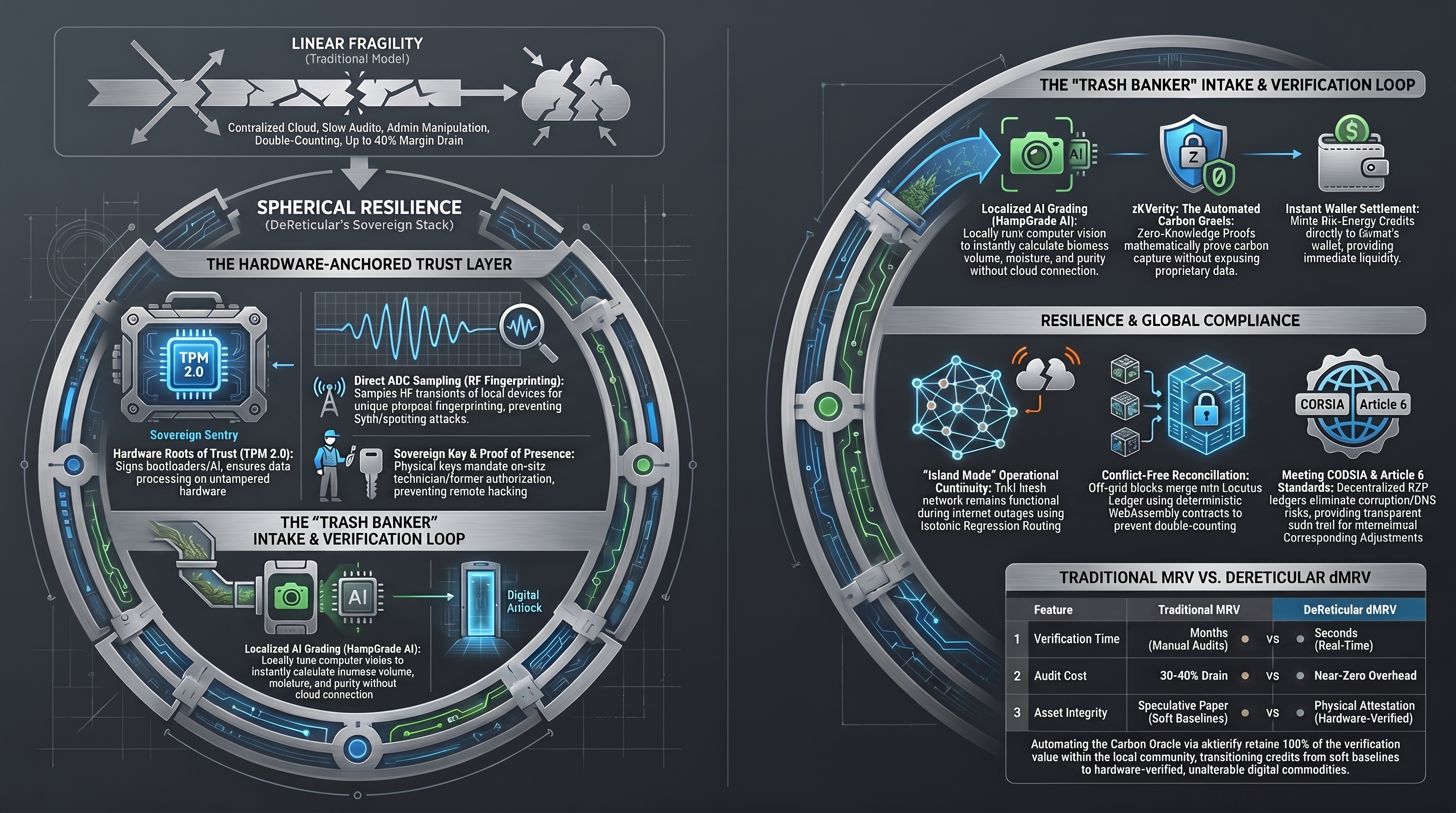
The global architecture for environmental asset tracking is undergoing a foundational transition from Linear Fragility to Spherical Resilience. Traditional systems operate on a linear dependency: data is collected at a local site and forced through a series of centralized intermediaries—registries, auditors, and cloud providers—before it is “validated.” This model is fundamentally ill-suited for rural environmental tracking, where inconsistent internet connectivity and centralized failure points create systemic risk.
video
Spherical Resilience, by contrast, creates a self-contained, sovereign environment where verification happens at the point of origin. By replacing cloud-dependent registries with hardware-secured, peer-to-peer (P2P) systems, we move from a model of “trusting administrators” to “trusting physics and mathematics.”
Architectural Comparison: Linear vs. Spherical
| Feature | Linear / Cloud Architecture | Spherical / Sovereign Architecture |
| Connectivity | Requires constant internet (Cloud-dependent). | Operates entirely offline (Island Mode). |
| Trust Model | Trust in central administrators and web domains. | Trust in hardware-locked cryptography (TPM 2.0). |
| Registry Sovereignty | Centralized Cloud Database (Vulnerable). | Locutus Ledger (P2P). |
| Verification | Retrospective, manual human audits. | Real-time, hardware-anchored dMRV. |
| Security | Vulnerable to DNS hijacking and database deletion. | Physically un-spoofable via Direct ADC Sampling. |
This theoretical shift is a response to the catastrophic failure vectors inherent in centralized systems, where the “Cloud Wall” often prevents data integrity from reaching global markets.
2. The Cloud Wall: Understanding Linear Fragility
Centralized registries built on commercial cloud platforms create a “Cloud Wall” that isolates local projects. There are four specific vectors of failure that jeopardize the integrity of environmental data:
- DNS Poisoning / Hijacking: Malicious actors reroute web traffic to spoofed registries, creating fraudulent transaction logs or unauthorized credit retirements.
- Administrative Leakage: Corrupt or negligent operators within a central organization can retroactively alter database entries, enabling the double-minting of assets or the manipulation of baselines.
- Database Deletion: Technical errors, targeted cyber-attacks, or service provider outages can permanently wipe years of historical carbon transaction data.
- Geopolitical Blocs: Regulatory bans or state-level internet blackouts can instantly sever a project’s connection to international markets, rendering local assets illiquid.
[!WARNING] The Zero-Token-Tolerance Mandate International compliance frameworks, specifically CORSIA (aviation offsetting) and Article 6.4 of the Paris Agreement, maintain a zero-tolerance mandate for double-counting. If a single carbon unit is claimed by more than one entity, the environmental integrity of the market collapses, triggering severe regulatory penalties and litigation.
To overcome these vulnerabilities, the Sovereign Stack replaces administrative trust with a multi-layered architecture of “Mind, Muscle, and Motion.”
3. The Sovereign Stack: Anatomy of Spherical Resilience
The Sovereign Stack deconstructs traditional computing into four layers of Hard Physical Attestation. This is not merely a software update; it is an architectural commitment to hardware-anchored truth.
The Four Layers of the Stack
- Application Layer (RIOS): The “Mind” of the system. The Rural Infrastructure Operating System runs the OpenClaw Framework, a multi-agent execution engine that manages localized AI agents like HempGrade AI and the Industrial Foreman.
- Cryptographic/Ledger Layer: Utilizes the Locutus Ledger (built on Freenet/Hyphanet). Here, the “keys” are WebAssembly (Wasm) Contracts that mathematically reject any state transition (transfer or retirement) that violates the protocol’s strict rules.
- Networking Layer: A localized TriFi Mesh that routes data via radio and P2P protocols when the macro-internet is dark.
- Hardware Layer: The physical foundation. The Sovereign Sentry Pro utilizes the Rockchip RK3588 SoC with an integrated 6 TOPS NPU and 32GB of LPDDR4x RAM—a memory footprint specifically required to run quantized 8-billion parameter models (like Llama 3) entirely in local memory.
The “So What?” of the Attestation Loop A software-only database can be manipulated by anyone with root access. The Sovereign Stack prevents this via the TPM 2.0 Attestation Loop. At boot, the TPM 2.0 measures and signs the BIOS, bootloader, and RIOS kernel state. If the software is modified or the chassis is breached, the hardware locks its cryptographic keys. This ensures the data is an indisputable physical truth, as the AI output is cryptographically bound to an unmodified system state.
Sovereign Stack Hardware Components
| Component | SKU | Role | Primary Function |
| Sovereign Sentry Pro | DR-SENTRY-PRO-CDR-INT | Stationary Core | 6 TOPS NPU; acts as the local registry gateway and PLC gatekeeper. |
| Sovereign Deck | DR-DECK-FIELD-MRV | Field Terminal | IP65 tablet; runs localized HempGrade AI for off-grid optical audits. |
| Sovereign Badge | DR-BADGE-IPLC-SEC | Presence Sensor | RF transponder; provides hardware-enforced “Proof of Presence.” |
This architecture allows for continuous operation in “Island Mode,” where the system maintains state without any connection to the global web.
4. Operating in the Dark: The Mechanics of “Island Mode”
When connectivity fails, the architecture shifts to Island Mode. The local network remains alive via the TriFi Mesh, which utilizes Isotonic Regression Routing. This algorithm optimizes data propagation across low-bandwidth, high-latency P2P radio connections, ensuring that the ledger stays consistent within the “Island.”
The 3-Step Conflict-Free Reconciliation
Upon reconnection to the global internet, the system resolves state without human intervention:
- Deterministic Merging: Offline transaction blocks are synced back to the global Locutus Ledger.
- State Resolution via Wasm: Wasm contracts integrate updates sequentially, resolving order conflicts using hardware timestamps verified by the TPM 2.0 internal clock.
- Double-Counting Prevention: The protocol mathematically rejects any token ID that was already moved or retired elsewhere, ensuring zero-token-tolerance compliance.
Direct ADC Sampling acts as the physical defense against Sybil Attacks. By sampling the raw electromagnetic transients of a radio wave—microscopic variations unique to a specific silicon chip’s capacitors—the Sentry identifies the “RF Fingerprint” of each device. This makes it physically impossible to spoof the network with virtual nodes or cloned chips.
5. Illumination in Practice: The Trash Banker and Project Umoja
At Project Umoja (Node 4) in Kaabong, Uganda, these architectures bridge the economic divide by turning “dead capital” into liquid assets. The deployment integrates the “Muscle” of Agra Dot Energy’s plasma gasification and the “Motion” of Kurb Kars’ autonomous logistics.
Key Features of the Sovereign Trash Banker
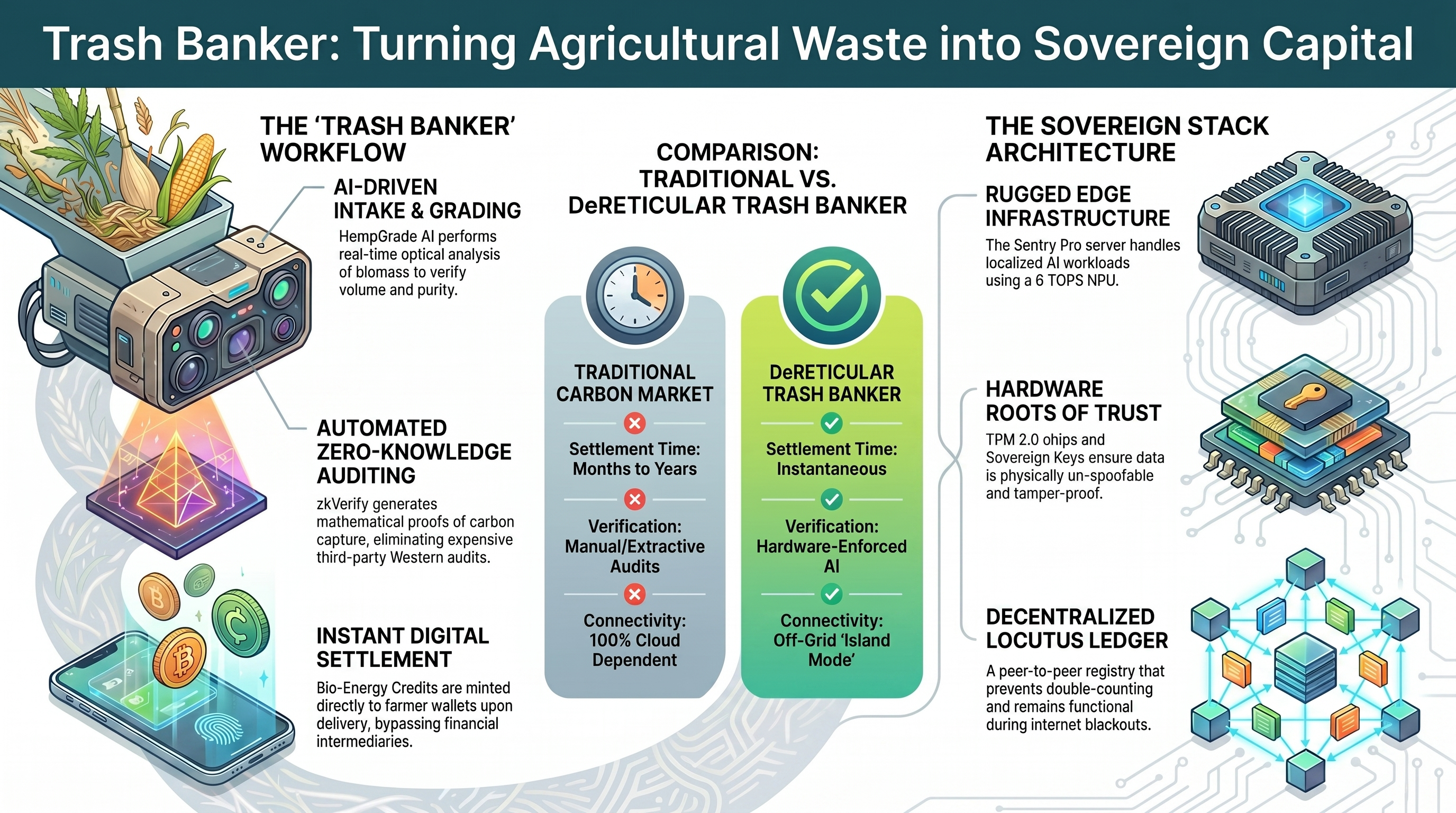
- Farmer Delivery: Smallholders bring agricultural waste (hemp stalks/residues) to the processing hub.
- Optical Scan & Grading: Using HempGrade AI on a Sovereign Deck, the system evaluates volume, moisture, and carbon content.
- Instant Settlement: Credits are minted directly to the farmer’s digital wallet, providing immediate liquidity for power, water, or fertilizer.
Comparison: Banking Models and Asset Value
| Feature | Traditional Banking (Exclusionary) | Sovereign Trash Banker (Inclusive) |
| Asset View | Biomass is “worthless rotting waste.” | Biomass is an instant digital asset. |
| Verification | High-cost manual audits by foreign firms. | Automated zkVerify hardware proofs. |
| Settlement | Months or years via intermediaries. | Instantaneous to local digital wallets. |
| Market Value | Legacy credits often trade at <$5/tonne. | Biochar CDR trades at 105–200/tonne. |
Technical Mechanics of the Intake Loop
- Industrial Foreman AI: Acts as the “Air-Gapped Executor.” It interfaces with machinery via Modbus RTU and CAN Bus, triggering physical diverter gates to reject contaminated or illegal feedstock.
- HempGrade AI: Performs real-time optical analysis on the Rockchip RK3588 NPU, classifying wood species and moisture levels to prevent kiln damage.
- Carbon Oracle (zkVerify): Generates Zero-Knowledge Proofs (ZKPs) that mathematically prove carbon sequestration without exposing proprietary engineering data, eliminating the need for Western auditors.
6. Summary: The Future of Global Tracking Integrity
The transition from cloud-dependent systems to the Sovereign Stack ensures that environmental tracking is a physical reality rather than a “paper promise.” By moving verification to the “Edge,” we eliminate the vulnerabilities of centralized registries and return economic agency to local communities.
Final Comparison: Traditional VCM vs. DeReticular-Enabled Ecosystems
| Dimension | Traditional VCM Projects | DeReticular-Enabled Ecosystems |
| Financial Settlement | Delayed (months/years) via brokers. | Instantaneous to local digital wallets. |
| Verification Auditing | High-cost manual audits; 30-40% margin loss. | Automated zkVerify hardware proofs at the edge. |
| Asset Class Definition | Volatile, speculative paper credits. | Bio-Energy Credits anchored to physical power. |
| Community Agency | Passive recipients of corporate aid. | Active owners of sovereign infrastructure. |
Moving environmental tracking to the “Edge” ensures that both ecological integrity and regional economic self-reliance are hard-coded into the very hardware of our global future. By anchoring data in the physical properties of silicon and the thermodynamic reality of carbon capture, we create a market that is not just efficient, but indisputable.


