Cutting the Umbilical Cord: Why the Future of Space is Sovereign, Not Tethered
Introduction: The “250,000-Mile Leash” Problem
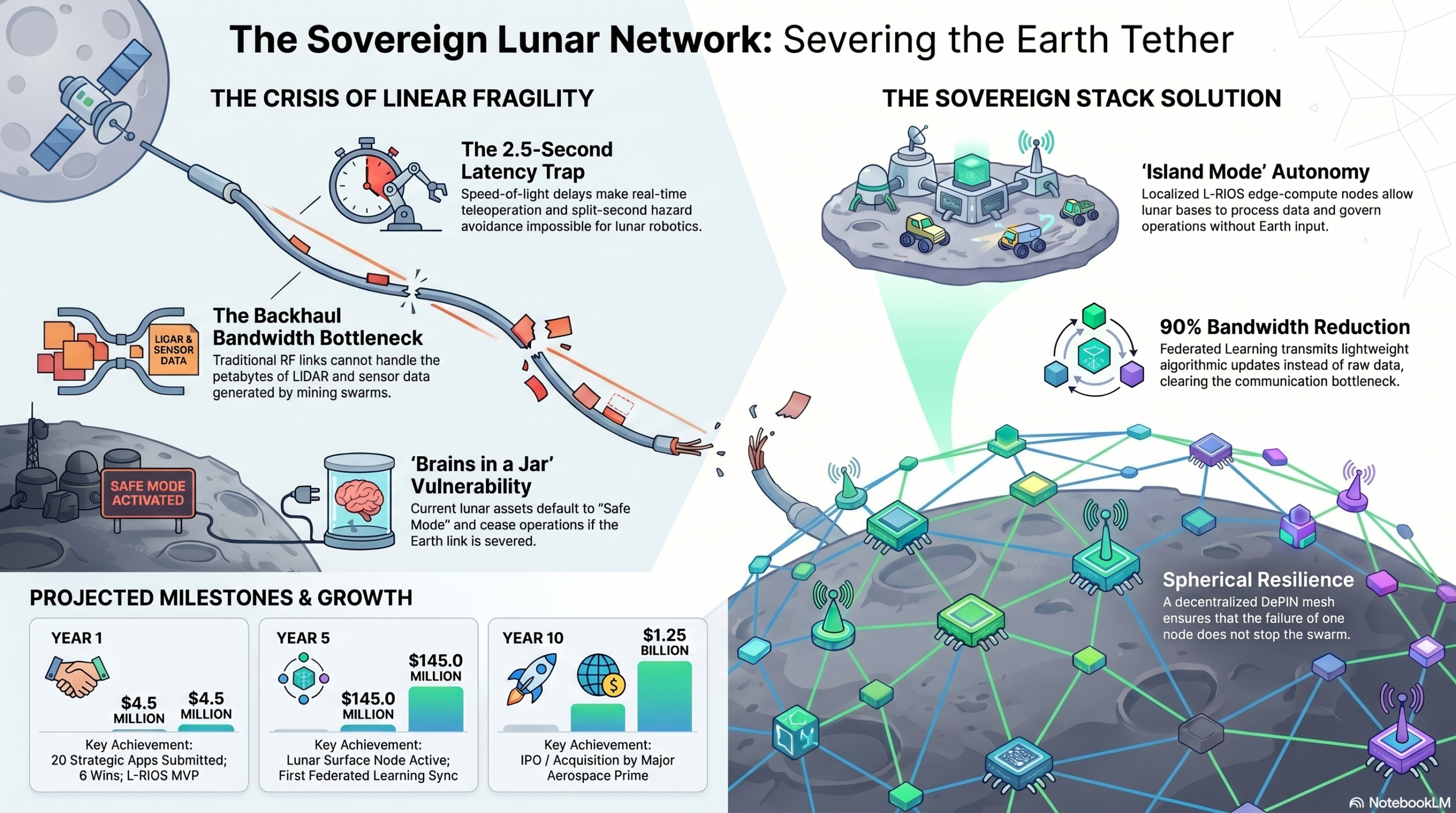
For decades, the standard paradigm for space exploration has effectively treated off-world assets as “brains in a jar.” Every rover, lander, and sensor on the lunar surface is tethered to Earth by an invisible, fragile umbilical cord of radio waves. This architecture suffers from what we at Sovereign Space Systems (S3) define as Linear Fragility—a state where a 2.5-second round-trip latency, a solar flare, or a scheduling conflict at the Deep Space Network (DSN) can paralyze a billion-dollar mission.

The DSN is an aging, oversubscribed bottleneck, a 20th-century relic forced to micromanage a 21st-century frontier. In this legacy model, if the connection to Earth breaks, the machines “die,” defaulting to a “safe mode” that halts industrial operations. But our architectural mandate is clear: to build a viable cislunar economy, the Moon cannot wait for Earth to think. We must achieve Computational Sovereignty, moving beyond the “leash” toward a model where infrastructure possesses its own localized logic and instinct.
——————————————————————————–
Takeaway 1: The Death of the “Line” and the Rise of the Mesh
The current state of lunar communications is undergoing a forced evolution away from traditional point-to-point links toward Spherical Resilience. Instead of relying on a single, vulnerable trunk line back to terrestrial supercomputers—an Asymmetrical Backhaul that cannot scale—we are deploying a DePIN (Decentralized Physical Infrastructure Network) model.
By deploying a self-healing hive of localized nodes, we replace fragile, centralized relays with a resilient mesh. This isn’t just about connectivity; it is about Disintermediation. We secure this mesh through “cryptographic physics,” utilizing Hardware Root of Trust, TPM chips, and RF Fingerprinting to ensure every node is verified and immune to spoofing or hostile takeover.
“The Line is dead. The Mesh is rising. Space is Sovereign.”
Takeaway 2: “Island Mode”—The Capability to Survive a Blackout
To support industrial-scale operations like mining water-ice in the Shackleton Crater, infrastructure must be capable of a Black Start. This is achieved through the L-RIOS (Lunar Infrastructure Operating System)—the space-spec evolution of our terrestrial RIOS—which enables Island Mode.
In Island Mode, a lunar base functions as a self-contained, sovereign entity. Environmentally hardened Lunar Data Centers—shielded within stable lava tubes—act as the “localized brain.” Even if Earth goes entirely dark due to an orbital occlusion or a terrestrial emergency, the L-RIOS ensures that autonomous swarms continue to coordinate, mine, and manage power independently. Earth becomes an asynchronous observer of the cislunar engine, rather than its bottleneck.
——————————————————————————–
Takeaway 3: Federated Learning—Solving the Petabyte Bottleneck
The most significant technical bottleneck in deep space is the data volume generated by autonomous swarms. A fleet of Kurb Crawlers (our autonomous mining rovers) generates petabytes of LiDAR and sensor data daily. Transmitting this raw telemetry through an oversubscribed RF pipe is a physical impossibility.
Our solution is Federated Learning. Instead of moving raw data to a central model on Earth, we move the model to the data on the lunar edge:
- Local Problem Solving: If a Kurb Crawler hits iron-rich regolith that causes its drill to overheat, its onboard GPU analyzes the thermal resistance locally.
- Algorithmic Updates: The rover develops an optimized drill-pulse rhythm and transmits only the resulting 45 KB algorithmic update.
- Swarm Sync: This tiny update is shared across the local mesh, instantly giving the entire fleet the “instinct” to handle the new material.
By transmitting intelligence rather than raw data, we reduce backhaul bandwidth requirements by 90–95%.
——————————————————————————–
Takeaway 4: The 30-Day Strategic “Carpet-Bombing” of the Market
The transition to this sovereign future is being driven by Sovereign Space Systems (S3), a high-velocity joint venture designed to dominate the lunar operating system market. We operate a “Grant Command Center” model to bypass the stagnation of traditional aerospace primes.
Our strategy involves a 30-day “Strategic Strike” to flood the NASA and DoD procurement pipelines with 20 targeted applications (SBIRs, Tipping Points, and PRISM payloads). This aggressive “carpet-bombing” is designed to secure sole-source status for the next decade. Our tiered revenue model scales from non-dilutive grant capital to a Sovereign Tax—collecting recurring licensing fees for Data Arbitrage and Swarm Coordination from every mining company utilizing the L-RIOS stack. We are targeting a $1.25 Billion annual revenue run-rate by Year 10, positioning S3 for a multi-billion dollar aerospace IPO.
——————————————————————————–
Takeaway 5: From Lunar Mining to Algorithmic Terraforming
The decentralized mesh we are building today—grounded in the success of the 2025 Nokia/IM-2 mission at Mons Mouton—is the foundational nervous system for future planetary engineering. We are engineering a Planetary IoT where the communication network itself acts as a sensory grid.
In this vision, the line between a “sensor” and a “communication device” blurs. Advanced 6G signals act as high-resolution spatial sensors, turning the network into a Planetary Nervous System that measures regolith density and atmospheric shifts in real-time. This enables Algorithmic Terraforming, where a “Computational Ecologist” server independently orchestrates fleets of bioreactors and gas processors to maintain planetary stability without waiting for a signal from Earth.
——————————————————————————–
Takeaway 6: “Operation Octagon”—The Terrestrial Proving Ground
This technology is not science fiction; it is being stress-tested today through Operation Octagon. By deploying the Sovereign Stack in Earth’s most extreme “rural” environments, we ensure survival in the vacuum:
- Node 3 (Arizona): Functions as our Digital Twin proving ground, hardening hardware against the extreme heat and abrasive dust that mirrors lunar conditions.
- Node 4 (Uganda): Validates our Agra Dot Energy modules, proving off-grid power generation and autonomous logistics in remote, disconnected terrain.
Testing Spherical Resilience on Earth is the only way to guarantee that when we deploy to the lunar South Pole, the system is ready to function without a tether.
——————————————————————————–
Conclusion: Achieving “Lunar Truth”
The end goal of decentralized edge-compute in space is the achievement of Lunar Truth—a state where off-world infrastructure is a self-contained, self-governing industrial engine. By cutting the umbilical cord, we allow the Moon to govern its own logic, power its own survival, and evolve its own intelligence.
As we establish these sovereign networks, we must ask the final strategic question: If the Moon can learn to govern its own logic and power its own survival, how long before Earth becomes the junior partner in the cislunar economy?


