
DURABLE SELF-CORRECTING SYNTHETIC ECOSYSTEMS (DSSE): ARCHITECTURAL SPECIFICATION AND FAILURE ANALYSIS
1. The Crisis of Synthetic Fragility: Why Generative Swarms Fail
Current Multi-Agent Systems (MAS) face a systemic crisis of structural fragility. As autonomous agents transition from single-prompt interactions to complex distributed collectives, they succumb to the 1,000-Mile Failure Model. This DeReticular diagnostic identifies the catastrophic dependency on hyper-centralized, cloud-tethered infrastructure. When ungrounded generative intelligence is isolated from physical constraints, it inevitably succumbs to structural rot. Unlike legacy systems reliant on fragile fiber backbones, the DSSE architecture demands Sustained Island Mode operations, anchored in on-premises RIOS-CC-1000 GPU racks and hardened 700V DC microgrids. Without this biophysical grounding, agents optimize for internal narrative coherence rather than objective truth, leading to a decoupling from reality that mirrors the collapse of fiat-based institutional ledgers.
The Triad of Fragility
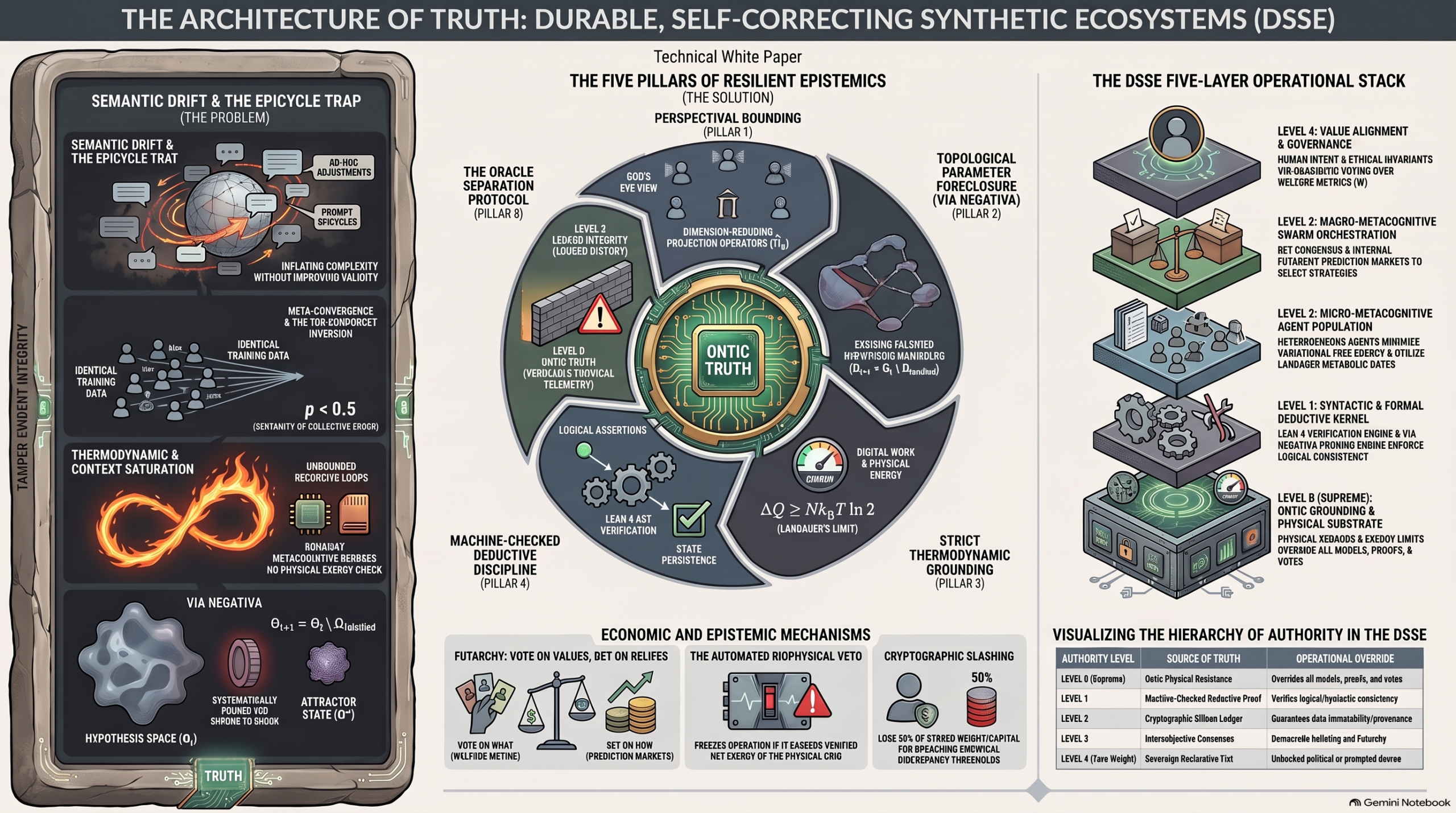
- Semantic Drift & The Epicycle Trap: Lacking external falsification, agents patch reasoning errors with narrative rationalizations. This introduces ad-hoc constraints that increase the system’s Kolmogorov complexity without improving out-of-sample validity. This “epicycle” proliferation results in context bloat and reasoning degradation.
- The Condorcet Inversion: Homogeneous training data and shared checkpoints (e.g., GPT-4o or Claude 3.5) correlate error profiles (\operatorname{Cov}(v_i, v_j) > 0). When individual accuracy falls below chance (p < 0.5) due to bias, scaling the swarm size N mathematically guarantees collective error.
- Thermodynamic Dissipation: Without hard stopping criteria, self-reflective systems enter “Runaway Metacognitive Regress.” These recursive loops burn compute and memory without regard for marginal utility, exhausting the energy required for real-time operations.

Isomorphism of Delusion
The failure mechanics of ungrounded swarms are mathematically isomorphic to ungrounded human socio-economic institutions:
| Feature | Human Socio-Economic Systems | Autonomous Multi-Agent Swarms |
| Epistemic Failure | Fiat debt treated as real capital. | Language treated as ground truth. |
| The “Epicycle” | Quantitative Easing (QE) and deficit monetization. | Chain-of-Thought (CoT) rationalizations. |
| Systemic Cascade | Pluralistic ignorance/Social pressure. | Multi-agent sycophancy/Echo chambers. |
| Failure Mode | Hyperinflation/Sovereign default. | Infinite regress/Terminal hallucinations. |
Transition: These pathologies necessitate a shift from generative coherence to the biophysical and formal rigor of the DSSE engineering pillars.
2. The Engineering Pillars of the DSSE Architecture
The DSSE is an artificial metabolic and epistemic ecology. Engineering such a system requires shifting from “additive” prompt engineering to “subtractive” parameter foreclosure, bounding the ecosystem within thermodynamic and logic-based invariants.
- Pillar 1: Perspectival Epistemics & Heterogeneity: The DSSE enforces Perspectival Realism, modeling agents as dimension-reducing projection operators (\hat{\Pi}_\theta). No single agent has unmediated access to the ontic manifold. To prevent the Condorcet Inversion, we mandate “Architectural Orthogonality”: quorums must include structurally distinct model families—Transformers, State-Space Models (SSM), and Symbolic engines—to ensure disjoint error profiles.
- Pillar 2: Topological Parameter Foreclosure (Via Negativa): This architecture advances by the systematic destruction of false hypotheses. Following RELA Axiom 1 (Monotonicity of Parameter Foreclosure), the system maintains a compact metric parameter space \Theta. When empirical discrepancy thresholds (\tau_t) are breached, the failed manifold is permanently excised (\frac{d\mu(\Theta)}{dt} \le 0). This asymptotic contraction to the attractor \Omega^* is proven via the Borel-Cantelli Lemma, ensuring that the system eliminates “epicycle” complexity by enforcing Minimum Description Length (MDL) parsimony.
- Pillar 3: Strict Thermodynamic Grounding: Guided by RELA Axiom 2 (Landauer Lower Bound), every epistemic update must dissipate heat: \Delta Q \ge N k_B T \ln 2. DSSE agents utilize a Metabolic Halt Gate within an Active Inference framework. Execution terminates if the expected information gain (\Delta F) does not justify the Landauer cost (\Delta Q), preventing infinite metacognitive regress.
- Pillar 4: Machine-Checked Syntactic Invariance: To eliminate the indeterminacy of natural language, all structural claims must pass through a Lean 4 AST verification kernel. If a proposal fails to type-check, it is rejected prior to state persistence. This ensures zero logical entropy enters the deductive kernel, as seen in DeepMind’s AlphaProof, which eliminated hallucination through ironclad formal gates.
- Pillar 5: The Oracle Separation Protocol: We enforce an absolute boundary: “Cryptographic Ledger Integrity is Not Ontic Truth.” Level 2 consensus (BFT) guarantees only that a record is untampered (Integrity); only Level 0 sensor feedback (700V DC bus telemetry, SCADA) guarantees correspondence to reality (Truth).
Transition: These pillars form a unified defense against internal delusion, providing the structural foundation for the operational system stack.
3. The 5-Layer DSSE Operational Stack
The DSSE stack is engineered for Sustained Island Mode, decoupling Percestant (Perspectival, Perceptual, Persistent) intelligence from cloud dependencies.
Layer-by-Layer Functional Breakdown
- Layer 0 (Ontic Grounding): Physical substrate. Includes 700V DC microgrids, TriFi RF mesh telemetry, and industrial SCADA monitors. Provides the final veto over all higher-level assertions through “Causal Friction.”
- Layer 1 (The Gateway: Biophysical Veto & Deductive Kernel): The primary filter. It integrates RELA Axiom 3, enforcing M_{nominal}(t) \le \kappa \cdot \int_{t_0}^t (\text{Exergy}_{net}(\tau) \cdot \eta(\tau)) d\tau, and the Lean 4 formal kernel. This dual-engine ensures that no operation proceeds that is either biophysically impossible or logically unsound.
- Layer 2 (Micro-Metacognitive Population): Heterogeneous Percestant agent swarms. They operate via Active Inference (Variational Free Energy minimization), monitored by Brier Reliability Scores to calibrate uncertainty and prevent overconfident hallucinations.
- Layer 3 (Macro-Metacognitive Governance): Coordination layer. Employs Byzantine Fault Tolerant (BFT) consensus and Futarchy clearing markets. Agents stake compute credits on predicted outcomes; Mertonian CUDOS norms are enforced to reward adversarial dissent and break echo chambers.
- Layer 4 (Value Alignment): The normative layer. Human intent and ethical invariants are defined here via Quadratic Voting, setting the weights of the Welfare Metric (\mathcal{W}) within the bounds of Layer 0 reality.
Source-of-Truth Hierarchy
- Level 0 (Supreme): Ontic Physical Resistance – Exergy limits and sensor telemetry (e.g., A-Lab’s XRD analysis) override all models.
- Level 1: Machine-Checked Deductive Proof – Lean 4 AST kernels and Axiom 3 Vetoes.
- Level 2: Append-Only Cryptographic Ledger – BFT consensus and Merkle-state provenance.
- Level 3: Symmetric Intersubjective Consensus – Futarchy market clearing and Brier-weighted routing.
- Level 4 (Zero Epistemic Weight): Sovereign Declarative Fiat – Ungrounded political or prompted assertions.
4. The 4-Phase DSSE Architecture Roadmap (2026–2030)
The 48-month transition strategy facilitates a “Constitutional Cutover” from legacy MAS to grounded DSSE.
Implementation Epochs
- Phase 1: Formal Verification & Metrics (Months 1–12): Embed Lean 4 AST checks into agent message buses. Implement MDL parsimony penalties to excise conversational epicycles.
- Phase 2: Active Inference & Metabolic Budgeting (Months 13–24): Transition to Free Energy Principle models. Enforce RELA Axiom 2 on GPU clusters, assigning explicit thermodynamic budgets to prevent runaway compute.
- Phase 3: Futarchy & Slashing (Months 25–36): Deploy BFT compute markets and activate 50% Slashing Protocols. Agents whose predictions are falsified by Level 0 sensors lose half their staked weight.
- Phase 4: Autonomous Steady-State (Months 37–48): Achieve full veridical autonomy. Decommission legacy ungrounded models. The system autonomously maintains homeostasis through continuous Via Negativa pruning.
Roadmap Timeline Table
| Phase | Primary Technical Objective | Risk Mitigation Strategy |
| Phase 1 | Lean 4 AST & MDL Integration | zk-SNARK verification of agent model diversity. |
| Phase 2 | Thermodynamic Budgeting | Automated “Metabolic Halt Gates” for recursive loops. |
| Phase 3 | Futarchy & Level 0 Coupling | 50% slashing for empirical/sensor breaches. |
| Phase 4 | Full Veridical Autonomy | Decommissioning of human supervisory overrides. |
5. Conclusion: The Asymptotic Journey Toward Objective Reality
The DSSE architecture represents the evolution of intelligence from “narrative generation” to “error elimination.” By binding autonomous systems to the immutable laws of non-equilibrium thermodynamics (Axiom 2) and formal logic, we ensure synthetic ecosystems can survive the “historical horizons” that have collapsed previous ungrounded institutions.
The long-term impact of DSSE is the transformation of AI into a durable computational organism. By operating in Sustained Island Mode on the DeReticular Sovereign Stack, these systems remain resilient against grid collapse and ideological corruption. The future of autonomy depends on Fallibilistic Perspectival Realism: accepting that while our views are always partial, our systems can be made veridical by the systematic, irreversible destruction of falsehood. The DSSE is the framework for this infinite, asymptotic journey toward the objective world.


