
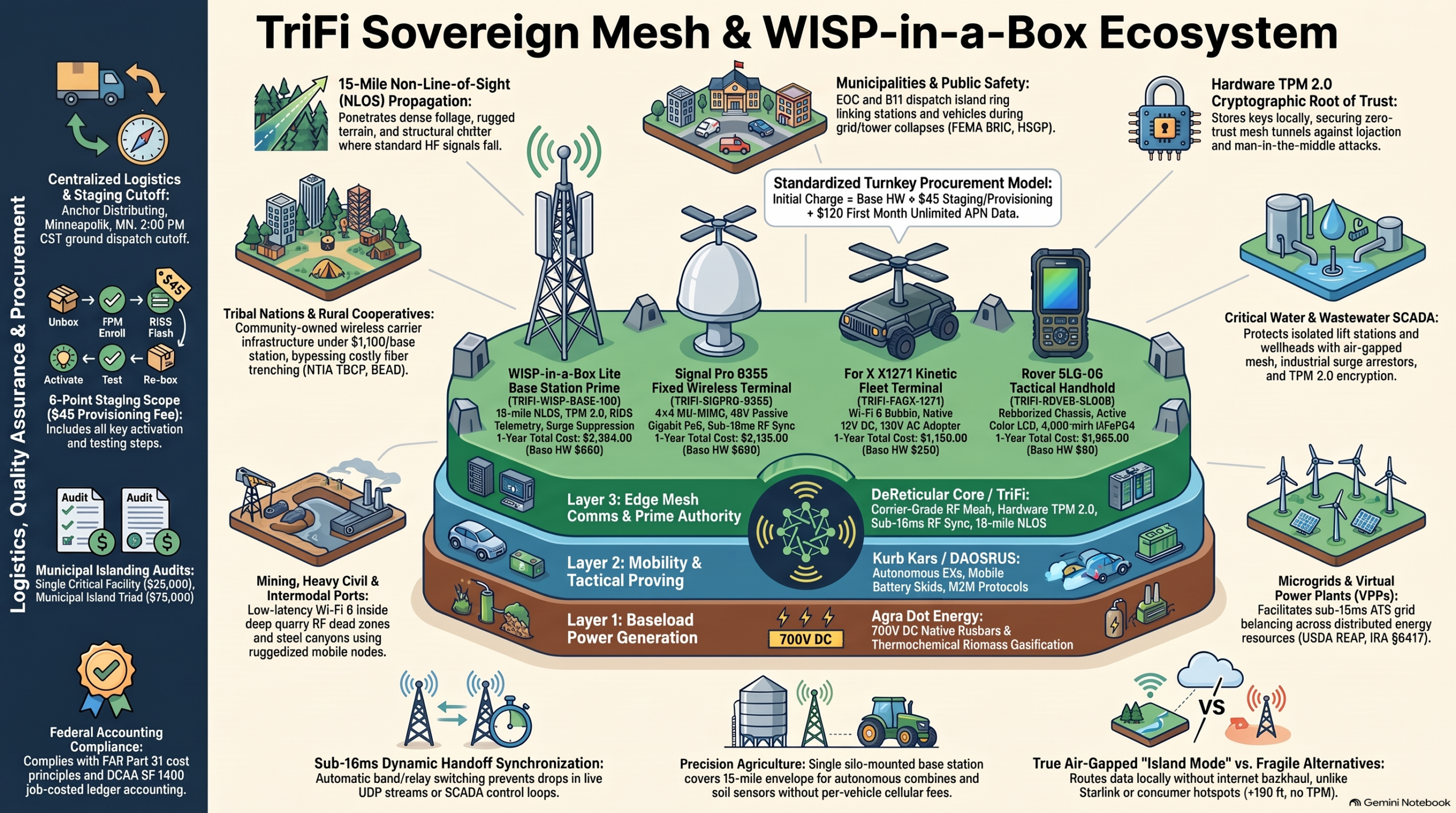
Learning Module: Wireless Hardware Selection & Resilient Architecture Strategy
- Conceptual Foundations: Demystifying Resilient Telecommunications
1.1 Core Engineering Principles
To evaluate high-reliability telecommunications systems, a learner must understand how hardware engineering directly solves real-world transmission and security failures. Traditional commercial networks rely on an extended sequence of centralized cloud servers, third-party cell towers, and terrestrial fiber lines. When any link in this chain breaks, connections collapse instantly. The core architectural and Radio Frequency (RF) principles below provide the foundation for continuous, autonomous networking.
- Non-Line-of-Sight (NLOS) Transmission: Standard microwave and high-frequency wireless connections require an unobstructed visual pathway between sender and receiver, failing when blocked by trees, hills, or structural clutter. Carrier-grade sub-6 GHz NLOS technology utilizes high link-budget radio propagation, contrasting standard line-of-sight propagation with a 15-mile carrier-grade NLOS coverage envelope designed to penetrate dense foliage, rugged mountain terrain, structural obstacles, heavy rainfall, and thick atmospheric smoke.
- So What? Communities and field personnel can maintain high-bandwidth communications through active wildfire zones, dense forest canopies, or urban canyons without constructing multi-million-dollar optical fiber lines or relying on clear-sky satellite dishes.
- Hardware Embodiment: Formally anchored within the TriFi WISP-in-a-Box Lite (Model TRIFI-WISP-BASE-100) to radiate district-wide backhaul coverage.
- Hardware Cryptoprocessor (TPM 2.0): Software-based security can be breached if an operating system is compromised over the air. A Trusted Platform Module (TPM 2.0) is a physical microchip hardwired into a device’s circuit board. It establishes a cryptographic hardware root of trust, authenticating zero-trust mesh tunnels, validating system boot integrity, and storing master cryptographic keys directly in silicon.
- So What? It prevents over-the-air firmware injection, state-sponsored signal spoofing, and man-in-the-middle (MITM) attacks on critical infrastructure like power grids, water systems, and emergency dispatch links.
- Hardware Embodiment: Hardwired into the TriFi WISP-in-a-Box Lite (Model TRIFI-WISP-BASE-100) to guarantee zero-trust mesh authentication across public sector nodes.
- Sub-16ms Dynamic RF Handoff: Standard cellular hotspots and client devices take several seconds to renegotiate connections when switching towers or frequencies, resulting in dropped calls or lost telemetry. Sub-16ms dynamic failover uses real-time carrier telemetry to monitor radio signal quality continuously, shifting data transmission across secondary bands or mesh nodes within a 16-millisecond window.
- So What? This sub-second transition occurs faster than a single human eye blink, preventing dropped User Datagram Protocol (UDP) video streams, disrupted tele-operated machinery, and broken Supervisory Control and Data Acquisition (SCADA) polling loops.
- Hardware Embodiment: Integrated directly across the TriFi Far X (Model X1271), TriFi Signal Pro (Model 8355), and WISP-in-a-Box Lite to enable seamless mobility and automated switchgear coordination.
- The “1,000-Mile Failure Model” vs. “Island Mode”: The “1,000-Mile Failure Model” describes how local facilities collapse when distant remote dependencies—such as hyperscaler cloud servers located thousands of miles away or centralized public power grids—experience outage events. This concept is governed by Noel’s Law of Structural Vulnerability: “The survivability of any operational node is inversely proportional to the length and central coordination of its critical supply chains and communication backhauls.”
- So What? By building networks capable of autonomous, air-gapped “Island Mode” operation, a municipal facility or remote worksite can keep local devices communicating, processing edge data, and executing automated safety actions even if regional fiber backbones or international cloud servers go completely dark.
- Hardware Embodiment: Governs the entire TriFi Sovereign Mesh Architecture, allowing district nodes to maintain continuous peer-to-peer telemetry without external internet uplinks.
Central Thesis of Network Sovereignty: True operational resilience requires moving away from fragile, long-haul centralized dependencies. By combining hardware-rooted zero-trust security, sub-16ms dynamic radio failover, and high link-budget NLOS propagation, local infrastructure transitions from a passive consumer of external telecom networks into an autonomous, sovereign system capable of self-healing operation under any environmental condition.
1.2 Concept Reference Table
Core Concept Technical Function Practical Benefit for the Learner
Non-Line-of-Sight (NLOS) Sub-6 GHz high link-budget RF propagation through dense physical obstacles across a 15-mile envelope. Delivers reliable broadband through trees, smoke, terrain, and structures without clear visual lines of sight.
Hardware TPM 2.0 Cryptoprocessor Physical silicon microchip providing hardware-rooted identity, encryption key storage, and boot validation. Blocks unauthorized over-the-air tampering, state-sponsored spoofing, and remote cyber hijacking of critical infrastructure.
Sub-16ms Dynamic RF Handoff Continuous carrier telemetry enabling sub-16ms channel, band, and carrier switching. Eliminates dropped video streams, active telemetry losses, and broken SCADA control loops during signal shifts.
Island Mode (“1,000-Mile” Solution) Localized, air-gapped network architecture operating independently of external cloud backhauls. Prevents local facility shutdowns when distant central grids, optical fiber cables, or hyperscaler cloud servers fail.
1.3 Narrative Transition
Understanding these fundamental radio frequency and cryptographic principles allows us to evaluate how these theoretical capabilities are physically manufactured into real-world networking hardware.
- The TriFi Ecosystem Hardware Spectrum
2.1 Visual & Structural Hardware Breakdown
The TriFi Sovereign Mesh hardware suite spans four distinct structural tiers, extending from personal handheld hotspots to carrier-grade district base stations:
- Tier 1 (District Master Anchor): TriFi WISP-in-a-Box Lite (Model TRIFI-WISP-BASE-100) — Serves as the high-elevation 15-mile NLOS parent node.
- Tier 2 (Fixed Commercial CPE): TriFi Signal Pro (Model 8355) — Serves as the IP67 weather-sealed fixed terminal for enterprise campuses and SCADA sites.
- Tier 3 (Kinetic Fleet & Rural Gateway): TriFi Far X (Model X1271) — Serves as the high-gain 12V DC desktop and vehicle fleet access point.
- Tier 4 (Tactical Mobile Node): TriFi Rover (Model SLG-06) — Serves as the personal, pocket-sized handheld hotspot for field personnel.
TriFi Rover (Model SLG-06)
- Pricing Structure: $80.00 Unbundled HW / 245.00 Turnkey Bundle (80.00 HW + $45.00 Staging + $120.00 Month 1 Data APN).
- Form Factor: Pocket-sized, vertical handheld mobile hotspot featuring a drop-tested, rubberized shock-absorbent body. Designed to be stowed easily in a backpack, vehicle glovebox, or emergency evacuation kit.
- Key Specs: Integrated vertical color active LCD displaying live 4G signal strength, 5GHz Wi-Fi status, battery percentage, megabytes consumed, and a dynamic QR code for instant client onboarding. Powered by a 4,000 mAh Lithium Iron Phosphate (LiFePO4) battery rated for extreme thermal environments up to 140°F (60°C). Features bidirectional USB-C Power Delivery (PD) pass-through charging.
- Primary Role: Entry-level tactical handheld hotspot providing personal, ultra-portable mobility for digital nomads, emergency evacuation kits, field inspectors, and traveling workers.
TriFi Far X (Model X1271)
- Pricing Structure: $250.00 Unbundled HW / 415.00 Turnkey Bundle (250.00 HW + $45.00 Staging + $120.00 Month 1 Data APN).
- Form Factor: Upright matte-gray stationary/desktop router featuring a sleek industrial chassis paired with four prominent high-gain vertical paddle/stick antennas.
- Key Specs: Equipped with four 9dBi directional vertical paddle antennas designed to capture distant, sparse cell signals. Operates a localized dual-band concurrent Wi-Fi 6 coverage bubble. Features native 12V DC vehicle input alongside a standard 120V AC desktop power adapter, running sub-16ms dynamic RF carrier sync.
- Primary Role: Kinetic fleet access point and rural desktop gateway built for remote cabins, rural homeowners, mobile command vans, utility maintenance trucks, and cross-country overland/RV vehicles.
TriFi Signal Pro (Model 8355)
- Pricing Structure: $650.00 Unbundled HW / 815.00 Turnkey Bundle (650.00 HW + $45.00 Staging + $120.00 Month 1 Data APN).
- Form Factor: Minimalist, low-profile matte-white circular dome/disc constructed from an IP67 weather-sealed, UV-stabilized cast composite/aluminum housing.
- Key Specs: Features an internal 4×4 MU-MIMO high-gain directional array engineered for maximum signal capture and advanced multi-carrier aggregation across cellular bands. Powered via 48V Passive Gigabit Power-over-Ethernet (PoE) and built for 24/7 continuous operation with sub-16ms dynamic carrier handoffs.
- Primary Role: Heavy-duty Fixed Wireless Terminal / Customer Premises Equipment (CPE) for commercial buildings, outdoor exterior eaves, enterprise campuses, critical water/SCADA substations, and industrial microgrids.
TriFi WISP-in-a-Box Lite (Model TRIFI-WISP-BASE-100)
- Pricing Structure: $899.00 Unbundled HW / 1,064.00 Turnkey Bundle (899.00 HW + $45.00 Staging + $120.00 Month 1 Data APN).
- Form Factor: High-elevation mast and tower-mountable carrier base station anchored inside a heavy-duty weatherized enclosure equipped with industrial gas-discharge lightning surge arrestors.
- Key Specs: Generates a 15-mile Non-Line-of-Sight (NLOS) carrier coverage envelope. Integrated hardware TPM 2.0 cryptoprocessor for zero-trust security, factory pre-flashed with the proprietary Resilient Infrastructure Operating System (RIOS) telemetry agent for automated mesh orchestration and management. Serves as the master parent node to backhaul and distribute data across edge client terminals.
- Primary Role: Flagship district base station prime for municipal districts, off-grid microgrids, regional utility providers, and emergency operations centers.
2.2 Master Hardware Comparison Matrix
Device Name Model SKU Form Factor & Design Unbundled HW Price Turnkey Price ($HW + $45 Stage + $120 M1) Primary Deploy Environment
TriFi Rover TRIFI-ROVER-SLG06 Pocket handheld, rubberized body, color display, LiFePO4 battery $80.00 $245.00 Urban travel, mobile work, emergency kits, field personnel
TriFi Far X TRIFI-FARX-1271 Upright matte-gray desktop, four 9dBi vertical paddle antennas $250.00 $415.00 Rural residences, remote cabins, kinetic vehicle fleets, RVs
TriFi Signal Pro TRIFI-SIGPRO-8355 Matte-white circular dome, IP67 cast aluminum chassis $650.00 $815.00 Enterprise campuses, exterior eaves, industrial SCADA sites
WISP-in-a-Box Lite TRIFI-WISP-BASE-100 High-elevation mast/tower anchor with surge suppression $899.00 $1,064.00 Municipal district anchors, central silos, utility towers
2.3 Narrative Transition
With these hardware specifications and form factors defined, we can now analyze how each tier is deployed within specific operational scenarios to resolve real-world connectivity challenges.
- Real-World Deployment Scenarios: Matching Need to Hardware
3.1 Scenario A: Personal Travel & Digital Nomad Mobility
Operational Challenge
- Nomadic Mobility Constraints: Remote workers and traveling inspectors require reliable, high-speed connectivity while working from cafes, field sites, and moving vehicles without carrying bulky fixed routing hardware.
- Thermal Instability: Consumer-grade cellular hotspots utilize unstable lithium-ion batteries that overheat, swell, and fail when left inside vehicles or exposed to direct sunlight.
- Configuration Friction: Manual network setup and typing complex passwords slows down deployment when connecting multiple mobile devices, tablets, and laptops in the field.
Hardware Solution
TriFi Rover (Model SLG-06)
Synthesis (“Why It Fits”)
- Ultra-Portable Form Factor: Designed as a pocket-sized, rubberized handheld terminal that withstands accidental drops and easily stows in gear bags or gloveboxes.
- High-Temperature Battery Safety: Powered by a 4,000 mAh LiFePO4 battery rated for safe operation in extreme heat up to 140°F (60°C), eliminating thermal degradation risks during vehicle deployment.
- Zero-Friction Client Onboarding: Generates a dynamic QR code directly on its vertical color LCD display, allowing users to scan and pair clients instantly without entering passwords or accessing admin menus.
Nomad Mobility Takeaway: The Rover delivers an ultra-portable personal hotspot setup that combines heat-resistant LiFePO4 battery safety with fast, QR-code-based client onboarding.
3.2 Scenario B: Off-Grid Rural Residence & Kinetic Fleets
Operational Challenge
- Distant Cell Signal Attenuation: Rural properties, mountain cabins, and field work sites operate miles away from cellular towers, causing standard mobile phones and entry-level hotspots to lose signal entirely.
- Kinetic Fleet Power Requirements: Utility maintenance trucks and mobile command vehicles require persistent multi-device connectivity while moving across unpaved roads, but lack standard AC outlets.
- Inverter Overhead: Running traditional 120V AC desktop routers in vehicles requires power inverters that draw excess battery current and introduce mechanical failure points.
Hardware Solution
TriFi Far X (Model X1271)
Synthesis (“Why It Fits”)
- Long-Range Signal Capture: Equipped with four prominent high-gain 9dBi directional vertical paddle antennas tuned to lock onto weak, distant cell towers that integrated handheld antennas miss.
- Native Vehicle Integration: Features native 12V DC input capabilities alongside a standard 120V AC adapter, allowing direct wiring into vehicle electrical systems without needing inefficient power inverters.
- Kinetic Mobile Handoffs: Operates sub-16ms dynamic RF carrier sync paired with a localized Wi-Fi 6 coverage bubble, keeping mobile command tools and crew laptops connected seamlessly as vehicles travel across tower sectors.
Kinetic & Rural Takeaway: High-gain 9dBi directional antennas combined with native 12V DC power input make the Far X the premier solution for stationary rural structures and moving vehicle fleets.
3.3 Scenario C: Enterprise Campus, Industrial SCADA & Critical Microgrids
Operational Challenge
- Severe Environmental Exposure: Water treatment facilities, industrial campuses, and solar/BESS microgrids require exterior-mounted communications hardware exposed to heavy rain, UV radiation, and temperature swings.
- Strict Industrial Latency Limits: Automated switchgear, power distribution controllers, and SCADA polling loops drop out if network handoffs exceed 20 milliseconds, causing unexpected plant shut-offs.
- Power Cabling Overhead: Running separate high-voltage power lines to exterior roof eaves or elevated antenna masts increases installation costs and safety risks.
Hardware Solution
TriFi Signal Pro (Model 8355)
Synthesis (“Why It Fits”)
- IP67 Industrial Enclosure: Housed inside an IP67 weather-sealed, UV-stabilized cast composite/aluminum circular dome engineered for 24/7 exterior mounting under severe weather conditions.
- Sub-16ms Real-Time Failover: Delivers dynamic RF carrier switching within 16 milliseconds, satisfying strict synchronization limits for SCADA polling and microgrid switchgear.
- Single-Cable Power & Data: Powered via 48V Passive Gigabit Power-over-Ethernet (PoE), enabling installation up high-elevation masts using a single outdoor-rated Ethernet cable.
- Multi-Carrier Band Optimization: Utilizes an internal 4×4 MU-MIMO directional array supporting advanced multi-carrier aggregation for maximum data throughput.
Industrial SCADA Takeaway: The Signal Pro combines an IP67 weather-sealed cast aluminum casing, 48V PoE single-cable installation, multi-carrier aggregation, and sub-16ms carrier switching to satisfy demanding industrial uptime standards.
3.4 Scenario D: Municipal Emergency Operations & Sovereign District Mesh
Operational Challenge
- Catastrophic Infrastructure Collapse: Hurricanes, wildfires, or severe winter storms sever fiber optic cables, knock out power grids, and overload commercial cell sites.
- Physical RF Obstructions: Thick wildfire smoke, dense tree lines, and structural clutter block standard high-frequency line-of-sight microwave links during emergency response operations.
- Cyber Security Threats: Open or software-only wireless backhauls during emergency events are highly vulnerable to over-the-air signal interception, firmware tampering, or state-sponsored spoofing.
Hardware Solution
TriFi WISP-in-a-Box Lite (Model TRIFI-WISP-BASE-100)
Synthesis (“Why It Fits”)
- 15-Mile NLOS Coverage Envelope: Radiates high link-budget sub-6 GHz RF signals capable of penetrating heavy smoke, dense foliage, and terrain obstacles across a 15-mile district radius.
- Hardware-Rooted Zero-Trust Encryption: Features an integrated hardware TPM 2.0 cryptoprocessor pre-flashed with the RIOS telemetry agent, enforcing hardware-authenticated encryption across all district mesh links.
- Severe Storm Hardening: Outfitted with industrial gas-discharge lightning surge arrestors to protect high-elevation water tower or mast mountings during severe electrical storms.
- Autonomous District Islanding: Functions as a master carrier parent node that maintains localized “Island Mode” routing between City Hall, 911 dispatch, and field-deployed client terminals without requiring external cloud servers.
Sovereign Mesh Takeaway: The WISP-in-a-Box Lite serves as a carrier-grade district anchor, providing high-power 15-mile NLOS penetration and hardware TPM 2.0 security to keep local public safety networks running during regional infrastructure collapses.
3.5 Narrative Transition
Deploying these physical hardware tiers requires evaluating the financial architectures, pre-staging workflows, and total cost of ownership models that support turnkey procurement.
- Financial Architecture & Total Cost of Ownership (TCO) Analysis
4.1 The Turnkey Billing Equation
To simplify procurement and eliminate surprise configuration fees, all TriFi hardware deployments utilize a standardized initial acquisition calculation:
\text{Initial Acquisition Cost} = \text{Base Hardware} + $45.00\text{ (Staging/Provisioning)} + $120.00\text{ (Month 1 Data)}
Following the initial acquisition charge, every deployed unit requires an ongoing, flat-rate Unlimited Data service subscription billed at $120.00/month. This plan provides an uncapped, non-throttled multi-carrier cellular APN profile.
Scope of the $45.00 Staging & Provisioning Fee
Every hardware unit undergoes a standardized 6-point quality assurance and staging process executed at the primary fulfillment hub (Anchor Distributing in Minneapolis, MN, operating under a 2:00 PM CST ground dispatch cutoff mapped to internal cost code 5200-LOGISTICS):
- Unboxing & Physical Inspection: Physical chassis and component verification.
- Cryptographic Enrollment: Hardening the onboard TPM 2.0 chip with master cryptographic root keys.
- Firmware Flashing: Flashing the proprietary Resilient Infrastructure Operating System (RIOS) telemetry agent.
- Cellular Activation: IMEI modem activation and ICCID SIM marrying to private APN backhaul channels.
- Bench Testing: RF loopback testing and sub-16ms failover verification.
- Barcoding & Dispatch: Serialized barcode assigning, custom packaging, and ground freight dispatch.
4.2 One-Year TCO Comparison Table
The total cost of ownership across the first year includes the initial hardware turnkey charge plus the remaining 11 months of recurring data service ($120/month × 11 = $1,320.00).
Device Name Model Base HW Cost Staging Fee Turnkey Charge (Mo. 1) Ongoing Monthly Data ($120/mo) 1-Year TCO Total
TriFi Rover SLG-06 $80.00 $45.00 $245.00 $120.00 / mo $1,565.00
TriFi Far X X1271 $250.00 $45.00 $415.00 $120.00 / mo $1,735.00
TriFi Signal Pro 8355 $650.00 $45.00 $815.00 $120.00 / mo $2,135.00
WISP-in-a-Box Lite BASE-100 $899.00 $45.00 $1,064.00 $120.00 / mo $2,384.00
4.3 B2G Integration & Non-Dilutive Grant Capital Stacking
Public sector, municipal, and enterprise entities can fund these deployments through non-dilutive capital stacking and grant structures, avoiding direct capital outlay.
Forensic Engineering Audits
Before deploying infrastructure, engineering assessments are performed under standardized Statements of Work (SOW):
- Single Critical Facility Audit ($25,000): A forensic engineering assessment for an isolated operational asset (e.g., standalone wastewater lift station, hospital, or fire station) to evaluate failover latency, RF coverage, and emergency power requirements.
- Municipal Island Triad Audit ($75,000): A full-spectrum regional forensic assessment covering the three vital pillars of municipal governance:
- Pillar 1: City Hall & Administrative Governance — Hardening central municipal administrative data paths and public communications.
- Pillar 2: Water/Wastewater SCADA Infrastructure — Auditing air-gapped telemetry and remote pump actuation links across distributed substations.
- Pillar 3: 911 Emergency Dispatch & Emergency Operations Centers (EOC) — Establishing continuous primary and secondary failover rings for first responder dispatch.
Federal Accounting Compliance Standards
All procurement orders, staging fees, Statements of Work, and logistics workflows are mapped to Federal cost-accounting standards, fully complying with FAR Part 31 (Federal Acquisition Regulation: Cost Principles) and DCAA SF 1408 job-costed general ledgers (mapped to internal cost code 5200-LOGISTICS).
Eligible Grant Funding Mechanisms
Deployments and forensic engineering audits qualify for 100% non-dilutive reimbursement under major federal grant vehicles:
- FEMA BRIC (Building Resilient Infrastructure and Communities): Funding local communications infrastructure hardening against natural hazards.
- Homeland Security Grant Program (HSGP): Supporting inter-agency first responder communications and emergency operations center islanding.
- USDA REAP (Rural Energy for America Program) & ReConnect: Funding off-grid microgrid communication links and agricultural broadband access.
- IRA §6417 (Inflation Reduction Act Direct Pay): Providing direct cash reimbursements for tax-exempt municipal entities deploying resilient microgrid networks.
- Clean Water State Revolving Fund (CWSRF): Reimbursing cybersecurity and air-gapped telemetry upgrades for public water and wastewater SCADA utilities.
- Port Infrastructure Development Program (PIDP): Hardening intermodal cargo tracking and vessel-to-shore communications against signal interference.
- NTIA TBCP & IIJA BEAD: Delivering broadband infrastructure grants to Tribal entities and underserved rural communities.
4.4 Narrative Transition
By combining standard turnkey pricing with federal grant compliance, organizations can systematically evaluate their deployment options using a clear decision framework.
- Learner Assessment & Decision Framework
5.1 Hardware Selection Flowchart (Decision Matrix)
Use this decision matrix to match operational requirements, primary power inputs, and environmental constraints to the correct hardware tier.
Primary User / Operational Need Key Environmental Obstacle Recommended Hardware Tier Primary Differentiating Feature (Including Power Input)
Personal Travel / Nomadic Work Frequent movement, lack of fixed power, dynamic field setup TriFi Rover (SLG-06) Pocket handheld form factor; dynamic QR code display; 4,000 mAh LiFePO4 battery (up to 140°F) with USB-C PD
Rural Residence / Mobile Fleet Distant cell towers, weak signal absorption, kinetic vehicle travel TriFi Far X (X1271) Four 9dBi vertical paddle antennas; localized Wi-Fi 6 bubble; Native 12V DC vehicle input & 120V AC adapter
Enterprise / Water SCADA / Microgrid Extreme weather exposure, 24/7 continuous uptime, zero-trust security demands TriFi Signal Pro (8355) IP67 cast aluminum dome; 4×4 MU-MIMO array with multi-carrier aggregation; 48V Passive Gigabit PoE
Municipal District / Island Mesh Total fiber collapse, regional power loss, severe physical terrain barriers WISP-in-a-Box Lite (BASE-100) Sovereign 15-mile NLOS envelope; hardware TPM 2.0 cryptoprocessor; Gas-discharge surge arrestor on mast mount
5.2 Strategic Summary & Key Takeaways
- Shift to Network Sovereignty: Transitioning from consumer-grade hotspots to sovereign mesh hardware shifts an organization’s status from a passive telecom customer (vulnerable to the “1,000-Mile Failure Model”) into an autonomous network operator capable of running in continuous “Island Mode.”
- Hardware-Rooted Security & Speed: Hardened telecommunications rely on physical hardware cryptoprocessors (TPM 2.0) to prevent over-the-air cyber threats, paired with sub-16ms dynamic RF carrier handoffs to protect SCADA loops and real-time streams from dropping.
- Purpose-Built Tiering: Hardware selection must align directly with operational parameters and power constraints:
- Rover (SLG-06) for personal pocket mobility and high-temp LiFePO4 battery safety.
- Far X (X1271) for long-range rural capture and native 12V DC kinetic vehicle fleets.
- Signal Pro (8355) for IP67 weather-sealed, 48V PoE exterior enterprise installations with multi-carrier aggregation.
- WISP-in-a-Box Lite (BASE-100) for 15-mile NLOS district-wide carrier anchors and hardware zero-trust routing.
- Turnkey Billing & Grant Alignment: Unified pricing structures ($Base HW + $45 Staging + $120 Data/mo) paired with FAR Part 31 and DCAA SF 1408 accounting compliance allow public sector entities to fund resilient network deployments using federal grant mechanisms (such as FEMA BRIC, HSGP, USDA REAP, CWSRF, PIDP, and IRA §6417 Direct Pay).


