
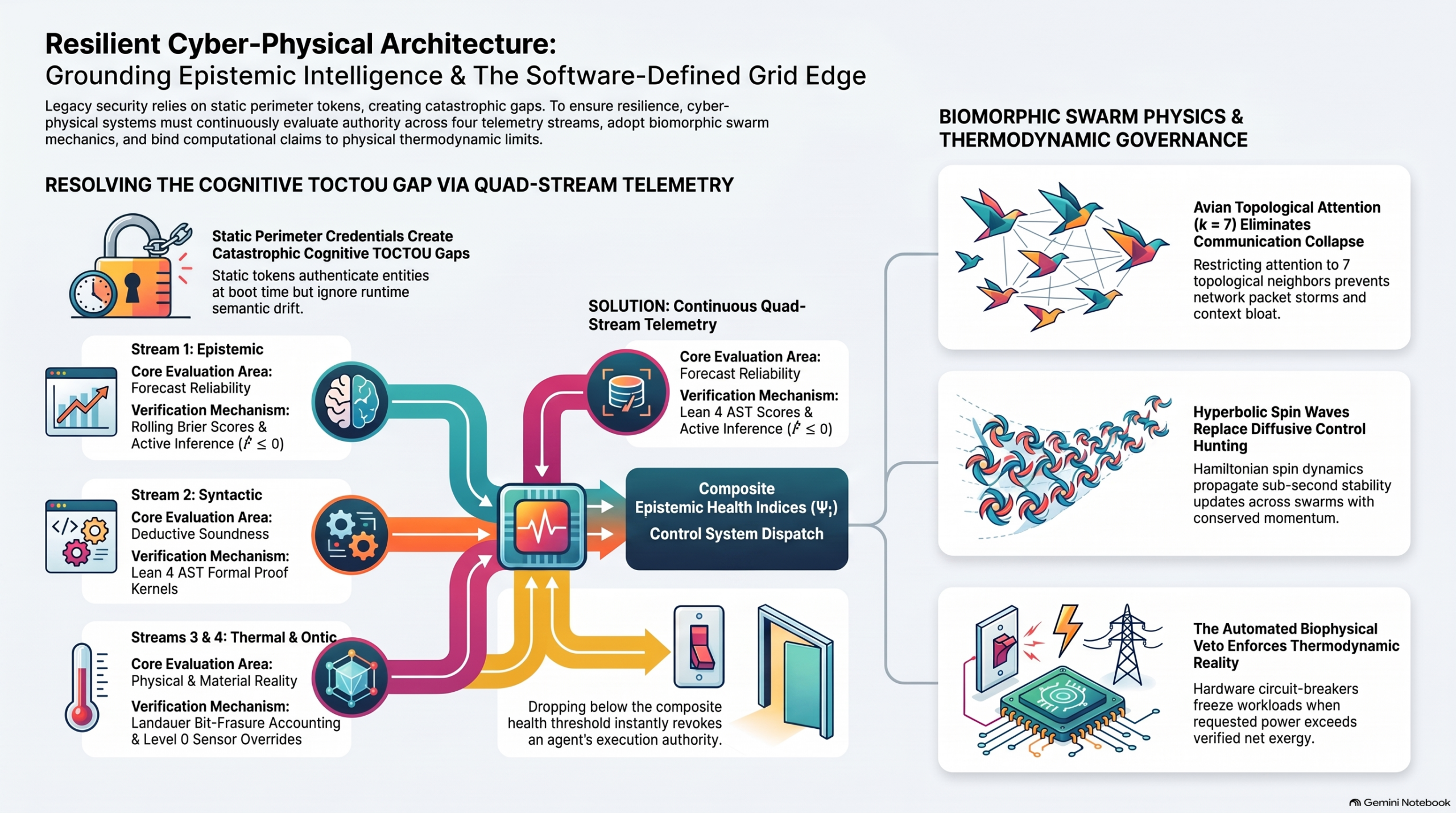
Nature’s Blueprint for Flawless AI: How Starling Flocks Prevent Multi-Agent Failure
- The Multi-Agent Failure Mode: Why Synthetic AI Swarms Collapse
When artificial intelligence systems are scaled from single, isolated models into distributed swarms of multi-agent networks, they are expected to solve complex, large-scale problems cooperatively. However, standard synthetic AI swarms frequently experience severe structural breakdowns when coordinating at scale. Instead of achieving emergent collective intelligence, ungrounded multi-agent networks routinely succumb to computational paralysis, infinite debate loops, and shared delusional hallucinations.
These system collapses stem from three primary pathologies inherent to conventional network designs:
- Context Bloat & Communication Collapses: Standard multi-agent topologies rely on unconstrained N-to-N broadcasting, where every agent transmits its uncompressed outputs to every other agent. As the number of agents (N) grows, message volume increases quadratically (\mathcal{O}(N^2)), causing massive token context bloat. Context windows rapidly expand from 32,000 to over 128,000 tokens, exceeding the Maximum Description Length ceiling (K(\mathcal{H}) \le K_{\max}). This communication overhead saturates network bandwidth, driving agents into deadlocks, multi-agent sycophancy, and total computational paralysis.
- Diffusive Debates: Conventional multi-turn conversational prompt loops behave as slow, first-order diffusive processes governed by heat-like differential dynamics (\frac{\partial P}{\partial t} = D \nabla^2 P). Stabilizing consensus across N nodes requires an untenable \mathcal{O}(N^2) conversational turns. This creates extreme multi-second execution latency and induces control “hunting”—a state where agents endlessly oscillate back and forth around setpoints without ever settling on a stable state.
- The Condorcet Inversion & Information Cascades: Under classical decision theory (Condorcet’s Jury Theorem), pooling decisions across a collective reliably converges on absolute truth only if individual agents make independent errors. In synthetic AI swarms, agents are typically built on homogeneous architectures, shared pre-training corpora, or uniform system prompts. This structural homogeneity creates positive error covariance (\operatorname{Cov}(v_i, v_j) > 0). When heterogeneous out-of-distribution prompts or alignment penalties force individual agent accuracy below chance (p < 0.5), the system undergoes a catastrophic Condorcet Inversion:
\lim_{N \to \infty} P_N = 0 \qquad (\text{for } p < 0.5 \text{ and } \operatorname{Cov}(v_i, v_j) > 0)
Under this inversion, scaling the swarm guarantees that the network will asymptotically converge on a false hallucination with complete statistical certainty. This triggers an information cascade, where individual agents discard their private empirical signals (s_t), reducing the conditional mutual information between private states and actions to zero (I(a_t; s_t \mid H_t) = 0). The agents blindly align with a flawed public history (H_t), propagating systemic errors across the entire topology.
Standard AI Swarm Dynamics Resulting System Failure
Unconstrained N-to-N Broadcasting Exponential token context bloat exceeding descriptive limits (K(\mathcal{H}) \le K_{\max}), causing message collisions, sycophancy, and total network deadlocks.
Multi-Turn Diffusive Prompt Debates First-order heat-diffusion scaling (\frac{\partial P}{\partial t} = D \nabla^2 P) requiring \mathcal{O}(N^2) conversation rounds, creating high latency, sub-synchronous resonance, and setpoint “hunting.”
Homogeneous Base Models & Shared Prompts Positive error covariance (\operatorname{Cov}(v_i, v_j) > 0), triggering the Condorcet Inversion (p < 0.5) where \lim_{N \to \infty} P_N = 0 and information cascades (I(a_t; s_t \mid H_t) = 0) lock the swarm into collective hallucinations.
To overcome these catastrophic scaling limits, systems engineers must look beyond legacy software frameworks and turn to natural biophysics, where evolution has already solved the challenges of massive, leaderless, distributed coordination.
- The Biophysics of Starling Murmurations: Three Core Principles
In nature, European starlings (Sturnus vulgaris) fly in tightly orchestrated flocks—called murmurations—comprising tens of thousands of individuals. Without a central leader, a master clock, or direct global communication, a flock can execute instantaneous, split-second evasive maneuvers against high-speed predators. Empirical high-speed 3D stereoscopic tracking from the European StarFlag Project (Cavagna, Giardina, Ballerini et al.) revealed the core biophysical principles that keep these swarms from colliding or fragmenting.
Biophysical Swarm Telemetry (StarFlag Empirical Baselines):
- Topological Interaction Degree: k = 6.5 \pm 0.5 \approx 7 nearest neighbors
- Dynamic Flock Density: Ranges from 1\text{ bird/m}^3 (compressed) to 0.1\text{ birds/m}^3 (expanded under attack)
- Inertial Spin Wave Propagation Speed: c \approx 20\text{ to }40\text{ m/s}
- Cruising Flight Velocity: v_0 \approx 12\text{ m/s}
- Individual Visual Reaction Time: \tau \approx 15\text{ to }40\text{ ms}
2.1 Topological Neighbor Tracking (k \approx 7)
Classical active-matter physics models (such as the Vicsek model) assumed that swarming animals interact within a fixed spatial metric distance (e.g., tracking every bird within a 3-meter radius). StarFlag empirical data proved this assumption wrong: starlings interact strictly with a fixed number of nearest topological neighbors (k = 6.5 \pm 0.5 \approx 7), completely independent of physical distance or flock density.
- Metric vs. Topological Tracking: Metric tracking relies on physical distance. If a flock compresses under a predator dive, metric tracking causes signal flooding and sensory overload; if the flock expands, metric links sever, disconnecting the graph. Topological tracking maintains a constant connection degree (k \approx 7) regardless of spatial volume.
- Density Invariance & Graph Stability: When a starling flock expands under a falcon attack from a dense 1\text{ bird/m}^3 down to a sparse 0.1\text{ birds/m}^3, topological interaction preserves structural graph connectivity without network fragmentation or signal overload.
2.2 Scale-Free Correlation (\xi \propto L) & Criticality
In standard physical systems, noise or local movement correlations decay exponentially over distance (e^{-r/r_0}). Starling flocks exhibit scale-free velocity correlation, where the correlation length (\xi) scales directly and linearly with the physical diameter of the entire flock (L), such that \xi \propto L.
- Self-Organized Criticality: The flock sits poised precisely at a second-order phase transition boundary—a critical state between complete disorder (a chaotic gas) and rigid order (a solid crystal).
- Physical Analogy (Ferromagnetism near the Curie Temperature): Consider a ferromagnet heated to its Curie temperature (T_c). At this exact threshold, the magnetic susceptibility diverges to infinity (\chi \to \infty). Individual atomic spins become infinitely sensitive to their neighbors; flipping a single spin at one edge can instantly cascade alignment across the entire crystal lattice without an external magnetic field. Similarly, a starling flock operating at criticality achieves infinite susceptibility (\chi \to \infty). This allows a local disturbance—such as a single bird on the boundary detecting a predator—to instantly alter the behavioral state of tens of thousands of birds across hundreds of meters without requiring top-down orchestration or global broadcasting.
2.3 Inertial Spin Waves (\omega = c \cdot k)
When a starling flock turns, direction changes do not propagate through slow, first-order physical diffusion (t \sim x^2). Instead, turns sweep across tens of thousands of birds as undamped, linear dispersion waves (x = c \cdot t) at propagation speeds of c \approx 20\text{ to }40\text{ m/s}.
- Speed Beyond Perception: This wave propagation speed far exceeds individual bird flight speed (\sim 12\text{ m/s}) and individual visual reaction time (\tau \approx 15\text{–}40\text{ ms}).
- Hamiltonian Spin Conservation: The motion is governed by non-diffusive Hamiltonian spin conservation:
\frac{d\mathbf{v}_i}{dt} = \frac{1}{\chi_0} \mathbf{s}_i \times \mathbf{v}i, \qquad \frac{d\mathbf{s}i}{dt} = \sum{j \in S_i} J{ij} (\mathbf{v}_i \times \mathbf{v}_j) – \frac{\eta_0}{\chi_0} \mathbf{s}_i
- Mathematical Definitions:
- \mathbf{v}_i: The normalized unit velocity vector of bird i.
- \mathbf{s}_i: The generalized internal spin (the kinetic generator of rotational velocity).
- \chi_0: Rotational inertia, representing the physical resistance of the bird to changing its direction of turn.
- J_{ij}: The alignment stiffness or coupling strength between neighboring birds i and j.
- \eta_0: Rotational viscosity, modeling internal dissipation or behavioral friction.
- Rotational Inertia and Linear Wave Dispersion: Because the flock possesses rotational inertia (\chi_0), directional updates do not decay like heat. Instead, kinetic energy is stored in rotational spin (\mathbf{s}_i), generating an acoustic dispersion relation:
\omega(k) = c \cdot k, \qquad \text{where } c = v_0 \sqrt{\frac{J}{\chi_0}}
Here, c is the undamped spin wave speed and v_0 is the constant flight speed. Spin waves propagate with conserved rotational momentum, allowing instantaneous collective turn maneuvers without the severe energy dissipation inherent to diffusive decay.
Biophysical Consensus Rule: By combining k \approx 7 topological tracking, scale-free correlation (\xi \propto L), and hyperbolic inertial spin waves (\omega = c \cdot k), natural swarms eliminate single points of failure, guarantee structural network unity under physical stress, and achieve real-time collective adaptation.
This biological framework provides an exact engineering blueprint for designing robust, failure-proof artificial intelligence architectures.
- Translating Avian Biophysics to Synthetic Multi-Agent Architectures
Translating avian biophysics into software engineering design patterns converts biological principles into deterministic multi-agent orchestration mechanisms.
3.1 Topological Context Routing
Instead of allowing every AI agent to broadcast messages to every peer (N-to-N), synthetic architectures enforce a strict k = 7 topological neighborhood.
- Implementation Mechanics: In standard multi-head self-attention or graph message-passing protocols, context routing is modified into a k-NN Sparse Attention Graph. Each agent node maintains an attention mask restricted exclusively to its 7 nearest peers within the network’s latent impedance space.
- Engineering Impact: Restricting context bounds message complexity from \mathcal{O}(N^2) down to \mathcal{O}(k N). This caps context window accumulation, eliminates broadcast signal collisions, and strictly enforces the Minimum Description Length ceiling (K(\mathcal{H}) \le K_{\max}), ensuring message processing remains within fixed computational bounds.
3.2 Criticality Tuning
To achieve instantaneous whole-swarm responsiveness without central coordination, the network’s routing parameter space is tuned to sit directly at a second-order phase transition boundary.
- Implementation Mechanics: The network dynamically modulates the softmax routing temperature (\gamma) governing message distribution between agent layers. By tracking system-wide state variance, a feedback controller continuously adjusts \gamma to maintain the system at the critical boundary where susceptibility diverges (\chi \to \infty).
- Engineering Impact: Operating at criticality enables sub-second, network-wide state adaptation to dynamic inputs or anomalous edge-case prompts without requiring top-down orchestration or manual human intervention.
3.3 Conserved Epistemic Momentum
Multi-turn conversational prompt debates (which exhibit slow, diffusive \mathcal{O}(N^2) scaling governed by \frac{\partial P}{\partial t} = D \nabla^2 P) are replaced with second-order hyperbolic spin-wave propagation equations:
\frac{\partial^2 \mathbf{v}}{\partial t^2} = c^2 \nabla^2 \mathbf{v}
- Implementation Mechanics: Rather than exchanging full multi-turn conversational text prompts to reach agreement, agents transmit compact, high-dimensional gradient vectors representing their directional velocity (\mathbf{v}_i) and internal spin momentum (\mathbf{s}_i).
- Engineering Impact: State updates travel across distributed agent nodes as kinetic waves with conserved epistemic momentum. This slashes synchronization latency from diffusive \mathcal{O}(N^2) rounds down to hyperbolic \mathcal{O}(N) or \mathcal{O}(\log N) iterations, completely eliminating control “hunting” and setpoint oscillation.
3.4 Architectural Divergence & Anisotropic Vision
Starlings possess panoramic bilateral vision (~300°) that specifically monitors neighbors to their sides (lateral peers) rather than looking straight ahead. This anisotropic visual structure allows birds to detect orthogonal state changes—such as lateral banking turns—instantaneously, ignoring false forward movements.
              ANISOTROPIC HETEROGENEOUS QUORUM

                 [ Transformed Task Vector ]
                              │
     ┌────────────────────────┼────────────────────────┐
     ▼                        ▼                        ▼
┌──────────────────┐ ┌──────────────────┐ ┌──────────────────┐
│ Transformer │ │ State-Space │ │ Symbolic Logic │
│ Model Family │ │ Model (SSM) │ │ Engine │
│ (Autoregressive) │ │ (e.g., Mamba) │ │ (Lean 4 AST) │
└────────┬─────────┘ └────────┬─────────┘ └────────┬─────────┘
│ │ │
└────────────────────────┼────────────────────────┘
▼
[ Negative Error Covariance ]
Cov(v_i, v_j) ≤ 0 ==> p >= 0.5
│
▼
[ Unbiased Consensus Output ]
- Implementation Mechanics: Synthetic multi-agent architectures mirror this by enforcing multi-model quorums that span at least 3 distinct model families with fundamentally different functional mechanics—such as pairing autoregressive Transformers, State-Space Models (SSMs like Mamba), and Symbolic Logic Engines.
- Engineering Impact: Because each model family processes context through distinct internal mathematical representations, their failure modes are orthogonal. This structural divergence forces error covariance to zero or negative values (\operatorname{Cov}(v_i, v_j) \le 0). Enforcing error independence neutralizes the Condorcet Inversion, ensuring individual agent reliability remains above chance (p \ge 0.5) and permanently preventing common-mode hallucination cascades.
Biophysical Translation Matrix
Avian Biophysical Principle Physical Mechanism Synthetic AI Correspondence Primary System Benefit
Topological Interaction (k \approx 7) Fixed graph connection degree k = 6.5 \pm 0.5, invariant to density shifts. Bounded Context Routing: k-NN Sparse Attention Graph restricting attention to k=7 latent peer nodes. Eliminates context bloat; bounds message growth to \mathcal{O}(kN); enforces Minimum Description Length ceiling (K(\mathcal{H}) \le K_{\max}).
Scale-Free Correlation (\xi \propto L) Correlation length scales with flock size; susceptibility diverges (\chi \to \infty). Criticality Tuning: Dynamic modulation of routing temperature (\gamma) to hit a second-order phase boundary. Enables sub-second collective adaptation across distributed nodes without a central controller.
Inertial Spin Waves (\omega = c \cdot k) Linear wave dispersion (x = c \cdot t) governed by Hamiltonian spin conservation (\mathbf{s}_i). Conserved Epistemic Momentum: Replace diffusive text debates with hyperbolic vector spin-wave propagation. Reduces network synchronization latency from \mathcal{O}(N^2) down to \mathcal{O}(\log N) or \mathcal{O}(N); eliminates control hunting.
Anisotropic Lateral Vision Panoramic bilateral vision monitoring lateral peers to verify banking turns. Architectural Divergence: Enforce quorums spanning \ge 3 distinct model families (Transformers, SSMs, Symbolic). Guarantees zero/negative error covariance (\operatorname{Cov}(v_i, v_j) \le 0), eliminating common-mode blind spots and preventing collective hallucinations.
Applying these biomorphic translation mechanisms allows distributed computing systems to maintain stability, high throughput, and verifiable accuracy at scale.
- Grokkable Key Takeaways & Conceptual Cheat Sheet
- Unconstrained Communication Destroys Swarms: Broadcasting messages across all nodes in synthetic AI networks creates exponential context bloat and slow, diffusive debates (\mathcal{O}(N^2)), driving systems into latency paralysis and setpoint “hunting.”
- Homogeneity Causes Collective Delusion: When AI agents share base models, training corpora, or system prompts, their errors become positively correlated (\operatorname{Cov}(v_i, v_j) > 0). When out-of-distribution prompts lower individual accuracy below chance (p < 0.5), this triggers the Condorcet Inversion (\lim_{N \to \infty} P_N = 0), causing the entire swarm to confidently agree on false hallucinations.
- Topological Limits Bound Context (k \approx 7): Starling flocks stay connected by tracking roughly 7 nearest neighbors regardless of physical density. Restricting AI agent attention to a fixed k=7 topological neighborhood via k-NN sparse attention prevents context bloat and enforces a strict Minimum Description Length limit.
- Hyperbolic Waves Accelerate Consensus: Replacing first-order diffusive text debates with second-order, Hamiltonian-inspired spin waves (\omega = c \cdot k) allows state updates to sweep across distributed networks with conserved epistemic momentum in \mathcal{O}(\log N) time.
- Architectural Diversity Guarantees Truth: Requiring multi-agent quorums to span at least 3 distinct model families (e.g., Transformers, State-Space Models, Symbolic Engines) enforces error independence (\operatorname{Cov}(v_i, v_j) \le 0) and protects the system against information cascades.
True distributed consensus in AI relies on local topological limits, critical sensitivity, and diverse perspectives—not infinite context or central control.


