
RIOS Implementation Blueprint: Deploying Sovereign Nodes for Spherical Resilience
1. Strategic Framework: The Death of the Line
The era of “Linear Fragility” is over. Modern industrial civilization is currently shackled to long, vulnerable supply chains and centralized utility grids where a single point of failure—a downed transmission line or a hijacked cloud API—can paralyze an entire region. Our mission is the transition to “Spherical Resilience,” a model where infrastructure is reimagined as a series of decentralized, self-sustaining nodes.
This strategic pivot is being proven through Project Octagon, the global deployment of Sovereign Nodes across Arizona, Canada, Uganda, and beyond. We are building for “The Death of the Line,” replacing fragile connections with independent, AI-managed power and intelligence centers.
| Dimension | Centralized Utility Models (Linear Fragility) | Sovereign Node Models (Spherical Resilience) |
| Failure Points | Centralized hubs; long-distance transmission vulnerable to partitioning. | Distributed nodes; “Island Mode” local functionality. |
| Data Ownership | Corporate silos; dependent on “Big Tech” cloud availability. | Self-sovereign; managed locally via Freenet/Hyphanet dual-stack. |
| Resource Orchestration | Top-down distribution; reactive and slow to adapt. | AI-native orchestration of local Electrons, Data, and Mobility. |
2. The Trinity Stack Architecture: Energy, Intelligence, and Human Capital
The Trinity Stack is the vertical integration of thermodynamics, AI-native orchestration, and human capital. It is the definitive “Civilization-in-a-Box,” designed to sustain industrial operations even when the global internet backbone is severed.
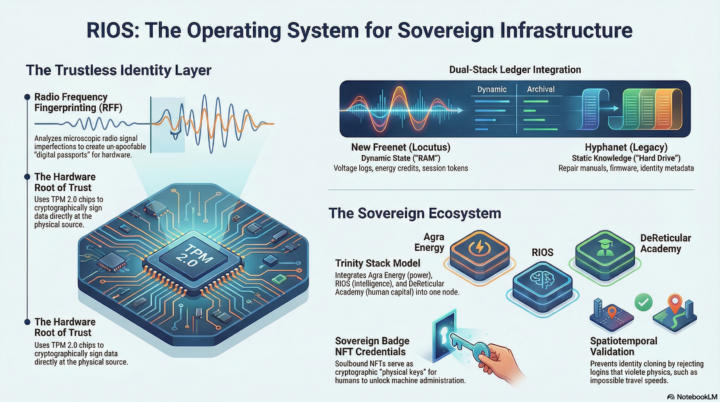
- Agra Energy (The Heart): The physical foundation utilizing plasma gasification waste-to-energy systems. It provides 10MW+ of baseload power, ensuring the node maintains absolute thermodynamic independence.
- RIOS (The Brain): The AI-native Operating System orchestrating three resource pillars: Electrons (baseload and storage), Data (intelligence transported via Trifi Wireless private mesh networks, utilizing WiFi 7 and 5G), and Mobility (autonomous logistics via Kurb Kars).
- DeReticular Academy (The Soul): The human capital layer responsible for certifying Sovereign Systems Architects who govern these autonomous environments.
This architecture enables “Island Mode,” the capability for a node to maintain full industrial capacity during network partitioning. To achieve this, we must establish a trustless bond between the hardware and the data it emits.
3. Hardware Root of Trust: Binding Physical Reality to Data Layers
Software-only security is a liability in industrial environments. To solve the “Oracle Problem”—preventing the injection of “Garbage In” data that a system might otherwise trust if signed by a compromised key—RIOS implements a Physical Truth layer. We bind data to the unique physical properties of the sensor itself.
- Radio Frequency Fingerprinting (RFF): Using Software Defined Radio (SDR), RIOS analyzes the Transient Response of incoming signals, measuring rise-time characteristics and oscillator drift caused by microscopic manufacturing imperfections. This creates an un-spoofable digital passport that cannot be simulated by software.
- TPM 2.0 Attestation: Once verified via RFF, a Trusted Platform Module (TPM) signs the data payload using a non-exportable private key “burned” into the hardware.
This physical-digital binding ensures that every data point—from voltage logs to crop quality—is originating from a verified physical sensor, not a software bot.
4. Dual-Stack Communication: Hyphanet and New Freenet (Locutus)
RIOS utilizes a “Dual-Stack” approach to handle both immutable archival needs and real-time state transitions without centralized servers.
| Feature | Hyphanet (Legacy Freenet) | New Freenet (Locutus/2023) |
| Role | Static Layer (The “Hard Drive”) | Dynamic Layer (The “RAM”) |
| Primary Use | Repair manuals, firmware binaries, human certs. | Wasm Smart Contracts, real-time industrial logs. |
| Identity Role | Protects human operator anonymity. | Manages real-time hardware state/uniqueness. |
| Key Advantage | Censorship-resistant static publishing. | Zero-Gas high-fidelity logging. |
The WebAssembly (Wasm) contracts of New Freenet enable “Zero-Gas” registries. This is essential for high-fidelity industrial logging, such as the HempGrade protocol, where AI-camera logs of crop quality are signed and verified without the prohibitive costs of traditional blockchain transaction fees.
5. The Identity Polling and State Verification Protocol (ID-SVP)
The ID-SVP ensures “Uniqueness, Liveness, and Provenance” across the serverless mesh, preventing the “physical double-spend” of an identity.
- Physical Challenge: The local node (N_{local}) scans the RFF Transient Response of the connecting device.
- DHT Lookup: The node queries the Distributed Hash Table on New Freenet for the device’s Identity State Contract (ISC).
- Spatiotemporal Validation: The system compares the last known heartbeat with current coordinates.
- State Transition: If valid, the node executes an Optimistic Propagation of the new location to the global ledger.
To prevent cloning, RIOS executes the “Teleportation Calculation”: V_{req} = \Delta d / \Delta t. If the distance (\Delta d) between the last seen location and the current node divided by the time delta (\Delta t) exceeds the maximum believable velocity (V_{max}), a Physics Violation is flagged and the identity is locked.
To preserve “Cypherpunk” privacy, RIOS utilizes zk-SNARKs to verify that a device followed a valid path through the mesh without revealing the specific GPS history to the node operator. Provenance is maintained through “Exit Visas”—signed packets containing a Hash_Chain_Previous of the last 10 nodes visited, ensuring an unbroken chain of custody for logistics like Kurb Kars.
6. Human-Machine Interface: The Sovereign Badge NFT
Human governance is managed through the Sovereign Badge, a cryptographic key issued to a Certified RIOS Administrator (CRA).
- Token Standard: These are RIOS-721 “Soulbound” NFTs, optimized for Freenet state contracts.
- The “Soulbound” Logic: Credentials are tied to a specific individual’s DID; they cannot be sold, transferred, or traded.
- Revocation Mechanism: The DeReticular Academy manages a global “Blacklist” via Freenet contracts. If a badge is flagged, the node rejects the administrator locally.
For high-risk administrative actions, such as firmware overrides, RIOS enforces the “Four-Eyes Principle.” This requires a multi-sig handshake where two separate CRAs must sign the command within a synchronized window before the logic gate opens.
7. Deployment Workflow: Initializing the RIOS Sovereign Node
Deploying a RIOS node is a manual engineering process. There is no “off-the-shelf” ISO that integrates these protocols; the architect must build the stack from the ground up.
Manual Build Strategy (Kubuntu + Freenet Model):
- Base OS: Install Kubuntu (KDE Plasma) for its robust repository support and KDE Gear suite.
- Environment: Manually install the Java Runtime Environment (JRE) via
default-jre. - Daemon Configuration: Download and configure the Hyphanet daemon for static storage and the New Freenet (Locutus) kernel for Wasm contract execution.
- Identity Registration: Initialize the Identity State Contract (ISC) on the New Freenet layer to anchor the node’s location and public key.
Required Hardware Components:
- Agra Energy Unit: 10MW+ plasma gasification unit for baseload thermodynamics.
- TPM 2.0 Module: For non-exportable cryptographic attestation.
- SDR Transceiver: For Radio Frequency Fingerprinting of the local device ecosystem.
8. Failure Mode Analysis and Mitigation
Maintaining security during “Island Mode” network partitioning is non-negotiable.
| Security Scenario | Mitigation Strategy |
| Sybil/Clone Attack | RFF (Physical Proof of Existence) + State Contract Lock via New Freenet. |
| Wormhole Attack | Verifiable Delay Functions (VDFs); detecting timing discrepancies in signal propagation that suggest artificial routing. |
| Hardware Damage | Academy-led Revocation of the node’s DID; log recovery via Freenet’s distributed data store. |
By integrating RIOS with a hardware root of trust and decentralized state machines, we achieve autonomous, un-spoofable industrial provenance. We invite developers to join the “Flood the Forge” initiative to expand the application layer of the Sovereign Stack, securing the future of global decentralized physical infrastructure (DePIN).


