Sovereign Biophysical Enterprise: A Learner’s Technical Glossary
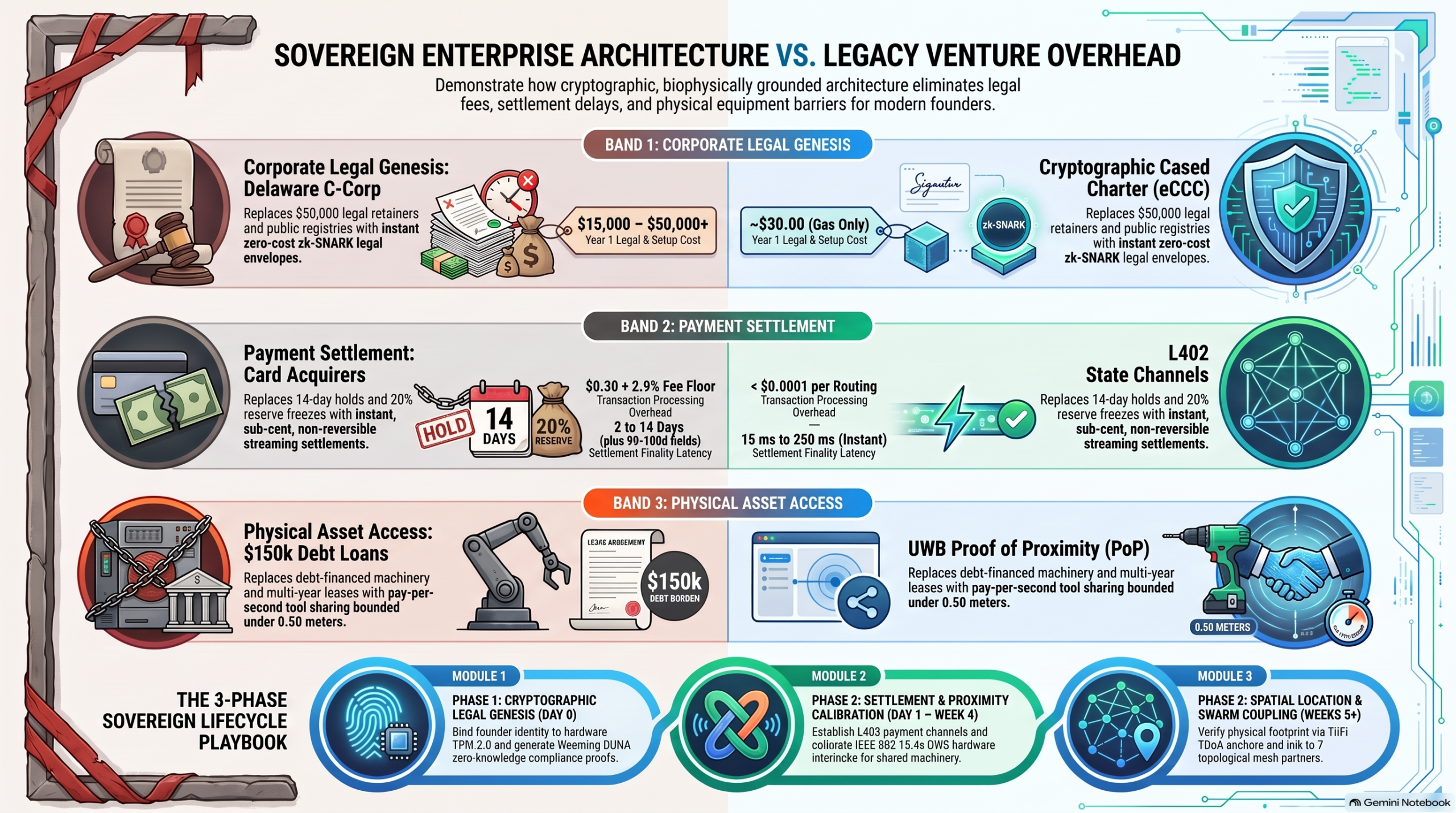
Welcome to the definitive translation guide for sovereign systems engineering and autonomous enterprise architecture. If you are an aspiring entrepreneur, systems engineer, or institutional architect, you have likely encountered the formidable structural friction of the legacy commercial stack: deploying tens of thousands of dollars in legal retainers for corporate formation, enduring multi-day settlement delays and predatory rolling reserves from merchant payment acquirers, signing multi-year commercial leases with uncapped personal guarantees, and paying digital ad ransoms to search monopolies plagued by unverified phantom operators.
Sovereign biophysical enterprises fundamentally reconstruct how business entities are initialized, legally shielded, financially settled, and physically coordinated. By replacing centralized human middleware, arbitrary regulatory gatekeeping, and speculative paper abstractions with zero-trust hardware roots of trust, speed-of-light distance-bounding cryptography, stateless authorization channels, and thermodynamic exergy accounting, this sovereign stack enables enterprise execution that is deterministic, biophysically grounded, and computationally sovereign—operating at near-zero marginal overhead.
This glossary serves as your conceptual decoder and architectural specification guide. Each entry systematically breaks down a foundational primitive across three key pedagogical dimensions: a Plain-English Definition establishing the rigorous engineering mechanics, an Everyday Analogy translating those mechanics into intuitive physical concepts, and a Learner Synthesis (“So What?”) detailing the precise operational, economic, and performance advantages over legacy institutional systems.
- Hardware Roots & Physical Layer Protocols
1.1 TPM 2.0 (Trusted Platform Module)
- Plain-English Definition: An on-chip hardware security module embedded directly within physical computing silicon that establishes an immutable Hardware Root of Trust. Operating at Level 0 of the sovereign stack, it generates zero-knowledge founder identities called Poseidon nullifiers (\text{Nullifier} = \text{Poseidon}(\text{Founder_Secret}, \text{Epoch})) bound to Platform Configuration Register digests (pcr_digest) and signed hardware quotes (hardware_tpm_quote). This mathematical construction decouples a founder’s real-world identity and personal assets from public surveillance registries while maintaining verifiable, untamperable cryptographic provenance.
- Everyday Analogy: Imagine a tamper-proof digital safe forged directly into your workstation’s processor. It issues official, un-forgeable ID badges for every business action your firm takes without ever printing your real name, social security number, or home address on the badge itself.
- Learner Synthesis (“So What?”): TPM 2.0 enables “Day 0” sovereign genesis. Instead of filing personally identifiable documents with public state registries—exposing founders to doxxing, targeted extortion, and identity theft—you can launch a legally valid, cryptographically shielded enterprise bound directly to your physical hardware silicon in milliseconds, achieving absolute identity protection from inception.
1.2 Proof of Proximity (PoP)
- Plain-English Definition: A physical-layer distance-verification protocol that uses IEEE 802.15.4z Ultra-Wideband (UWB) time-of-flight (ToF) ranging (d \le 0.50\text{ m}, \Delta t_{\text{flight}} \le 3.33\text{ ns}) to control hardware power interlocks on shared high-value industrial capital machinery, such as 5-axis CNC mills or fiber lasers. Coupled with Level 0 ontic telemetry (vibration accelerometers, acoustic emission sensors, and thermal probes), the protocol executes a two-phase security model requiring an upfront collateral bond stake (e.g., 50% of the lease value) that is automatically slashed if telemetry detects spindle collisions or operator misuse.
- Everyday Analogy: Think of a physical safety key connected to an invisible, light-speed electronic leash. A dangerous, high-precision power tool will only energize when your authenticated hardware key is physically within arms’ reach (0.50\text{ meters}); if you step away or if a remote attacker attempts to mirror your authorization signal over Wi-Fi, the machine safe-halts within microseconds.
- Learner Synthesis (“So What?”): PoP eliminates the debt burden of 150,000–180,000 industrial capital equipment loans by allowing small workshops to rent shared, high-precision machine tools in regional maker hubs on a pay-per-second basis. Crucially, its speed-of-light timestamp verification mathematically stops remote wireless relay attacks (“Mafia Fraud”), while automated 50% collateral bond slashing protects tool owners against operator negligence without requiring expensive court litigation.
1.3 Proof of Location (PoL)
- Plain-English Definition: A spatial verification protocol that utilizes multi-static Time Difference of Arrival (TDoA) multilateration across fixed, survey-calibrated TriFi mesh anchors (\mathbf{s}_1, \mathbf{s}_2, \mathbf{s}_3, \mathbf{s}4) to confirm an enterprise’s physical footprint with decimeter-level precision (\le 2.5\text{ m} spatial tolerance). By logging RF beacon arrival times (t_i) and calculating hyperbolic distance differentials (\Delta d{ij} = c \cdot (t_i – t_j) = |\mathbf{x} – \mathbf{s}_i| – |\mathbf{x} – \mathbf{s}_j|), the system verifies physical presence independent of centralized orbital GPS infrastructure.
- Everyday Analogy: Picture four stationary local lighthouses measuring the microsecond timing differences of a mobile delivery truck’s foghorn. By comparing those timing offsets, the lighthouses pinpoint exactly which physical parking spot the truck occupies, mathematically proving it is actually there rather than a ghost operation claiming to be in two places at once.
- Learner Synthesis (“So What?”): PoL protects mobile physical businesses—such as food trucks, pop-up artisan retail pods, and mobile repair units—from search-engine extortion and digital “pin farm” fraud. Verified physical presences yield residual timing errors under 0.05\text{ meters}, whereas remote ghost kitchens attempting to spoof presence from distant server racks generate residual errors exceeding 50\text{ meters} and are automatically rejected. This enables peer-to-peer customer discovery on decentralized registries without paying pay-to-play ad ransoms.
Hardware roots of trust and spatial verification protocols provide the un-fakeable physical foundation required to deploy automated, self-executing corporate legal structures.
- Cryptographic Legal Genesis & Corporate Architecture
2.1 Cryptographic Cased Commercial Charter (eCCC)
- Plain-English Definition: A dual-envelope smart contract container that encrypts proprietary operating agreements, equity distributions, and cap tables inside an additively homomorphic inner core (T_{\text{core}} = \operatorname{Enc}(\mathcal{O}, r) = (g^r, ; h^r \cdot g^{\mathcal{O}})) while displaying a public zero-knowledge proof outer envelope (T_{\text{env}}) to demonstrate legal compliance. Before deployment, the charter’s operational bylaws are compiled and type-checked against Lean 4 Abstract Syntax Tree (AST) invariant gates (CasedCharterInvariant) to guarantee that operating rules contain no predatory or contradictory terms.
- Everyday Analogy: This directly updates the ancient Mesopotamian cased clay tablet: a private, detailed commercial agreement was written on an inner clay tablet, which was then sealed inside an outer clay envelope stamped with an official magistrate seal. Anyone in the marketplace could verify the official seal on the outside without cracking open the private tablet inside.
- Learner Synthesis (“So What?”): Traditional corporate formation requires Delaware legal retainers ranging from $15,000 to $50,000, multi-week attorney delays, and public exposure of investor cap tables. The eCCC enables sub-second corporate formation for $0 in legal overhead (paying only minimal network gas fees), guaranteeing complete commercial privacy while maintaining absolute statutory validity.
2.2 zk-SNARKs (Zero-Knowledge Succinct Non-Interactive Arguments of Knowledge)
- Plain-English Definition: Advanced validity proofs (specifically Groth16 or PLONK implementations) generated over arithmetic constraint circuits (\mathcal{C}{\text{DUNA}}) that allow an enterprise to mathematically demonstrate compliance with statutes without revealing underlying trade secrets. The proof evaluates public inputs (\vec{x}{\text{public}}, including T_{\text{core}} hashes, tax escrow commitments, and statutory IDs) against private witnesses (\vec{w}{\text{private}}, including raw operating agreements \mathcal{O}, randomness r, TPM signatures \sigma{\text{TPM}}, and solvency balances) to prove that \mathcal{C}{\text{DUNA}}(\vec{x}{\text{public}}, \vec{w}_{\text{private}}) = 1.
- Everyday Analogy: It is equivalent to presenting a bouncer with an automatic scanner that illuminates a green light to confirm you are over 21 years old, without revealing your birthdate, legal name, home address, or driver’s license number.
- Learner Synthesis (“So What?”): zk-SNARKs eliminate the historical tradeoff between enterprise trade-secret privacy and public regulatory compliance. Businesses can mathematically prove to tax authorities, courts, and commercial counterparties that they hold required tax reserves and satisfy statutory solvency bounds without leaking profit margins, customer lists, or proprietary source code to competitors.
2.3 Wyoming DUNA Act (Senate File SF0050)
- Plain-English Definition: Codified under Wyo. Stat. § 17-31-101 et seq., the Wyoming Decentralized Unincorporated Nonprofit Association (DUNA) Act is a web3-native statutory framework that grants decentralized entities separate legal personality (§ 17-31-104) and statutory limited liability protection (§ 17-31-106). It formally recognizes distributed consensus mechanisms, software protocols, and smart contracts as valid legal governing principles.
- Everyday Analogy: Imagine placing an impenetrable statutory shield around a community project. The association can sign contracts, hold property, and open bank accounts as an independent legal person, but if the project incurs a liability, individual members cannot have their personal savings or homes seized to satisfy the debt.
- Learner Synthesis (“So What?”): The DUNA Act resolves the existential “general partnership” trap highlighted in CFTC v. Ooki DAO (2023), where federal courts ruled that unwrapped DAOs are general partnerships, exposing every voting token holder to joint and several personal liability for protocol debts. Crucially, while classified as “nonprofit” under state law (prohibiting direct, passive net profit dividends to token holders), DUNAs can run for-profit commercial operations, distributing economic value legally via developer grants, staking rewards, liquidity provision yield, and Subchapter T cooperative patronage dividends.
Legally shielded, cryptographically deployed entities require dedicated, streaming financial rails to execute daily operations without banking friction.
- Streaming Finance & Biophysical Economics
3.1 L402 State Channels
- Plain-English Definition: A native web payment and stateless authorization protocol combining HTTP 402 Payment Required headers, cryptographic Macaroon bearer tokens supporting contextual caveats, and Layer-2 Lightning Network state channels. The protocol relies on hashlock preimage verification where H = \operatorname{SHA-256}(P); presenting the revealed preimage P along with the signed Macaroon grants instant, stateless resource access without querying central authentication databases.
- Everyday Analogy: Imagine a pay-as-you-go utility meter that measures and charges fractions of a cent for every single drop of water consumed. Water flows continuously as long as micro-payments stream in, eliminating paper bills, monthly subscription contracts, credit applications, and invoicing delays.
- Learner Synthesis (“So What?”): L402 completely bypasses legacy credit card acquirers and payment gateways. Its technical metrics dramatically outperform traditional card processors across all dimensions:
- Routing Cost: Below $0.0001 (sub-satoshi precision via L2 state channels) vs. legacy $0.30 + 2.9% fee floors that render micro-commerce impossible.
- Finality Latency: 15 ms–250 ms (bounded by network RTT) vs. 2-to-14-day legacy clearing delays.
- Reserve Requirements: 0.00% (instant self-custodial settlement with zero chargeback risk) vs. 10%–20% rolling reserve freezes held by merchant banks for 90–180 days.
3.2 Exergy Bounds (RELA Axiom 3)
- Plain-English Definition: A thermodynamic economic constraint under the RELA Biophysical Standard where total authorized nominal enterprise credit and monetary issuance (M_{\text{nominal}}(t)) is strictly capped by verified net physical exergy throughput: M_{\text{nominal}}(t) \le \kappa \int_{t_0}^t \left[ \text{Exergy}_{\text{net}}(\tau) \cdot \eta(\tau) \right] d\tau where \kappa = 1.0\text{ Credit/MJ} represents the invariant conversion scalar, and \eta(\tau) represents measured thermal/mechanical conversion efficiency. Telemetry inputs from real-time kilowatt-hour meters and calorimeters are continuously logged to BiophysicalBalanceRegister.json.
- Everyday Analogy: Think of a corporate bank account that mathematically locks its credit limit to match the exact physical kilowatt-hours of usable, performable work generated by its on-site solar arrays, battery banks, and biomass gasifiers today.
- Learner Synthesis (“So What?”): Exergy bounds enforce the “Automated Solvency Veto.” This stops speculative financial bubbles, ungrounded debt expansion, and venture capital “epicycle traps”—where failing companies burn artificial equity subsidies to mask negative unit economics, violating the Minimum Description Length (MDL) parsimony principle. Value creation is anchored strictly to physical thermodynamic work.
3.3 Topological k-NN (k=7) Flocking
- Plain-English Definition: A biomorphic supply chain coordination model based on starling murmurations (Sturnus vulgaris), where enterprise nodes coordinate strictly with their k=7 nearest complementary commercial partners using undamped second-order hyperbolic spin waves (\omega = c \cdot k). Supply shocks and inventory imbalances propagate across the local peer network as wave signals at phase velocities of c = 20\text{ to }40\text{ m/s}.
- Everyday Analogy: A neighborhood emergency phone tree where every shopkeeper communicates exclusively with their 7 closest business partners during a sudden rush. If a bakery unexpectedly runs out of flour, the signal ripples instantly down the street, allowing nearby shops to transfer excess supplies smoothly without needing a corporate central manager to organize a shipment.
- Learner Synthesis (“So What?”): Bounded topological attention keeps communication channels lightweight and immune to data congestion. Regional merchant alliances can absorb sudden demand surges and inventory runs in \mathcal{O}(\log N) time. Physical goods are rebalanced locally via autonomous KurbKar micro-utility pods executing 4-minute district transits, preventing stockouts and keeping capital circulating within the community.
Reviewing these individual hardware, legal, and economic primitives demonstrates how they integrate into a complete operational matrix.
- Master Architectural Synthesis & Comparative Matrix
Term Domain Layer Legacy System Displaced Learner “So What?” (Core Advantage)
TPM 2.0 Hardware Public State Corporate Registries Anonymous, hardware-bound founder identity preventing state registry surveillance.
Proof of Proximity (PoP) Physical Asset 150,000–180,000 Equipment Loans Pay-per-second tool access with speed-of-light relay protection and 50% damage slashing.
Proof of Location (PoL) Physical Spatial Search Engine Ad Ransoms / Pin Farms Decimeter-verified physical footprint on a P2P mesh without GPS or ad-platform dependency.
eCCC Cryptographic Legal Delaware C-Corps & $50k Legal Retainers Sub-second legal formation at $0 marginal overhead with complete cap-table privacy.
zk-SNARKs Cryptography Public Plaintext Disclosures / Audits Solvency and regulatory proof without leaking trade secrets, margins, or customer data.
Wyoming DUNA Legal Entity General Partnership Personal Liability Statutory liability shield (CFTC v. Ooki DAO) for decentralized, co-op-style entities.
L402 State Channels Payment Settlement Credit Card Plastic Wall ($0.30 + 2.9%) Sub-millicent streaming micro-settlements with 0% rolling reserve holdbacks.
Exergy Bounds Thermodynamics Speculative Debt & Vanity Metrics Currency issuance backed strictly by physical thermodynamic work, stopping epicycle traps.
Topological k-NN (k=7) Swarm Physics Centralized Corporate Supply Chains Fast, local inventory rebalancing via spin waves and KurbKar pods without bottlenecks.
Summary: Building the Sovereign Future
Mastering the technical architecture of sovereign biophysical enterprises reveals a profound systems-engineering truth: legacy commercial friction—predatory credit card fee floors, 90-day merchant reserve freezes, multi-year commercial leases with personal guarantees, $50,000 legal retainers, and central database surveillance—are not immutable laws of economics. They are historical artifacts of an industrial era that lacked high-speed cryptography, precise physical distance verification, and biomorphic local consensus.
By combining on-chip hardware roots of trust, zero-knowledge legal charters, streaming L402 state channels, and thermodynamic exergy bounding, aspiring systems architects gain a complete operational blueprint. Deploying this sovereign stack transforms enterprises from fragile entities vulnerable to central gatekeepers into self-sovereign, biophysically grounded nodes capable of operating continuously, autonomously, and efficiently in a decentralized economy.


