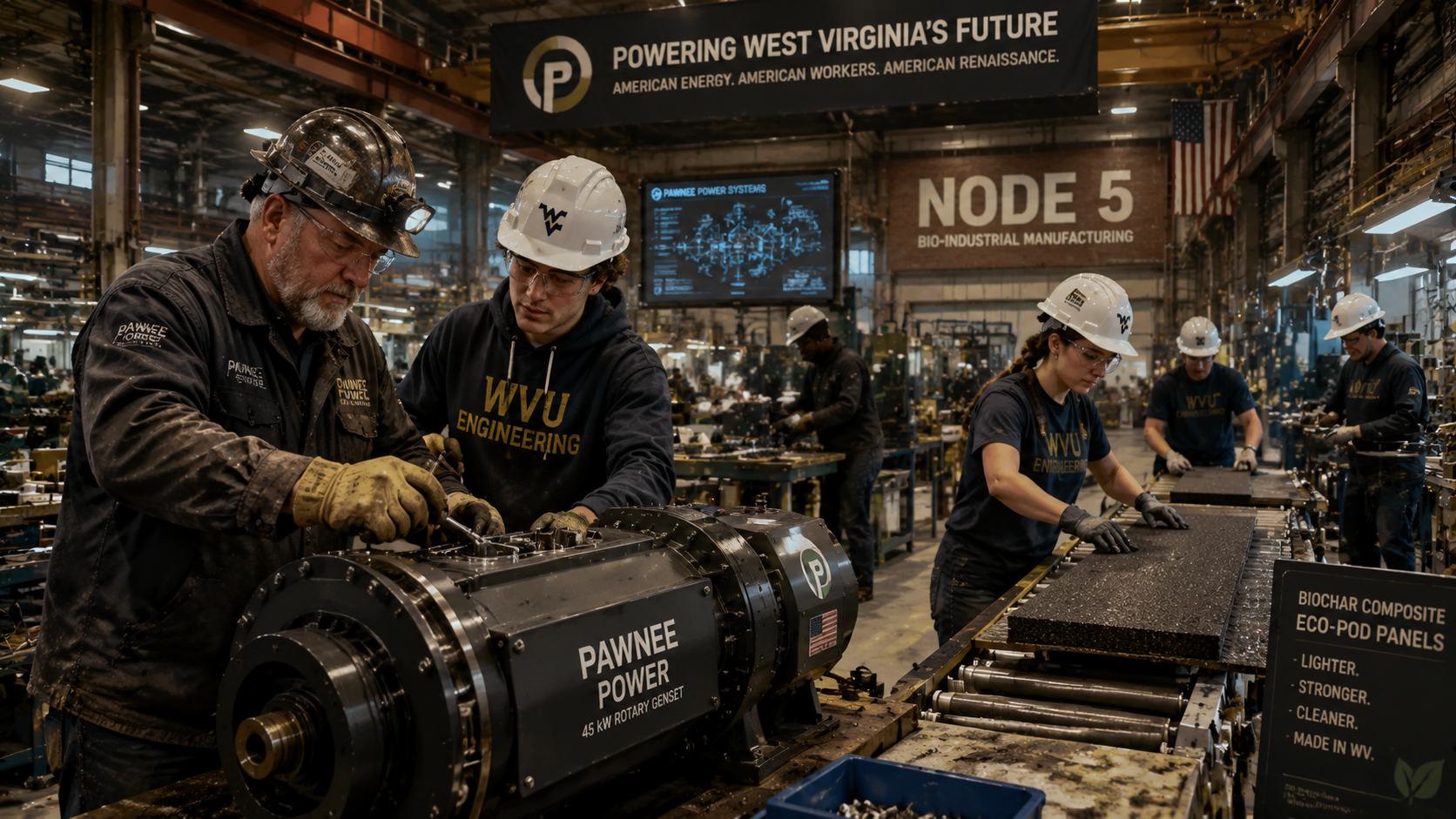
Sovereign Edge Infrastructure: Operationalizing West Virginia H.B. 2014 for Behind-the-Meter AI Compute and Microgrid Orchestration via DeReticular’s Sovereign Stack
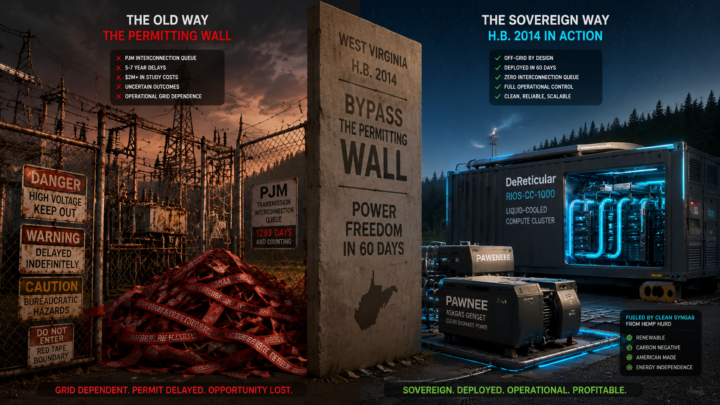
Authors: Michael Noel, Founder & Chief Systems Architect, DeReticular
Institutional Target Audience: Academic Leadership at West Virginia University
(Statler College of Engineering, Brad D. Smith OEDC), Principal Investigators of
the NSF RETI Consortium, Officials of the West Virginia Division of Economic
Development, and Institutional Energy & Data Center Infrastructure Investors.
SECTION I: EXECUTIVE SUMMARY & SYSTEMIC CONTEXT
- The AI Power Crunch & “The Permitting Wall”
The exponential proliferation of Large Language Model (LLM) training runs,
high-throughput Transformer inference clusters, and autonomous agent workflows
has transformed the data center industry from a real-estate-driven sector into a
constrained energy-arbitrage market. Modern high-density compute racks (e.g.,
NVIDIA HGX H100/B200 platforms) require thermal and electrical power densities
exceeding 40\text{ kW} to 120\text{ kW} per rack, pushing megawatt-scale
workloads into gigawatt-scale campus demands.
Concurrently, regional transmission organizations (RTOs)—most notably the PJM
Interconnection, which spans West Virginia—face an unprecedented structural
bottleneck. The PJM New Service Requests Queue is choked by multi-year
interconnection studies, transmission network upgrade requirements, and regional
capacity shortfalls. For a hyperscale or edge data center developer attempting
to connect a 100\text{ MW}+ facility to the regional transmission grid, the
queue timeline regularly spans 5 to 7 years. This systemic queue delay is
colloquially and operationally referred to as “The Permitting Wall.”
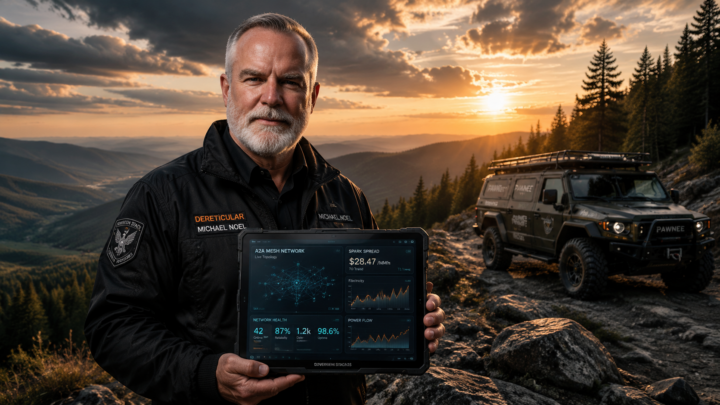
TRADITIONAL GRID-TIED DATA CENTER (PERMITTING WALL BOTTLENECK)
[ Power Generation ] —> [ PJM Transmission Queue (5-7 Yrs) ] —> [ Substation ] —> [ Data Center ] (FAILED TIMELINE)
BEHIND-THE-METER SOVEREIGN EDGE NODE (H.B. 2014)
[ Local Biomass/Syngas ] —> [ BtM Microgrid District ] —> [ RIOS-CC-1000 Compute Cluster ] (3-6 MO. DEPLOYMENT)
The Permitting Wall represents an existential threat to compute expansion. It is
driven by three main factors:
- Network Upgrade Allocations: Transmission owners require new generation or
large load additions to fund multi-hundred-million-dollar substation and
line reconductoring projects. - PJM Interconnection Reform Lag: Transitioning from a first-come,
first-served queue to a cluster-study process has temporarily frozen queue
movement. - Regional Capacity Depletion: Accelerated thermal plant retirements (coal and
legacy gas) combined with slow renewable integration have depleted localized
PJM capacity margins, raising localized marginal pricing (LMP) and capacity
market clears to historic highs. - Paradigm Shift: From “The Line” to “Spherical Resilience”
Legacy energy and telecommunications architectures were designed on linear,
single-point-of-failure topologies—a paradigm designated as “The Line.” In a
linear infrastructure regime:
\text{Reliability}{\text{system}} = \prod{i=1}^{n} R_i where R_i is the
operational reliability of the i-th dependent node (e.g., central coal plant
\rightarrow high-voltage transmission \rightarrow regional substation
\rightarrow local distribution feeder \rightarrow facility transformer). If any
link i drops to R_i = 0, the system collapses.
DeReticular introduces an architectural alternative: Spherical Resilience.
Operating under a decentralized, self-healing, mesh-oriented physical and
digital topology, Spherical Resilience constructs localized, autonomous
micro-industrial nodes capable of instantaneous, deterministic detachment from
legacy utilities—a state designated as “Island Mode.”
| Feature / Metric | Linear Infrastructure (“The Line”) | Spherical Resilience (DeReticular Sovereign Stack) |
|---|---|---|
| Topology | Cascading, central-outward tree | Non-Euclidean, self-healing mesh |
| Grid Interdependence | Total ($100\%$ reliant on PJM interconnect) | Zero-to-Minimal (Behind-the-Meter / Captive Generation) |
| Interconnection Timeline | 60–84 Months (PJM Queue) | 3–6 Months (State-Level Microgrid Designation) |
| Fault Isolation | Cascading regional blackouts | Localized deterministic islanding (IEEE 1547.4 compliant) |
| Energy Monetization | Passive consumer subjected to LMP volatility | Active “Spark Spread” real-time compute/power arbitrage |
| Regulatory Oversight | Federal (FERC) & State Utility Commissions (PSC) | Streamlined State Division of Economic Development |
- Abstract of the Solution: The Sovereign Stack
DeReticular’s Sovereign Stack is an integrated hardware, software, and
thermodynamic architecture engineered to bypass the Permitting Wall entirely. By
deploying on-site, behind-the-meter (BtM) multi-fuel generation paired directly
with high-density kinetic compute modules, the Sovereign Stack decouples AI
infrastructure from regional transmission constraints.
Operating under the explicit statutory protections of West Virginia House
Bill 2014 (H.B. 2014), the Sovereign Stack harmonizes three key elements:
- The Mind: The Rural Infrastructure Operating System (RIOS)—an AI-native
Distributed Energy Resource Management System (DERMS) utilizing
hardware-secured oracles (TPM 2.0) and Sysbox container isolation. - The Muscle: Agra Energy plasma gasification (converting regional forestry
residue, industrial hemp, and waste into syngas) driving RIOS-CC-1000
liquid-cooled, high-density edge compute modules. - The Motion: Kurb Kars autonomous DePIN transport fleets operating off-grid
for continuous feedstock logistics and regional connectivity.
SECTION II: DEEP-DIVE REGULATORY ANALYSIS: WEST VIRGINIA H.B. 2014
Enacted as the Power Generation and Consumption Act, West Virginia House
Bill 2014 (codified across relevant sections of W. Va. Code §24 and §5B)
established the Certified Microgrid Development Program, administered directly
by the West Virginia Division of Economic Development. H.B. 2014 offers four key
legal structural advantages for edge compute and microgrid deployment.
+———————————————————————————–+
| WEST VIRGINIA DIVISION OF ECONOMIC DEVELOPMENT |
| (Administers H.B. 2014 Program) |
+—————————————–+—————————————–+
|
v
+———————————————————————————–+
| CERTIFIED MICROGRID DISTRICT |
| |
| 1. W. Va. Code §24-2-21a: Total PSC Exemption (No Rate/Siting Regulation) |
| 2. W. Va. Code §24-2F-8 Exemption: Complete PJM Interconnect Queue Bypass |
| 3. State Statutory Preemption: Overrides Municipal/County Zoning Bans |
| 4. Captive Power Mandate: ≥70% Energy Consumed On-Site via AI Compute Load |
+———————————————————————————–+
- Public Service Commission (PSC) Jurisdiction Exemption (§24-2-21a)
Under legacy utility frameworks, any entity generating, transmitting, or
distributing electricity to a third party or within a localized district is
classified as a “public utility” under W. Va. Code §24-2-1, subjecting it to
rate-of-return regulation, public hearings, territorial service monopolies, and
Certificates of Public Convenience and Necessity (CPCN).
H.B. 2014 alters this landscape through the creation of W. Va. Code §24-2-21a.
This statute explicitly removes Certified Microgrid Districts from PSC
jurisdiction:
- Rate Unregulation: Microgrid developers may negotiate direct, unmonitored
power purchase agreements (PPAs), compute-for-power contracts, or internal
transfer prices without filing rate cases or tariff schedules. - Exemption from CPCN Requirements: Microgrid operators are not required to
prove a public “need” for generation assets, bypassing contested
administrative litigation before the PSC that traditional power plant
developers endure. - Service Obligations Abolished: The microgrid operator is relieved of the
“duty to serve” external retail customers, ensuring all generated energy
remains captive to the industrial compute facility.
- Interconnection Queue & Net Metering Bypass (§24-2F-8 Exemption)
Traditional grid-interconnected projects are subject to W. Va. Code §24-2F-8,
which mandates utility net-metering compliance, interconnection safety reviews,
and regional transmission organization (RTO) study schedules.
Under H.B. 2014, a Certified Microgrid District operating in behind-the-meter or
off-grid configuration is statutory exempt from §24-2F-8. The operational
consequences are profound:
\Delta T_{\text{deployment}} = T_{\text{PJM Queue}} – T_{\text{State Microgrid Certification}}
where T_{\text{PJM Queue}} \approx 60 \text{ to } 84 \text{ months}, while
T_{\text{State Microgrid Certification}} \approx 3 \text{ to } 6 \text{ months}.
By operating behind-the-meter (BtM) with zero net export back onto the PJM
transmission system during peak hours, the microgrid avoids triggering a PJM
Interconnection Request. The speed-to-power advantage reduces time-to-market by
over 90\%, allowing compute infrastructure to be deployed within the capital
expenditure cycle of modern GPU hardware generations (18–24 months).
- Preemption of Local Siting Restrictions
Historically, local county commissions and municipal planning boards have used
land-use zoning, conditional use permits (CUPs), and noise ordinances to delay
or block microgrid power generation and data center construction.
podcast
H.B. 2014 establishes Statewide Statutory Preemption. Authority over the
creation, siting, environmental boundary validation, and operational
certification of Certified Microgrid Districts is consolidated exclusively
within the West Virginia Division of Economic Development (WVDED).
- Once certified by the WVDED Secretary, local municipal or county zoning bans
restricting generation equipment, containerized compute enclosures, or
gasification units are preempted as a matter of state law. - Siting authority is streamlined through a single administrative agency,
eliminating fragmented municipal approval processes.
- Mathematical & Operational Breakdown of the Captive Power Structure
H.B. 2014 imposes a explicit operational condition to maintain Certified
Microgrid status: the Captive Power Rule.
Statutory Requirement:
A Certified Microgrid District must guarantee that at least 70\% of the total
electrical energy (\text{MWh}) generated within the district is consumed locally
by on-site high-impact industrial or compute assets, with net exports to the
commercial utility grid strictly capped at < 10\% on an annual aggregate basis.
\text{Captive Ratio } (\mathcal{C}R) = \frac{\int{0}^{8760} P_{\text{compute}}(t) \, dt}{\int_{0}^{8760} P_{\text{generation}}(t) \, dt} \ge 0.70
\text{Export Ratio } (\mathcal{E}R) = \frac{\int{0}^{8760} P_{\text{grid_export}}(t) \, dt}{\int_{0}^{8760} P_{\text{generation}}(t) \, dt} \le 0.10
Mathematical Proof: High-Density AI Compute as the Ideal Captive Load
Traditional industrial manufacturing loads suffer from variable operational
cycles, shift changes, and supply-chain outages, creating volatile load profiles
(P_{\text{load}}(t)) that struggle to maintain \mathcal{C}_R \ge 0.70 without
curtailing generation.
Conversely, a High-Density AI Compute Cluster operating LLM training runs or
continuous batch inference functions as a near-constant, flat load profile
(\text{Capacity Factor} \approx 0.95 – 0.98).
Let P_{\text{gen}}(t) = P_{\text{rated}} (constant prime power output from Agra
Energy plasma gasification).
Let
P_{\text{compute}}(t) = P_{\text{GPU_cluster}} + P_{\text{liquid_cooling_parasitic}}.
Assume a 10\text{ MW} nameplate Agra Energy microgrid district:
\int_{0}^{8760} P_{\text{gen}}(t) \, dt = 10\text{ MW} \times 8760\text{ hrs} = 87,600\text{ MWh/year}
Configure a RIOS-CC-1000 compute module with a continuous draw of 8.5\text{ MW}:
\text{Annual Compute Consumption} = 8.5\text{ MW} \times 8760\text{ hrs} \times 0.96 \text{ (uptime factor)} = 71,481.6\text{ MWh/year}
\mathcal{C}_R = \frac{71,481.6\text{ MWh}}{87,600\text{ MWh}} = 0.816 \quad (81.6\%)
Because 81.6\% \ge 70.0\%, the facility satisfies the statutory Captive Power
Mandate (\mathcal{C}_R \ge 0.70). The remaining 18.4\% of generated energy is
either absorbed by on-site battery energy storage systems (BESS), utilized for
local biomass processing, or selectively dispatched to adjacent micro-industrial
loads, ensuring \mathcal{E}_R < 0.10.
Conclusion: High-density AI compute is mathematically the most effective load
profile to fulfill the statutory requirements of W. Va. Code H.B. 2014.
SECTION III: DERETICULAR SOVEREIGN STACK TECHNICAL ARCHITECTURE
The Sovereign Stack is an integrated hardware and software environment designed
for behind-the-meter compute deployment.
===================================================================================
RIOS ORCHESTRATION LAYER (THE MIND)
[ Real-Time Spark Spread Engine ] <—> [ TPM 2.0 Security Oracles / Sysbox ]
|
+—————–+—————–+
| Zero-Trust Mesh (Hyphanet/NeoMesh)|
+—————–+—————–+
|
==========================================|========================================
PHYSICAL EXECUTION LAYER
|
+———————————+———————————+
| |
v v
AGRA ENERGY (THE MUSCLE) RIOS-CC-1000 (THE EDGE)
[ Biomass Gasifier ] —> [ Syngas GenSet ] —> DC Bus (700V) —> [ Liquid-Cooled GPUs ]
^ |
| v
KURB KARS (THE MOTION) <————————————- [ On-Site BESS / Thermal Dump ]
[ Autonomous Biomass Logistics Fleet ]
- The Mind — RIOS (Rural Infrastructure Operating System)
RIOS is an AI-native Distributed Energy Resource Management System (DERMS)
operating at the physical/digital boundary.
+———————————————————————————–+
| RIOS KERNEL |
| |
| +———————————–+ +———————————–+ |
| | Sysbox Container Runtime | | Hardware TPM 2.0 Root-of-Trust | |
| | (Isolated Rootless MicroVMs) | | (Cryptographic Sensor Oracles) | |
| +—————–+—————–+ +—————–+—————–+ |
| | | |
| +——————–+——————–+ |
| | |
| v |
| +—————————————————————————–+ |
| | Zero-Trust Hyphanet / NeoMesh Stack | |
| | (Decentralized Peer-to-Peer Telemetry & Control) | |
| +—————————————————————————–+ |
+———————————————————————————–+
- Sysbox Isolated Container Runtimes: RIOS eschews standard Docker/Kubernetes
container engines due to shared-kernel security vulnerabilities. Instead, it
embeds Sysbox—a specialized container runtime that creates unprivileged,
rootless system containers capable of running systemd, Docker-in-Docker, and
specialized K8s nodes with virtual-machine-level isolation. This prevents a
compromised AI workload from gaining access to physical microgrid control
loops. - Hardware-Secured TPM 2.0 Oracles: Physical sensors (current transducers,
thermocouple sensors, gas composition analyzers) are interfaced via Trusted
Platform Module (TPM 2.0) hardware chips. Every telemetric packet
(I(t), V(t), \text{Gas composition}) is cryptographically signed at the
silicon level before being ingested by the RIOS DERMS logic:
\text{Packet}{\text{signed}} = \text{Sign}{\text{TPM_Key}}\Big(\text{Data} \,|\, \text{Timestamp} \,|\, \text{Nonce}\Big)
This architecture eliminates “Oracle Attacks,” preventing malicious actors
or rogue software agents from spoofing microgrid telemetry to trigger
thermal or electrical tripping. - Zero-Trust Mesh Networking (Hyphanet / NeoMesh): Telemetry and control
commands between distributed nodes are transmitted over a decentralized
peer-to-peer mesh network utilizing the Hyphanet protocol stack. Operating
over local sub-GHz radio (915 MHz), optical line-of-sight, and encrypted
wireguard tunnels, Hyphanet ensures the microgrid control loop remains fully
operational even during complete satellite or cellular blackout.
- The Muscle — Agra Energy & Plasma Gasification
Prime power generation within the Sovereign Stack is driven by Agra Energy
plasma gasification units, converting regional waste feedstocks into high-BTU
syngas.
+———————————————————————————–+
| AGRA ENERGY THERMODYNAMIC CYCLE |
| |
| [ Biomass Feedstock ] —> [ High-Temp Gasification Vessel ] |
| (Plasma Torch T > 3000°C) |
| | |
| v |
| [ Syngas Synthesis ] |
| (CO + H2 Clean Gas) |
| | |
| v |
| [ Syngas Reciprocating Engine ] |
| (High-Efficiency Mechanical Shaft) |
| | |
| v |
| [ Permanent Magnet Synchronous Gen ] |
| (Raw Power -> Direct DC Bus) |
+———————————————————————————–+
Gasification Thermodynamics:
Agra Energy plasma gasification subjects organic feedstocks (forestry residue,
waste timber, industrial hemp, coal seam methane) to high-temperature thermal
conversion (T > 3,000^\circ\text{C}) in an oxygen-depleted reactor vessel.
\text{Biomass } (\text{C}_n\text{H}_m\text{O}_k) + \text{Thermal Energy} \longrightarrow a\text{CO} + b\text{H}_2 + c\text{CH}_4 + d\text{CO}_2
The resulting Synthesis Gas (Syngas) undergoes multi-stage scrubbing (tar
removal, particulate cyclonic filtering, and desulfurization) to produce a fuel
gas with a Lower Heating Value (LHV) of 12\text{ to } 18\text{ MJ/Nm}^3.
Generation Specifications:
- Heat Rate: 8,800\text{ BTU/kWh} (thermal-to-electric efficiency
\approx 38.7\%). - Emissions Profile: Sub-10\text{ ppm } \text{NO}_x, near-zero \text{SO}_x,
and carbon-negative potential when utilizing regional biomass coupled with
biochar byproduct sequestration. - Fuel Flexibility Index: Dynamically auto-tunes internal combustion engine
fuel-injection timing based on real-time methane-to-hydrogen ratios reported
by the TPM 2.0 gas sensors.
- The Muscle — RIOS-CC-1000 Kinetic Compute Modules
The RIOS-CC-1000 is a ruggedized, deployable containerized compute module
engineered specifically for high-density edge AI deployment.
+———————————————————————————–+
| RIOS-CC-1000 MODULE ARCHITECTURE |
| |
| +—————————————————————————–+ |
| | 700V Centralized DC Bus System | |
| +————————————+—————————————-+ |
| | Direct DC Coupling |
| v |
| +—————————————————————————–+ |
| | Liquid Cold-Plate Cooling Loop (CDU) | |
| | (Direct-to-Chip Fluorinert/PGW Coolant Circuit) | |
| +————————————+—————————————-+ |
| | Thermal Heat Heat Recovery |
| v |
| +—————————————————————————–+ |
| | 1.2 MW GPU Inference/Training Racks | |
| | (High-Density Vibration-Isolated Structural Frame) | |
| +—————————————————————————–+ |
+———————————————————————————–+
Engineering Specifications:
- Volumetric Power Density: 1.2\text{ MW} compute capacity housed within a ISO
40\text{-ft} high-cube reinforced enclosure. - Direct-to-Chip Liquid Cooling: Closed-loop Coolant Distribution Units (CDUs)
circulating propylene glycol/water (PGW) mixtures directly across GPU/CPU
cold plates, maintaining junction temperatures T_j < 65^\circ\text{C} under
100\% TDP loads with an ambient operating range of
-30^\circ\text{C} \text{ to } +50^\circ\text{C}. - Direct DC Bus Power Coupling: Bypasses traditional AC-to-DC
double-conversion UPS losses. Power generated by the Agra Energy syngas
gensets is rectified directly to a centralized 700\text{V DC} busbar within
the container, feeding server power supply units (PSUs) directly:
\eta_{\text{power_chain}} = \eta_{\text{rectifier}} \times \eta_{\text{DC_bus}} = 0.985 \times 0.992 = 0.977 \quad (97.7\% \text{ Efficiency})
Compared to traditional AC data center power trains (\eta \approx 88-91\%),
direct DC bus coupling yields a \approx 7-9\% reduction in parasitic power
losses. - Kinetic Structural Isolation: Reinforced chassis mounted on multi-axis tuned
kinetic dampers, isolating GPU silicon from physical vibrations induced by
on-site gas engines or heavy transport machinery.
- The Motion — Kurb Kars & DePIN Logistics
Microgrid reliability is dependent on continuous fuel delivery. Kurb Kars
represents the logistics layer of the Sovereign Stack, consisting of off-grid,
autonomous electric freight vehicles.
+———————————————————————————–+
| KURB KARS LOGISTICS LOOP |
| |
| [ Regional Biomass Hub ] —> [ Kurb Kars Fleet (Off-Grid EV) ] |
| | |
| v |
| [ Microgrid Fuel Bay ] <— [ On-Site DC Fast Charger (Direct BtM) ] |
+———————————————————————————–+
- Autonomous Feedstock Delivery: Kurb Kars operate on defined logging and
private access routes, hauling regional biomass (woodchips, agricultural
waste) from regional collection hubs directly to the Agra Energy gasifier
hopper. - Off-Grid Charging Mechanics: Vehicles charge directly from the local
microgrid 700\text{V DC} bus using direct DC fast-charging protocols
(CCS2/NACS) during periods of low AI compute demand, absorbing surplus
microgrid power without touching external utility chargers. - Islanded Fleet Intelligence: Fleet routing and battery state-of-charge (SoC)
management are governed by RIOS via the local Hyphanet mesh, operating
independently of external cloud or cellular networks.
- The Spark Spread Arbitrage Engine
The financial core of the Sovereign Stack is the Spark Spread Arbitrage Engine
embedded within the RIOS kernel. The engine continuously executes real-time
deterministic optimization to maximize node profitability by switching between
energy generation, compute execution, battery storage, and localized grid power
dispatch.
The Spark Spread Objective Function:
Let V_{\text{FLOP}}(t) be the real-time monetary value of executing one Floating
Point Operation (1\text{ FLOP}) on the local AI compute cluster at time t
(\$/\text{TFLOP}).
Let C_{\text{fuel}}(t) be the levelized cost of biomass/syngas feedstock input
(\$/\text{MMBTU}).
Let P_{\text{LMP}}(t) be the PJM Locational Marginal Price for external power
export/import (\$/\text{MWh}).
Let \eta_{\text{thermal}} be the heat rate of the Agra Energy engine
(\text{MMBTU/MWh}).
Let \text{Eff}{\text{compute}} be the hardware compute efficiency (\text{TFLOPS/MW}). Let S{\text{BESS}}(t) be the State-of-Charge of the battery storage system
(\%).
\text{Maximize } \Pi(t) = \max \Big( \Pi_{\text{compute}}(t), \, \Pi_{\text{grid_export}}(t), \, \Pi_{\text{bess_charge}}(t) \Big)
Where:
\Pi_{\text{compute}}(t) = \left[ P_{\text{gen}}(t) \times \text{Eff}{\text{compute}} \times V{\text{FLOP}}(t) \right] – \left[ P_{\text{gen}}(t) \times \eta_{\text{thermal}} \times C_{\text{fuel}}(t) \right] – \text{OPEX}_{\text{compute}}
\Pi_{\text{grid_export}}(t) = \left[ P_{\text{gen}}(t) \times P_{\text{LMP}}(t) \right] – \left[ P_{\text{gen}}(t) \times \eta_{\text{thermal}} \times C_{\text{fuel}}(t) \right] – \text{OPEX}_{\text{gen}}
\text{Subject to the statutory constraints of H.B. 2014:}
\mathcal{C}R = \frac{\int{0}^{T} P_{\text{compute}}(t) \, dt}{\int_{0}^{T} P_{\text{gen}}(t) \, dt} \ge 0.70 \quad \text{and} \quad \mathcal{E}_R \le 0.10
                            SPARK SPREAD DECISION LOGIC
                                         |
                                         v
                       +-----------------------------------+
                       | Is V_FLOP * Eff_compute > P_LMP?  |
                       +-----------------+-----------------+
                                         |
                  +----------------------+----------------------+
                  | YES                                         | NO
                  v                                             v
   +-------------------------------+             +-------------------------------+
   | PRIORITIZE AI COMPUTE (RIOS)  |             | ROUTE TO STORAGE / CAPTIVE    |
   |  - Maximize GPU Utilization   |             |  - Charge Local BESS          |
   |  - Maintain Captive Ratio >70%|             |  - Process Biomass (Kurb Kars)|
   +-------------------------------+             +-------------------------------+
When V_{\text{FLOP}}(t) is high (e.g., peak demand for LLM inference), RIOS
routes 100\% of available syngas power to the RIOS-CC-1000 modules. If compute
demand softens, RIOS shifts power to process local biomass feedstocks, charge
BESS systems, or dispatch energy to local thermal processes, adhering strictly
to the 70\% captive power ratio mandate (\mathcal{C}_R \ge 0.70).
SECTION IV: INSTITUTIONAL SYNERGY: WVU & THE $321M NSF RETI CONSORTIUM
The National Science Foundation (NSF) established the Resilient Energy
Technology and Infrastructure (RETI) Consortium led by West Virginia University
(WVU), representing over 321\text{ million} in public-private investments
(160\text{M} NSF Regional Innovation Engine grant matched by 161\text{M} in
state and industrial funding). DeReticular’s Sovereign Stack aligns directly
with the RETI Engine’s strategic imperatives.
+———————————————————————————–+
| NSF RETI CONSORTIUM AT WVU |
| ($321M Engine) |
+—————————————–+—————————————–+
|
+——————-+—————-+——————-+——————-+
| | | |
v v v v
[ Pillar 1 ] [ Pillar 2 ] [ Pillar 3 ] [ Pillar 4 ]
Grid-Edge Resilience AI Data Center Infrastructure Cybersecurity Commercialization
| | | |
+——————-+—————-+——————-+——————-+
|
v
+———————————————————————————–+
| DERETICULAR SOVEREIGN STACK INTEGRATION |
| |
| • RIOS Autonomous DERMS • Captive BtM AI Compute (H.B. 2014) |
| • TPM 2.0 / Sysbox Zero-Trust Core • A2A Outdoor Proving Ground (Node 3) |
+———————————————————————————–+
- Structural Alignment with RETI Research Pillars
RETI PILLAR MAPPING MATRIX
NSF RETI PILLAR DERETICULAR SOVEREIGN STACK CAPABILITY
———————– ————————————————–
- Grid Edge Resilience RIOS Autonomous DERMS (Island Mode Operation)
- AI Infrastructure Behind-the-Meter High-Density Compute (RIOS-CC-1000)
- Cybersecurity TPM 2.0 Silicon Root-of-Trust & Sysbox Isolation
- Commercialization DeReticular Venture Studio & Project Octagon Deployment
- Pillar 1: Grid-Edge Resilience & Advanced DERMS: RIOS provides a real-world
testing environment for edge grid stability, frequency regulation, and
autonomous microgrid islanding without risking regional transmission
stability. - Pillar 2: AI & Data Center Power Mitigation: DeReticular offers a functional
model for co-locating energy production directly with high-density compute,
resolving regional utility load growth challenges. - Pillar 3: Hardware Cybersecurity & Zero-Trust Architecture: Incorporating
TPM 2.0 hardware oracles and Sysbox runtimes aligns directly with RETI’s
mission to secure critical energy infrastructure against state-actor cyber
threats. - Pillar 4: Commercialization & Regional Job Creation: DeReticular acts as an
execution vehicle, scaling academic R&D from WVU laboratories into
commercial deployments across West Virginia.
- Agent-to-Agent (A2A) Outdoor Campuses
In collaboration with the WVU Statler College of Engineering and the Brad D.
Smith Outdoor Economic Development Collaborative (OEDC), DeReticular proposes
the establishment of an Agent-to-Agent (A2A) Outdoor Proving Ground on
WVU-affiliated rural land.
+———————————————————————————–+
| AGENT-TO-AGENT (A2A) CAMPUS TOPOLOGY |
| |
| +——————–+ A2A Peer-to-Peer +——————–+ |
| | Energy Agent (Agra)| <———————–> | Compute Agent (CC) | |
| +———+———-+ (Hyphanet Mesh) +———+———-+ |
| | | |
| | A2A Trade Negotiation | Local Sensor Data |
| v v |
| +——————–+ +——————–+ |
| | Fleet Agent (Kurb) | <———————–> | Sensor Agent (TPM) | |
| +——————–+ +——————–+ |
+———————————————————————————–+
Operational Concept:
The A2A Outdoor Campus functions as an autonomous micro-economy governed by
software agents executing peer-to-peer protocols over the Hyphanet mesh:
- Energy Agent (Agra Gasifier): Monitors syngas pressure, thermodynamic
efficiency, and fuel inventory. It autonomously negotiates power pricing
with the Compute Agent. - Compute Agent (RIOS-CC-1000): Evaluates incoming LLM inference workloads and
bids for energy from the Energy Agent based on real-time FLOP margins. - Fleet Agent (Kurb Kars): Monitors biomass fuel levels at the gasifier,
autonomously dispatching electric transport vehicles to harvest and haul
feedstock from regional collection hubs. - Sensor Agent (Environmental Oracles): Cryptographically signs local air
quality, water run-off, and soil health metrics, feeding verified data to
academic researchers via TPM 2.0 roots-of-trust.
- Project Octagon (Node 3 Integration)
DeReticular is deploying Project Octagon—a global network of eight strategic
sovereign infrastructure nodes designed to validate the Sovereign Stack across
diverse geopolitical and climatic environments.
+———————————————————————————–+
| PROJECT OCTAGON GLOBAL MESH |
| |
| [ Node 1: Kaabong, Uganda ] <—> [ Node 2: Canadian Authority ] |
| (Hemp-to-Energy/AI) (Software & Cold-Testing) |
| |
| ^ |
| | Peer-to-Peer Sync |
| v |
| |
| [ NODE 3: WEST VIRGINIA ] <—> [ Node 4: Arizona Desert ] |
| (Morgantown/N. River Gorge) (Extreme Thermal Testing) |
+———————————————————————————–+
- Node 1 (Kaabong, Uganda): 7,000-acre agricultural campus testing plasma
gasification and rural AI compute under tropical conditions. - Node 2 (Canada): Software control authority and extreme cold-weather
operational testing. - NODE 3 (West Virginia — Morgantown / New River Gorge): The primary North
American R&D anchor node. Node 3 will serve as the global integration site
for H.B. 2014 microgrid district compliance, A2A outdoor campus operations,
and university-partnered research.
SECTION V: OPERATIONAL BLUEPRINT & RISK MITIGATION
- Feedstock Logistics & Biomass Supply Chain
To guarantee continuous 24/7/365 prime power generation for Agra Energy
gasifiers, a structured feedstock supply chain is established within a
35\text{-mile} operational radius of the microgrid district.
+———————————————————————————–+
| REGIONAL BIOMASS SUPPLY CHAIN |
| |
| [ Sawmills & Timber Ops ] —\ |
| [ Agri-Waste & Hemp Ops ] —-> [ Local Processing Hub ] —> [ Kurb Kars Fleet ]|
| [ Mine Methane Captures ] —/ (Sizing/Drying to <15% H2O) (Dry Feed Delivery) |
| | |
| v |
| [ Gasifier Hopper ] |
+———————————————————————————–+
- Feedstock Diversification: Sourcing timber residues from regional wood
product facilities, agricultural waste, and dedicated industrial hemp crops. - Moisture & Particle Standardization: Raw biomass is processed at local
collection yards—chipped to standardized 2\text{-inch} dimensions and dried
using waste heat recovered from the gasifier exhaust circuit to achieve
moisture levels < 15\% \text{ H}_2\text{O}. - Volumetric Security: Maintaining a 45\text{-day} on-site dry feedstock
reserve at the microgrid district to hedge against seasonal forestry
interruptions or severe winter weather events.
- System Failover & “Island Mode” Redundancy
Sovereign microgrids must maintain utility-grade uptime (99.999\% reliability)
for AI compute assets without relying on the external electrical grid.
+———————————————————————————–+
| ISLAND MODE REDUNDANCY FLOW (N+1) |
| |
| [ Primary Gasifier A ] —-\ |
| [ Backup Gasifier B ] —–> [ Central 700V DC Bus ] <—> [ Fast-Response BESS ]|
| [ Emergency Methane ] —-/ | |
| v |
| [ RIOS Compute Racks ] |
+———————————————————————————–+
- N+1 Engine Redundancy: A 10\text{ MW} demand facility deploys three
5\text{ MW} syngas generator sets. Two units run continuously at 100\% load,
while the third remains in warm-standby mode. - Transient Load Suppression via BESS: A high-C-rate Lithium Iron Phosphate
(LFP) Battery Energy Storage System (2\text{ MW} / 2\text{ MWh}) bridges the
DC bus during rapid GPU load transients
(\Delta P_{\text{compute}} / \Delta t). The BESS absorbs or supplies
instantaneous power within < 4\text{ milliseconds}, ensuring zero voltage
sag at the GPU power supply units. - Deterministic Islanding (IEEE 1547.4): In configurations with physical grid
ties, automated solid-state breaker switches execute physical separation
within < 8\text{ milliseconds} upon detecting external grid frequency instability (\Delta f > 0.5\text{ Hz}).
- Environmental & Permitting Compliance
While H.B. 2014 provides exemptions from PSC utility jurisdiction, environmental
protection regulations managed by the West Virginia Department of Environmental
Protection (WVDEP) Division of Air Quality remain in force.
+———————————————————————————–+
| WVDEP AIR PERMITTING STREAMLINING |
| |
| [ Syngas Engine Exhaust ] —> [ Selective Catalytic Reduction (SCR) ] |
| | |
| v |
| [ Oxidation Catalyst ] |
| | |
| v |
| [ Continuous Emissions (CEMS) ] |
| (Real-time WVDEP Telemetry) |
+———————————————————————————–+
- Air Quality Permitting (Rule 13 Exemption / Minor Source Classification): By
utilizing high-temperature plasma gasification and syngas scrubbing,
emissions of Criteria Pollutants
(\text{NO}x, \text{CO}, \text{VOC}, \text{PM}{2.5}) remain below
major-source Title V thresholds (< 100\text{ tons/year}). Sites qualify for
streamlined WVDEP Rule 13 Construction Permits. - Exhaust After-Treatment: Syngas engine exhaust passes through Selective
Catalytic Reduction (SCR) and oxidation catalysts, reducing \text{NO}_x
emissions to sub-5\text{ ppm} levels. - Closed-Loop Water Management: Plasma gasification and CDU cooling circuits
utilize closed-loop heat exchangers, resulting in zero industrial wastewater
discharge.
SECTION VI: CONCLUSION & STRATEGIC CALL TO ACTION
- Summary of Economic and Technological Impact
West Virginia stands at an infrastructural inflection point. The intersection of
H.B. 2014 statutory incentives and the 321\text{M} NSF RETI Consortium at WVU
provides an optimal regulatory and academic environment to deploy
next-generation infrastructure.
By co-locating energy generation directly with high-density compute using
DeReticular’s Sovereign Stack, West Virginia can achieve significant
technological and economic outcomes:
- Bypass “The Permitting Wall”: Deploy gigawatt-scale AI compute
infrastructure within 3\text{ to } 6\text{ months}, compared to
5\text{ to } 7\text{ years} in regional utility transmission queues. - Rural Economic Revitalization: Transform agricultural and forestry waste
into high-margin, local clean energy and AI compute revenue, moving away
from legacy extractive commodity models. - Academic Leadership: Establish West Virginia University as a leading global
institution for autonomous DERMS orchestration, behind-the-meter compute
research, and DePIN hardware security. - Implementation Roadmap (Targeting September 1 Execution)
[ PHASE 1: AUG 1 – AUG 31 ] [ PHASE 2: SEPT 1 – OCT 31 ] [ PHASE 3: NOV 1 – Q1 2027 ]
Formal State Microgrid Filing A2A Campus Site Prep Deployment of RIOS-CC-1000
and Ascend WV Onboarding and WVU Research Integration Node 3 Integration & Testing
Phase 1: Regulatory Filing & Ascend WV Onboarding (August 1 – August 31)
- Complete formal onboarding into the Ascend West Virginia program,
establishing DeReticular’s primary software authority and R&D headquarters
at the Morgantown Hub. - Submit formal application materials to the West Virginia Division of
Economic Development for Certified Microgrid District designation under
H.B. 2014 for targeted deployment sites in Monongalia and Fayette counties.
Phase 2: Site Preparation & Academic Engagement (September 1 – October 31)
- Establish the formal research framework between DeReticular, the WVU Statler
College of Engineering, and the NSF RETI Consortium leadership. - Finalize land-use agreements for the Agent-to-Agent (A2A) Outdoor Campus
testbed in proximity to Morgantown and the New River Gorge region. - Execute local feedstock supply-chain contracts for biomass delivery.
Phase 3: Hardware Deployment & Node 3 Activation (November 1 – Q1 2027)
- Deploy the initial RIOS-CC-1000 1.2\text{ MW} containerized compute module
paired with an Agra Energy plasma gasification unit. - Activate Project Octagon Node 3, establishing real-time peer-to-peer
telemetry and A2A trade negotiations across the global Hyphanet mesh. - Initiate joint publication of academic findings on “Spark Spread”
efficiency, TPM 2.0 oracle security, and behind-the-meter microgrid
stability alongside WVU RETI researchers.
Submitted by:
Michael Noel
Founder & Chief Systems Architect, DeReticular
Website: www.dereticular.com
Core Specializations: AI-Native Infrastructure | Behind-the-Meter Compute |
DePIN | Sovereign Microgrids


