Strategic Roadmap: Transitioning to the Distributed Micro-Enterprise (DME) Economy
- Strategic Context: The Post-Extractive Imperative
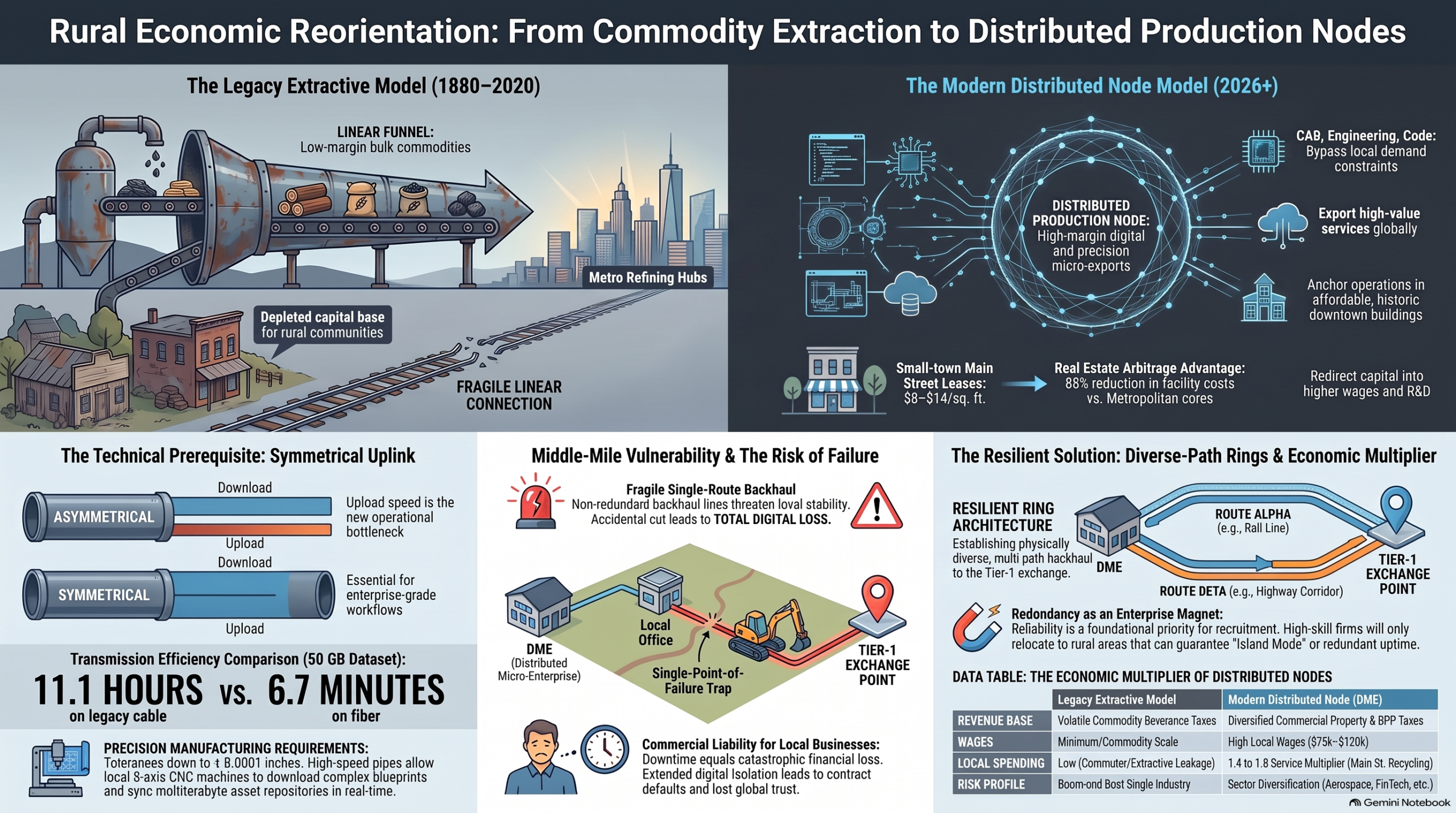
Rural leaders have spent seventy years chasing a 1,000-mile failure model. This legacy strategy of industrial recruitment—offering ruinous tax abatements to attract corporate branch plants or low-margin call centers—has left non-metropolitan America in a thermodynamic trap. When corporate headquarters in distant metros face a quarterly earnings hiccup, the rural “terminal end-point” is the first to be severed, leaving the municipality with empty shells and a cratered tax base. To secure long-term survival, leaders must pivot to the Distributed Node model. This paradigm shift moves the municipality from a passive participant in volatile commodity cycles to a sovereign economic center that anchors high-value, knowledge-based operations.
Comparative Economic Architectures
The following table contrasts the fragility of the legacy model with the resilience of the DME Node:
Feature Legacy Extractive Model Distributed Micro-Enterprise (DME) Node Model
Economic Basis Bulk Commodities (Timber, Grains, Ores) Knowledge-Work & Precision Production
Primary Driver Low-cost labor & tax abatements Technical infrastructure & cost arbitrage
Vulnerability High (Vulnerable to capital flight/relocation) Low (Anchored by local ownership & assets)
Market Reach Terminal end-point of a supply chain Sovereign hub for global exports
Capital Flow Capital flight to metropolitan hubs Reinvestment in local municipal balance sheets
By decoupling economic scalability from physical geography, a municipality can capture metropolitan-grade wealth while maintaining rural operating costs. This transition effectively transforms the town from a subservient supplier into a sovereign node, but such status is only achievable if the community masters the technical mechanics required by the modern enterprise.
- The Operational Foundation: Technical Mechanics and Cost Arbitrage
The “digital divide” is no longer about residential download speeds for entertainment; it is an industrial bottleneck defined by enterprise-grade upload capacity and real estate leverage. In the DME economy, the ability to transmit massive geospatial models, encrypted financial audits, or complex 3D toolpaths is the prerequisite for commercial entry. Communities relying on legacy asymmetric cable are structurally barred from high-margin competition.
The Technical Prerequisite: Symmetrical Gigabit Fiber
Modern workflows depend on synchronous data transmission. Legacy asymmetric connections (e.g., 50 Mbps down / 10 Mbps up) create severe operational failures during large-scale data transfers.
Operational Bottleneck: 50GB Dataset Transmission
- Legacy Asymmetric Cable (10 Mbps Upload): 11.1 Hours (Subject to packet loss and timeout)
- Symmetrical Gigabit Fiber (1,000 Mbps Upload): 6.7 Minutes (Secure, low-latency, synchronous)
The Rural Arbitrage Advantage
The primary competitive advantage for a rural DME is the massive structural reduction in overhead. This “-80% Rural Arbitrage” is not just a cost-saving measure; it is a weaponized financial strategy.
Annualized Operating Cost Comparison (12-Person Engineering/Tech Firm)
Expense Category Tier-1 Metro Core Suburban Office Park Small-Town Main Street Rural Arbitrage Savings
Commercial Rent 227,500 (65/sq. ft.) 98,000 (28/sq. ft.) 38,500 (11/sq. ft.) -83.1% vs. Metro
Property Tax Pass-Through High (12–18/sq. ft.) Moderate (4–7/sq. ft.) Low (1.50–3/sq. ft.) -75% to -80%
Cost per Workstation $23,500 / year $10,200 / year $3,600 / year -84.7% vs. Metro
These savings allow rural firms to out-compete urban rivals by directing capital toward higher R&D investment, superior talent retention, and the acquisition of high-value equipment. These economic foundations manifest most clearly within four high-margin industry pillars that redefine rural economic capacity.
- The Four Pillars of Rural DME Diversification
To protect the municipal budget from single-industry shocks—such as a collapse in timber prices or the closure of a legacy plant—leaders must foster a diversified DME ecosystem. These firms bypass local consumer constraints by exporting specialized services and precision goods to global markets.
The Four DME Sectors
- Specialized Finance & Forensic Accounting
- High-Value Export Activities: Cross-border transfer pricing, R&D tax credit defense, and forensic blockchain auditing.
- Geospatial & Environmental Engineering
- High-Value Export Activities: LiDAR point cloud modeling, 2D hydrodynamic flood mapping, and multispectral drone data processing.
- Distributed Software & Digital Media
- High-Value Export Activities: Cloud-native API integrations, enterprise systems reliability engineering (SRE), and real-time 3D creation (Unreal/Unity).
- Precision Manufacturing & Micro-Fabrication
- High-Value Export Activities: Aerospace sensor housings, titanium surgical tools, and custom defense fittings machined to ±0.0001″ tolerances.
Digital-to-Physical Manufacturing Workflow
Precision DMEs utilize a “Cloud-Linked” pipeline to transform global blueprints into local products:
- Step 1: Global OEM uploads native CAD blueprints to local secure servers.
- Step 2: Edge servers optimize toolpaths locally to protect Intellectual Property.
- Step 3: 5-axis CNC mills fabricate precision parts on-site.
- Step 4: Quality inspection via Coordinate Measuring Machines (CMM) followed by express global shipping.
High-wage salaries (75k–120k) in these sectors generate a local “Service Multiplier” effect of 1.4 to 1.8. Critically, because DMEs integrate their workforce into downtown office spaces—patronizing local cafes, trades, and grocers daily—they offer a significantly higher multiplier than isolated remote workers. This recycled payroll stabilizes the town’s core, but only if the physical core is ready for modern production.
- Spatial Strategy: Main Street Adaptive Reuse and Regulatory Reform
Revitalizing historic assets—19th-century banks, dry-goods warehouses, and masonry dealerships—is a strategic necessity to minimize capital outlay and rebuild density. However, this is often blocked by the “Heirs’ Property” impasse and outdated zoning. Municipalities must proactively resolve clouded titles and modernize land-use laws to allow modern production.
Adaptive Reuse Topology (Historic Building)
- Upper Level (Advanced Data/Production): Enterprise engineering desks and acoustically isolated video suites.
- Ground Level (Civic Interaction): Tech incubators, retail/cafes, and shared conference hubs.
- Basement/Rear Alley (Precision Fabrication): 3-phase 480V power conversion for 5-axis CNC enclosures with direct micro-logistics access.
Regulatory Conversion Checklist
Municipalities must abandon “Single-Use Euclidean Zoning” in favor of Form-Based Codes:
- Zero Hazardous Emissions Mandate: Allow clean, precision manufacturing to operate alongside retail and residential units.
- Acoustic Isolation Standards: Require modern sound-dampening to ensure fabrication remains invisible to the street.
- Electrical Infrastructure Upgrade: Modernize downtown distribution to 3-phase 480V power to support industrial equipment.
- Heirs’ Property Resolution: Implement municipal legal support to clear clouded titles, enabling building modernization.
In many non-metro areas, the “appraisal gap”—where construction costs exceed market value—makes adaptive reuse the only viable path for commercial growth. Revitalizing these parcels directly repairs the town’s fiscal ledger by converting idle assets into revenue engines.
- Fiscal Mechanics: Reversing Attrition and Stabilizing Tax Bases
The DME model utilizes “Municipal Fiscal Recycling” to mitigate the “Natural Decrease” in population. By attracting high-value equipment and talent, the town stabilizes its budget without raising tax rates on fixed-income residents.
Revenue Stream Diversification
- Business Personal Property (BPP) Taxes: A single $350,000 5-axis CNC mill or a high-density edge server rack provides a stable, high-value tax stream for schools and emergency services.
- Fiber Utility Franchise Fees: Recurring revenue collected from symmetrical gigabit providers.
- Commercial Assessment Surges: Adaptive reuse increases the capital value of downtown parcels, reversing the slide of deteriorating assessments.
Stability Analysis: Revenue Volatility
Commodity-Extractive Revenue Diversified DME Commercial Assessments
High Volatility: Exposed to market busts. High Stability: Insulated by sector diversity.
Eroding Base: Driven by mechanization. Growing Base: Driven by tech appreciation.
Severance/Stumpage Fees: Non-renewable. Equipment/BPP Taxes: Predictable & anchored.
Property value surges on revitalized downtown parcels protect essential services—water, fire, and education—without increasing the burden on residents. However, this stability is vulnerable to systemic infrastructure failures that must be navigated with executive precision.
- Navigating Bottlenecks: The Capacity Chasm and Infrastructure Resilience
Small municipal staffs are structurally disadvantaged in “Grant Tournaments.” This Administrative Capacity Deficit often prevents the absorption of federal funds, leading to a reinforcing cycle of decay.
The Three-Way Systemic Trap
- Housing Obsolescence: Pre-1970 stock and appraisal gaps halt all new private construction.
- Insurance Retreat: Volunteer Fire Department (VFD) depletion reduces fire protection ratings to ISO PPC Class 9 or 10. This triggers a mass retreat by national insurers, making local properties uninsurable or prohibitively expensive.
- Administrative Deficit: The inability to manage complex NEPA, BABA, and Davis-Bacon compliance requirements.
Middle-Mile Architecture: The Resilient Ring
A single fiber cut along a highway easement can paralyze a DME. Municipalities must move from fragile single-routes to resilient diverse-path rings.
RESILIENT DIVERSE-PATH RING
[DME Node] <—> [Local Central Office]
|
/——————————
[Route Alpha: Rail] [Route Beta: Highway]
——————————/
|
[Tier-1 Internet Exchange]
The Role of Rural Electric Cooperatives (RECs): RECs are the “Transformative Anchors” of this transition. Because they already own utility poles and rights-of-way and operate on multi-decade capital horizons, they are the ideal partners for deploying fiber and microgrids. These defensive strategies are the prerequisite for the offensive “Sovereign Enclave” model.
- The Sovereign Enclave: Achieving “Island Mode” Resilience
The final stage of the DME transition is DeReticulation: shifting from “Linear Fragility” to “Spherical Resilience.” A sovereign enclave can operate in Island Mode, protecting local commerce during regional grid or telecom collapses.
The 5-Layer Sovereign Stack
- Layer 1: Baseload Power: 700V DC Microgrids utilizing IRA Section 6417 Direct Pay for on-site biomass gasification or rotary generation.
- Layer 2: Kinetic Mobility: Autonomous utility EVs and mobile battery skids for local logistics.
- Layer 3: Edge Mesh Comms: Self-healing wireless arrays providing an autonomous municipal communication canopy.
- Layer 4: Cognitive AI: Air-gapped Remnant AI nodes that optimize municipal SCADA systems and precision toolpathing without cloud dependency, protecting against IP theft and connection loss.
- Layer 5: Governance: Regional Councils of Government (COGs) and P3 capital stacking to bypass the capacity deficit.
“Island Mode” creates a definitive competitive advantage. While other towns go dark during a storm or network outage, the Sovereign Enclave remains operational, securing its global contracts and local commerce through autonomous intelligence and power.
- Implementation Roadmap: The 2026+ Municipal Checklist
Local action is mandatory in an environment where federal funding favors the well-resourced. Municipalities must transition from terminal end-points to sovereign nodes through a disciplined, phased protocol.
The Four-Phase Transition Protocol
- Phase 1: Audit & Isolate
- Conduct forensic municipal audits. Identify critical nodes (Water, 911, Town Hall) for island-mode conversion to prevent systemic collapse.
- Phase 2: Secure the Baseload
- Deploy Layer 1 microgrids using REC partnerships and IRA Section 6417 cash refunds. Establish energy autonomy on Main Street to run industrial 5-axis CNC equipment.
- Phase 3: Erect the Mesh
- Install edge mesh arrays on public assets. Deploy local, air-gapped compute clusters to ensure cognitive sovereignty and SCADA protection.
- Phase 4: Activate & Export
- Execute form-based zoning. Modernize downtown distribution to 3-phase 480V power. Invite DMEs to export high-margin value globally.
The era of begging for corporate branch plants is over. Resilience lies in owning the infrastructure of the knowledge economy.
Stop Begging. Start Building.


