
Technical Specification: Integrated Sovereign Node Architecture – RF Resilience & High-Density DC Power Systems
- Foundational Philosophy: Spherical Resilience vs. The 1,000-Mile Failure Model
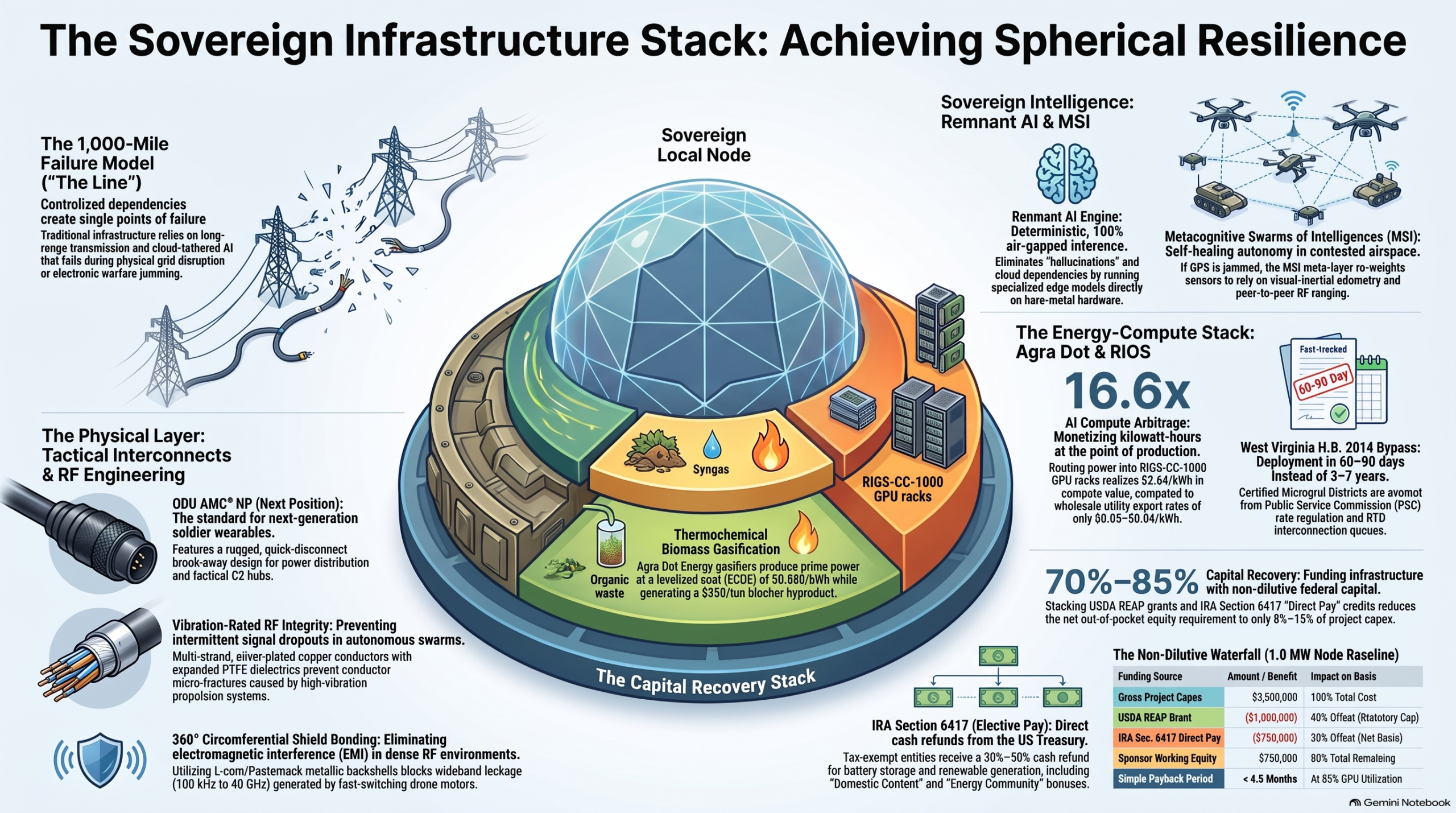
Modern mission-critical infrastructure must immediately pivot from “The Line”—a 1,000-mile failure model characterized by linear, centralized dependencies—to a posture of Spherical Resilience. The legacy framework tethers operations to a bulk power grid and cloud compute monopolies that are vulnerable to physical disruption, high-latency bottlenecks, and single-point-of-failure collapses. Furthermore, the “Permitting Wall” imposed by Regional Transmission Operators (RTOs) introduces 3-to-7-year utility interconnection queues that impede strategic responsiveness. Spherical Resilience replaces this fragility with autonomous, omnidirectional enclaves that maintain continuity regardless of external grid or supply chain status.
The architecture is anchored by three mandatory pillars of sovereignty:
- Local Baseload Syngas: Thermochemical biomass gasification and solar thermal preheating ensure continuous, off-grid power generation.
- Native DC Busbars: Direct-current distribution eliminates AC-DC-AC conversion losses, providing the thermal efficiency required for high-density hardware.
- Air-Gapped AI: Deterministic, hardware-anchored intelligence operates without cloud reachback, securing the node in contested electronic warfare (EW) environments.
Architectural Comparison: Legacy vs. Sovereign Stack
Metric The Line (Legacy) Sovereign Node (Target State)
Power Delivery Centralized Grid (AC) Local Baseload Microgrid (700V DC)
Compute Logic Probabilistic Cloud LLMs Deterministic Air-Gapped Remnant AI
Interconnect Strategy Commercial/Consumer Grade Ruggedized Tactical (ODU/L-com)
Regulatory Path RTO Interconnect (3–7 Years) WV H.B. 2014 (60–90 Days)
This philosophical shift dictates the specific electrical and physical hardware standards required to maintain an isolated, high-performance ecosystem.
- High-Density Power Infrastructure: Native 700V DC Busbar Systems
Lead systems architects must prioritize direct DC distribution to minimize thermal waste and maximize the energy-compute chain for dense GPU clusters. By rectifying power directly into 700V DC busbars, the architecture bypasses traditional inverter-stage losses, delivering steady-state energy to high-impact industrial loads with minimal parasitic drain.
The Agra Dot Energy Generation Chain serves as the prime power engine for this infrastructure, integrating the following technologies:
- Thermochemical Biomass Gasification: Converts organic feedstocks and forestry slash into high-BTU synthesis gas (CO + H₂). This process produces high-grade agricultural biochar (valued at $350/Ton) as a secondary revenue stream and carbon-sink credit.
- DOE 80x Concentrating Parabolic Solar Thermal: Mirror arrays focus sunlight onto receiver tubes to produce 350^\circ\text{C} industrial process steam. This steam is injected directly into gasifier reaction chambers to eliminate daytime parasitic fuel consumption.
- Pawnee 45 kW Wankel Rotary GenSets: Multi-fuel rotary engines feed power directly to the DC busbar, achieving a 97.7% power-chain efficiency rating.
The system delivers energy at a levelized cost (LCOE) of $0.038/kWh, enabling radical value extraction.
AI Compute Arbitrage Formula: By routing energy directly into GPU computing rather than selling back to the grid at wholesale rates, the system realizes a value of $2.64/kWh. This represents a 69.5x Gross Fuel Conversion Multiplier over generation costs.
Physical implementation requires solid-copper, ceiling-mounted rails. System reliability must be anchored by solid-state automatic transfer switches (ATS) to ensure sub-16ms fast-islanding, maintaining compute uptime during generation shifts.
- Tactical Wearable Interconnects: ODU AMC® Standards for Next-Gen Ensembles
Physical layer stability is the non-negotiable prerequisite for reliable edge computing and command-and-control (C2) data fabrics. In tactical environments, engineers must specify ruggedized, miniaturized connectors to prevent the mechanical failures associated with the mud, water, and stress of the battlefield.
The ODU AMC® NP (Next Position) series is the mandatory standard for tactical wearable environments. It features a “Quick Break-Away” release mechanism for emergency scenarios, pin-and-groove keying for zero-visibility mating, and a RoHS-compliant matte-black carbon finish for low-light profile management.
ODU AMC® Technical Performance Comparison
Series Technical Performance (Durability & Ingress) Primary Application
Series T > 500 Mating Cycles / IP6K9K Mated Heavy Vehicle Mounted / Field Command Nodes
High-Density > 5,000 Mating Cycles / IP6K9K Mated NASA Mars 2020 / Multi-Protocol Splitters
Series NP > 2,000 Mating Cycles / IP68 Sealed Tactical Wearables / Conformable Batteries
Material science for next-gen ensembles must incorporate “Wearable Fabrics” utilizing micro-pitch board-to-flex circuitry and conformable body batteries. These high-density interconnects must interface seamlessly with the broader RF environment of the airframe or soldier system to ensure signal integrity.
- Resilient RF Architectures: EMI Mitigation in Modular UAV Airframes
Unmanned Aerial Vehicles (UAVs) consistently exhibit an “Installed Performance Gap” where component-level testing fails within the carbon-fiber airframe. Dense RF environments necessitate strict mitigation of electromagnetic interference (EMI) to prevent receiver desensitization.
Integration engineers must implement 360-degree circumferential shield bonding using solid metallic backshells to prevent RF leakage across the 100 kHz to 40 GHz spectrum. To address propulsion-induced vibration, all RF assemblies must utilize vibration-rated, phase-stable 50-ohm coaxial assemblies featuring multi-strand, silver-plated copper conductors with expanded PTFE dielectrics. These materials prevent conductor micro-fractures, fretting corrosion, and intermittent impedance faults common in high-G environments.
UAV Design Pitfalls to Avoid
- Isolated Result Reliance: Failing to validate performance in the actual installed configuration early.
- Late Antenna Placement: Shifting antenna locations late in the design cycle, distorting radiation patterns.
- Excessive Adapter Usage: Increasing signal loss and mismatch through redundant transitions.
Ensuring physical RF stability is the only pathway to securing the operational reliability of the cognitive compute stack.
- Sovereign Compute Stack: Remnant AI and Metacognitive Swarm Logic
Cloud-tethered AI models are operational liabilities in electronic warfare environments. Sovereign architecture requires air-gapped, deterministic intelligence to survive jamming and data exfiltration.
The Metacognitive Swarms of Intelligences (MSI) stack utilizes a two-tiered logic:
- Meta-Level (Supervisory): A self-monitoring layer that performs confidence arbitration and sensor re-weighting. When EW attacks compromise GPS, the meta-level autonomously reconfigures navigation to Visual-Inertial Odometry (VIO) and peer-to-peer RF ranging.
- Object-Level (Execution): The Remnant AI Engine, which executes deterministic multi-agent tasks, sensor fusion, and motor kinematics on bare-metal hardware.
Hardware security is enforced via TPM 2.0 Physical Root-of-Trust, while high-performance operations utilize Kove:SDM Software-Defined Memory for microsecond-latency RAM pooling.
The Remnant AI Engine provides the following advantages:
- Zero-Cloud Dependency: Continuous operation in denied or jammed environments.
- Hallucination Suppression: Rejection of probabilistic drift in favor of deterministic execution trees.
- Low-Latency Performance: Bare-metal execution optimized for real-time kinetic response.
- Statutory Compliance and Capital Engineering: WV H.B. 2014 & Federal Stacking
The “Regulatory Bypass Architecture” enabled by West Virginia H.B. 2014 (W. Va. Code §5B-2-21 & §24-2-21a) allows for the creation of Certified Microgrid Districts. These districts are exempt from Public Service Commission (PSC) rate regulation, allowing nodes to sidestep 3-7 year interconnection queues.
Funding these installations requires a “Non-Dilutive Capital Recovery Stack” to offset 70%–80% of project costs. This involves stacking USDA REAP (50% grant) with IRA Section 6417/48E “Direct Pay” tax credits (up to 50% with Energy Community and Domestic Content bonuses). To address the timing deficit between upfront capex and retrospective reimbursements, developers must utilize Specialized Non-Dilutive Bridge Facilities collateralized by verified grant award letters and IRS registrations.
Sovereign Node Financial Eligibility Checklist
- Rural Status: Population < 50,000 per USDA demographic scoring.
- Entity Type: Agricultural producer or rural small business.
- Baseload Requirement: Minimum 84.8% captive baseload (on-site energy consumption).
- Statutory Alignment: Siting on coal-transition brownfields or former mining permits.
- Implementation Roadmap: 90-Day Execution Cycle
The sovereign build compresses traditional 5-year utility timelines into a 90-day execution cycle by operating entirely behind the meter.
Phase 1: Statutory & Entitlement (Days 1-30)
- File for Certified Microgrid District status under W. Va. Code §5B-2-21.
- Secure long-term feedstock contracts for forestry slash and agricultural waste.
- Execute USDA REAP applications and secure bridge facility syndication.
Phase 2: Physical Build & Commissioning (Days 31-65)
- Install ceiling-mounted 700V DC busbars and sub-16ms islanding switchgear.
- Deploy 80x concentrating parabolic solar thermal troughs and steam piping.
- Commission Agra Dot Energy gasifiers and perform 72-hour burn-in of Pawnee GenSets.
Phase 3: Compute & Network Activation (Days 66-90)
- Seat RIOS-CC-1000 liquid-cooled GPU racks and connect DC-to-DC power feeds.
- Inject Remnant AI cores and load TPM 2.0 security keys.
- Activate WISP-in-a-Box multi-gigabit mesh backhaul masts for local data fabric.
Summary: Spherical Resilience is the ultimate defensive posture for forward-deployed infrastructure. By integrating high-density DC power, silver-plated RF interconnects, and deterministic AI, sovereign nodes thrive in isolation from failing centralized grids.


