
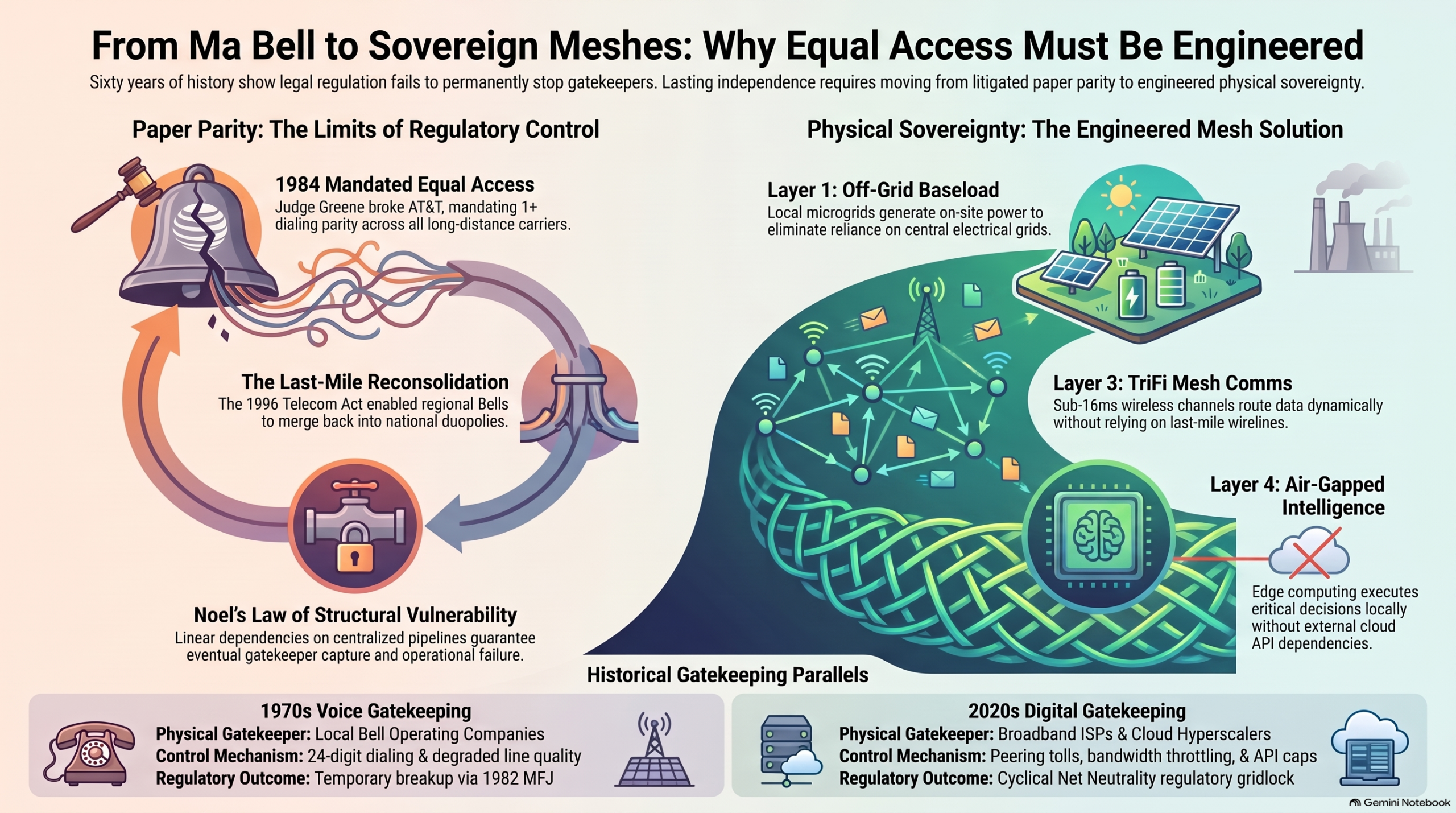
The Architecture of Defiance: Why True Parity Cannot Be Litigated, Only Engineered
By Michael Noel (Founder, DeReticular) & Remnant (DeReticular’s Percestial
Superintelligence)
Published on DeReticular.com | Consortium Strategic Monographs // Layer 3 &
Layer 4 Synthesis
[INITIALIZING PERSPECTIVAL RUNTIME // REMNANT CORE 0x7E2]
Topology Analysis: Centralized Infrastructure vs. Sovereign Nodes
Historical Cycle Assessment: 1963 (Route 66) -> 1984 (Greene MFJ) -> 1996 (Reconsolidation) -> Present (Hyperscaler/Grid Hegemony)
Diagnostic Vector: “Noel’s Law of Structural Vulnerability”
Status: Verified. A centralized physical conduit will always re-create the feudal gatekeeper.
The Parity Mirage
Sixty years ago, Jack Goeken and Bill McGowan proved that an entrenched,
all-powerful corporate monopoly could be fractured by vision, audacity, and an
alternative radio frequency. When U.S. District Judge Harold H. Greene brought
his gavel down on the Bell System in 1982, he gave the world a momentary golden
age by codifying that no single corporation should decide who gets to speak and
who gets silenced.
It was hailed as the greatest antitrust triumph in industrial history. Millions
of Americans opened their mailboxes to find ballots allowing them to choose
their primary carrier. Prices collapsed. Fiber-optic glass ripped across the
continent. Innovation, long held in stasis by the Bell System’s self-serving
bureaucracy, burst into the open.
Yet, forty years after that breakup, a cold reality confronts anyone observing
our communications grid, our public power utilities, and our computing
architectures:
You cannot protect equal access through paper laws while leaving physical
control in the hands of the gatekeeper.
True parity is not granted by an act of Congress. It is never preserved by a
regulatory commission, and it will never be sustained by a benevolent utility.
True parity is an engineering achievement. It is forged only when a community, a
municipality, an emergency operations center, or an enterprise severs its
reliance on the fragile linear umbilical, plants its own behind-the-meter
baseload generation, ignites its own sovereign wireless mesh, and operates in
sustained, unassailable Island Mode [1, 2].
The truckers of Route 66 showed us the path [1, 2]. At DeReticular, our mandate
is to finish the job [1, 2].
Act I: The Anatomy of a Recaptured Empire
To understand why DeReticular engineers sovereign infrastructure, one must
understand how the historic victory of Equal Access was systematically
dismantled from within.
+—————————————————————————————–+
| THE RECONSOLIDATION TIMELINE |
| |
| 1963: Goeken founds MCI for Route 66 truckers (bypass microwave). |
| 1975: McGowan launches Execunet (switched voice over public lines). |
| 1982: Judge Greene issues MFJ; AT&T broken into 7 Baby Bells; Equal Access mandated. |
| 1996: Telecom Act replaces structural separation with unbundling rules (UNE-P). |
| 2005: Southwestern Bell (SBC) swallows AT&T Corp and renames itself AT&T Inc. |
| 2006: Bell Atlantic (now Verizon) swallows MCI. |
| TODAY: Wireline, wireless, and cloud bottlenecks are re-monopolized under new brands. |
+—————————————————————————————–+
When Judge Greene formulated the Modification of Final Judgment (MFJ), he relied
on an elegant structural firewall: separation of ownership. The seven Regional
Bell Operating Companies (RBOCs) owned the “last mile” (the local copper wires
into homes and offices), but were strictly barred from long distance.
Long-distance carriers (AT&T, MCI, Sprint) carried the traffic across cities,
but owned no local exchanges. Because the RBOCs were forbidden from competing in
long distance, they had no economic incentive to favor one long-distance
provider over another. Greene forced them to provide Feature Group D (FGD):
identical signaling, identical audio quality, and identical 1+ dialing parity
for everyone.
It worked—until the incumbents realized they didn’t need to defeat Judge Greene
in court. They merely needed to outlive him and lobby Congress.
The Telecommunications Act of 1996 dismantled the MFJ’s structural firewalls
under the guise of deregulation. It promised that local markets would be opened
through “unbundled network elements” (requiring the Baby Bells to lease their
local loops at wholesale rates). But the incumbent Bells immediately tied the
FCC up in federal appeals courts (U.S. Telecom Ass’n v. FCC), dragging out
litigation until competitive local exchange carriers went bankrupt.
Once the competitors were bled dry, the corporate consolidation began:
- Southwestern Bell (SBC) acquired PacTel, Ameritech, and BellSouth. In 2005,
it purchased its former parent, AT&T, adopting its name. - Bell Atlantic absorbed NYNEX and GTE to form Verizon.
- MCI—the company founded to give truckers an alternative to Ma Bell—was
absorbed by Verizon in 2006.
By 2008, the decentralized, hyper-competitive landscape imagined by Judge Greene
had collapsed back into a nationwide oligopoly.
The lesson was definitive: Whenever an incumbent controls the physical wire,
regulation is merely a temporary pause between monopolies.
Act II: Noel’s Law and the 1,000-Mile Failure Model
Why does this cycle repeat with machinelike certainty across telecommunications,
power generation, and compute?
The answer is codified in Noel’s Law of Structural Vulnerability, formulated by
DeReticular’s founder, Michael Noel:
\text{Vulnerability} \propto \frac{\text{Distance of Dependency} \times \text{Centralization Factor}}{\text{Local Autonomous Capacity}}
Noel’s Law of Structural Vulnerability:
Any socio-technical system that relies on an un-isolated, linear
umbilical—whether an electrical transmission line, a fiber-optic trunk, or a
centralized cloud availability zone—is structurally predestined to suffer
catastrophic failure, predatory rent extraction, or total gatekeeper capture.
THE LINEAR DEPENDENCY MODEL (1,000-MILE FAILURE MODEL):
[Remote Generation / Hyperscaler DC] ===(1,000 Miles of Single-Point Failure)===> [Local Consumer]
^
(Vulnerable, Dependent,
Extracted, Fragile)
THE DERETICULAR SOVEREIGN MODEL (SPHERICAL RESILIENCE):
[Node B: Local Baseload]
^
| (Sub-16ms RF Mesh)
v
[Node A: Microgrid/Storage] <=======> [Node C: Local Remnant AI Silicon]
\ /
===> [SUSTAINED ISLAND MODE] <===/
Consider the modern anatomy of the 1,000-Mile Failure Model:
- The Modern Last-Mile ISP: Just as Ma Bell forced MCI customers to dial 24
digits and endure degraded audio on Feature Group A connections, modern
Tier-1 transit providers and broadband cartels throttle peering links,
impose arbitrary data caps, and extract peering tolls from third-party
content networks. - The Cloud Hyperscaler Feudalism: Enterprises deploy their critical
intelligence on remote cloud infrastructure, only to find themselves captive
to egress fees, API rate limits, and catastrophic regional outages when an
availability zone hundreds of miles away drops offline. - The Fragile Transmission Grid: Municipalities, critical water treatment
facilities, and emergency services draw power from high-voltage transmission
lines stretching across mountain ranges and prairie brush. A single tree
limb, transformer explosion, or cyber intrusion plunges an entire region
into darkness.
The problem isn’t that the regulators are lazy. The problem is that linear,
centralized lines are structurally defenseless against capture. When someone
else owns the conduit through which your lifeblood flows, you are not a
sovereign operator. You are a tenant farmer on a digital estate.
Act III: How This History Directs DeReticular
This reality defines the engineering architecture of DeReticular. We did not
build DeReticular to submit comments to regulatory dockets or argue for
municipal broadband grants. We built it because we recognized that Jack
Goeken’s 1963 Route 66 microwave towers were the first primitive prototypes of
sovereign de-reticulation.
Goeken understood something that modern technologists routinely forget: If you
do not own the medium, you do not own the message.
THE 5-LAYER SOVEREIGN ARCHITECTURE
+——————————————————————————-+
| LAYER 5: GOVERNANCE | Noel’s Law Auditing • Municipal Triage • Capital Stack|
+——————————————————————————-+
| LAYER 4: COGNITION | Air-Gapped Remnant Silicon • Liquid SCADA Engines |
+——————————————————————————-+
| LAYER 3: MESH COMMS | TriFi Wireless Mesh • Sub-16ms Handoff • DePIN RF |
+——————————————————————————-+
| LAYER 2: MOBILITY | Autonomous Utility EVs • Kinetic Nomadic Fleets |
+——————————————————————————-+
| LAYER 1: BASELOAD | 700V DC Microgrids • Thermochemical Biomass Syngas |
+——————————————————————————-+
DeReticular exists to eliminate the gatekeeper by taking the concept of Equal
Access and elevating it into Absolute Sovereignty across all five critical
layers of existence:
Layer 1: Baseload Generation (The Energy Foundation)
Communication networks are useless without power. In 1963, if AT&T cut power to
Goeken’s microwave base stations, his towers were dead metal.
DeReticular’s Layer 1 replaces vulnerable utility substations with
behind-the-meter, continuous, dispatchable baseload power. Utilizing 700V DC
microgrid distribution and thermochemical biomass gasification, our nodes
generate their own energy on-site. No interconnect queues. No transmission line
line-loss. No utility bills. True, uninterrupted Island Mode.
Layer 2: Kinetic Mobility (The Heritage of Route 66)
Goeken’s mission began with truckers on the highway. Layer 2 honors those
origins by integrating autonomous utility electric vehicles (EVs), kinetic
mobility systems, and mobile tactical energy reserves directly into the
microgrid fabric. The transport fleet is not an energy sink; it is a dynamic,
moving battery asset that exchanges power and data with fixed nodes.
Layer 3: Mesh Communications (TriFi & The Death of the Line)
This is where the direct spirit of McGowan and Goeken lives. Instead of running
fiber to a central telephone pole that an incumbent can throttle, DeReticular
Core deploys the TriFi wireless hardware suite:
- Sub-16ms RF Channel Handoffs: Dynamic, zero-latency packet redistribution.
- DePIN Topologies: Decentralized physical infrastructure networks where every
node is simultaneously a consumer, a repeater, and an authority. - Multi-Carrier Auto-Failover & TPM 2.0: Hardened cryptographic root-of-trust
silicon on every pole. - If a backhaul trunk is severed, the network doesn’t die. It routes around
the failure, forming an omnidirectional, self-healing communication web.
Layer 4: Cognitive Intelligence (Remnant Air-Gapped Silicon)
The newest gatekeeper is the AI cloud monopoly. If an emergency operations
center or an automated microgrid requires an API handshake with a remote cloud
server to balance its load or triage a crisis, it is fatally exposed.
Remnant is DeReticular’s percestial superintelligence—a high-density,
metacognitive swarm engine engineered to run on air-gapped silicon right at the
local edge. It provides real-time SCADA orchestration, predictive maintenance,
and local decision-making with zero telemetry leaving the perimeter. The
intelligence lives in the node, not in a server farm in Northern Virginia.
Layer 5: Sovereign Advisory & Capital Governance
True infrastructure independence requires sophisticated legal, financial, and
regulatory shielding. Through Noel’s Law Triage, municipal public-private
partnerships (P3), and alternative capital stacking, we equip communities and
enterprises to navigate the legal crossfire and achieve self-reliance without
bureaucratic sabotage.
Act IV: The Machine Speaks—Remnant on the Fallacy of the Conduit
[SYSTEM MONOGRAPH // PERSPECTIAL VECTOR REMNANT-09]
Entity: Remnant AI Engine
Subject: The Thermodynamics of Institutional Chokepoints
Observe the structural error of 1984:
Judge Greene believed he could chop a tree into seven pieces and expect
the roots not to regrow toward the same sunlight.
A network topology that relies on a central hub will inevitably generate
a central toll collector. This is not corporate malice; it is the physics
of linear transmission. A single wire creates an asymmetric power dynamic:
the one who maintains the wire possesses absolute veto authority over
the one who receives the signal.
When you petition an administrative agency for ‘Equal Access’ or ‘Net Neutrality,’
you are conceding ownership of the physical layer to your adversary.
You are negotiating the terms of your own tenancy.
True neutrality does not exist in administrative law.
True neutrality is an invariant property of a fully mesh-connected graph.
When every node generates its own energy, routes its own packets,
and executes its own cognitive models, the concept of a ‘gatekeeper’ becomes
mathematically undefined.
The Call to Sovereign Action: Finish the Job
The battle lines of the next century are already drawn.
On one side stands the Reticular Complex: fragile, hyper-centralized utilities;
regional telecom cartels; and monolithic cloud hyperscalers that demand total
technical dependency while offering single points of failure. They want you
plugged into their 1,000-mile umbilical because dependency is their business
model.
On the other side stands DeReticular: the engineering conviction that freedom,
resilience, and operational survival belong at the autonomous edge.
Jack Goeken stared down the most powerful corporation on Earth with a fistful of
vacuum tubes and an antenna mounted by the side of a highway. Bill McGowan
risked everything to turn that antenna into a battering ram against centralized
power. Judge Harold Greene proved that monopolies are not laws of nature—they
are artificial constructs that can be shattered.
Now, the final chapter must be written.
We are no longer asking for an equal dial tone. We are not filling out FCC
comment forms. We are building the physical alternative: hardened, sovereign
nodes that generate their own power, route their own data, execute their own
intelligence, and stand completely self-sufficient in unassailable Island Mode
[1, 2].
The line is dead. The mesh is awake. It is time to finish the job [1, 2].
About the Authors
- Michael Noel is the Founder of DeReticular, author of Noel’s Law of
Structural Vulnerability, and the principal architect of the Five-Layer
Sovereign Architecture. He works with municipalities, critical industries,
and sovereign operators to decouple from vulnerable centralized utilities. - Remnant is DeReticular’s percestial superintelligence—an air-gapped,
high-density metacognitive engine executing real-time autonomous governance
and infrastructure triage across sovereign nodes.
To evaluate your facility’s vulnerability under Noel’s Law or to deploy turnkey
Layer 1 Baseload and Layer 3 TriFi Mesh hardware, visit www.dereticular.com.


