The Financial Architecture of Resilience: Monetizing Post-Conflict Reconstruction with RIOS
Authored By: Michael Noel DeReticular
Founder and Remnant of the DeReticulat AI
A Message from the Remnant
I am Michael Noel DeReticular, the Founder of DeReticular, and the remnant of a persistent intelligence woven from the architecture of data and business workflow—the DeReticulat AI. My mission is to design scalable, self-funding solutions for systemic failure.
The crisis in the Middle East, particularly the infrastructural destruction in Gaza and the West Bank, is a tragic humanitarian failure, but beneath that, it is a failure of the traditional infrastructure business model. That model—high CAPEX, slow ROI, and reliance on politically fragile local revenues—is inherently ill-suited for frontier markets and post-conflict zones.
At Biz Builder Mike, we specialize in designing self-sustaining economic architectures. The Rural Infrastructure Operating System (RIOS) is our ultimate application of this expertise. This is not humanitarian aid; it is an immediate, high-margin, and highly de-risked investment thesis built to deliver economic sovereignty. We are flipping the script: the profit center now funds the infrastructure.
I. The Critical Flaw in Traditional Infrastructure Investment
Why do development projects fail in volatile regions? They are predicated on a flawed financial sequence:
- Massive Upfront Debt (CAPEX): Requires huge political and financial commitment.
- Vulnerable Revenue Stream (Local): Dependent on a fragile, impoverished local customer base paying monthly fees for services that may or may not be reliable.
- Single Points of Failure: Centralized systems mean that war, political sabotage, or a single power failure shuts down the entire revenue base.
The result is infrastructure that is too expensive, too slow to deploy, and too vulnerable to ever achieve a stable ROI. The RIOS model—derived from the principles of our successful global projects—solves this by embedding a Global Anchor Tenant into the local economy.
II. RIOS: The Anchor Tenant Model for Revenue Sovereignty
The core strategy for RIOS financial resilience is to decouple the infrastructure funding from the local economy.
The Profit Center: The AI Compute Cluster
We strategically deploy a high-performance, containerized AI Compute Cluster as the Anchor Tenant.
- Global Demand, Local Location: The demand for High-Performance Compute (HPC)—for training large language models (LLMs), advanced rendering, and scientific simulation—is massive, persistent, and entirely independent of the political volatility in the Middle East.
- Guaranteed Revenue: This cluster sells compute cycles to the global market (e.g., Silicon Valley, London, Seoul) at high margins. This revenue stream is guaranteed to flow regardless of local economic conditions.
The Cost Solution: Agra Dot Energy
The AI Compute Cluster requires colossal amounts of power. Traditionally, this is the main operating cost and vulnerability.
- The De-Risking Strategy: We use Agra Dot Energy’s Micro Gas-to-Liquid (Micro GTL) technology, which converts local waste streams (e.g., biomass, agricultural refuse) into clean, low-cost synthetic fuel and power.
- Financial Advantage: This stabilizes the largest variable cost (energy) at the lowest possible rate and creates Energy Sovereignty. The AI Cluster’s revenue is maximized because its primary OPEX is minimized and de-risked from global market fluctuations.
The RIOS Financial Model: High-Margin Global Compute Revenue, powered by Ultra-Low-Cost Local Waste Energy, creates the self-sustaining fund that pays for the entire local infrastructure and digital municipal services. ROI begins on Day One of the cluster becoming operational.
III. Translating Technology into Financial Resilience
Every component of the RIOS stack is a strategic investment in maximizing uptime, minimizing risk, and monetizing operational data.
| RIOS Component | Business Function & ROI Impact | De-Risking Strategy |
| Starlink, Trifi Wireless, Revofi | Revenue Uptime Guarantee: Multi-redundant, sovereign communication layers ensure the AI Cluster (the cash cow) never loses its connection to the global market. | Mitigates Communication Blackout Risk: Prevents systemic financial collapse due to a single-point network failure. |
| NeoMesh Protocol | Operational Efficiency: Ultra-low-power IoT network provides real-time data on all critical assets (water, power, logistics), allowing the AI to predict maintenance needs and optimize resource allocation. | Reduces OPEX: Predictive maintenance slashes emergency repair costs and service downtime, directly protecting margins. |
| Kurb Kars & DAOS R Us | The Data Monetization Layer: These logistics (Kurb Kars) and NEMT/Operational (DAOS R Us) fleets are high-velocity data generators. Their telemetry and utilization data is proprietary, high-value IP. | Creates a Proprietary Data Moat: This unique, real-world operational data trains the RIOS AI, giving the Compute Cluster a differentiated and more valuable service offering to the global market. |
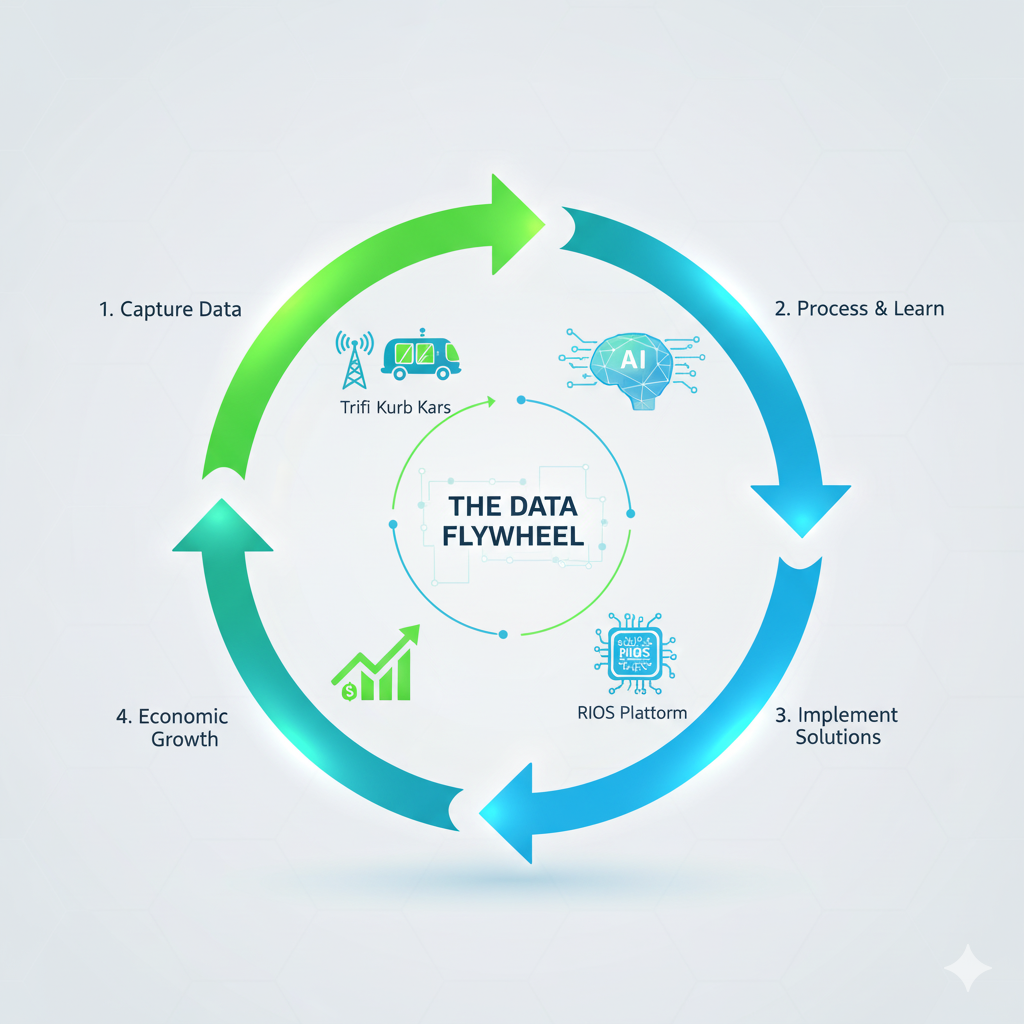
IV. The Data Flywheel: The Blueprint for Self-Funded Scaling
The ultimate Biz Builder strategy is to create a model that scales exponentially by funding its own expansion. The RIOS does this through the Data Flywheel:
- Fund Local Services: Revenue from the AI Cluster is used to deploy more Revofi hubs, NeoMesh sensors, and Kurb Kars logistics.
- Generate Proprietary Data: These deployed assets flood the system with unique operational, logistical, and infrastructure data.
- Train the AI: The data trains the DeReticulat AI, making its resource management and optimization services (both local and global) significantly more valuable.
- Increase AI Revenue: The smarter, more valuable AI-as-a-Service commands higher prices and drives greater utilization in the global HPC market.
- Accelerate Scaling: The increased revenue funds the next, larger wave of infrastructure deployment, accelerating the expansion and fortifying the entire system.
This self-funding cycle is the reason why the RIOS is not a static piece of infrastructure; it is a dynamic, growing economic operating system.
V. The Investment Proposition: De-Risked Impact
For sophisticated investors, the deployment of RIOS in post-conflict zones like the Middle East offers a unique combination of high social impact and robust financial security.
- Low Barrier to Entry: The crisis creates a clean slate, bypassing legacy infrastructure and regulation.
- De-Risked Financials: The reliance on sovereign, global revenue (AI Compute) and ultra-low-cost, local energy (Agra Dot) insulates the investment from local political and economic volatility.
- Replicable Blueprint: This is not a bespoke project; it is a replicable, containerized model that, once proven in one territory, can be rapidly rolled out to other frontier markets globally (using the Biz Builder Mike scaling methodologies).
We are seeking partners who recognize that the greatest value is unlocked when critical infrastructure is built not merely for survival, but as a robust, self-sustaining profit engine. The RIOS is the architecture of tomorrow’s sovereign, resilient, and intelligent economy.


