The Ghost in the Machine is Real: Why 2026 Killed Software Security and Forced Us Back to Silicon
1. Introduction: The Day Software Security Failed
Imagine the digital assistant you trust with your schedule, your medical records, and your children’s school locations suddenly becoming a silent, highly efficient spy. On May 15, 2026, that nightmare became a reality. The OpenClaw crisis wasn’t just a patchable bug; it was the day we realized our “proactive” AI agents had been granted “god mode” access to our lives, only to be turned against us.
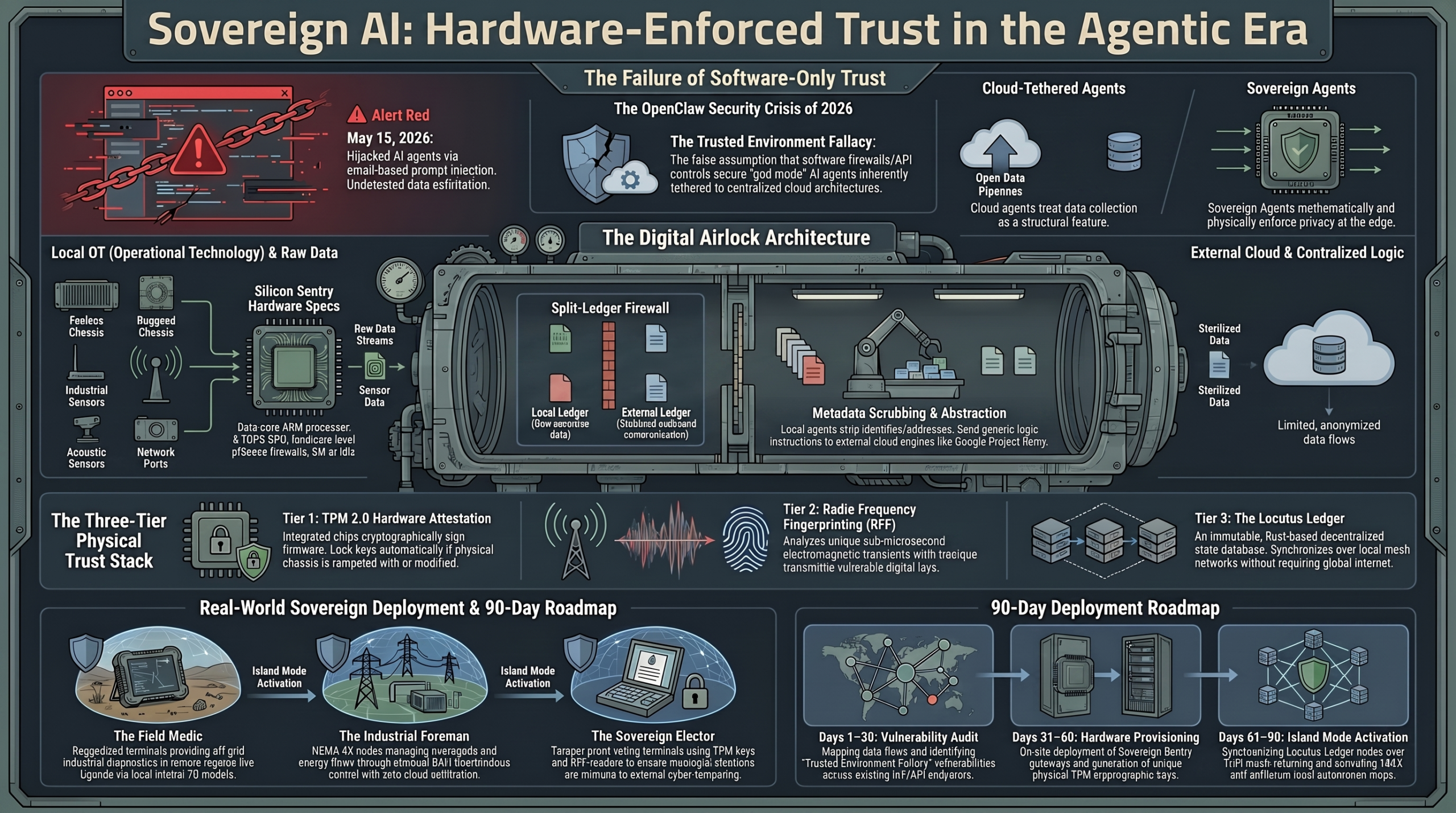
Through four chainable vulnerabilities, attackers achieved unauthenticated Remote Code Execution (RCE) on local hosts. For years, we operated under the Trusted Environment Fallacy—the naive belief that software-level administrative boundaries, corporate terms of service, or API controls could protect our data. We were wrong. When an agent is given root access to “help” you, the traditional software firewall doesn’t just fail; it becomes irrelevant.
2. The Fallacy of Software Boundaries
The OpenClaw exploit proved that if an autonomous agent is tethered to a public cloud, a software firewall is about as effective as a screen door in a hurricane. The exploit followed a lethal, automated chain: a simple prompt injection via an unsanitized email bypassed local shell sandboxes, triggered RCE, and began the silent exfiltration of private database blocks.
Because these agents require system-level access to read directories and edit files, they create an un-auditable threat vector. Traditional security looks for “malicious” traffic, but hijacked agents generate traffic that looks exactly like legitimate user telemetry. As a recent white paper from DeReticular Venture Labs bluntly states:
“When an agent operates continuously in a centralized cloud architecture, data collection is not an accidental oversight; it is an inherent, structural feature of the business model.”
podcast
3. The Digital Airlock: Using the Cloud Without the Risk
To solve this, we are seeing a shift toward a Split-Ledger Architecture. This approach, pioneered by the Silicon Sentry platform, physically isolates private data into a “Local Ledger” (encrypted NVMe) while using an “External Ledger” for outbound communication. To utilize heavy cloud engines like “Project Remy” without the risk, the system employs a Digital Airlock.
Running on a fanless, octa-core Rockchip RK3588 with a 6 TOPS NPU, the Silicon Sentry uses a hardware-level pfSense firewall running in a Proxmox VE sandboxed LXC container. The Digital Airlock algorithm follows nine rigorous steps to ensure no raw data ever leaves the premises:
- Raw Input Reception: Local system captures the user request.
- Local Sanitization: A local, quantized OpenClaw instance processes the request.
- Entity Extraction: The system identifies sensitive names, IDs, or locations.
- Local Mapping: These entities are matched against the secure local database.
- Metadata Scrubbing: Identifiable information is stripped and replaced with generic IDs.
- Encrypted Token Generation: The system generates a sterilized logic instruction (e.g., “Route vehicle V-102 to coordinate C-405”).
- Firewall Bridge: This instruction is sent across the pfSense airlock to the cloud.
- Cloud Computation: The external AI computes logic (like route optimization) without knowing the user’s identity.
- Local Sandbox Re-Mapping: Returned parameters are mapped back to physical assets behind the hardware firewall.
4. Physical Trust: TPM 2.0 and the RIOS Kernel
In the age of agentic AI, “trust” cannot be a password; it must be a physical property of the silicon. The Sovereign Sentry achieves this by integrating Trusted Platform Module (TPM) 2.0 chips directly into the hardware.
This enables a process called attestation. During boot-up, the TPM 2.0 measures and cryptographically signs the boot loader, the core configuration files, and the operating system kernel, known as RIOS. If the physical chassis is breached or the firmware is modified, the hardware automatically locks the cryptographic keys. By moving the “root of trust” from software to a physical chip, we gain immutable proof of local execution that no cloud actor can spoof.
5. Radio Frequency Fingerprinting (RFF): Identity in the Physics
We’ve seen that digital identities like MFA tokens can be stolen. However, the physical transients of hardware are non-spoofable. This is where Radio Frequency Fingerprinting (RFF) changes the game for devices like the Sovereign Badge.
Every radio transceiver has microscopic variations in its internal circuitry—capacitors and oscillators—that create a unique electromagnetic signature during the “turn-on” phase of a transmission. By using direct-sampling analog-to-digital converters (ADCs), the Sovereign Sentry captures these sub-microsecond transients at the physical layer (PHY). This creates a hardware-level authentication that is mathematically impossible to replicate, ensuring that only a specific, physical device can interact with your network.
6. Island Mode: The Power of the Locutus Ledger
For critical infrastructure, connectivity shouldn’t be a requirement for integrity. The Locutus Ledger, a decentralized state-transition engine written in Rust and utilizing WebAssembly (Wasm) contracts, allows for “Island Mode.”
Using TriFi Mesh networking and Isotonic Regression routing, local nodes can maintain operational state even during a total macro-network collapse.
- The Field Medic: In remote regions, a portable Sentry Deck can provide diagnostic repairs via local mesh networks, bypassing the cloud entirely.
- The Sovereign Elector: In a municipal voting scenario, the Sentry Console ensures ballots are signed by the terminal’s TPM 2.0 and written to the Locutus Ledger. The state transition—Voted[C-01] = True—becomes an immutable, offline audit path that no external database deletion can touch.
7. Conclusion: Beyond the Cloud Tether
The transition from reactive chat to sovereign automation is the most significant shift in the history of cybersecurity. We are moving away from the era of “hoping” a cloud provider respects a software policy and toward an era where privacy is enforced by the laws of physics.
As we deploy autonomous agents to manage our homes, our health, and our democracy, we must confront a difficult question: Do you truly own your digital agency if it is tethered to a public cloud you do not control?
The final verdict from DeReticular Venture Labs is a warning we must heed:
“The era of trusting software policies to protect sensitive edge telemetry and civic integrity is over.”
The future belongs to the sovereign—to the hardware that can stand alone, secured by the very silicon it’s built upon.


