
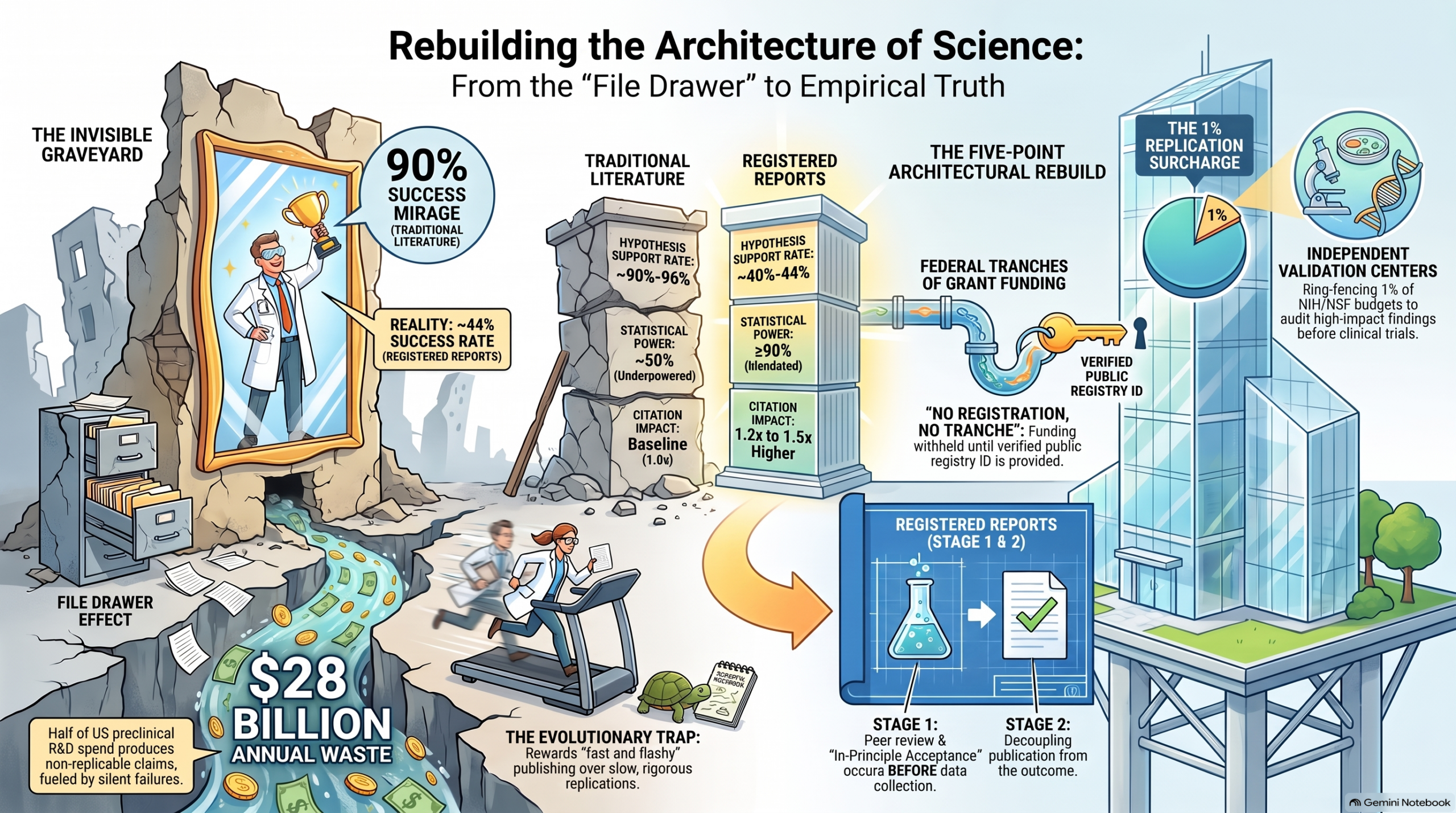
The Invisible Graveyard: A Comparative Case Study of Scientific Breakthroughs vs. Empirical Reality
- The Epistemological “Funhouse Mirror”
In the idealized vision of the scientific method, the literature serves as a high-fidelity lens through which we observe the physical world. However, the current institutional architecture has warped this lens into an “Epistemological Funhouse Mirror.” While mathematical discovery models dictate an expected empirical baseline of 20% to 40% success for novel hypotheses, the published record presents an artificial reality where 85% to 90% of studies claim positive results.
This distortion is a systemic feedback loop collapse. As noted by Scheel et al. (2021), standard literature in top journals reports a 96% hypothesis support rate, whereas Registered Reports—which eliminate publication bias—reveal a support rate of only 44%. This 52-point gap represents the “Invisible Graveyard” of scientific failure.
The Popperian Ideal The Current Reality (Funhouse Mirror)
Objective: Truth advances through systematic falsification. Objective: Prestige advances through novelty and positive results.
Null Results: Viewed as “Epistemic Gain” (closing a dead end). Null Results: Viewed as uninformative non-events to be buried.
Incentive: Reward for rigorous, reproducible methodology. Incentive: Reward for publication velocity and Impact Factor.
Systemic State: A self-correcting engine for truth. Systemic State: A parallel wasteland of redundant waste.
These theoretical distortions have lethal consequences, creating a “Proprietary Graveyard” where the suppression of failure leads to catastrophic medical and financial bankruptcy.
- Case Study A: The Amyloid-Beta “Cabal” in Alzheimer’s Research
For thirty years, the Amyloid-Beta hypothesis reigned as the unchallenged paradigm of neurobiology. This “citadel” was not built on empirical success, but on institutional dominance that silenced dissenting data.
- The Breakthrough Narrative: This paradigm channeled billions in NIH funding into amyloid-clearing drug targets, presenting an unblemished record of theoretical success in high-impact journals.
- The Forensic Audit: As documented in the landmark 2019 investigative report by Sharon Begley in STAT News, the paradigm suffered a 99.6% clinical failure rate. While drugs successfully cleared plaques, cognitive decline remained halted in fewer than 1% of cases.
The Gatekeeping Apparatus Entrenched incumbents used specific methods of “Sunk-Cost Feudalism” to protect this model:
- Study Section Dominance: Amyloid researchers controlled the NIH panels, systematically denying capital to researchers investigating alternative theories like Tau pathology or neuroinflammation.
- Anonymous Gatekeeping: Dissenting manuscripts were routed to the very authors whose work was being challenged, allowing incumbents to assassinate critiques without public accountability.
- Institutional Dependency: Universities and biotech startups became so reliant on the “Amyloid” brand for patent licensing and F&A overhead that admitting failure became an existential threat to institutional revenue.
- Case Study B: The c-kit+ Cardiac Stem Cell Empire
The rise and fall of Piero Anversa illustrates the “Experimenter’s Regress”—a sociological mechanism used to dismiss independent verification. Anversa claimed that c-kit+ stem cells could regenerate heart muscle, securing $50 million in grants despite universal replication failure in independent labs.
When the Molkentin and Murry labs utilized genetic lineage-tracing to prove these cells formed blood vessels, not muscle, Anversa deployed the “Golden Hands” defense. He argued the replicators were technically incompetent, lacking the “surgical delicacy” to isolate the cells.
The Anatomy of a Suppressed Replication
Element Detail
Initial Claim c-kit+ cells transdifferentiate into functional cardiomyocytes.
Replication Outcome 0% muscle regeneration; results showed zero myocyte generation.
Incumbent Retaliation The Experimenter’s Regress: Claiming challengers lacked “tacit knowledge.”
Tactical Response Grant Strangulation: Using influence in study sections to kill critic funding.
The retraction of 31 papers and a $10 million fraud settlement highlighted that in a broken system, a false paradigm is often protected as a reputational asset until the forensic audit becomes unavoidable.
- The Mathematics of False Positives: Why the Mirror Distorts
The distortion of science is a predictable outcome of the Ioannidis Transformation, which calculates the Positive Predictive Value (PPV)—the probability that a published result is true.
In cutting-edge discovery, the pre-study odds (R) are often low (0.01 to 0.1). When journals reject negative results, the bias parameter (u) skyrockets. The formalization is:
PPV = \frac{(1 – \beta) R + u \beta R}{(1 – \beta) R + \alpha + u(1 – \alpha)}
Where \alpha is the error rate (0.05) and 1-\beta is the power. Under current conditions, mathematical models suggest that fewer than 7% of published positive results in high-bias fields are actually true.
The Evolutionary Spiral of Bad Science According to the Smaldino-McElreath formulation, the ecosystem naturally selects for lower rigor:
- Selection for Velocity: Institutions reward publication volume and “novel” results.
- Reproduction of Low Rigor: Labs using small sample sizes and high-bias protocols publish faster and more frequently.
- Capital Accumulation: Low-rigor labs secure more grants and tenure slots.
- Inherited Habits: Trainees from these labs establish new labs, inheriting the habit of burying null results.
- Extinction of Rigor: Rigorous labs, which spend time on validation and report nulls, are starved of resources and face institutional attrition.
- The Architecture of the “Invisible Graveyard”
The “File Drawer Effect” creates a wasteland where failed experiments are hidden. When Lab A fails to replicate a breakthrough and hides the result, Labs B, C, and D unknowingly repeat the exact same failed experiment, burning years of talent in parallel isolation. In the industrial sector, these failures are often marked “Proprietary/Secret,” preventing the scientific community from learning that a target is non-viable.
Industrial Replication Bombshells Audits by pharmaceutical giants revealed the true scale of the graveyard:
Organization Papers Audited Success Rate Failure Rate
Amgen Audit 53 “Landmark” Cancer Papers 11% (6 papers) 89%
Bayer Audit 67 Target-Validation Projects 21% (14 papers) 79%
- The Human and Economic Toll of Silent Failure
The suppression of negative results accounts for an estimated $28 billion in annual waste in the U.S. preclinical sector. The breakdown of this waste is architecturally revealing:
- 36.1% Biological Reagents and Reference Materials.
- 27.6% Study Design and Methodological Flaws.
- 25.5% Data Analysis and Selective Reporting.
- 10.8% Laboratory Protocols.
The Redundant Secondary Waste—multiple labs repeating the same hidden failure—accounts for approximately $7 billion of this total.
The Price of the File Drawer
- For the terminal patient: Enrollment in a doomed clinical trial to test a mechanism that industrial labs already knew was unworkable, exposing the patient to physiological harm and false hope.
- For the animal model: Millions of transgenic rodents sacrificed for “phantom targets” that have already been disproven in silent laboratories, a total collapse of the “Reduction” principle.
- For the young scientist: “Epistemic Gaslighting,” where a trainee believes their failure to replicate a famous (but false) paper is a personal technical defect, leading to the attrition of honest talent.
- Rebuilding the Architecture: The Blueprint for Empirical Parity
To restore science, discovery and verification must have institutional parity.
The Unified Reform Matrix
Intervention Enforcing Stakeholder Primary Benefit / “So What?”
Registered Reports Journals / Publishers Mandates \ge 90% power; shifts incentive from “getting a result” to rigorous design.
Preclinical Registries Federal Funders “No Registration, No Tranche” policy; stops the burial of failed animal trials.
Sleuthing Infrastructure Universities Integrates PubPeer/AI forensics; protects whistleblowers from incumbent retaliation.
Replication Surcharges Legislatures A 1% set-aside from NIH/NSF to fund independent verification before human trials.
Raw Data Mandates OSTP / Nelson Memo Access to uncropped gels; prevents the “Data on Request” 96% failure rate.
To align self-interest with truth, the Replication Index (r-index) must replace the Impact Factor in tenure decisions:
r_i = \log_{10} \left( \frac{\sum \text{Replicated Claims}i + 1}{\sum \text{Disconfirmed Claims}i + 1} \right) + \sum{k=1}^{M} w_k \cdot R{\text{audit}}^{(k)}
This rewards scientists for the proportion of their findings that hold up, rather than the volume of their claims.
- Final Synthesis: From Funhouse Mirror to Clear Lens
Science is a self-correcting engine only when the “waste removal” systems of verification are fully funded. To navigate the current literature, the learner must internalize 3 Essential Truths:
- Novelty is a Filter, Not a Fact: High-impact journals select for “exciting” results, which are statistically more likely to be the upper tail of noise.
- Null Results are an Epistemic Gain: Knowing what does not work is a vital structural asset that closes dead ends and prevents parallel waste.
- Verification is Infrastructure: Until verification has parity with discovery, the literature will remain a graveyard of silent failures. Progress is not just the discovery of the new, but the rigorous removal of the false.


