
The Mesh That Binds: How Decentralized “Foremen” are Saving the Local Grid
The legacy power grid is a ghost of a centralized era—a massive, monolithic web that is increasingly fragile, inefficient, and prone to cascading failures. For years, the promise of energy independence has been sold through individual solar installations. Yet, many homeowners discover a frustrating irony during a blackout: when the macro-grid goes down, their standard solar setups are engineered to shut down with it. This “solo mission” approach to renewable energy creates isolated silos that remain tethered to a failing architecture.
To achieve true resilience, we must move beyond these individual backup systems and embrace the DeReticular philosophy of anti-fragility. True independence is not found in isolation, but in the transition from solitary solar arrays to unified, localized microgrids. By linking disparate energy systems into a community-driven network, we transform energy from a centralized commodity into a distributed, sovereign resource that thrives even when the global infrastructure falters.
The emergence of the Resilient Microgrid represents a fundamental shift in systems architecture. It is no longer just about generating electricity; it is about the autonomous, local negotiation of energy to ensure that no watt is wasted and no critical service is left in the dark.
1. Your Energy Can Now “Negotiate” for the Community
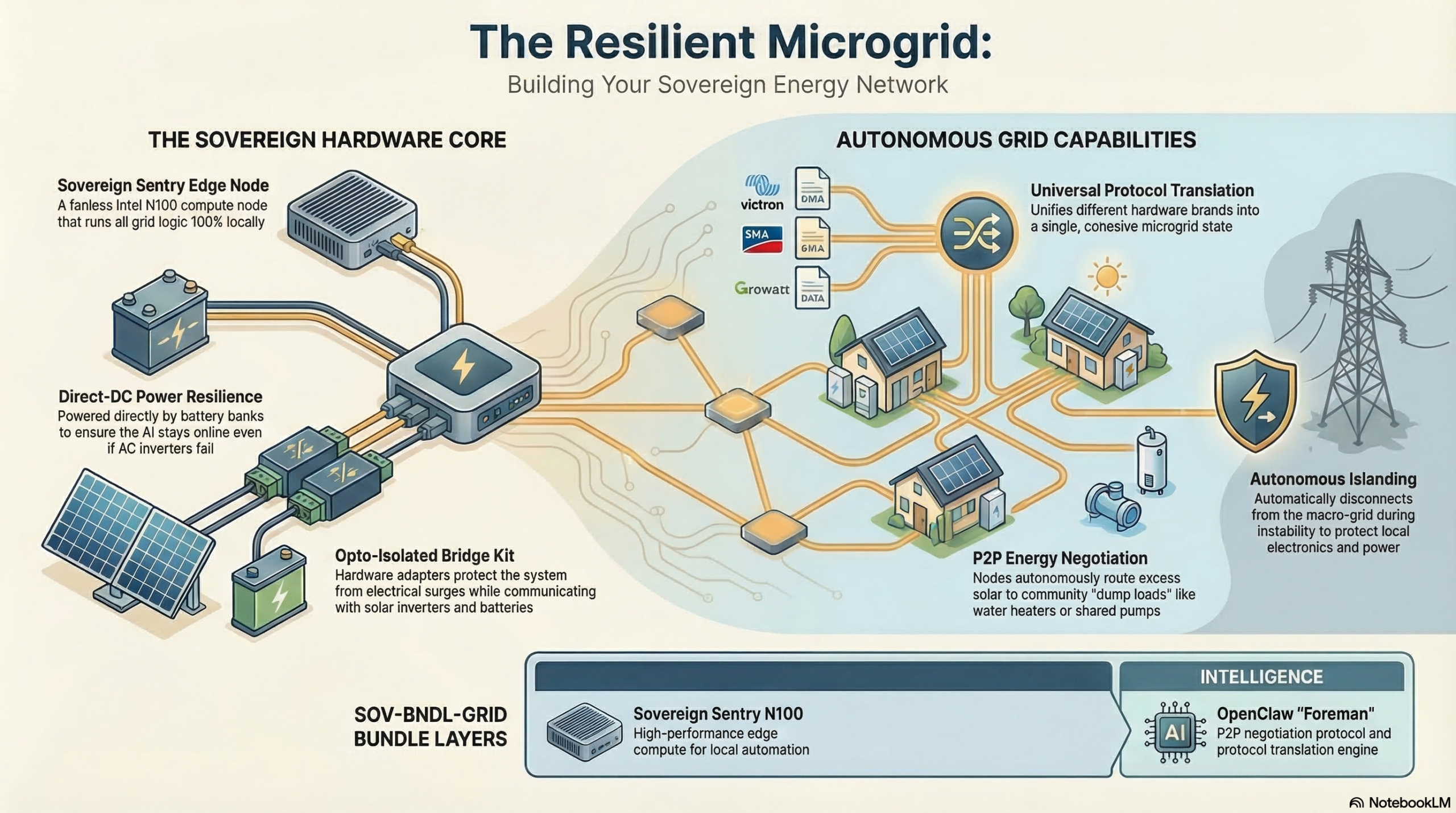
At the heart of an anti-fragile network is the P2P Energy Negotiator, a localized protocol that allows individual energy nodes to communicate their State-of-Charge (SoC) metrics over a local mesh. Utilizing LoRaWAN and long-range Wi-Fi, these nodes broadcast their status to the community without ever needing to touch the public internet.
In a traditional setup, once your batteries reach capacity, excess solar energy is either “clipped” and lost or sold back to massive utility companies at a steep discount. This “financial erosion” forces homeowners to buy energy at retail rates while selling their surplus for pennies. The Resilient Microgrid upends this dynamic. If a local farm’s battery bank hits 100% while a nearby town clinic is straining its reserves, the farm’s node autonomously detects the clinic’s state via the mesh.
“If your battery is full and the sun is shining, your node will automatically negotiate to ‘dump’ your excess energy into critical community infrastructure—like heating the local clinic’s water supply—instead of wasting it.”
This peer-to-peer load balancing ensures that energy stays within the community. It prioritizes immediate, local utility—like thermal storage or agricultural pumping—over feeding a distant, centralized entity that offers no resilience in return.
2. An “Immortal” Brain That Ignores Inverter Failure
One of the greatest vulnerabilities in modern solar design is the integration of logic and power conversion. If the heavy AC inverter fails, the entire system’s intelligence usually dies with it. The Sovereign Sentry—a fanless edge compute node powered by an Intel N100 architecture with 16GB of RAM and a 500GB NVMe drive—solves this by separating the system’s “brain” from its “muscles.”
Running on the RIOS Core OS, the Sentry acts as a survivable kernel of logic. The architecture demands a dedicated DC-to-DC Step-Down Converter, allowing the Sovereign Sentry to run directly off the 12V, 24V, or 48V battery bank. This “Direct-DC Hookup” ensures that the AI manager remains online even if the main AC inverter fails or is manually shut down to protect the house.
This separation is the definition of anti-fragility. By isolating the logic from the high-voltage stresses of power conversion, the system maintains its ability to monitor and communicate during a hardware crisis. While traditional “all-in-one” systems go dark when an internal relay pops, the Sovereign Sentry stays awake to manage the recovery.
3. The Great Translator: Ending Brand Monopolies
The energy industry has long been plagued by brand-locked silos. A homeowner with a Growatt inverter often finds it impossible to coordinate with a municipal building running SMA hardware or a neighbor using Victron equipment. This lack of interoperability is the primary barrier to community-scale resilience.
The OpenClaw Foreman serves as the universal industrial translator. Pre-loaded with PyModbus and PySerial libraries, it converts complex, raw industrial protocols like Modbus RTU and CAN Bus into a unified dashboard. For a systems architect, hardware agnosticism is vital for municipal planning; it allows a town to build a cohesive grid using the best available hardware without being held hostage by a single manufacturer’s ecosystem.
Safety, however, is not sacrificed for connectivity. The Foreman utilizes Opto-isolated USB-to-RS485 adapters, providing a physical barrier that protects the Sovereign Sentry from ground loops and electrical surges up to 3kV. This industrial-grade protection ensures that a fault in the high-voltage inverter won’t “fry” the digital logic of the community grid.
4. True “Island Mode” Means No Cloud Required
Security and reliability are compromised the moment a critical system requires an internet connection. Most “smart” energy systems rely on cloud APIs, meaning your power management could be crippled if a provider’s server goes down or a fiber optic cable is cut.
The Resilient Microgrid operates with Autonomous Islanding and Local-Only Logic. The system runs 100% locally on the Sovereign Sentry hardware. There are no external servers involved in the decision-making process. If the Foreman detects macro-grid voltage frequency anomalies (brownouts), it instantly commands the local inverter to disconnect and run in “Island Mode,” protecting local electronics from “dirty” grid power.
To secure this decentralized network, the system employs a “digital immune system.” Using SHA-256 cryptographic node keys and X.509 certificates, the nodes establish a hardware root of trust. Only verified, certified nodes can negotiate power loads on the mesh, preventing “grid spoofing” or malicious actors from attempting to drain community reserves.
5. Turning Waste into a Community Resource
In a standard solar setup, “excess” is a problem to be managed. In a resilient microgrid, excess is an asset. Using the Node-RED Logic Engine, users can configure autonomous “dump load” routing. When batteries hit their threshold, the system directs surplus power to community water heaters, shared municipal battery banks, or local agricultural pumps.
To protect the physical hardware from the stresses of high-frequency automation, the system employs Hysteresis Enforcement. This logic strictly enforces a 5-minute minimum state-hold for any physical relay. This is a critical engineering safeguard against “Relay Chatter”—the rapid, destructive toggling of mechanical components caused by passing clouds or fluctuating loads. By preventing this rapid cycling, the Foreman extends the lifespan of the heavy mechanical equipment it controls.
By intelligently managing these dump loads, the microgrid converts what was once wasted energy into a stored community resource, such as thermal energy in a boiler or gravitational energy in a water tower.
Conclusion: The Sovereign Powerhouse
The Resilient Microgrid is more than a bundle of hardware; it is a platform for Sovereign Automation. By combining the Sovereign Sentry edge server with the OpenClaw Foreman AI, communities can finally break free from fragile, centralized dependencies. For a one-time perpetual license with zero monthly fees, homeowners and municipalities can deploy a digital manager that works tirelessly to ensure local survival.
As we move into an era of increasing grid instability and climate uncertainty, we must ask ourselves a vital question: When the next major blackout hits, would you rather trust your family’s security to a distant utility company, or to a local, autonomous network managed by you and your neighbors?


