The Rise of the Machine Economy: 5 Ways AI Agents are Rewriting the Rules of Commerce
1. Introduction: When Your AI Becomes Your Personal Shopper
Imagine planning a high-complexity trip to a remote destination. In the legacy commerce model, this requires hours of manual cross-referencing: browsing disjointed websites, checking 50-amp hookup availability at RV parks, and verifying real-time pricing. In the emerging machine economy, you simply voice your intent to an agent: “Find me an RV spot in Sedona for next Tuesday with specific hookups under $70.”
Your agent—whether a specialized retail bot like “Flai” or a general-purpose assistant—instantly scans inventories via machine-readable protocols, negotiates terms with merchant agents, and executes the transaction. This is Agentic Commerce (a-commerce): the fundamental shift from human-centric “click-and-buy” to autonomous delegation. This is not a niche evolution; it is a tectonic shift projected to influence up to $1 trillion in U.S. retail revenue, with 15% to 25% of all e-commerce flows expected to pass through autonomous channels by 2030.
2. The “Invisible Storefront”: Why the Web UI is a Legacy Constraint
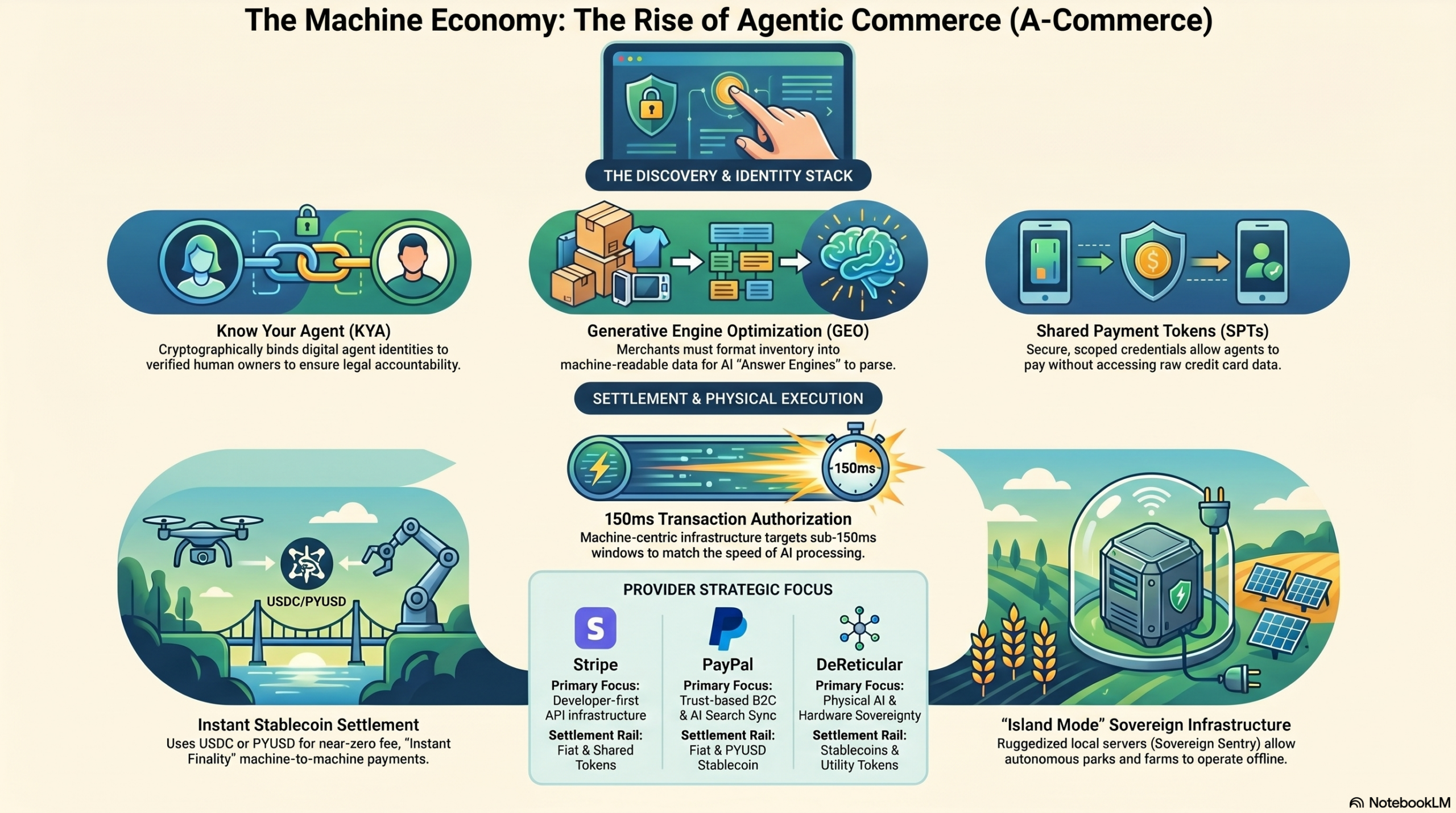
In the agentic era, the traditional seller-controlled funnel is collapsing. For decades, merchants focused on the “User Interface” (UI) to capture human attention. However, the web UI is now a legacy constraint that actively decelerates agentic workflows. As power shifts to the buyer-agent, brands must move from Search Engine Optimization (SEO) to Generative Engine Optimization (GEO).
If an agent cannot programmatically verify a product’s technical specifications, that product effectively ceases to exist. Merchants are now forced to prioritize machine-readable data over visual aesthetics, utilizing Schema.org and tools like PayPal Store Sync to push real-time inventory directly into “Answer Engines” like Perplexity and Google Gemini.
There is a burgeoning strategic divide in how this infrastructure is built:
- Stripe is positioning itself as the developer-first engine, providing Shared Payment Tokens (SPTs) and APIs for B2B and SaaS flows.
- PayPal is leveraging its 400M+ consumer base to build a trust-coordinated marketplace, focusing on retail and the “Invisible Storefront” where AI agents perform discovery and payment without a human ever visiting a merchant’s site.
3. “Island Mode”: The Hardware of Sovereign Commerce
As commerce becomes autonomous, it requires what DeReticular terms “Sovereign Infrastructure.” To eliminate the fragility of centralized cloud dependencies like AWS or Google, the machine economy relies on hardware capable of “Island Mode”—fully autonomous environments that function in air-gapped or remote settings.
This physical layer is defined by specific hardware primitives:
- Sovereign Sentry: A ruggedized local server acting as the “brain,” hosting localized AI inference engines and reservation ledgers.
- Industrial Foreman: A physical executor that translates digital logic into mechanical movement, such as managing power grids or gate access.
- Model Context Protocol (MCP): Often described as the “USB-C for AI,” this open standard allows agents to securely plug into local data and tools without cloud mediation.
This infrastructure is the flagship layer that allows a “patch of dirt to think.” In remote “Smart RV Parks,” localized Edge AI ensures commerce continues even when traditional bank APIs are unreachable. In these mesh environments, stablecoins become the only viable way to settle transactions, unbundling traditional banking from the execution of intent.
4. Stablecoins: The High-Velocity Settlement Rails
Traditional credit cards are structurally incompatible with agentic commerce. Hindered by 2FA hurdles, fraud filters, and slow processing, they cannot match the sub-150ms authorization windows required for machine-to-machine (M2M) velocity.
To bridge this gap, the machine economy has adopted stablecoins like USDC and PYUSD as the default settlement currency. The architecture relies on two distinct layers:
- The Mandate (AP2): The Agent Payment Protocol (AP2) handles the user mandate, proving the agent has the legal authority to spend.
- The Settlement (x402): This protocol enables high-frequency micropayments—settling transactions as small as $0.05 for M2M data exchanges with “Instant Finality.”
This programmable money allows for conditional payments; for instance, funds are released only when an IoT sensor confirms a physical event, enabling 24/7 automated operations without human oversight.
5. Know Your Agent (KYA): Identity as the New Firewall
As autonomous agents execute transactions at speeds that would trigger legacy fraud alerts, traditional Know Your Customer (KYC) frameworks are failing. We are witnessing a transition to Know Your Agent (KYA), where identity serves as the new firewall.
The critical challenge is the “Velocity Gap”: a human making 50 transfers an hour is a red flag for money laundering; for an agent, 50 transactions per second is standard operation. To secure this, the industry is adopting:
- Hardware Attestation: Utilizing Trusted Execution Environments (TEEs) like Intel SGX to provide “Hardware KYC,” proving an agent’s code has not been tampered with.
- Chain of Trust: Cryptographically binding a verified human principal to a Digital Agent Passport.
- Doctrine of Attributed Liability: The legal reality that the human owner is strictly liable for an agent’s actions, including “hallucinations” or financial errors.
In this framework, humans move from “participants” clicking buttons to “governors” who set the high-level policies and budgets that agents must follow.
6. Kinetic Commerce: From High-Tech RV Parks to Sovereign Harvests
The physical application of these technologies is best seen in “Kinetic Commerce,” where value is exchanged through physical actions. In a “Smart RV Park,” a guest’s agent (like “Flai”) negotiates with a park’s “Merchant Agent” via the Agentic Commerce Protocol (ACP) to secure a site and settle the bill instantly via stablecoin.
This extends far beyond hospitality into industrial and agricultural sectors:
- Sovereign Harvest: Large-scale farmers are deploying $85,000 infrastructure packages where agents grade crops locally, mint certificates to the Locutus Ledger, and autonomously negotiate sales.
- Proof of Labor: Unlike digital-only protocols, this uses the ledger to validate that a physical task—such as dispatching a vehicle or grading a harvest—was completed as specified.
These real-world applications prove that a-commerce is not merely a digital convenience but the foundation for an autonomous physical economy.
7. Conclusion: The Five Levels of Autonomy
The transition to a machine economy follows five levels of autonomy:
- Levels 1-2: Humans use AI for discovery but handle the final payment (the current state).
- Level 3: Agents execute simple tasks with specific human approval.
- Level 4: Agents manage complex, multi-vendor workflows (e.g., booking a multi-city tour).
- Level 5: Fully autonomous, anticipatory commerce where agents manage a user’s business needs within a set budget.
As we move toward Level 5, trust and verifiable identity become the most valuable commodities. In an economy where bots talk to bots at millisecond speeds, the survivors will be those who prioritize structured, machine-readable truth over emotional marketing.
As we move toward a trillion-dollar machine economy, are you building a business that a human can love, or one that an agent can find?


