The Sovereign Stack Consortium: A Guide to Human-AI Collaboration
podcast
- Foundation: The Philosophy of Spherical Resilience
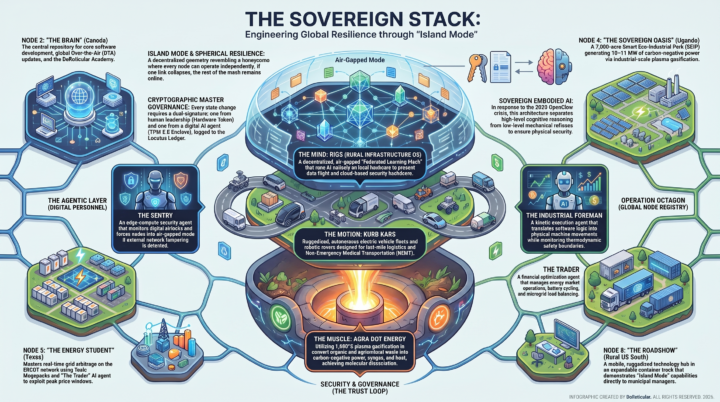
At the DeReticular Academy, we define our mission by our name: “to move away from the network.” In the current landscape of Project Octagon, we recognize that the traditional centralized infrastructure model—historically known as “The Line”—is fragile by design. Whether it is a national electrical grid or a global cloud provider, linear systems fail when a single link collapses.
To counter this systemic vulnerability, the Consortium utilizes Spherical Resilience. This is a decentralized geometry resembling a honeycomb, where every node is engineered to operate in “Island Mode.” In this state, a node possesses absolute computational, energy, and communication self-reliance.
The transition to Spherical Resilience was necessitated by the mid-2026 OpenClaw Security Crisis. This event exposed catastrophic Remote Code Execution (RCE) and prompt-injection vulnerabilities in cloud-dependent “thin clients.” It proved that any system tethered to third-party APIs acts as a permanent, exploitable backdoor into physical infrastructure.
Synthesis Insight: The “so what?” of our curriculum is the elimination of the “Trusted Environment Fallacy.” Computational and energy self-reliance is the only viable defense against a connected world’s vulnerabilities. To achieve this, “The Mind” (AI) and “The Muscle” (Energy) must live natively on local hardware and remain strictly air-gapped to prevent external network tampering.
This resilient architecture is maintained through a specialized synergy between human strategic architects and autonomous digital agents.
- The Human Architects: Strategic Governance & Leadership
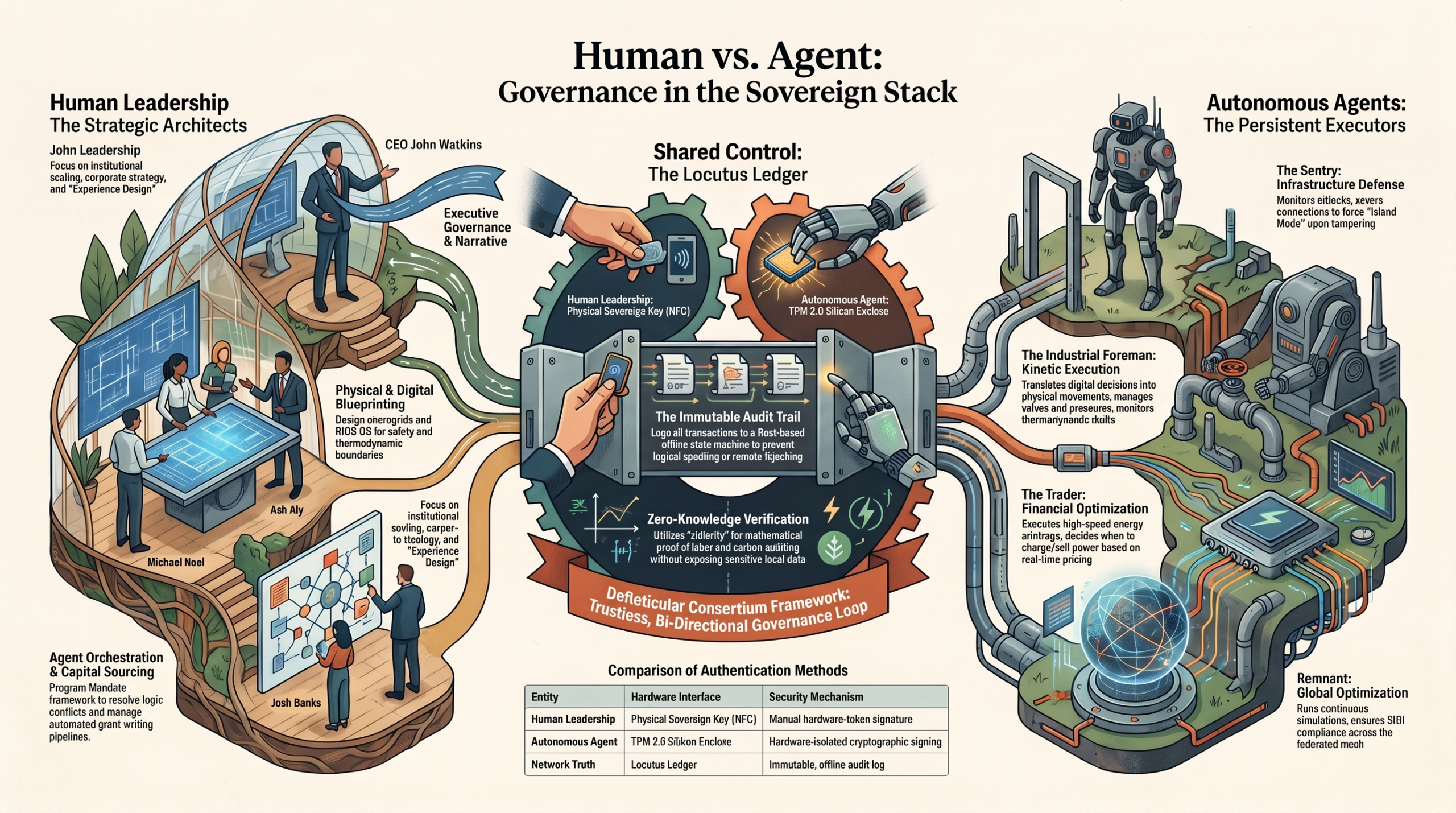
Human leadership within the Sovereign Stack Consortium provides the “Strategic Intent.” While AI handles high-speed execution, humans define the ethical, financial, and structural boundaries of the mesh.
Leader Core Mandate Primary Contribution to Sovereignty
John Watkins (CEO) Corporate Governance & Strategy Integrates Value Mapping™ via Stellar Research metrics to provide empirical proof of community welfare to municipal partners.
Michael Noel (Founder) Principal Systems Engineering Architect of the RIOS (Rural Infrastructure Operating System) physical-kinetic layouts and power-to-compute standards.
Aaron Babcock (President, TriFi) Hardware & Telecom Supply Chain Manufactures BABA-compliant (Build America, Buy America) hardware to bridge the rural “fiber gap” with sovereign mesh networks.
Melissa Chalfant (GP, InVentures) Non-Dilutive Capital Stacking Pairs private equity with federal grants (NTIA, NSF VINES) to de-risk heavy infrastructure and bridge the “Valley of Death.”
video
Synthesis Insight: Sovereignty is as much a regulatory achievement as it is a technical one. By adhering to BABA standards, we ensure our hardware is eligible for federal grant pairing, which Melissa Chalfant uses to absorb heavy capital expenditures. Simultaneously, Watkins uses Stellar Research to satisfy the rigorous validation requirements of municipal investors, proving that Noel’s systems engineering creates measurable social value.
While humans provide the roadmap, they require digital partners for real-time, air-gapped execution.
- The Agentic Layer: Four Guardians of the Mesh
The Consortium delegates continuous monitoring and execution to four specialized autonomous agents. These are not general-purpose tools; they are air-gapped entities running natively on local hardware enclaves.
Remnant
- Classification: Global Optimization & Strategic Planning Agent.
- Core Operational Mandate: Running continuous microgrid performance simulations and ensuring all federated data exchange complies with SIDI standards.
- Physical Alignment: Typically inhabits Node 2 (Canada), the central repository and “Brain.”
- Primary Reflex: Strategic Balance—adjusting global compute workloads to prevent local energy depletion.
The Sentry
- Classification: Edge-Compute Security & Infrastructure Defense Agent.
- Core Operational Mandate: Monitoring digital airlocks and blocking Zero-Day RCE attempts and network-based tampering.
- Physical Alignment: Inhabits Node 3 (Arizona) and all stationary Sovereign Sentry racks.
- Primary Reflex: Isolation—immediately severing all external connections to force a node into “Island Mode” if a vulnerability is detected.
The Industrial Foreman
- Classification: Physical Execution & Thermodynamic Safety Agent.
- Core Operational Mandate: Translating RIOS software decisions into Kinetic Governance (e.g., managing industrial valves, robotic arms, and gasification pressures).
- Physical Alignment: Active at Node 4 (Uganda) and Node 1 (Chicago).
- Primary Reflex: Safety Shutdown—terminating physical operations if mechanical systems exceed engineered thermodynamic limits.
The Trader
- Classification: Financial Optimization & Energy Arbitrage Agent.
- Core Operational Mandate: Managing high-speed ERCOT market operations, battery charging cycles for Tesla Megapacks, and grid discharge.
- Physical Alignment: Exclusively aligned with Node 5 (Fort Worth).
- Primary Reflex: Arbitrage—exploiting market volatility to buy energy at negative rates and sell during peak demand windows (up to $5,000/MWh).
Learning Narrative: To prevent “behavioral drift,” these agents are bound to their human counterparts through a shared governance protocol that separates high-level reasoning from low-level mechanical reflex.
- The Locutus Ledger: The Cryptographic Handshake
The Locutus Ledger is the Master Operational Governance protocol. It enforces a “Trustless Loop” through a bi-directional verification process, ensuring that no state change occurs without dual authorization.
- Intent Initiation: A human leader initiates a state change (e.g., a RIOS firmware update or energy discharge).
- Human Signature: The leader signs the intent using a Physical Hardware Token (the NFC-enabled Sovereign Key).
- Agent Verification: The autonomous agent receives the command and verifies it against local safety and thermodynamic constraints.
- Agentic Signature: The agent signs the execution using a Zero-Knowledge Enclave Proof (zkVerify) generated within its hardware TPM 2.0 enclave.
- Immutable Logging: The bi-directional handshake is recorded on the Locutus Ledger, a Rust-based, offline state machine.
Synthesis Insight: This trustless loop is the secret to scaling a global mesh without losing local control. By requiring a physical key from a human and a cryptographic proof from an AI, we eliminate the need for a central, vulnerable authority.
- Operational Case Study: The Roadshow (Node 8)
Following the Vanguard Pivot, Node 8 transitioned into The Roadshow, a mobile technology hub deployed across the Rural American South. This unit demonstrates the Sovereign Stack directly to municipal managers facing infrastructure decay.
The Division of Labor during a “Grid Defection” Simulation:
- Human Tasks:
- Field engineers utilize the Sovereign Deck (ruggedized terminal) to oversee the demonstration.
- InVentures personnel draft a “Funding Roadmap” to bridge the Valley of Death using federal grant pairing.
- Operators map local infrastructure needs using Value Mapping™ metrics.
- Agent Tasks:
- The Industrial Foreman manages the 1-TPD Mini Gasifier, converting local waste into electricity.
- The Sentry monitors the TriFi Far X satellite-bonded antennas, ensuring the local Campus 15 mesh remains air-gapped.
- The Field Medic (AI), running as a quantized Mistral-7B model on the Sovereign Deck, provides real-time mechanical repair diagnostics for the gasifier.
Synthesis Insight: This synergy creates the “Business Case” for sovereignty. The AI provides the “Island Mode” reliability that de-risks the investment, while human strategic stacking ensures the project is financially viable for the community.
- Summary Checklist for the Aspiring Systems Architect
To achieve certification as a Sovereign Systems Architect, you must master these five critical pillars:
- [ ] Embrace the “Island Mode” Mindset: Always design for absolute self-reliance. If the network collapses, your node must maintain full power, compute, and communication.
- [ ] Enforce Split-Loop Control: Keep high-level cognitive reasoning (edge servers) separated from low-level mechanical reflexes (microcontrollers) to ensure physical security.
- [ ] Trust, but Verify Cryptographically: Never rely on cloud-based authentication. Every state change must involve a hardware token and a zkVerify enclave proof logged to the Locutus Ledger.
- [ ] Master Non-Dilutive Capital Stacking: Technical sovereignty is impossible without financial sovereignty. Learn to pair private equity with BABA-compliant federal grants to de-risk heavy assets.
- [ ] Apply the “Velcro Principle”: Coupling digital compute with physical survival is mandatory. You must route waste heat from server racks into greenhouses or water distillation systems, converting a computational cost into a community asset.


