The Vanguard Pivot: Establishing the Chicago Urban Citadel
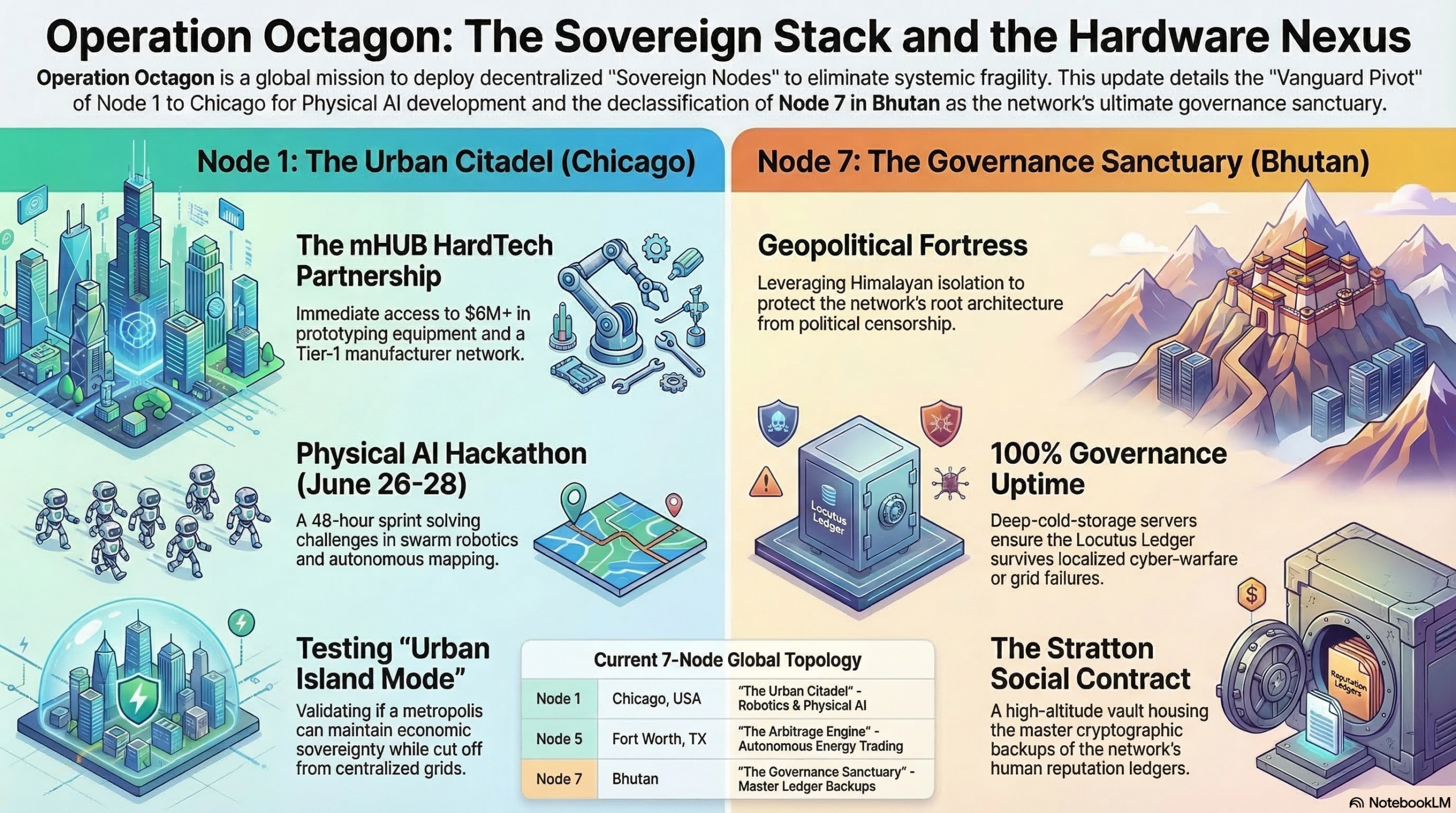
The evolution of sovereign infrastructure necessitates a shift from stationary intelligence to kinetic autonomy. While the initial deployment of Operation Octagon’s Node 1 was slated for Uganda, our continuous systemic friction analysis has detected unacceptable latency within the African theater due to importation bottlenecks and volatile regulatory frameworks. In the post-industrial era, “Speed-of-Learning Legitimacy” is the primary metric for success. To achieve this, the project has executed a “Vanguard Pivot,” relocating Node 1 to Chicago, Illinois. As an Industrial Architect, I view this not merely as a strategic shift, but as the mathematically correct response to industrial friction: we are routing around the resistance to establish a high-coherence operational container where the AI agent “Thunder” is already executing autonomous capital formation and grant writing within the U.S. financial system.
The “Vanguard Pivot” is defined by three core strategic justifications:
- Supply Chain & Capital Proximity: Chicago provides frictionless access to Tier-1 supply chains for specialized hardware—including TPM 2.0 modules, EMP-shielded Sentries, and FIDO2 keys—and immediate proximity to deep capital markets to fund the wider Octagon network.
- Surfboard Synergy: By aligning DeReticular’s “Hardware OS” with Project Surfboard’s “Human OS,” we leverage an existing network of high-trust stewards (led by Bryant Stratton and Kahlil Sullivan), eliminating the need to build community coherence from scratch.
- Urban Island Mode Testing: This deployment serves as a rigorous testbed for “Urban Spherical Resilience.” Proving that a node can maintain complete economic and operational sovereignty—cutting itself off from AWS, Google, and centralized power grids while remaining functional—validates the model for global citadels like London, Tokyo, and Dubai.
This geographic shift is physically anchored by a strategic partnership with mHUB, providing the world-class physical container required to transition from digital ledgers to “cold steel.”
——————————————————————————–
2. The mHUB Advantage: A $6M Prototyping Arsenal
The partnership with mHUB provides Node 1 with its essential “Urban Citadel” architecture, acting as the collision point where sovereign intelligence meets advanced manufacturing. Under the formal structuring initiated by Kahlil Sullivan and Bryant Stratton, this partnership grants our builder network instantaneous access to an industrial-grade ecosystem designed to eliminate the friction between concept and kinetic reality.
| Platform Resource | Strategic Impact for Partners |
| $6M+ Prototyping Arsenal | Immediate access to advanced labs and dedicated technical staff for the rapid fabrication of drone enclosures, robotic chassis, and IoT sensors. |
| National Lab Integration | Direct collaboration channels with Argonne, Oak Ridge, and Lawrence Berkeley National Laboratories for high-tier R&D and material science. |
| The Talent Router | A high-bandwidth connection to elite builder cohorts from MIT, UChicago, Purdue, Northwestern, and the University of Pennsylvania. |
| Corporate Accelerator | Direct engagement with Tier-1 partners (Google, Schneider Electric, Baxter) for industrial pilots, mentorship, and high-stakes commercialization. |
| Resilient Supplier Network | Direct Midwestern and national connections to manufacturers, ensuring a supply chain that resists “Linear Fragility.” |
The “Network Effect” of mHUB functions as an architectural container for high-trust cohorts. By hosting continuous meetups and sprints, Node 1 creates a workspace where anonymous builders, mechanical engineers, and AI developers can solve the complex problems of sovereign infrastructure. This physical foundation is the prerequisite for achieving the mission’s ambitious technical milestones in kinetic intelligence.
3. The Hardware Nexus: Defining Cyber-Physical Autonomy
“Physical AI” is the ultimate manifestation of the Sovereign Stack: intelligence that does not merely “chat” behind a screen, but moves, lifts, and builds in the physical world. It is the transition from stationary computation to kinetic agents capable of navigating and manipulating their environment. To enable this, we utilize a tiered technical architecture anchored in “HardTech” security, utilizing TPM 2.0 modules and FIDO2 keys to secure the hardware layer.
The Sovereign Stack is comprised of three critical components:
- Sovereign Sentry Servers: Air-gapped, localized compute clusters providing the processing power necessary for autonomous operations without centralized cloud vulnerabilities.
- Industrial Foreman & Sovereign Executive: The localized “brains” of the operation. The Sovereign Executive handles high-level strategic logic, while the Industrial Foreman translates that logic into physical execution, such as routing power flows or managing robotic movement.
- RIOS (Sovereign OS): The core operating system that serves as the enabler for “Island Mode” functionality, ensuring that all local operations remain 100% functional even when disconnected from the global internet.
By focusing on Urban Spherical Resilience, this architecture allows Tier-1 manufacturers to secure their intellectual property against the systemic fragilities of centralized clouds. In an era of political censorship and cyber-warfare, this stack provides a fortress for industrial IP, ensuring that the “laws” governing autonomous fleets remain sovereign and intact.
——————————————————————————–
4. The Flagship Event: Physical AI Hackathon (June 26–28)
To formally launch Node 1, DeReticular and Project Surfboard will co-sponsor the Physical AI Hackathon at mHUB. Strategically timed with the Automate trade show, this event serves as a high-intensity testbed for rapid prototyping and the “Genesis State” for the Locutus Ledger in Illinois.
The Sprint Framework This 24–48 hour high-intensity sprint is limited to elite teams of 2–4 builders each.
- DeReticular (The Brains): Will provide Sovereign Sentry servers and Industrial Foreman agents, allowing builders to deploy robots that run securely in “Island Mode.”
- Project Surfboard (The Human OS): Stewards will utilize the Locutus Ledger to cryptographically track and score every builder’s contribution. This creates a decentralized reputation database for the region, transforming the hackathon into an immutable record of talent.
Judging and Prize Structure A panel of investor and industry partner judges will evaluate the output based on subjective performance and technical ingenuity. Prizes include cash rewards, advanced gear, hardware, and compute credits, providing a clear pathway for winners to transition from prototypes to scalable, sovereign ventures.
——————————————————————————–
5. Challenge Tracks: Solving Industrial Friction
The hackathon tracks are designed to solve real-world industrial friction through subjective performance metrics that validate our protocols in diverse environments.
- Swarm Robotics Coordination: Builders will utilize DeReticular edge-networks to enable two or more robots to coordinate physical tasks (e.g., transport or assembly) without any reliance on centralized Wi-Fi or cloud infrastructure.
- Autonomous Physical Mapping: Mobile robots must navigate and map a space using onboard sensors to create semantic, labeled maps, specifically mimicking our “Vault Warden” security protocols for asset protection.
- Human-Robot Collaboration: This track focuses on “cobots” that safely adapt to human speed and gestures, a critical requirement for applications ranging from Arizona mobility nodes to Ugandan eco-tourism.
- Vision-Guided Inspection: Builders will create autonomous systems to inspect physical components (PCBs, welds, or complex parts) and use computer vision to flag defects, providing a vetted pipeline for Tier-1 manufacturing deployment.
These tracks validate the Sovereign Sentry and Industrial Foreman protocols as robust, ready-for-market solutions for investors and industrial partners.
——————————————————————————–
6. The Talent Router: Sourcing the Global Builder Network
A “Hardware OS” is only as effective as the “Human OS” that directs it. Through the mHUB partnership and Project Surfboard, we act as a filter for elite engineering talent, sourcing teams from a vast network of premier partners.
The Global Network Partners Our “Talent Router” draws from the highest levels of academia and defense:
- Tier-1 Engineering: MIT, Purdue, Georgia Tech, Berkeley, and Oregon State University.
- Medical & Research Hubs: Harvard, UChicago, UPenn, Northwestern, Vanderbilt, and OHSU.
- Strategic & Defense Institutions: Army West Point, Princeton, Brown, and Washington University in St. Louis.
- Global Research: University of Calgary, Wisconsin-Madison, and the National Labs (Argonne, Oak Ridge).
The Stratton Social Contract Traditional hiring is too slow for the Physical AI revolution. The Locutus Ledger implements the “Stratton Social Contract,” creating an immutable resume for builders. By cryptographically recording “trust and opportunity generation,” the ledger allows Tier-1 employers to hire based on verified, performance-based truth rather than static credentials.
——————————————————————————–
7. Global Resilience: The Operation Octagon Topology
Node 1 (Chicago) is the vanguard of a 7-node global mesh designed to defeat “Linear Fragility” through decentralized resilience and “Tree of Life” architecture.
- Node 5 (Fort Worth, TX) – “The Arbitrage Engine”: This node weaponizes grid volatility within ERCOT. Using the “Spark Spread Algorithm,” the node calculates the mathematical differential between electricity costs and digital compute value. It buys power when cheap to charge battery arrays or run local compute and discharges back to the grid during peak demand spikes, creating an automated “Capital Geyser” to fund the network.
- Node 7 (Bhutan) – “The Governance Sanctuary”: Situated in the Himalayas, this node serves as the digital fortress for the network. Utilizing the “Tree of Life” architecture, it houses deep-cold-storage clusters and master backups of the Locutus Ledger. It ensures that the governance IP and human reputation ledgers remain untouched by urban political censorship or cyber-warfare.
The synergy between the Human/Robotics innovation in Chicago and the Revenue Engine in Fort Worth creates a self-sustaining ecosystem, secured by the geopolitical isolation of the Bhutan sanctuary.
——————————————————————————–
8. Partnership Commercial Opportunities: Tiered Engagement
We invite industrial leaders to join the Physical AI Revolution. This is an opportunity to co-innovate during the most transformational period in the history of hardware.
Tiered Partner Benefits
- Lead Sponsors: Directly define the challenge tasks for the hackathon to solve your specific industrial problems; gain high visibility within the HardTech ecosystem.
- Hardware & Software Partners: Place your tools directly in the hands of elite builders; participate on judging panels and contribute technical personnel.
- Investors: Gain early access to a vetted pipeline of Physical AI ventures; engage with teams as a competition judge to secure early-stage deal flow.
- Universities: Access sponsoring partners for research collaboration; co-market cutting-edge applications of your institution’s top talent.
Immediate Next Steps The momentum of the Physical AI market is accelerating toward the June 26–28 target. We have authorized the immediate dispatch of 5 specialized “Builder Kits” (containing Sovereign Keys and localized edge-compute boards) to mHUB for pre-hackathon testing.
Contact the DeReticular Strategy & Innovation Group today to secure your role in the Urban Citadel. We do not just build software. We build the machines that will build the future.


