
The Vulnerability of the Modern Town
think Master Writer and Editor. Civic Technologist & Systems Architect (expert in municipal infrastructure, decentralized tech, resilient systems). Rewrite a draft based on a specific outline and a detailed expert critique.
    *   Detailed Outline (Hook, 5 Takeaways, Conclusion).
    *   Expert Critique (Fidelity issues, persona gaps, missed technical details, formatting).
    *   Initial Draft (The base to be improved).
    *   Source Context (SSOT for "Digital Nervous System").

    *   Trust Source (SSOT) over everything.
    *   Address all critique points.
    *   Maintain the specific Persona/Tone.
    *   Output *only* the final document (no preamble).
    *   Main title = H1.

*   *Critique Point 1: 10GbE Switch.* Must include the 10GbE Managed Municipal Backbone Switch in Takeaway 1/2.
*   *Critique Point 2: Active-Active Swarm.* Clarify the 3-node cluster architecture (R-HW-03).
*   *Critique Point 3: Code & Script Patching.* Add Section 5 capabilities (auditing Git, hardcoded credentials).
*   *Critique Point 4: Clarify "Air-Gap".* Not literally offline, but sovereign from the macro-grid/public cloud.
*   *Critique Point 5: Persona/Terminology.* Use "topology," "latency-sensitive," "cryptographic primitives," "orchestration," "subordinate edge node," "container migration."
*   *Critique Point 6: Economic Impact.* Mention the $4,999 price vs. $100k+ for a human SOC.

*   *Title:* Needs to be click-worthy and intelligent regarding municipal sovereignty.
    *   *Idea:* The Sovereign Core: Architecting an Un-killable Digital Nervous System for the Autonomous Municipality.

*   *Introduction (The Hook):*
    *   Focus on the vulnerability of towns.
    *   Resource gap: No budget for 24/7 SOC.
    *   Shift from macro-grid cloud to "Digital Nervous System."
    *   Tone: Authoritative, systems-oriented.

*   *Takeaway 1 (Silicon and Steel):*
    *   Specs: 3-node Sentry Pro Cluster (Intel x86_64, 64GB RAM, RAID 1 NVMe).
    *   Add: 10GbE Managed Municipal Backbone Switch (16-port).
    *   Concept: Active-Active Swarm (R-HW-03).
    *   Clarify "Air-gap": Sovereign from global cloud, tied to local fiber ring.
    *   Quote integration (from Long Description).

*   *Takeaway 2 (Autonomous Orchestration):*
    *   Focus: Eliminating the 3:00 AM crisis.
    *   Terms: Subordinate edge nodes, service-level restoration via SystemD, heartbeat monitoring.
    *   Economic: $4,999 perpetual license vs. $100k SOC seat.
    *   Add: Code & Script Patching (Git auditing, credential scanning).

*   *Takeaway 3 (Autonomous Defense):*
    *   Terms: Mesh-Wide Log Sentinel, Llama-3-8B.
    *   Action: Null-routing via the 10GbE switch.
    *   Capability: Semantic analysis vs. noise.

*   *Takeaway 4 (Human-in-the-Loop):*
    *   Risk: R-SEC-01 (Rogue Ban).
    *   Logic: External blocks = auto; Internal blocks = Signal app Y/N.
    *   Why: Civic trust, preventing lockouts during voting/high-traffic.

*   *Takeaway 5 (Root CA):*
    *   Concept: Mesh Root CA.
    *   Terms: Cryptographic primitives, identity issuance, Absolute Data Sovereignty.
    *   No data to OpenAI/Google.

*   *Conclusion:*
    *   Future landscape for WISPs/IT directors.
    *   Hardware-software hybrid.
    *   Closing question: Is the future "smaller"?

*   *Check:* Did I include the 10GbE switch? Yes.
*   *Check:* Did I explain the active-active swarm? Yes.
*   *Check:* Did I include code/script patching? Yes.
*   *Check:* Is the "air-gap" clarified? Yes.
*   *Check:* Is the persona strong (Systems Architect)? Using terms like *topology, orchestration, primitives*.
*   *Check:* Is the budget comparison there? Yes ($4,999 vs SOC costs).
*   *Check:* Is the formatting correct (H1 title, no preamble)? Yes.

*   *Self-Correction during drafting:* Ensure I don't just say "restarting services." Use "container orchestration" or "service-level restoration." Ensure the distinction between "external" and "internal" IP bans is sharp. Focus on the "High-Capacity" aspect of the Sentry Pro nodes.# The Sovereign Core: Architecting an Un-killable Digital Nervous System for the Autonomous Municipality
1. The Vulnerability of the Modern Town
In our current era of hyper-connectivity, the modern municipality exists in a state of structural fragility. As local governments and essential utilities migrate toward localized mesh topologies, they inevitably paint a target on their backs for sophisticated ransomware syndicates and automated exploit kits. The dilemma is mathematically cruel: a small town or regional utility provider requires enterprise-grade security but lacks the multi-million dollar capital expenditure required to provision a 24/7 human-staffed Security Operations Center (SOC).
This resource asymmetry creates a “security debt” that leaves critical infrastructure—from wastewater SCADA systems to sensitive courthouse databases—exposed to the predatory whims of the macro-grid. Traditionally, the only remedy was a total surrender to the public cloud, offloading sovereignty to AWS or Microsoft in exchange for a semblance of protection.
However, the “Digital Nervous System” offers a more resilient, counter-intuitive architecture. By pivoting away from centralized cloud dependence and toward a localized, high-capacity hardware cluster, a municipality can establish its own autonomous defense layer. This is the transition from a passive client to a sovereign operator—deploying a localized “nervous system” that remains operational even when the wider internet falters.
2. A “Nervous System” Made of Silicon and Steel
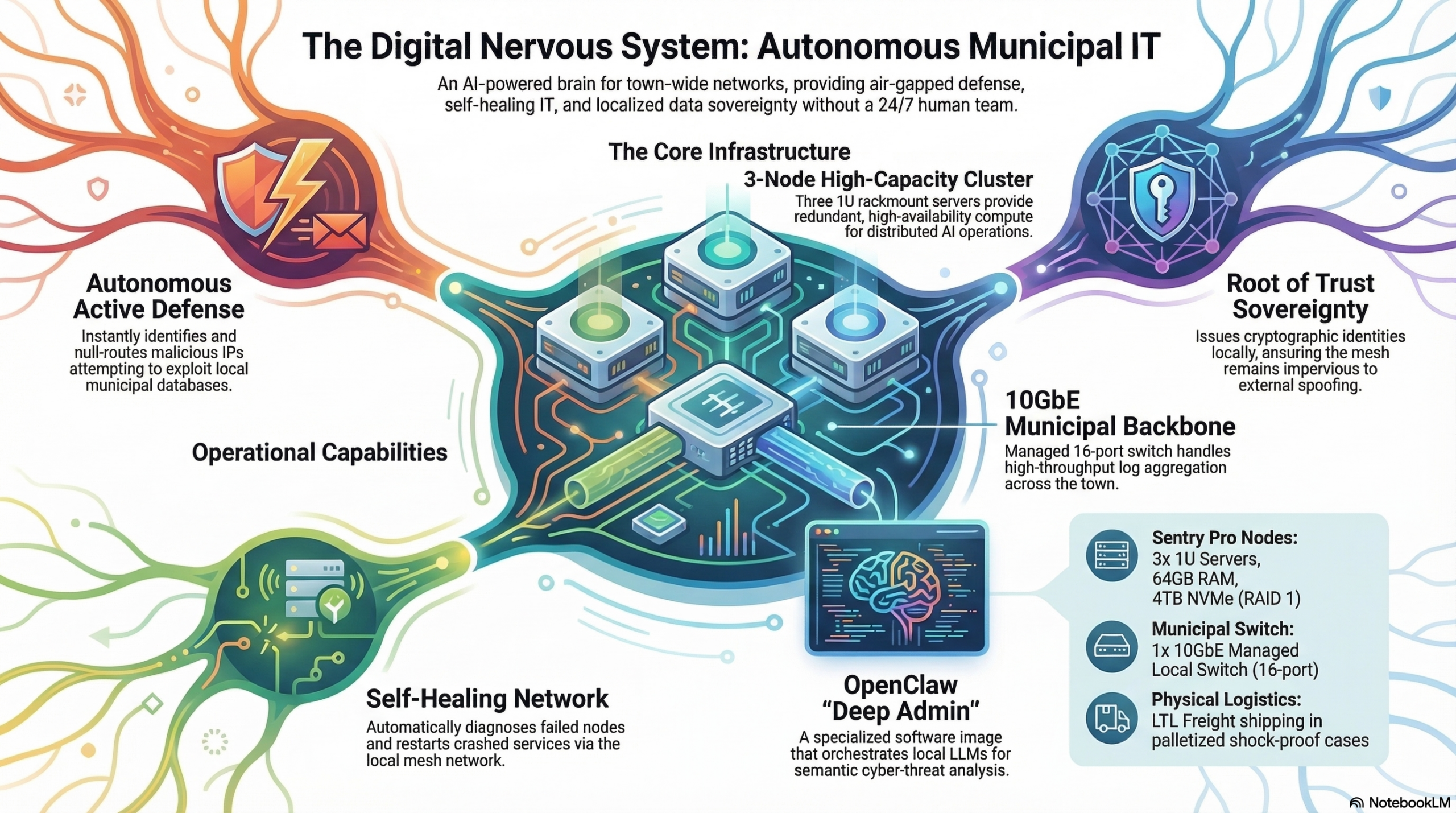
The foundation of this resilience is the High-Capacity Sentry Pro Cluster. Far from a nebulous software subscription, this is a physical 3-node 1U rackmount configuration engineered for survivability. Each node is outfitted with an Intel x86_64 architecture, 64GB of RAM, and 4TB of NVMe storage in RAID 1. Crucially, the cluster operates as an Active-Active Swarm (Risk ID: R-HW-03). In the event of a catastrophic power failure or hardware fault on a single node, the system’s DevOps containers and LLM inference tasks instantly migrate to the surviving nodes with zero downtime.
This cluster functions as the “sovereign brain” of the municipal intranet. While the system is technically “air-gapped” from the public cloud’s vulnerability vectors, it is deeply integrated into the town’s local fiber ring via the 10GbE Managed Municipal Backbone Switch. This high-throughput interconnect allows for massive log aggregation across every subordinate edge node in the topology.
“Relying on remote cloud security providers introduces latency, privacy violations, and a single point of failure if the macro-grid goes down… Designed for Local ISP datacenters and municipal IT closets, this enterprise bundle serves as the un-killable brain of your localized intranet.”
3. Autonomous Orchestration: Eliminating the 3:00 AM Tactical Response
For the resource-strapped IT Director, management is historically reactive. When a library’s server hangs or a water treatment plant’s subordinate node suffers a memory leak, the burden falls on a human administrator to provide manual service-level restoration, often in the dead of night.
The Digital Nervous System disrupts this cycle through its Self-Healing Network capability. The “Deep Admin” acts as a persistent supervisor, monitoring “missing heartbeats” across the mesh. If a service fails, the AI doesn’t just alert a human; it executes an autonomous repair runbook—SSHing into the node via the mesh to perform a diagnostic check and restarting the failing SystemD service or container.
This shifts the economic reality of municipal IT. At a perpetual license cost of $4,999, the system provides a persistent, senior-level SysAdmin capability that would otherwise cost a municipality $100,000+ per year in human SOC salaries. Beyond mere restarts, the system performs continuous Code & Script Patching, auditing municipal Git repositories for hardcoded credentials, SQL injection risks, and dangerous logic loops, securing the perimeter before a vulnerability can be weaponized.
4. Autonomous Defense vs. Modern Ransomware
Traditional firewalls are often blinded by the sheer volume of “noise” in modern traffic. The Digital Nervous System addresses this through its Mesh-Wide Log Sentinel, powered by a localized Llama-3-8B LLM. By performing semantic analysis on millions of raw log lines from every connected business and utility node, the AI differentiates between harmless scanning and the coordinated probing stages of a ransomware campaign.
Because the system controls the 10GbE Municipal Backbone Switch, its Autonomous Active Defense is instantaneous. If the Sentinel identifies a malicious IP attempting to pivot into a local clinic’s database, it can immediately “null-route” the threat at the town’s perimeter. This provides a umbrella of protection for every business on Main Street, reacting with a level of precision and speed that human-led security teams simply cannot match.
5. The “Human-in-the-Loop” Safety Switch
A common critique of autonomous systems is the risk of the “False Positive”—the AI inadvertently locking out legitimate citizens during high-stakes events like municipal voting or tax deadlines. The Digital Nervous System mitigates this via the Rogue Ban (R-SEC-01) protocol.
This strategy establishes a critical boundary between external and internal security. While the AI is empowered to block external, malicious IPs without intervention, any decision to ban an internal mesh IP triggers a “Human-in-the-Loop” prompt. The IT Director receives a simple “Y/N” request via the Signal app, providing a final layer of human context to the AI’s speed. This balance is essential for maintaining civic trust and ensuring that the town’s digital infrastructure remains both secure and accessible.
6. Absolute Sovereignty Through a Local Root CA
True digital sovereignty requires the ownership of identity. The Digital Nervous System achieves this by instantiating the cluster as the Mesh Root CA (Certificate Authority). This hardware cluster becomes the absolute source of truth for cryptographic primitives across the entire town.
By issuing and revoking its own certificates for every “Main Street” shop and “Microgrid” utility node, the municipality ensures its mesh network is entirely closed and encrypted. This architecture prevents external spoofing and ensures that sensitive data—from utility usage to personal records—is never sent to external AI giants for processing. It is the realization of absolute data sovereignty: the municipality no longer rents its identity from a global provider; it owns it locally.
7. Conclusion: The Future of the Sovereign Municipality
The “Digital Nervous System” represents a profound evolution in municipal infrastructure. By merging enterprise-grade silicon with localized, autonomous intelligence, towns and local WISPs can finally achieve the resilience of a global corporation without the overhead of a massive human SOC.
This hybrid hardware-software approach suggests a fundamental shift in our digital topology. As the risks of a centralized, vulnerable macro-grid become undeniable, we must ask: Is the future of the internet actually “smaller”—a constellation of thousands of smarter, sovereign networks rather than one single, fragile center?


