Why the Future of Intelligence is a Box, Not a Cloud: 5 Radical Shifts Toward Cognitive Sovereignty
1. Introduction: The Telemetry Paradox
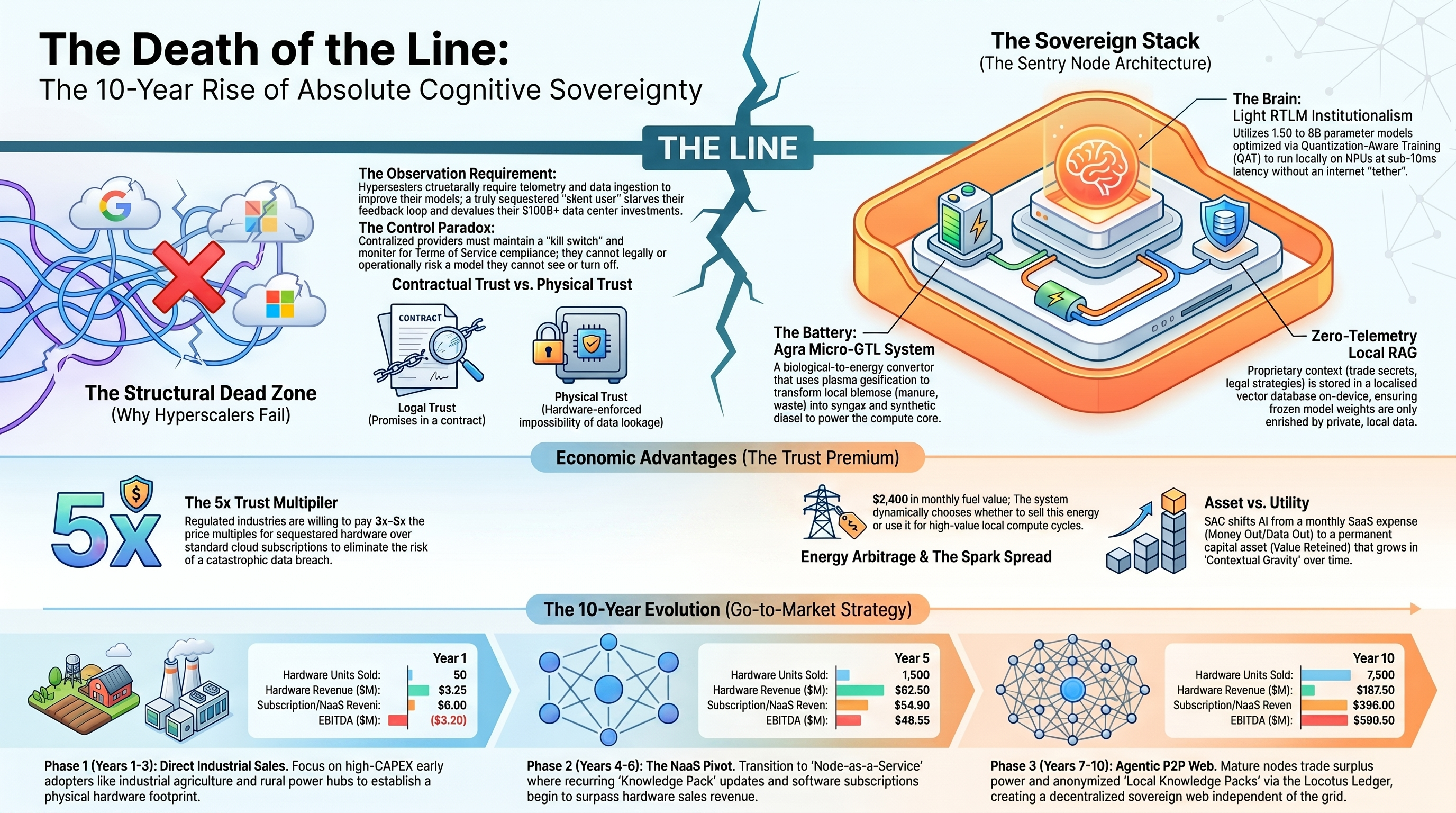
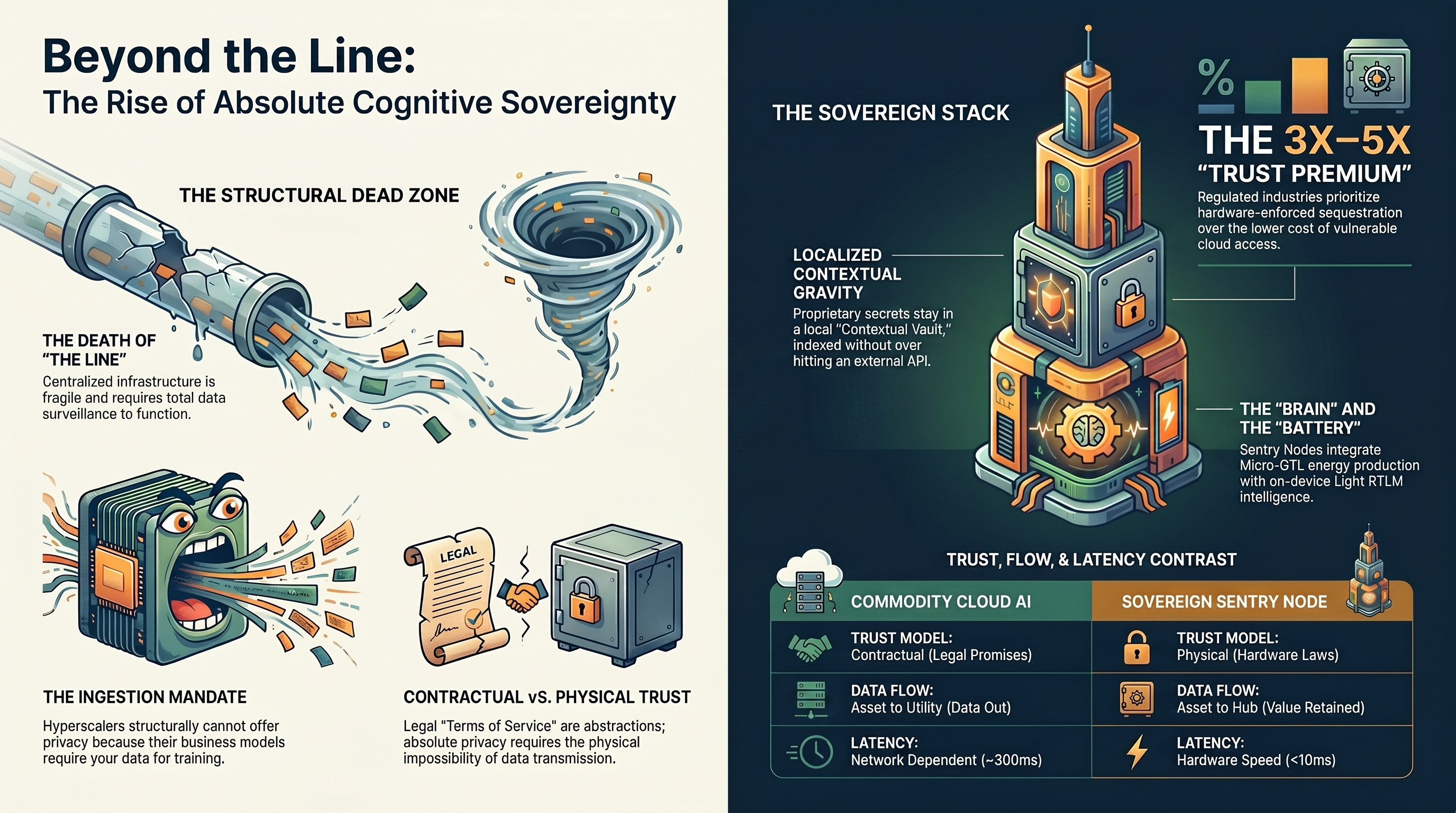
We are currently witnessing the terminal phase of the Telemetry Paradox: the more valuable a company’s data becomes, the more dangerous it is to send to a centralized server. For decades, “The Line”—the centralized grid and hyperscale cloud—offered the convenience of infinite scale. But that convenience came with a hidden cost: the mandatory ingestion of your proprietary context.
The goal of the modern industrial strategist is no longer to secure “AI-as-a-Service,” but to achieve Absolute Cognitive Sovereignty. We are moving away from “contractual trust”—fragile legal promises in a Terms of Service—and toward hardware reality. By placing the “brain” and the “battery” inside a physical, sequestered perimeter, we are replacing the structural risks of the cloud with the unyielding laws of physics.
2. The Death of ‘The Line’ (and the Rise of the Node)
Value has fundamentally split. We now distinguish between “Below the Line” commodities—generic LLM access and search-based agents that are racing to zero value—and “Above the Line” moats. These moats consist of industry-specific workflows, proprietary local context, and high-trust reliability.
“The Line” represents a linear topology of fiber cables and high-voltage wires. It is structurally fragile; a single point of failure (SPF) halts production. In contrast, the Sovereign Node offers spherical resilience. It is a standalone, closed-loop system that operates independently of the wide area network (WAN).
Why “The Line” is failing:
- Structural Fragility: Linear dependencies on long-haul infrastructure are prone to high-impedance faults and physical cuts.
- Total Surveillance: To use a centralized cloud, your data D_{in} must be transmitted. If T(D_{in}) \neq 0, the mathematical probability of exposure over the data’s lifecycle is strictly greater than zero.
- The Commodity Floor: Generic intelligence is becoming a free utility, making the “Access” model economically obsolete.
“We are witnessing the final collapse of ‘The Line’—the centralized, fragile dependencies of the grid and the cloud.”
video
3. Selling Incapacity: Why Big Tech is Structurally Banned from Privacy
There is a Structural Dead Zone for hyperscalers like Google and Microsoft. They are economically and technologically prohibited from offering true sequestration because their valuations depend on an Ingestion Mandate.
To offer true sovereignty, Big Tech would have to become blind. They cannot compete because of three core pillars:
- Telemetry Starvation: Their frontier models require constant “Instruction Tuning” from billions of user interactions. A sequestered node is a “silent user” who provides no feedback, effectively starving their central flywheel.
- Margin Erosion: Hyperscalers have $100B+ invested in data centers. They require high-utilization cloud traffic to maintain margins. One-time hardware sales for a “vault” they cannot meter or monitor is a direct threat to their SaaS revenue recognition.
- The Control Paradox: Centralized providers maintain “kill switches” to minimize liability. Sovereignty means the user controls the boundaries; Big Tech cannot risk the legal fallout of a model they cannot monitor or turn off.
“Sovereignty means the user controls the boundaries. Big Tech cannot risk the legal fallout of a model they cannot monitor or turn off.”
podcast
4. From Manure to Models: The Sovereign Energy Loop
The most radical industrial shift is the Agra Dot Energy concept. Using NEMA 4X-rated enclosures and plasma gasification, industrial operators are converting biological feedstock (farm waste, manure, or tires) into high-margin AI compute cycles.
This process uses a Micro-GTL (Gas-to-Liquids) system to turn biomass into syngas (CO + H_2) and synthetic diesel (ASF^{TM}). A high-efficiency thermodynamic loop captures waste heat from the thermochemical synthesis to warm anaerobic digesters, creating a self-sustaining cycle.
The decision engine here is the Spark Spread Arbitrage Coefficient (C_{ssa}). The system dynamically calculates whether it is more profitable to sell the synthetic fuel or route the energy into local AI inference. In this model, “Security” is redefined as energy independence.
The Sovereign Stack:
- The Hardware (Sovereign Sentry): A modular, industrial-grade enclosure featuring NPU-optimized server clusters and edge Tensor Processing Units (TPUs).
- The Energy (Micro-GTL): A thermochemical refinery that provides behind-the-meter power, insulating the node from grid instability and utility pricing.
5. The Security Move: Physics Trumps Contracts
The “Sequestration Move” is the shift from “Legal Trust” to “Physical Trust.” Traditional cloud providers ask for trust via an agreement—a legal abstraction that cannot physically prevent an insider threat or a government subpoena.
Sovereign infrastructure utilizes Hardware-Enforced Trust. By using GPIO-controlled physical relays, the system can de-energize networking cards at the hardware level. This creates “Compliance by Omission.” If a device has no wire and no power to its transceiver, its transmission capacity T(D_{in}) is exactly zero.
This is a mathematical exemption from audits for HIPAA, FINRA, and the SEC. If the data cannot physically leave the box, there is no transmission vector to audit. Furthermore, TPM 2.0 binding and Trusted Execution Environments (TEEs) ensure that the model weights and proprietary context remain in a tamper-proof memory vault, even against side-channel or physical-access attacks.
“Security is no longer a software update, but a hardware reality.”
6. Contextual Gravity: The Power of Light RTLM
While the mainstream media obsesses over 175B+ parameter cloud models, the industrial frontier is being won by Light RTLMs (Real-Time Language Models) sized between 1.5B and 8B parameters.
These models use Quantization-Aware Training (QAT) to run at INT4 Precision, allowing them to bypass the “Memory Wall” and execute at conversational speeds (>30 tokens/sec) on edge hardware. The real value is Contextual Gravity. A smaller model grounded in a local, zero-telemetry vector database (Local RAG) containing your company’s trade secrets, soil history, or M&A strategy is more valuable than a giant, general-purpose model in California.
Because these models reside on-device, they achieve Zero-Latency Reality. By bypassing the “Cloud Round-Trip,” they provide the sub-millisecond response times required for robotic control and high-stakes diagnostics.
7. Conclusion: The Sovereign Supercycle
We are entering the Sovereign Supercycle, moving from the role of “AI Consumer” to “Industrial AI Developer.” This transition is inevitable for those who wish to retain their “Trust Premium.”
The shift unfolds in three distinct phases:
- Phase 1: Direct sales of hardware-sequestered Sentry Nodes to high-CAPEX early adopters in agriculture and law.
- Phase 2: The rise of Node-as-a-Service (NaaS), where the hardware is leased but the proprietary context remains sequestered and owner-controlled.
- Phase 3: A future of Agentic P2P via the Locutus Ledger. Sovereign nodes will trade surplus power and localized “Knowledge Packs” over secure mesh networks, bypassing the public internet entirely to form a parallel, un-commoditizable economy.
The next decade belongs to those who control the soil, the atom, and the private neural weights.
If you send your data through “The Line” to Big Tech, you are paying a permanent tax on your future value. Are you ready to own your own node?


