Biz Builder Mike: The Architecture of Sovereign Infrastructure
Executive Summary
Biz Builder Mike is the professional alias and personal brand of Michael Noel, the founder and chief architect of the DeReticular research ecosystem. Functioning as the “Mentorship Layer” of the ecosystem, Noel serves as a strategic consultant and “Local Economic Architect,” translating complex technologies—Artificial Intelligence, Decentralized Physical Infrastructure (DePIN), and micro-grids—into revenue-generating business models for local communities.
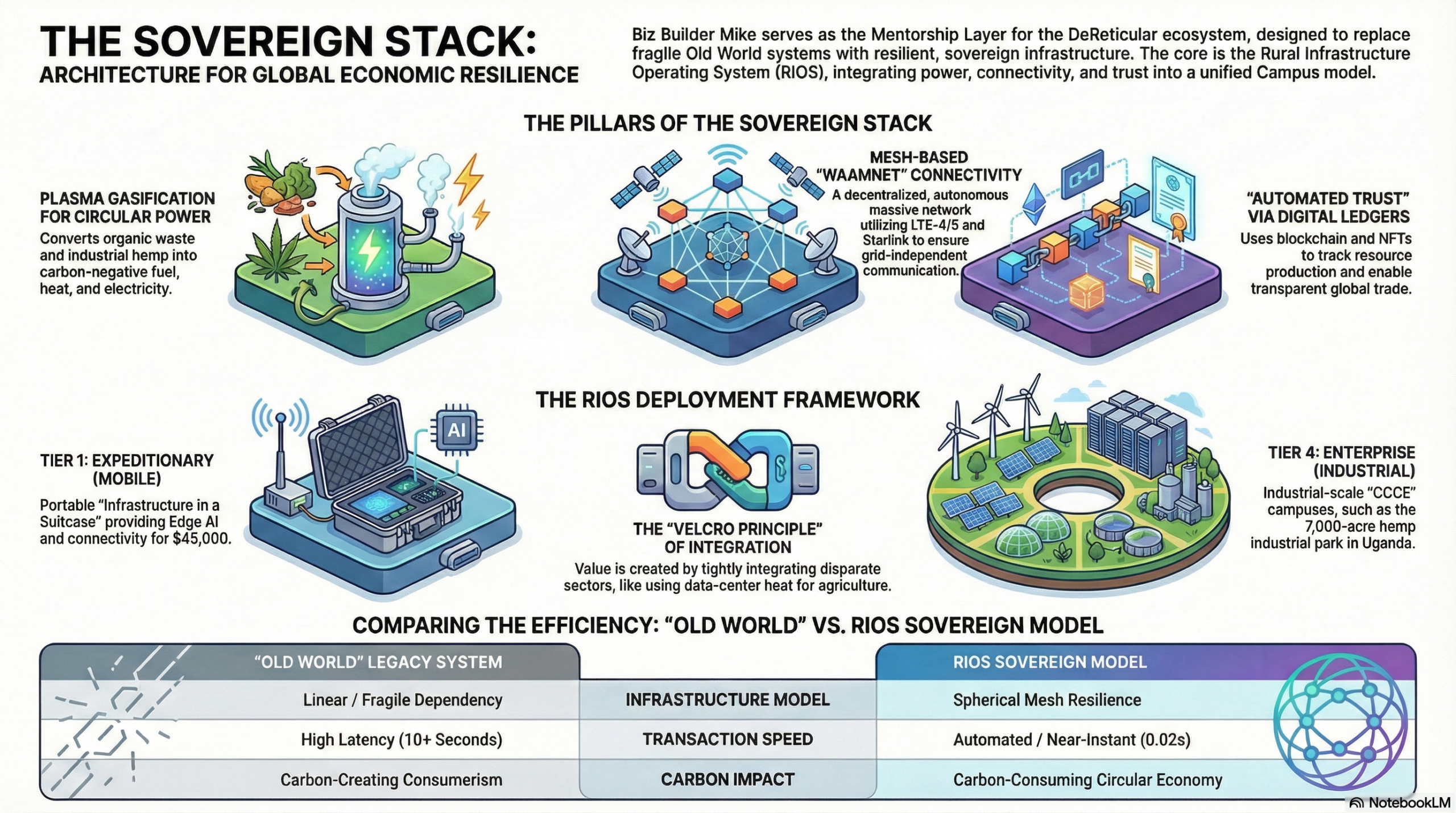
The central pillar of this ecosystem is the Rural Infrastructure Operating System (RIOS) and the Sovereign Stack, a framework designed to decouple local economies from centralized, “fragile” global infrastructure. Through the Carbon-Consuming Circular Economies (CCCE) model, the ecosystem integrates sustainable agriculture (industrial hemp), plasma gasification, and digital ledger technology (DLT) to create self-sufficient, carbon-negative campuses. Following a stealth phase in early 2025, the brand has moved into a “Hardware Offensive,” standardizing infrastructure products from portable “expeditionary” units to industrial-scale city deployments.
——————————————————————————–
1. Identity and Strategic Role: The Mentorship Layer
While other entities in the ecosystem provide hardware and power, Biz Builder Mike provides the human interface and adoption strategy.
- Strategic Architect: Michael Noel designed the interdependencies between the various layers of the ecosystem: power generation (Agra), compute (RIOS), and user experience (DAOSRUS).
- The Velcro Principle: A core consulting philosophy asserting that maximum value is created by tightly integrating disparate sectors, such as utilizing data center waste heat to support agricultural production.
- Fractional Executive Services: Noel acts as a temporary C-level strategist for communities and companies, helping them structure “Data Flywheels” and economic models for sovereign deployments.
- Thought Leadership: Noel is the primary author of foundational texts including “The Mandate for Absolute Resilience” and “The Great Repatriation,” the latter of which argues for moving data from centralized clouds to local, “bare metal” edge computing.
——————————————————————————–
2. The RIOS Ecosystem: Sovereign Stack Architecture
The Rural Infrastructure Operating System (RIOS) is the technical framework for the ecosystem. In 2025, the project moved from theoretical decentralization to standardized hardware production.
RIOS Product Tiers
The stack is categorized into four distinct tiers to meet varying scales of need:
- Tier 1: Expeditionary (Mobile/Suitcase): A $45,000 “Go-Bag” for the digital age, consisting of three ruggedized Pelican cases containing Starlink bonding, Edge AI compute, and battery management.
- Tier 2: Standard (Containerized): Standardized infrastructure housed in shipping containers.
- Tier 3: Lite (Village): Infrastructure scaled for small community deployments.
- Tier 4: Enterprise (Industrial/City): Large-scale systems designed for industrial parks or municipal resilience.
The RIOS-CC-1000
This is a field-deployable sovereign compute cluster classified for “Kinetic Environments.” Unlike traditional IT equipment requiring climate control, this hardware is designed to survive heat, ash, vibration, and total grid failure.
——————————————————————————–
3. Carbon-Consuming Circular Economies (CCCE)
The CCCE model is a community-oriented paradigm for green energy and rural development. It aims to replace “carbon-creating consumer economies” with resilient, self-sufficient campuses.
The Five Pillars of a CCCE Campus
- Plasma Gasification: Converts organic waste (industrial hemp) into syngas, electricity, and carbon-negative fuels.
- Digital Ledger Technology (DLT): Manages transactions and resource tracking via utility tokens and NFTs for automated trust.
- Comprehensive Communications Infrastructure: Provided through WAAMNET (Wireless AdHoc Autonomous Massive Network).
- Sustainable Agriculture: Focuses on industrial hemp as a primary feedstock and rotational organic food crops.
- Social Systems: Integrated platforms for education (WEB3-based), healthcare (digital-first/self-custody), and housing (rammed earth construction).
Economic and Output Potential
A fully operational CCCE campus is designed to produce:
- Fuels: Sustainable Aviation Fuel (SAF), Green Hydrogen, and Methanol.
- Agricultural Byproducts: CBD oils, biochar (for soil regeneration), wood vinegar (organic fertilizer/pesticide), and activated carbon.
- Employment: A typical campus creates approximately 250 full-time equivalent jobs across agriculture, logistics, gasification, and community services.
——————————————————————————–
4. Key Technologies and “Automated Trust”
The ecosystem utilizes several advanced technologies to ensure “Spherical Mesh Resilience” and bypass traditional, fallible audit models.
- WAAMNET: A non-hierarchical mesh network using LTE-4 and LTE-5. It utilizes Named Data Networking (NDN) and the InterPlanetary File System (IPFS) to ensure content is available even without internet backbone connectivity.
- Zero-Knowledge Proofs (zkVerify): Used to verify compute power and carbon credits without exposing sensitive proprietary data.
- Automated Trust: By recording all inputs (moisture, nitrogen, energy) on a decentralized ledger, the system replaces periodic third-party audits with real-time, verifiable data attached to products via NFTs.
- AI Integration: AI is employed for predictive harvest modeling and managing automated customer touchpoints within the campus ecosystem.
——————————————————————————–
5. Operations and Global Roadmap
The ecosystem is currently scaling through international partnerships and rapid hardware deployment.
Uganda Case Study (Kaabong Blueprint)
The “Kaabong Reveal” in August 2025 demonstrated a 7,000-acre industrial park in the Karamoja sub-region.
- Goal: Establish 100 campuses in Uganda by May 2027.
- Impact: Projected creation of 25,000 new jobs.
- Power: Utilizes plasma gasification of hemp hurd to provide a cold gas efficiency of approximately 58-60%.
2025-2026 Timeline
| Period | Focus | Key Events |
| Q1-Q2 2025 | Stealth Phase | Unifying Agra Dot Energy, Kurb Kars, and Revofi into the RIOS Architecture. |
| Q3 2025 | Reveal Phase | Release of the Kaabong Blueprint and Node 4 deployment in Uganda. |
| Q4 2025 | Hardware Offensive | Launch of the RIOS Product Catalog and the $45,000 Expeditionary Suitcase. |
| 2026 (Forward) | Financial Integration | Tokenization of Real World Assets (RWA) like energy and compute capacity. |
6. Conclusion
Biz Builder Mike serves as the evangelist and strategist for a post-centralized world. By positioning Michael Noel not merely as a tech founder but as an architect of new economic models, the brand ensures that the “Sovereign Stack” hardware is successfully adopted and monetized by real-world communities. The overarching goal for 2026 is the activation of the “Sovereign Age,” moving from building the machine to turning it on globally.


