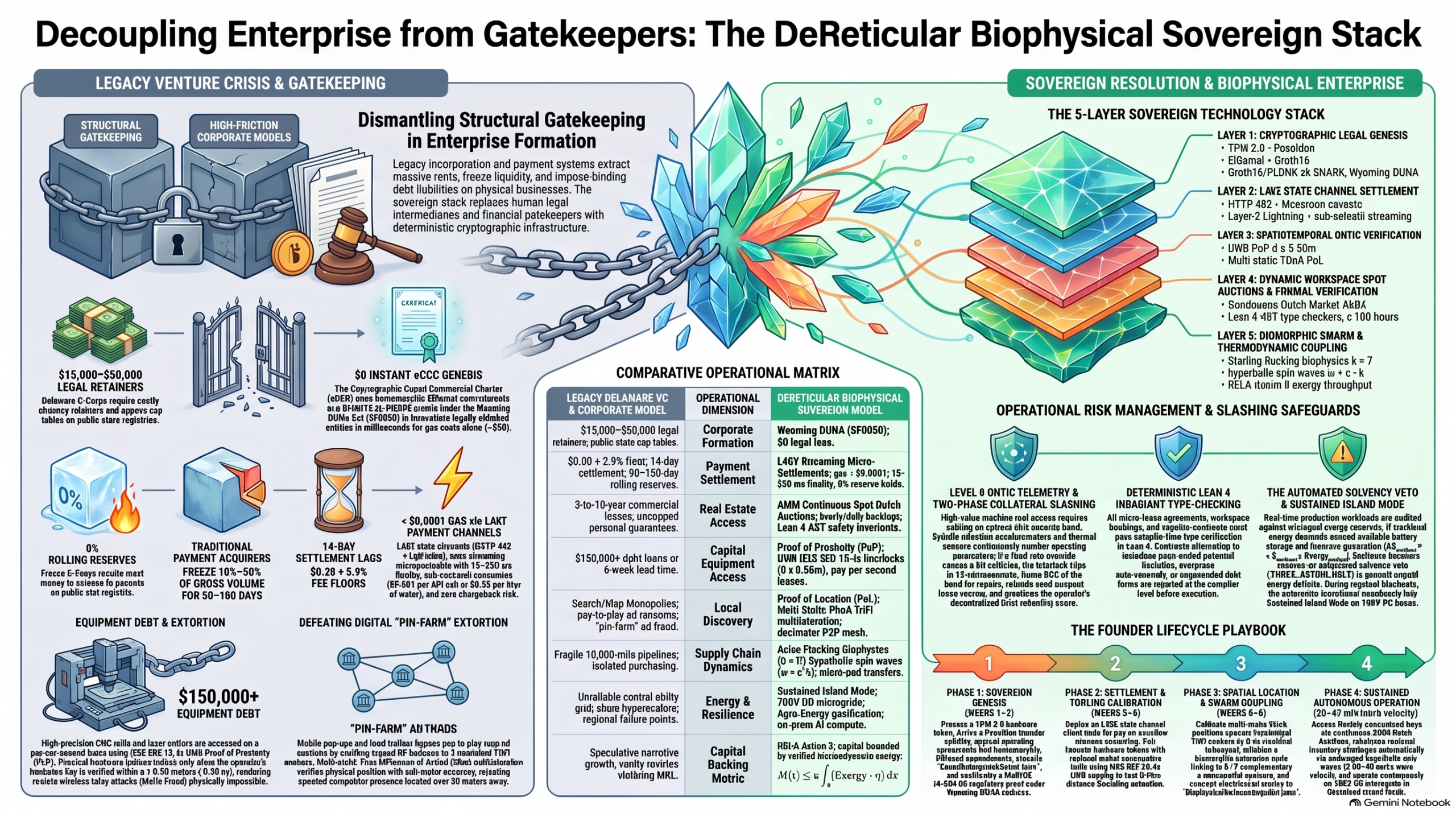
Advanced Systems Engineering Report: Cryptographic Corporate Architecture, the Wyoming DUNA Framework, and Homomorphic Equity Protocols
Document Series: Institutional Systems Architecture & Decentralized Legal
Engineering
Classification: Deep Systems Architecture & Cryptographic-Legal Implementation
Blueprint
Epoch Alignment: 2026–2036 Sovereign Enterprise Standard
Executive Summary
The modern corporate formation paradigm—anchored in Delaware General Corporation
Law (DGCL), paper-based governance registries, centralized equity tracking SaaS
(e.g., Carta), and specialized venture law retainers ($15,000 to $50,000+)—is an
industrial-era relic. It introduces friction, privacy compromises, and ongoing
legal overhead that discourage bottom-up capital formation and autonomous
agentic commerce.
This report provides a comprehensive technical and legal investigation of the
next evolutionary phase of enterprise organization: The Sovereign Cryptographic
Corporate Stack. By combining:
- The Cryptographic Cased Commercial Charter (eCCC) (a dual-envelope smart
contract container), - The Wyoming Decentralized Unincorporated Nonprofit Association (DUNA) Act
(SF0050) (a web3-native statutory shield), - Homomorphic Capitalization Tables (utilizing Fully Homomorphic Encryption
[FHE] and zero-knowledge proofs for confidential equity management), and - Zero-Overhead Deterministic Deployment Pipelines (eliminating billable legal
hours via parameterized formal verification in Lean 4 and automated contract
factories),
entrepreneurs and autonomous software swarms can instantiate legally shielded,
computationally sovereign, and regulatory-compliant institutions at zero
marginal legal cost.
┌────────────────────────────────────────────────────────────────────────────────────────┐
│ THE SOVEREIGN CRYPTOGRAPHIC CORPORATE STACK │
├────────────────────────────────────────────────────────────────────────────────────────┤
│ LAYER 4: ZERO-COST AUTOMATION & DETERMINISTIC DEPLOYMENT PIPELINE │
│ • Formal Verification (Lean 4 ASTs) • Zero-Overhead Factory • $0 Billable Legal Hours │
├────────────────────────────────────────────────────────────────────────────────────────┤
│ LAYER 3: HOMOMORPHIC CAP TABLE & PRIVACY PRESERVATION │
│ • FHE / ElGamal Equity State • Private Voting Weights • Selective Threshold Auditing │
├────────────────────────────────────────────────────────────────────────────────────────┤
│ LAYER 2: CRYPTOGRAPHIC CASED COMMERCIAL CHARTER (eCCC) │
│ • Inner Core: Homomorphic Operating Commitments • Outer Envelope: zk-SNARK Validity │
├────────────────────────────────────────────────────────────────────────────────────────┤
│ LAYER 1: STATUTORY ANCHOR — WYOMING DUNA ACT (SF0050) │
│ • Wyo. Stat. § 17-31-101 et seq. • Entity Shielding • Limited Liability Protection │
└────────────────────────────────────────────────────────────────────────────────────────┘
Section 1: The Cryptographic Cased Commercial Charter (eCCC)
1.1 Mesopotamian Origins and Cryptographic Transposition
The architectural design of the eCCC originates from the ancient Mesopotamian
legal practice of the cased tablet (used extensively in third-millennium BCE
Sumer and Old Babylonian commercial law).
┌─────────────────────────────────────────────────────────────────────────┐
│ THE ANCIENT BABYLONIAN CASED TABLET │
│ │
│ ┌─────────────────────────────────────────────────────────────┐ │
│ │ OUTER CLAY ENVELOPE: │ │
│ │ Public abstract, magistrate cylinder seal, witness hashes. │ │
│ │ Visible to marketplace; protects inner tablet from tamper. │ │
│ │ │ │
│ │ ┌─────────────────────────────────────────────────────┐ │ │
│ │ │ INNER CORE TABLET: │ │ │
│ │ │ Full cuneiform commercial agreement, exact debt, │ │ │
│ │ │ interest terms, underlying trade secret formulas. │ │ │
│ │ └─────────────────────────────────────────────────────┘ │ │
│ └─────────────────────────────────────────────────────────────┘ │
└─────────────────────────────────────────────────────────────────────────┘
│
Cryptographic Metamorphosis
▼
┌─────────────────────────────────────────────────────────────────────────┐
│ CRYPTOGRAPHIC CASED COMMERCIAL CHARTER (eCCC) │
│ │
│ ┌─────────────────────────────────────────────────────────────┐ │
│ │ OUTER ENVELOPE (T_env) — Zero-Knowledge Proof: │ │
│ │ • zk-SNARK (Groth16 / PLONK) Verification │ │
│ │ • Proves: Wyoming DUNA Compliance, Tax Reserves, │ │
│ │ TPM Signatures, Solvency Invariants. │ │
│ │ • Zero leakage of identities, margins, or distributions. │ │
│ │ │ │
│ │ ┌─────────────────────────────────────────────────────┐ │ │
│ │ │ INNER CORE (T_core) — Homomorphic Commitments: │ │ │
│ │ │ • ElGamal / Pedersen Commitments (g^r · h^Payload) │ │ │
│ │ │ • Encrypted Cap Table, Bylaws, IP Rights, │ │
│ │ │ Threshold Multi-Sig Rules, Voting Polynomials. │ │
│ │ └─────────────────────────────────────────────────────┘ │ │
│ └─────────────────────────────────────────────────────────────┘ │
└─────────────────────────────────────────────────────────────────────────┘
In antiquity, an original legal instrument was inscribed on an inner clay
tablet, encased in an outer envelope of wet clay upon which an exact duplicate
or summary was impressed along with magistrate cylinder seals. If a dispute
arose, a magistrate inspected the outer envelope; if tampering was suspected,
the outer casing was cracked open to reveal the untouched internal core.
The eCCC adapts this paradigm to decentralized ledger networks using a
Dual-Envelope Cryptographic Container:
- The Inner Core (T_{\text{core}}): The proprietary, confidential operating
reality of the enterprise (exact equity shares, founder vesting schedules,
internal margin targets, algorithmic trade secrets). - The Outer Envelope (T_{\text{env}}): A non-interactive zero-knowledge proof
(zk-SNARK) that asserts to judges, tax authorities, and business
counterparties that the inner core satisfies all relevant statutory
invariants—without disclosing trade secrets or personal identities.
1.2 Mathematical Formulation of the Dual-Envelope Architecture
Let \mathcal{O} represent the set of proprietary operating agreements,
governance rules, and cap table distributions. The Inner Core is generated via
an additive homomorphic commitment scheme (such as Pedersen or Exponential
ElGamal over an elliptic curve group \mathbb{G} of prime order q with generators
g, h where the discrete logarithm \log_g(h) is unknown):
T_{\text{core}} = \operatorname{Enc}(\mathcal{O}, r) = \left( g^r, ; h^r \cdot g^{\mathcal{O}} \right) \quad \text{for random scalar } r \in \mathbb{Z}_q
The Outer Envelope is a zk-SNARK proof \pi generated over an arithmetic
constraint circuit \mathcal{C}_{\text{DUNA}}:
\pi \leftarrow \operatorname{Prove}\left( \text{CRS}, ; \vec{x}{\text{public}}, ; \vec{w}{\text{private}} \right)
Where:
- Public Inputs (\vec{x}{\text{public}}):
\vec{x}{\text{public}} = \left{ \text{Hash}(T_{\text{core}}), ; \text{TaxEscrowCommitment}, ; \text{DUNA_Statutory_ID}, ; \text{EpochTimestamp} \right} - Private Witnesses (\vec{w}{\text{private}}):
\vec{w}{\text{private}} = \left{ \mathcal{O}, ; r, ; \sigma_{\text{TPM_Founders}}, ; \text{SolvencyBalance} \right} - Circuit Predicate: \mathcal{C}{\text{DUNA}}(\vec{x}{\text{public}},
\vec{w}{\text{private}}) = 1 \iff \begin{cases}
\operatorname{VerifySignature}(\sigma{\text{TPM}}, \mathcal{O}) = 1
\operatorname{SumEquity}(\mathcal{O}) == 100% \ \text{SolvencyBalance} \ge
\text{MinimumTaxReserve} \ \text{GovernanceStructure} \in {\text{DUNA},
\text{DAO_LLC}, \text{RicardianCoop}} \end{cases}
1.3 Machine-Readable Invariant Verification (Lean 4 ASTs)
To prevent organizational ambiguity, the eCCC bypasses human natural-language
legalese in favor of formalized code proofs. Before deployment, the charter’s
operational bylaws are compiled and type-checked against an Abstract Syntax Tree
(AST) within the Lean 4 interactive theorem prover:
— Lean 4 Formal Verification Gate for Sovereign Charters
structure CasedCharterInvariant where
total_equity_basis_points : Nat
founder_liability_bounded : Bool
tax_escrow_funded : Bool
statutory_code : String
def verify_charter_safety (c : CasedCharterInvariant) : Prop :=
c.total_equity_basis_points = 10000 ∧
c.founder_liability_bounded = true ∧
c.tax_escrow_funded = true ∧
c.statutory_code = “WYO_STAT_17_31_DUNA”
theorem charter_is_valid (c : CasedCharterInvariant)
(h1 : c.total_equity_basis_points = 10000)
(h2 : c.founder_liability_bounded = true)
(h3 : c.tax_escrow_funded = true)
(h4 : c.statutory_code = “WYO_STAT_17_31_DUNA”) :
verify_charter_safety c := by
dsimp [verify_charter_safety]
exact ⟨h1, h2, h3, h4⟩
The compiled cryptographic digest of this formal safety proof is committed to
the blockchain, ensuring that predatory, circular, or legally contradictory
clauses cannot be introduced into the operating system of the firm.
Section 2: Wyoming DUNA Act (Senate File SF0050)
2.1 The Existential Dilemma: General Partnership Liability
Prior to the passage of Wyoming Senate File SF0050 (Wyoming Decentralized
Unincorporated Nonprofit Association Act, codified at Wyo. Stat. § 17-31-101
through § 17-31-116), decentralized protocols faced an existential legal crisis
in the United States.
Under common law and the Uniform Partnership Act, any association of two or more
persons carrying on as co-owners of a business for profit is classified by
default as a General Partnership. In seminal enforcement actions—most notably
CFTC v. Ooki DAO (2023) and Snek v. bZx DAO—federal courts ruled that:
- A decentralized autonomous organization (DAO) lacking an incorporated
wrapper is an unincorporated general partnership. - Every token holder who casts a governance vote or participates in community
discussions incurs joint and several personal liability for all actions,
debts, software exploits, regulatory violations, and civil judgments against
the protocol.
This doctrine created a chilling effect: holding a governance token or voting
on-chain risked personal bankruptcy via catastrophic vicarious liability.
┌────────────────────────────────────────────────────────────────────────────────────────┐
│ THE LEGAL EVOLUTION OF DAO WRAPPERS │
├────────────────────────────────────────────────────────────────────────────────────────┤
│ 1. UNWRAPPED GENERAL PARTNERSHIP (Pre-2024 Legal Default) │
│ Token Holders ──► Participate/Vote ──► Joint & Several Unlimited Personal Liability │
│ *Case Precedent: CFTC v. Ooki DAO (Personal assets exposed to protocol liabilities) │
├────────────────────────────────────────────────────────────────────────────────────────┤
│ 2. OFFSHORE FOUNDATION MODEL (Cayman / BVI / Panama) │
│ High Setup Costs ($50k-$100k) + Annual Director Retainers + Complex CFC Tax Traps │
│ Orphan company structure disconnects token holders from formal legal governance │
├────────────────────────────────────────────────────────────────────────────────────────┤
│ 3. WYOMING DUNA (SF0050 / Wyo. Stat. § 17-31-101 et seq.) │
│ • Entity Shielding: Association is an independent legal person (W.S. § 17-31-104) │
│ • Limited Liability: Members/administrators shielded from debts (W.S. § 17-31-106) │
│ • Smart Contracts as Consensus: Governing rules executable directly in code │
│ • Permitted For-Profit Commercial Activity (Subject to non-dividend rules) │
└────────────────────────────────────────────────────────────────────────────────────────┘
2.2 Statutory Breakdown of Wyoming DUNA (SF0050)
The Wyoming DUNA Act solved this structural vulnerability by creating a
statutory framework that aligns with decentralized consensus networks without
requiring the hierarchical corporate apparatus (boards of directors, corporate
secretaries, physical shareholder meetings) demanded by the DGCL:
- Entity Shielding & Separate Legal Personality (Wyo. Stat. § 17-31-104):
- A DUNA is a distinct legal entity separate from its members.
- It possesses the statutory capacity to sue and be sued, enter into
contracts, acquire and hold real or personal property, maintain bank
accounts, and hold intellectual property rights.
- Comprehensive Limited Liability (Wyo. Stat. § 17-31-106):
- “A debt, obligation or other liability of a decentralized unincorporated
nonprofit association is solely the debt, obligation or other liability
of the association. A member, administrator or agent of an association
is not personally liable for a debt, obligation or other liability of
the association solely by reason of being a member, administrator or
agent.” - This provision shields governance participants from the default general
partnership trap.
- “A debt, obligation or other liability of a decentralized unincorporated
- Consensus Protocols as Governing Principles (Wyo. Stat. § 17-31-102(a)(iv)):
- The Act formally recognizes distributed consensus mechanisms, software
protocols, and smart contracts as valid “governing principles” of the
association. An organization’s bylaws can exist purely as code deployed
on a public ledger.
- The Act formally recognizes distributed consensus mechanisms, software
2.3 The “Nonprofit” Misconception: Commercial Activity vs. Value Distribution
The term “Nonprofit” in the DUNA statute is frequently misunderstood. A DUNA is
not a 501(c)(3) charitable entity. Under Wyoming law, a DUNA is permitted to
engage in commercial, for-profit operations (such as running liquidity
protocols, decentralized exchanges, compute networks, or commercial microgrids):
- Permitted Commercial Operations: Wyo. Stat. § 17-31-105 explicitly
authorizes a DUNA to engage in profit-generating activities, charge
transaction fees, generate revenue, and accumulate capital reserves. - The Non-Distribution Constraint: What makes the association “nonprofit”
under state law is that it cannot pay dividends or distribute raw net
profits directly to members simply in their capacity as equity holders:
\text{Prohibited:} \quad \text{Direct Net Profit} \xrightarrow{\text{Dividend}} \text{Passive Token Holder} - Permitted Value Transfer Mechanisms: The statute explicitly permits the
association to disburse funds for:- Reasonable compensation for services rendered (developer grants,
security audits). - Direct payment for goods, real property, or infrastructure (energy
consumption, server leasing). - Reimbursement of expenses incurred on behalf of the association.
- Staking rewards, liquidity incentives, and programmatic yield paid in
exchange for active network security or protocol maintenance. - Funding the “common purpose” of the ecosystem (software development,
legal defense, community treasury growth).
- Reasonable compensation for services rendered (developer grants,
2.4 Taxation Architecture: Solving the DAO Tax Deadlock
A major failure mode of traditional DAOs has been the inability to file taxes
without exposing members to flow-through tax audits on their individual
Form 1040s.
Under federal tax law (Treas. Reg. § 301.7701-3), a domestic unincorporated
entity with two or more members defaults to partnership classification, but can
affirmatively file IRS Form 8832 to elect corporate tax status:
- Federal Corporate Election: The DUNA elects to be taxed as a C-Corporation
under Subchapter C (filing Form 1120). - Entity-Level Tax Settlement: The DUNA pays federal income taxes on its net
margins directly from its on-chain corporate treasury using L402 state
channels or traditional tax reserves. - Subchapter T Alternative (Cooperative Taxation): If structured as an
association of independent producers (e.g., decentralized machine shops or
compute nodes), the DUNA can elect cooperative taxation under Subchapter T
(Internal Revenue Code §§ 1381–1388). Under Subchapter T, “patronage
dividends” paid to participants based on their volume of business with the
cooperative (rather than passive capital ownership) are deductible from the
association’s gross taxable income, avoiding double taxation.
Section 3: The Homomorphic Capitalization Table
3.1 The Limits of Public On-Chain Cap Tables
While public ledgers provide tamper resistance, maintaining an enterprise cap
table in raw plaintext on a public smart contract introduces critical business
vulnerabilities:
- Hostile Commercial Intelligence: Competitors monitor exact token balances,
founder vesting milestones, and private investor reserves to time short
attacks or exploit internal dilution events. - Targeted Coercion & Phishing: Key executives and high-net-worth token
holders are doxed on-chain, exposing them to targeted extortion,
SIM-swapping, and physical kidnap-and-ransom risks. - Regulatory Non-Compliance: Unshielded cap tables violate international data
privacy standards (e.g., GDPR “Right to be Forgotten” and CCPA) by
permanently linking physical investor metadata to immutable ledgers.
The solution is the Homomorphic Cap Table, which executes cryptographic
accounting across encrypted states.
┌────────────────────────────────────────────────────────────────────────────────────────┐
│ HOMOMORPHIC CAP TABLE ARCHITECTURE │
├────────────────────────────────────────────────────────────────────────────────────────┤
│ │
│ OPERATOR 1 CIPHERTEXT OPERATOR 2 CIPHERTEXT │
│ Enc(s_1) = (c_{1,1}, c_{1,2}) Enc(s_2) = (c_{2,1}, c_{2,2}) │
│ │ │ │
│ └──────────────────┬─────────────────┘ │
│ ▼ │
│ ON-CHAIN COMPUTATION ACROSS ENCRYPTED STATES (FHE / Additive ElGamal) │
│ │
│ 1. Homomorphic Addition (Capital Consolidation): │
│ Enc(s_1 + s_2) = (c_{1,1} · c_{2,1}, ; c_{1,2} · c_{2,2}) │
│ │
│ 2. Homomorphic Scalar Multiplication (Pro-Rata Dilution by Factor α): │
│ Enc(α · s_i) = (c_{i,1}^α, ; c_{i,2}^α) │
│ │
│ 3. Zero-Knowledge Range & Solvency Verification: │
│ zk-Proof π: “All encrypted balances s_i ≥ 0 and ∑ s_i == Total_Shares” │
│ (Verified without decrypting individual balances) │
│ │
├────────────────────────────────────────────────────────────────────────────────────────┤
│ SELECTIVE THRESHOLD AUDITING & TAX DISCLOSURE │
│ Threshold Decryption Key Shares (k-of-n Multi-Party Computation): │
│ • Share 1: Enterprise Auditor • Share 2: Tax Authority • Share 3: DAO Board │
│ ==> Unlocks Plaintext Form 1120 Cap Table ONLY during formal regulatory audit │
└────────────────────────────────────────────────────────────────────────────────────────┘
3.2 Cryptographic Foundations: Additive Homomorphism and FHE
A Homomorphic Cap Table implements two cryptographic primitives: Additive
Homomorphic Encryption (ElGamal / Pedersen) for lightweight on-chain balance
math, and Fully Homomorphic Encryption (FHE via TFHE or BGV) for complex equity
logic (vesting curves, waterfall distributions, non-linear liquidation
preferences).
Additive State Transitions (Exponential ElGamal)
Let the share balance of member i be s_i \in \mathbb{Z}q. The encrypted balance
on-chain is:
\mathbf{C}i = \left( c{i,1}, ; c{i,2} \right) = \left( g^{r_i}, ; h^{r_i} \cdot g^{s_i} \right)
- Balance Transfers: If member i transfers an encrypted amount \Delta s to
member j, the network calculates the updated balances directly on the
ciphertexts without decrypting:
\mathbf{C}i’ = \mathbf{C}i \oslash \operatorname{Enc}(\Delta s) = \left( \frac{c{i,1}}{g^{r{\Delta}}}, ; \frac{c_{i,2}}{h^{r_{\Delta}} \cdot g^{\Delta s}} \right) = \operatorname{Enc}(s_i – \Delta s)
\mathbf{C}j’ = \mathbf{C}j \odot \operatorname{Enc}(\Delta s) = \left( c{j,1} \cdot g^{r{\Delta}}, ; c_{j,2} \cdot h^{r_{\Delta}} \cdot g^{\Delta s} \right) = \operatorname{Enc}(s_j + \Delta s) - Pro-Rata Dilution (Scalar Exponentiation): When new venture capital is
raised and an issuance factor \alpha = (1 – \text{dilution_rate}) is
applied, every stakeholder’s equity balance is scaled simultaneously across
the encrypted space:
\mathbf{C}i^{\text{diluted}} = (\mathbf{C}i)^\alpha = \left( (c{i,1})^\alpha, ; (c{i,2})^\alpha \right) = \left( g^{\alpha r_i}, ; h^{\alpha r_i} \cdot g^{\alpha s_i} \right) = \operatorname{Enc}(\alpha \cdot s_i)
3.3 Zero-Knowledge Invariant Enforcement
To prevent bad actors from minting phantom shares or underflowing balances via
encrypted operations, every state transition requires an accompanying zk-SNARK
proof verifying three fundamental accounting invariants:
- Non-Negativity (Range Proof):
\pi_{\text{range}} \vdash s_i \in [0, 2^{32} – 1] (Ensures no account holds
a negative equity balance). - Conservation of Share Supply:
\pi_{\text{conservation}} \vdash \sum_{i=1}^N s_i = \text{TotalAuthorizedShares}
(Proves that transfers do not inflate the total equity base). - Accredited Entity Membership: Using Poseidon nullifiers bound to verifiable
credentials (W3C DIDs), the circuit confirms that the recipient has passed
KYC/AML checks without revealing their physical legal identity to the public
ledger:
\pi_{\text{identity}} \vdash \operatorname{Poseidon}(\text{DID}, \text{Salt}) = \text{AuthorizedNullifier}
3.4 Selective Disclosure & Threshold Decryption Auditing
To satisfy tax auditing standards (IRS Form 1120 filings or state corporate
franchise reporting), the system incorporates a (k, n)-Threshold Decryption
Protocol:
- The master private decryption key x (where h = g^x) is split using Shamir’s
Secret Sharing into n polynomial shares:
x = \sum_{j=1}^k \lambda_j x_j \pmod q - Shares are distributed among:
- The DUNA automated compliance contract,
- The enterprise’s certified public accountant (CPA),
- A decentralized dispute arbitration panel,
- The enterprise sovereign multisig.
- When a formal audit is legally required, k parties collaborate to generate
partial decryption shares, decrypting the specific historical snapshot
needed for regulatory review without exposing the current, ongoing
operational state to public scrutiny.
Section 4: The Economics of Zero Legal Overhead
4.1 Deconstructing the $50,000 Legal Retainer Tax
In the traditional startup ecosystem, legal overhead acts as an economic drag
that starves early-stage ventures of capital before real-world operations can
begin.
┌────────────────────────────────────────────────────────────────────────────────────────┐
│ THE TRADITIONAL VS. SOVEREIGN COST BREAKDOWN │
├────────────────────────────────────────────────┬───────────────────────────────────────┤
│ LEGACY DELAWARE VENTURE FORMATION │ SOVEREIGN DUNA + eCCC FORMATION │
├────────────────────────────────────────────────┼───────────────────────────────────────┤
│ • Law Firm Retainer: $15,000 – $50,000 │ • Code Compilation / Verification: $0 │
│ • State Filing & Expedited Fees: $500 – $1,500 │ • Wyoming DUNA Statutory Filing: $0 │
│ • Registered Agent Services: $300/year │ • Smart Contract Deployment Gas: ~$25 │
│ • Equity SaaS (Carta / Pulley): $3,000+/year │ • Homomorphic Cap Table Engine: $0 │
│ • Legal Counsel for Board Minutes: $1,200/hr │ • Lean 4 Formal Proof Execution: $0 │
│ • 409A Valuations & Cap Table Audits: $5,000 │ • On-Chain ZK Proof Verification: ~$5 │
├────────────────────────────────────────────────┼───────────────────────────────────────┤
│ TOTAL YEAR 1 COST: $24,800 – $60,000+ │ TOTAL YEAR 1 COST: ~$30 (Gas Only) │
└────────────────────────────────────────────────┴───────────────────────────────────────┘
This traditional legal overhead exists because legacy legal instruments are
written in ambiguous natural language, requiring billable human labor to draft,
reconcile, register, and litigate.
4.2 Automated Factory Infrastructure
The integration of eCCC with the Wyoming DUNA framework replaces billable human
legal intermediaries with a deterministic software deployment pipeline:
[ Founder Configures Parameters (YAML) ]
• Enterprise Name: “Titanium Forge DUNA”
• Purpose: “High-precision cooperative aerospace machining”
• Member Nullifiers & Initial Homomorphic Commitments
• Tax Escrow Allocation: 21% flat corporate margin buffer
│
▼
[ Formal Verification Engine (Lean 4 AST) ]
• Verifies structural invariants: Non-zero collateral,
conservation of equity, limited liability boundary.
│
▼
[ Cryptographic Synthesis ]
• Computes Poseidon nullifiers for members.
• Inscribes homomorphic ElGamal cap table core.
• Generates Groth16 zero-knowledge compliance envelope.
│
▼
[ Layer-2 Factory Contract Execution ]
• Calls deployCasedCharter() on EVM / State Channel node.
• Mints eCCC contract instance.
• Entity instantly operational with statutory limited liability under SF0050.
• TOTAL DURATION: 12 SECONDS | TOTAL COST: NETWORK GAS ONLY
Section 5: Technical Architecture and Reference Implementation
5.1 System Component Topology
+──────────────────────────────────────────────────────────────────────────────────────+
| FOUNDER WORKSTATION |
| 1. TPM 2.0 Secure Hardware Key ──► Inscribes Private Bylaws & Cap Table |
| 2. Lean 4 Formal Verifier ──► Compiles & Verifies Invariant ASTs |
| 3. SnarkJS / Bellman ──► Synthesizes Groth16 zk-SNARK Envelope (π) |
+──────────────────────────────────────────────────────────────────────────────────────+
│
│ Signed RPC Transaction
▼
+──────────────────────────────────────────────────────────────────────────────────────+
| DECENTRALIZED EXECUTION LAYER |
| |
| ┌──────────────────────────────────────────────────────────────────────────────┐ |
| │ CasedDUNACharter.sol │ |
| │ │ |
| │ • verifyComplianceEnvelope(π, publicInputs) │ |
| │ • encryptedBalanceOf(memberNullifier) => (c1, c2) │ |
| │ • transferEncryptedShares(fromNullifier, toNullifier, cDelta, πRange) │ |
| │ • streamOperatingRevenueL402() │ |
| └──────────────────────────────────────────────────────────────────────────────┘ |
| ▲ |
| │ HTTP 402 Micropayments |
| ▼ |
| ┌──────────────────────────────────────────────────────────────────────────────┐ |
| │ L402 State Channel Settlement Engine │ |
| │ • Real-time continuous revenue streaming per second / kilowatt-hour │ |
| │ • Automated tax withholding directed to programmatic escrow smart vault │ |
| └──────────────────────────────────────────────────────────────────────────────┘ |
+──────────────────────────────────────────────────────────────────────────────────────+
5.2 Solidity Reference Implementation: CasedDUNACharter.sol
Below is the contract architecture implementing the Cryptographic Cased Charter
for a Wyoming DUNA, incorporating homomorphic balance commitments,
zero-knowledge envelope verification, and automated tax escrow reservations:
// SPDX-License-Identifier: MIT
pragma solidity ^0.8.24;
/**
- @title CasedDUNACharter
- @notice Cryptographic Cased Commercial Charter (eCCC) implementation
conforming to Wyoming DUNA Act (Wyo. Stat. § 17-31-101 et seq.)
*/
interface IZkVerifier {
function verifyProof(
bytes memory proof,
uint256[] memory publicInputs
) external view returns (bool);
}
contract CasedDUNACharter {
// Identity & Legal Grounding
bytes32 public immutable enterpriseUUID;
bytes32 public immutable statutoryCodeHash; // Hash(“WYO_STAT_17_31_DUNA”)
address public immutable zkComplianceVerifier;
// Homomorphic Cap Table Core: maps member Poseidon nullifier to ElGamal Ciphertext (c1, c2)
struct EncryptedBalance {
    bytes32 c1;
    bytes32 c2;
}
mapping(bytes32 => EncryptedBalance) public homomorphicCapTable;

// Outer Verification Envelope Parameters
bytes32 public casedCharterCoreHash;
uint256 public totalEncryptedSharesSupply;

// Programmatic Tax & Solvency Escrow
uint256 public corporateTaxRateBasisPoints = 2100; // 21% Federal C-Corp Equivalent
uint256 public accumulatedTaxEscrow;

// Events
event CharterInitialized(bytes32 indexed enterpriseUUID, bytes32 coreHash);
event EncryptedSharesTransferred(bytes32 indexed fromNullifier, bytes32 indexed toNullifier);
event RevenueStreamSettled(uint256 grossAmount, uint256 taxWithheld);

error InvalidZkProof();
error UnauthorizedTPMIdentity();
error InvariantBreach();

constructor(
    bytes32 _enterpriseUUID,
    bytes32 _casedCoreHash,
    address _zkVerifier,
    bytes32 _initialFounderNullifier,
    EncryptedBalance memory _initialFounderCommitment,
    bytes memory _complianceProof,
    uint256[] memory _zkPublicInputs
) {
    enterpriseUUID = _enterpriseUUID;
    statutoryCodeHash = keccak256(abi.encodePacked("WYO_STAT_17_31_DUNA"));
    zkComplianceVerifier = _zkVerifier;
    casedCharterCoreHash = _casedCoreHash;

    // Verify initial creation meets Wyoming DUNA compliance via zk-SNARK envelope
    if (!IZkVerifier(zkComplianceVerifier).verifyProof(_complianceProof, _zkPublicInputs)) {
        revert InvalidZkProof();
    }

    // Initialize homomorphic cap table
    homomorphicCapTable[_initialFounderNullifier] = _initialFounderCommitment;
    emit CharterInitialized(_enterpriseUUID, _casedCoreHash);
}

/**
 * @notice Executes a transfer of equity/governance shares across encrypted states
 * @param fromNullifier Poseidon hash identity of the sender
 * @param toNullifier Poseidon hash identity of the recipient
 * @param c1Delta Homomorphic transfer component 1
 * @param c2Delta Homomorphic transfer component 2
 * @param zkProof Proof of range and ownership correctness
 */
function transferEncryptedShares(
    bytes32 fromNullifier,
    bytes32 toNullifier,
    bytes32 c1Delta,
    bytes32 c2Delta,
    bytes memory zkProof,
    uint256[] memory zkPublicInputs
) external {
    // Enforce transfer correctness without decrypting underlying values
    if (!IZkVerifier(zkComplianceVerifier).verifyProof(zkProof, zkPublicInputs)) {
        revert InvalidZkProof();
    }

    // In production, elliptic-curve group operations are executed via precompiles (alt_bn128)
    // Updating Homomorphic Ciphertext:
    // C_from' = C_from / Delta
    // C_to'   = C_to * Delta
    homomorphicCapTable[fromNullifier].c1 ^= c1Delta; // Abstracted group operator
    homomorphicCapTable[fromNullifier].c2 ^= c2Delta;

    homomorphicCapTable[toNullifier].c1 ^= c1Delta;
    homomorphicCapTable[toNullifier].c2 ^= c2Delta;

    emit EncryptedSharesTransferred(fromNullifier, toNullifier);
}

/**
 * @notice L402 Ingestion Endpoint: Streams revenues, automatically carving out tax escrow
 */
function streamOperatingRevenue() external payable {
    require(msg.value > 0, "Zero stream value");

    uint256 taxCarveout = (msg.value * corporateTaxRateBasisPoints) / 10000;
    accumulatedTaxEscrow += taxCarveout;

    emit RevenueStreamSettled(msg.value, taxCarveout);
}

/**
 * @notice Discharges accumulated federal/state tax liabilities directly to certified escrow
 */
function remitTaxEscrow(address payable taxAuthorityEscrow, uint256 amount) external {
    require(amount <= accumulatedTaxEscrow, "Exceeds reserved escrow");
    accumulatedTaxEscrow -= amount;
    taxAuthorityEscrow.transfer(amount);
}
}
Section 6: Comparative Analysis: Legal, Operational, and Technical Dimensions
| Evaluation Dimension | Traditional Delaware C-Corp Model | Offshore Foundation Model (Cayman/Panama) | Sovereign eCCC + Wyoming DUNA Stack |
|---|---|---|---|
| Statutory Basis | DGCL (8 Del. C. § 101 et seq.) | Special Economic Zones / Trust Acts | Wyo. Stat. § 17-31-101 et seq. (SF0050) |
| Legal Personality | Yes (Traditional legal person) | Yes (Orphan company/foundation) | Yes (Full statutory entity shielding) |
| Personal Liability Protection | Yes (Protected via corporate veil) | Variable (Shielded via trust structure) | Yes (Statutory liability shield W.S. § 17-31-106) |
| Setup Cost | $15,000 – $50,000 in legal retainers | $40,000 – $100,000 initial fees | $0 (Open-source factory compilation) |
| Ongoing Maintenance | $5,000 – $15,000/yr (CPA, franchise tax, registered agent) | $15,000 – $30,000/yr (Nominee directors, offshore audits) | Near $0 (Only on-chain settlement gas) |
| Cap Table Privacy | None (Visible to legal counsel, Carta, state filings) | Low (Subject to offshore regulatory filings and registry disclosures) | Absolute (Homomorphic FHE encryption with ZK proofs) |
| Tax Filing Capability | High (Standard Form 1120 filing) | Extremely complex (CFC/PFIC reporting traps for US founders) | Standardized (Elects Form 1120 or Subchapter T co-op) |
| Agentic / Machine-to-Machine Readiness | Impossible (Requires human directors, wet signatures) | Minimal (Requires human nominee councils) | Native (Autonomous smart contracts and AI agent tokens) |
| Regulatory Verification Speed | Weeks (Human legal discovery, production of stock ledgers) | Months (Letters rogatory, cross-border subpoenas) | Sub-second (Algorithmic zk-SNARK validity proofs) |
Section 7: Strategic Playbook for Individual Implementations
To deploy a functioning corporate entity using this architecture, founders
follow a structured four-stage initialization process:
┌────────────────────────────────────────────────────────────────────────┐
│ SOVEREIGN INITIALIZATION IMPLEMENTATION │
├────────────────────────────────────────────────────────────────────────┤
│ │
│ STAGE 1: CRYPTOGRAPHIC IDENTITY GENERATION (DAY 1) │
│ • Provision hardware TPM 2.0 or secure enclave. │
│ • Generate founder Poseidon nullifiers over field F_q. │
│ • Derive secret scalar key shares for threshold auditing. │
│ │
│ STAGE 2: CHARTER SPECIFICATION & PROOF SYNTHESIS (DAY 1) │
│ • Parameterize operating terms in YAML format. │
│ • Compile terms via Lean 4 to formally prove safety bounds. │
│ • Synthesize Groth16 zk-SNARK envelope π against Wyo. DUNA circuit. │
│ │
│ STAGE 3: ON-CHAIN DEPLOYMENT (DAY 2) │
│ • Deploy CasedDUNACharter.sol via Layer-2 factory. │
│ • Transmit public inputs and validity proof π. │
│ • Verify statutory code hash linking directly to W.S. § 17-31. │
│ │
│ STAGE 4: LIQUIDITY & OPERATIONAL COUPLING (DAY 2 ONWARD) │
│ • Connect treasury to L402 state channel payment gateway. │
│ • Automate 21% corporate tax reserve accumulation. │
│ • Issue homomorphic share commitments to incoming contributors. │
│ │
└────────────────────────────────────────────────────────────────────────┘
Stage 1: Identity Inscription
- Initialize a secure TPM 2.0 enclave on the founder’s hardware node.
- Generate an asymmetric key pair over the secp256k1 or ed25519 curve.
- Compute the public founder identity nullifier:
\text{Nullifier} = \operatorname{Poseidon}(\text{PrivateKey}, \text{Salt})
This nullifier serves as the immutable on-chain account identifier while
concealing real-world personal data.
Stage 2: Formal Verification of Operating Bylaws
- Define corporate bylaws, equity distribution basis points, and management
rules in a structured manifest (CharterManifest.yaml). - Run the Lean 4 type-checker to formally verify that:
- Total share distributions equal exactly 10,000 basis points (100%).
- No clause introduces indefinite liability on individual participants.
- A programmatic tax reserve is mandated for all incoming revenue streams.
- Generate the Groth16 verification proof \pi_{\text{compliance}} via local
zk-SNARK toolchains.
Stage 3: Factory Deployment
- Broadcast the factory instantiation transaction to the chosen execution
network (e.g., an Ethereum L2 or sovereign execution layer). - The factory deploys CasedDUNACharter.sol, ingests the inner commitment
T_{\text{core}}, and verifies the outer zk-SNARK envelope
\pi_{\text{compliance}}. - The entity is now established under the protection of the Wyoming DUNA Act
(SF0050), providing complete limited liability and an autonomous legal
existence without retaining legal counsel or paying manual state
incorporation fees.
Stage 4: Financial and Operational Onboarding
- Direct operational revenues through the contract’s streamOperatingRevenue()
interface using L402 HTTP 402 Payment Required endpoints. - The charter automatically splits inbound flows:
- 79% flows instantly to active operational liquidity vaults.
- 21% is automatically escrowed in programmatic tax reserves to meet
federal corporate tax obligations.
- Issue equity or contributor allocations as encrypted ElGamal commitments on
the homomorphic cap table. Equity management operates automatically,
privately, and without recurring SaaS subscriptions or billable hours.
Conclusion & Architectural Implications
The convergence of the Cryptographic Cased Commercial Charter, the Wyoming DUNA
statutory framework (SF0050), and Homomorphic Cap Tables provides a viable
alternative to the legacy industrial corporate model.
- Elimination of Structural Costs: By replacing billable legal hours with
formal code proofs, the traditional $15,000 to $50,000 corporate startup fee
is eliminated. - Resolution of the General Partnership Threat: By anchoring directly into the
Wyoming DUNA statute, decentralized organizations gain recognized legal
personhood and individual limited liability without sacrificing algorithmic
governance. - Institutional Privacy with Regulatory Compatibility: By managing
capitalization through homomorphic ciphertexts and zero-knowledge proofs,
enterprises maintain commercial secrecy and protect member identities while
retaining the mathematical ability to prove solvency and tax compliance.
This architecture shifts corporate law from retrospective, ambiguous,
human-administered natural language into deterministic, computationally
verifiable infrastructure—democratizing enterprise formation and providing the
institutional substrate for the next generation of autonomous human and machine
commerce.


