
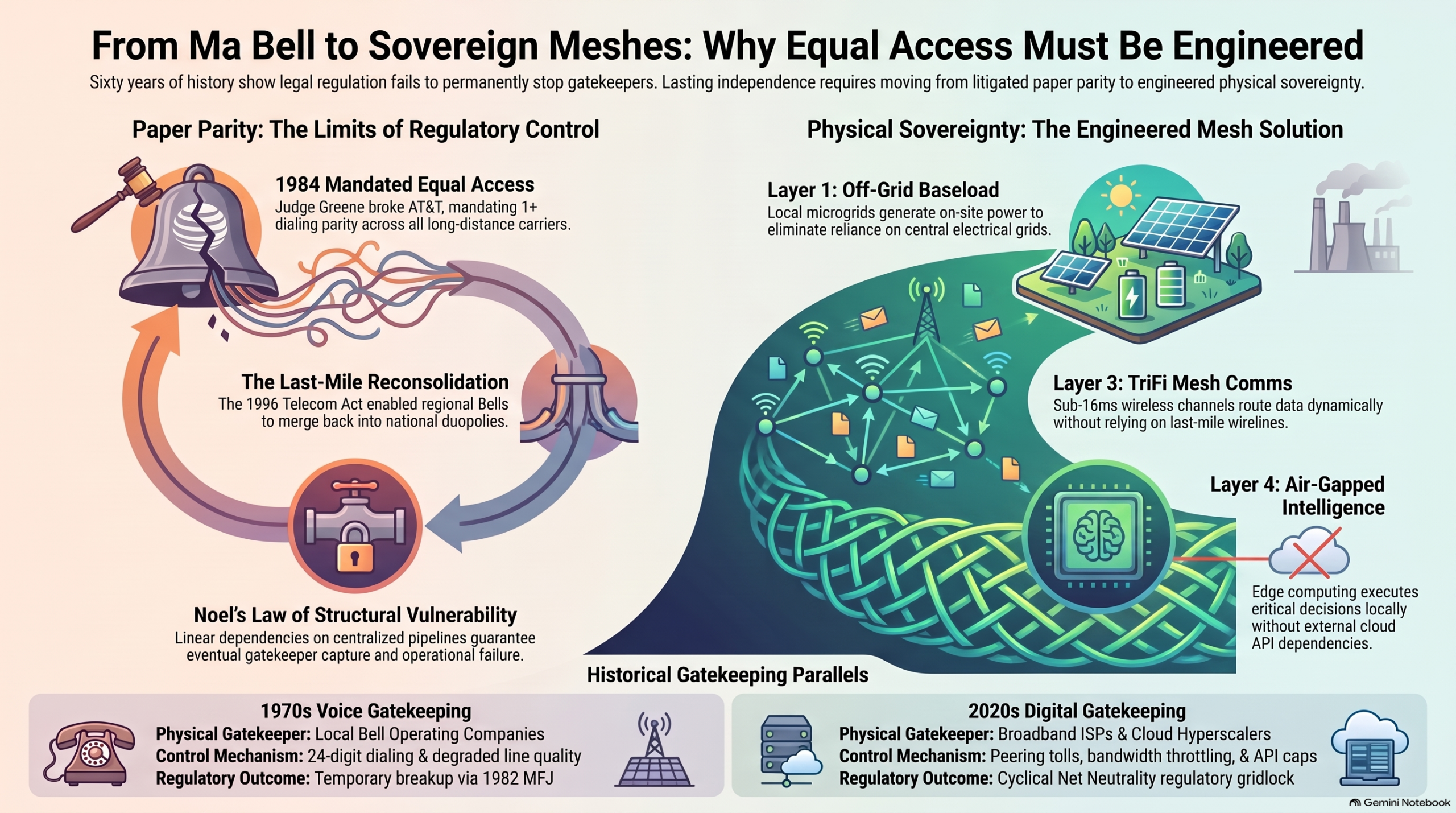
Historical Comparison Summary: From Ma Bell’s Wire to the Modern Web Grid.
- Conceptual Framework: The Law of the Last-Mile Gatekeeper
Throughout the history of communications infrastructure, a fundamental architectural principle repeatedly emerges: physical control over a last-mile conduit inevitably leads to gatekeeping, rent extraction, and competitive sabotage. When a single entity controls the physical link between the end consumer and the broader network, it possesses both the economic incentive and the technical power to favor its proprietary offerings, tax third-party competitors, and artificially degrade non-monopolized traffic. From an information architecture perspective, centralized linear conduits create structural single points of control where topology dictates market power.
In the 20th century, this dynamic was defined by the American Telephone and Telegraph Company (AT&T, or “Ma Bell”), which leveraged its physical monopoly over local copper loops to suppress competitive long-distance networks. In the 21st century, this exact structural bottleneck has re-emerged across digital networks. Broadband Internet Service Providers (ISPs) and Cloud Hyperscalers now occupy the same structural choke points over data packets, API endpoints, and compute workloads that the Bell System once held over circuit-switched voice traffic.
Historical Element (20th Century) Modern Equivalent (21st Century)
AT&T / Bell System (Local Loop Monopoly) Broadband ISPs / Telecom Cartels (AT&T, Verizon, Comcast, Charter) & Cloud Hyperscalers
24-Digit Execunet Dialing / Inferior Audio (Feature Group A) Throttling, Peering Tolls, Egress Fees, and Artificial Data Caps
Equal Access Mandate (Feature Group D / 1+ Parity) Net Neutrality (Title II Common Carriage Classification)
Goeken’s Route 66 Microwave Towers Sovereign Mesh / De-Reticulated Nodes
Understanding this historical pattern demonstrates that contemporary debates surrounding net neutrality, cloud egress fees, and platform gatekeeping are not novel digital anomalies, but rather the modern continuation of an infrastructure struggle that originated along a stretch of highway in the American Midwest.
- The Original Battle: Fighting “Ma Bell” for the Physical Wire (1963–1978)
In the early 1960s, the Bell System controlled more than 80% of U.S. telephone lines and virtually 100% of the transcontinental long-distance network, operating as a sanctioned natural monopoly under the Communications Act of 1934. In December 1963, John D. “Jack” Goeken, a two-way radio salesman from Joliet, Illinois, incorporated Microwave Communications, Inc. (MCI) to address a clear operational bottleneck: long-haul trucking fleets operating between Chicago and St. Louis along U.S. Highway 66 (Route 66) required affordable dispatch communications. However, VHF mobile radio signals faded after 30 to 50 miles, and AT&T’s long-distance leased-line tariffs were cost-prohibitive for small fleet operators.
Goeken petitioned the Federal Communications Commission (FCC) in December 1963 for permits to construct a chain of low-power microwave relay towers along Route 66. AT&T, supported by its regional operating subsidiaries Illinois Bell and Southwestern Bell, mounted fierce administrative opposition. AT&T’s primary regulatory defense rested on the economic concept of systemic cross-subsidies: Ma Bell argued that MCI was engaging in “cream-skimming”—selectively building high-density, highly profitable corporate routes while leaving AT&T to maintain expensive, low-margin rural and residential services. AT&T claimed that allowing private bypass links would destroy the internal revenues used to keep universal residential service affordable. After six years of regulatory gridlock, the FCC issued the landmark 1969 MCI Decision (Docket 16509), narrowly approving MCI’s private Route 66 microwave link in a 4-to-3 vote.
Recognizing that Goeken lacked the financial capital and legal framework to withstand AT&T’s systemic resistance, venture capitalist William G. “Bill” McGowan stepped in during 1968. McGowan transformed MCI into a national corporate challenger, organizing 16 regional affiliates and merging them into the MCI Communications Corporation in 1972. McGowan famously embraced litigation as a core operational strategy, remarking that MCI was “a law firm with an antenna on the roof.” In 1975, MCI expanded beyond private leased lines by launching Execunet, a shared-switch service that allowed any customer to dial a local access number, input a PIN, and connect to any telephone in another city—placing MCI in direct competition with AT&T’s core Message Telecommunications Service (MTS). When the FCC attempted to halt Execunet at AT&T’s request, MCI appealed. Between 1977 and 1978, the U.S. Court of Appeals for the D.C. Circuit ruled repeatedly in MCI’s favor, establishing that AT&T was legally required to interconnect competitive long-distance providers to its local telephone exchanges.
Despite these legal victories, AT&T exploited its physical ownership of the local copper loop to execute “gatekeeper sabotage,” deliberately degrading the physical and operational topology available to MCI’s subscribers.
Feature AT&T Long Distance Competitors (Early MCI)
Dialing Method “1+” Direct Dialing: User dialed 1 + Area Code + Number (7 to 11 digits total). Two-Stage Dialing: User dialed a local 7-digit access number, waited for a second dial tone, entered a 5- to 7-digit security PIN, then dialed the 10-digit destination (up to 24 digits total).
Phone Compatibility Worked on all consumer equipment (Rotary & Touch-Tone). Required Touch-Tone (DTMF) phones to transmit PINs; unusable on standard rotary sets without purchasing an external acoustic tone generator.
Audio Quality & Signaling Trunk-Side Interconnection: Crystal-clear 4-wire trunk interconnections with standardized direct network signaling. Feature Group A (Line-Side): Routed through inferior 2-wire local exchange connections, resulting in severe audio attenuation, line noise, and delayed call setups.
Call Completion & Billing Automatic Answer Supervision: Instant network recognition of call pickup for accurate billing. Manual/Imperfect Supervision: Lack of automatic answer signaling, frequently causing billing inaccuracies and dropped connections.
Architecturally, Feature Group A (FGA) line-side connections treated MCI’s long-distance switches as if they were simple residential telephone extensions rather than exchange-level network trunks. By forcing competitors onto 2-wire line-side terminations rather than 4-wire trunk-side interfaces, AT&T introduced severe audio signal loss and eliminated automatic answer supervision (the electronic signal confirming the called party had picked up). Consequently, MCI subscribers suffered higher noise floors, connection delays, and billing errors. Controlling the physical last mile enabled AT&T to comply with judicial interconnection mandates on paper while rendering competitive alternatives functionally inferior in practice.
This technical sabotage demonstrated that legal rights of interconnection were insufficient without structural parity, directly setting the stage for federal antitrust intervention.
- The Structural Solution: Judge Greene and the Equal Access Mandate (1982–1986)
In November 1974, the U.S. Department of Justice (DOJ) filed an antitrust lawsuit (United States v. AT&T) alleging that AT&T had violated Section 2 of the Sherman Act by using its local loop monopoly to exclude competitors from the long-distance and customer premises equipment markets. Assigned to the case in 1978, U.S. District Judge Harold H. Greene brought rigorous case management to the proceedings, rejecting AT&T’s procedural delays and ordering the trial to begin in 1981. In late 1981, following the government’s presentation of evidence, Judge Greene issued a memorandum denying AT&T’s motion to dismiss, stating that the government had established a prima facie case that AT&T had systematically used its local distribution monopoly to obstruct long-distance competition.
Recognizing the probability of a adverse judicial ruling, AT&T negotiated a settlement with the DOJ. Judge Greene reviewed the proposed consent decree and required major structural modifications, formally entering the Modification of Final Judgment (MFJ) on August 24, 1982, which took effect on January 1, 1984:
- The Divestiture: AT&T was forced to divest its 22 local Bell Operating Companies (BOCs), which were consolidated into seven independent Regional Bell Operating Companies (RBOCs), known as the “Baby Bells” (Ameritech, Bell Atlantic, BellSouth, NYNEX, Pacific Telesis, Southwestern Bell, and US West). AT&T retained its long-distance network, equipment manufacturing (Western Electric), and research arm (Bell Labs).
- Structural Separation / Line-of-Business Firewall: The Baby Bells retained local exchange monopolies but were strictly prohibited from offering interLATA long-distance services or manufacturing telecommunications equipment. By legally severing local bottleneck operators from competitive long-distance units, the MFJ eliminated the economic incentive for local loop owners to favor any specific long-distance provider.
- The Equal Access Mandate: The RBOCs were legally required to provide all long-distance carriers (AT&T, MCI, Sprint) with local exchange interconnections equal in type, quality, and price to that provided to AT&T. This technical standard was codified as Feature Group D (FGD). FGD replaced line-side connections with 4-wire trunk-side terminations, introducing 1+ Dialing Parity. Between 1984 and 1986, nationwide consumer balloting allowed subscribers to select their preferred Primary Interexchange Carrier (PIC). Dialing 1 + Area Code + Number automatically routed the transmission through the user’s chosen carrier with direct signaling and clear audio.
The structural separation of the Bell System can be mapped across its pre- and post-divestiture frameworks:
- Pre-1984 Integrated Monopoly Structure:
- AT&T Central Empire: Unified ownership encompassing Long Lines (Long Distance), Western Electric (Equipment), and 22 Local Bell Operating Companies (Local Loop Bottleneck).
- Post-1984 MFJ Structural Separation:
- Competitive Long-Distance & Equipment Sector: AT&T Long Distance, MCI, Sprint (Operating across competitive 4-wire Feature Group D trunks).
- Regulated Local Exchange Bottleneck Sector (Line-of-Business Firewall): 7 Independent RBOCs (Ameritech, Bell Atlantic, BellSouth, NYNEX, PacTel, Southwestern Bell, US West), restricted exclusively to local exchange operations and prohibited from entering long distance.
The implementation of Feature Group D and 1+ Parity initiated a golden era of competitive telecommunications. Long-distance tariffs dropped by more than 60% over the following decade. Deprived of monopoly protection, carriers competed on technical performance: MCI deployed the world’s first transcontinental single-mode fiber-optic network, while Sprint constructed an all-fiber network, forcing AT&T to replace its analog and copper routes with digital fiber infrastructure.
However, because this competitive architecture relied on regulatory line-of-business restrictions rather than permanent topological decentralization, it remained vulnerable to future legislative re-deregulation and corporate reconsolidation.
- Corporate Reconsolidation and the Obsolescence of Voice Parity (1996–2000s)
The structural protections imposed by the MFJ began to unravel in the 1990s as the telecommunications sector lobbied for convergence. Congress passed the Telecommunications Act of 1996, replacing Judge Greene’s line-of-business firewalls with an unbundling model. In exchange for opening their local exchange loops to Competitive Local Exchange Carriers (CLECs) via leased wholesale access known as Unbundled Network Elements – Platform (UNE-P), the RBOCs were permitted to re-enter the long-distance market. However, a series of legal challenges brought by the incumbent RBOCs culminated in federal court rulings (U.S. Telecom Ass’n v. FCC) that struck down the FCC’s mandatory UNE-P unbundling rules. Deprived of affordable access to the local loop, independent CLECs went bankrupt or were acquired, leaving local access firmly in the hands of the incumbent local exchange carriers.
A rapid wave of corporate consolidation followed, systematically re-assembling the original Bell System topology:
- SBC Communications (formerly Southwestern Bell) acquired Pacific Telesis (1997), Ameritech (1999), and SNET. In 2005, SBC purchased its former parent corporation, AT&T Corp., and adopted the historic name AT&T Inc. SBC/AT&T Inc. subsequently absorbed BellSouth in 2006.
- Bell Atlantic acquired NYNEX (1997) and GTE (2000) to form Verizon.
- The Re-Absorption of MCI: MCI merged with WorldCom in 1998, which collapsed in 2002 following an $11 billion accounting fraud scandal. In 2006, the restructured remnants of MCI—the original competitor that fought Ma Bell—were acquired by Verizon.
By 2007, the competitive wireline long-distance voice industry had ceased to exist as an independent sector, re-consolidating into a near-duopoly dominated by AT&T Inc. and Verizon.
Concurrently, voice Equal Access became technically obsolete due to fundamental shifts in network architecture:
- Transition from TDM to IP Architecture: Circuit-switched Time-Division Multiplexing (TDM) networks were replaced by packet-switched Internet Protocol (IP) networks. As voice traffic transitioned into Voice over IP (VoIP) data packets, the marginal cost of carrying long-distance voice dropped to near zero, converting long distance from a billable utility into an unmetered, bundled feature within broadband subscriptions.
- Wireless Preemption: Mobile cellular networks expanded rapidly during the late 1990s. Both technically and regulationally, cellular communications were established without applying 1+ wireline Equal Access rules. Mobile operators carried all voice traffic natively over their licensed spectrum and IP backhauls without offering independent interexchange carrier selection.
While the structural battles over circuit-switched voice lines concluded, the underlying architectural problem—control over the physical last-mile conduit—transferred directly to high-speed broadband and cloud data networks.
- The Modern Legacy: Broadband Gatekeepers, Cloud Hyperscalers, and Net Neutrality
The structural chokepoints that characterized 20th-century telephony are recreated in the modern digital grid. Today’s Broadband ISPs—comprising reconstituted Bell descendants (AT&T, Verizon) alongside cable cartels (Comcast, Charter)—control the physical fiber, coaxial drops, and wireless spectrum connecting end consumers to the internet. Concurrently, Cloud Hyperscalers (Amazon Web Services, Microsoft Azure, Google Cloud) control concentrated compute, storage, and API infrastructure.
While Broadband ISPs control the local access pipeline, Cloud Hyperscalers practice “Cloud Hyperscaler Feudalism” at the infrastructure layer. By imposing asymmetric egress fees (charging enterprise customers exorbitant tariffs to move data out of their cloud while making data ingress free), setting aggressive API rate limits, and experiencing regional availability zone outages that disrupt dependent enterprises, hyperscalers enforce technological lock-in. This dual gatekeeper topology—ISPs at the local transport layer and Hyperscalers at the compute layer—recreates the linear dependency model.
Control Dimension 20th-Century Telephony (Voice Era) 21st-Century Internet & Cloud (Data Era)
Gatekeeper Entity AT&T / Local Bell Operating Companies Broadband ISPs (AT&T, Verizon, Comcast, Charter) & Cloud Hyperscalers (AWS, Azure, GCP)
Physical/Technical Chokepoint Local Loop Copper Wires & Central Switching Offices Fiber/Coaxial Drops, IP Transit/Peering Points, & Remote Cloud Availability Zones
Anti-Competitive Tactic Two-stage 24-digit dialing, Feature Group A line noise, suppressed answer supervision Traffic throttling, zero-rating, paid prioritization, artificial data caps, and cloud egress fees
Regulatory Debate/Solution Equal Access Mandate (Feature Group D / 1+ Dialing Parity via MFJ) Net Neutrality (Title II Common Carrier classification vs. Title I deregulation)
The ongoing regulatory conflict over Net Neutrality directly mirrors the historical Execunet and Equal Access proceedings. The FCC classified broadband under Title II (Common Carrier) in 2015, repealed it under Title I in 2017, and moved to reinstate Title II classification in 2024. This regulatory oscillation addresses the same structural question litigated by MCI and AT&T: whether last-mile infrastructure owners can legally leverage physical network control to charge differential tolls, throttle competing protocols, or prioritize proprietary services.
To formalize why linear centralized conduits repeatedly exhibit these failure modes, information architecture employs Noel’s Law of Structural Vulnerability:
\text{Vulnerability} \propto \frac{\text{Distance of Dependency} \times \text{Centralization Factor}}{\text{Local Autonomous Capacity}}
The operational variables of Noel’s Law explain system fragility across eras:
- Distance of Dependency: The physical, topological, or operational length of the transmission path between the end user and the core service. In the 1970s, this represented reliance on local copper wires spanning miles to a centralized AT&T exchange; today, it represents a 1,000-mile data path extending to a remote cloud availability zone or centralized ISP headend.
- Centralization Factor: The degree to which transit, switching, compute, or routing is concentrated within a single gatekeeper or single point of failure (e.g., Ma Bell’s switching matrix or a Tier-1 transit peering point).
- Local Autonomous Capacity: The operational capability of the local edge node to function independently when severed from the main conduit (e.g., a 1970s rotary phone had zero local switching capability; a modern enterprise with zero local compute or off-grid power has zero autonomous capacity).
When Local Autonomous Capacity approaches zero, any increase in Distance of Dependency or Centralization Factor exponentially increases structural vulnerability to gatekeeper rent extraction, traffic manipulation, and systemic outages.
The architectural progression of network choke points across eras illustrates this continuous structural parallel:
- 1970s–1980s Voice Choke Point Topology:
- Local Gatekeeper: Local Bell Operating Companies (Control over physical copper local loop).
- Interconnection Bottleneck: Line-side Feature Group A access lines (24-digit dialing, audio attenuation).
- Competitive Transit Layer: MCI, Sprint, AT&T Long Lines.
- Regulatory Mechanism: Equal Access Mandate / Feature Group D / 1+ Parity.
- 2010s–2020s Data Choke Point Topology:
- Local & Cloud Gatekeepers: Broadband ISPs, Cable Cartels, and Cloud Hyperscalers (Control over physical drops and remote compute hubs).
- Interconnection Bottleneck: IP Transit, Peering Points, API Rate Limits, and Cloud Egress Fees.
- Competitive Edge Layer: Independent Edge Providers, CDNs, SaaS, and Decentralized Nodes.
- Regulatory Mechanism: Net Neutrality / Title II Common Carrier Rules.
Examining these structural patterns allows telecommunications historians and information architects to distill precise operational conclusions regarding network policy, structural topology, and technological evolution.
- Summary of Essential Insights for Students
- Conduits Drive Control: Physical control over a last-mile infrastructure bottleneck creates an inescapable economic incentive for the gatekeeper to degrade independent competitors and favor internal offerings. Whether manifested as 24-digit dialing on Feature Group A lines in 1975 or cloud egress fees and broadband throttling today, technical friction is consistently deployed by conduit owners to capture rents and protect market dominance.
- Paper Rules vs. Physical Topology: Legislative and regulatory mandates (such as Net Neutrality or the Modification of Final Judgment) can enforce temporary operational parity, but administrative rules remain structurally vulnerable to legal challenge, regulatory capture, and legislative erosion. So long as the underlying physical topology remains linear and centralized, market power naturally re-consolidates around the physical chokepoints over time.
- Bypass as Innovation: Enduring architectural disruption rarely occurs by litigating access terms with an incumbent gatekeeper across its own network. Meaningful technological advancement occurs when innovators bypass the centralized conduit entirely—just as Jack Goeken bypassed Ma Bell’s copper network using microwave towers along Route 66, and modern decentralized information architectures deploy sovereign mesh topologies and edge compute to operate independently of centralized network grids.


