
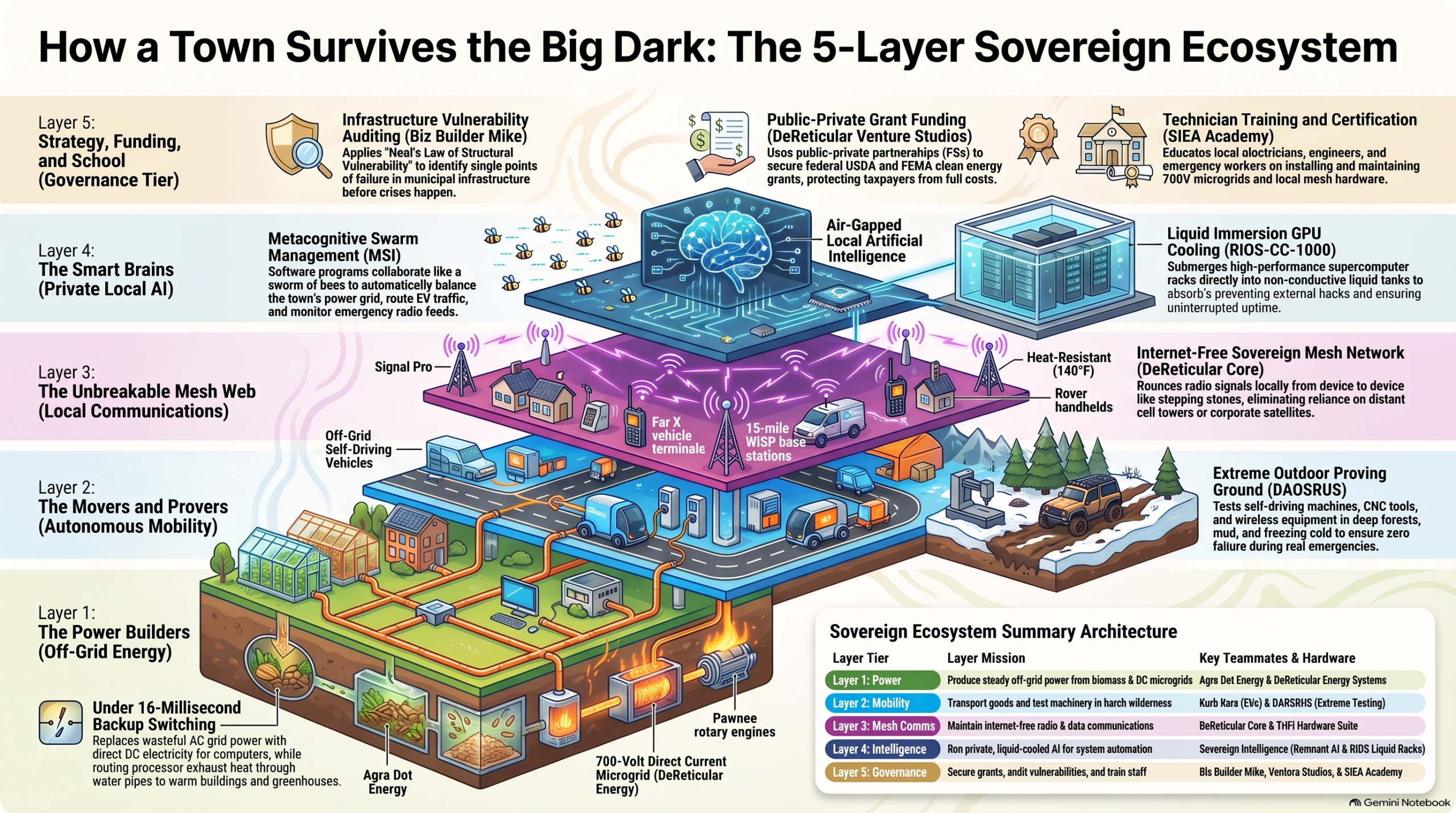
Blueprint for Resilience: An Explanatory Guide to the 5 Layers of DeReticular Superfortress Towns
- Introduction: The Concept of a “Sovereign Ecosystem”
Imagine a massive winter storm rolling across the region, pulling down utility poles for hundreds of miles. Suddenly, the lights shut off, mobile phones lose their signal, streaming services stop loading, and grocery store checkouts freeze completely. In a conventional municipality, residents and emergency workers have no choice but to wait days or even weeks for distant utility companies to send repair crews.
DeReticular and its network of partner organizations designed an architectural alternative to eliminate this vulnerability: a Sovereign Ecosystem.
In this context, the term “sovereign” refers to an entity that is completely self-ruling and independent. The primary goal of a DeReticular system is to empower any municipality, hospital, agricultural hub, or crisis center to instantly activate Island Mode.
Island Mode: The operational state in which a town, medical facility, or emergency response center remains fully functional—generating continuous power, running vehicles, processing data, and maintaining communications—completely independent of outside power grids or global internet infrastructure.
Traditional towns collapse during major outages because they rely on fragile, long-distance supply lines for power, data, and fuel. DeReticular towns remain functional because every necessary service is generated, managed, and maintained locally through an integrated five-layer infrastructure.
To run an independent town in Island Mode, you must first start with a reliable, local source of energy—leading into Layer 1.
- Layer 1: The Power Builders (Making and Moving Energy)
The foundational layer of a Superfortress Town focuses on on-site energy generation and efficient electrical distribution. Layer 1 replaces traditional power lines with two specialized entities: Agra Dot Energy and DeReticular Energy Systems.
On-Site Fuel Generation
Rather than waiting years to link up to distant regional power grids, Agra Dot Energy creates clean electricity right where the town stands. They process municipal farm leftovers and wood chips (known as biomass) using a specialized process called pyrolysis and gasification. This technique heats organic waste without burning it into smoke, converting raw material into a clean fuel. This fuel powers continuous-duty Pawnee rotary engines, generating local electricity 24 hours a day, regardless of weather conditions.
High-Efficiency Electrical Plumbing
Standard electrical grids distribute Alternating Current (AC) power, which suffers significant energy losses when converted into Direct Current (DC) to power computers and electronics. DeReticular Energy Systems fixes this by building high-efficiency 700-Volt Direct Current (700V DC) local microgrids.
Layer 1 Power Component How It Works & Primary Benefit to the Town
Agra Dot Energy Uses pyrolysis and gasification to heat organic waste (biomass like farm scraps and wood chips) without smoke, powering Pawnee rotary engines. Produces continuous, clean local electricity 24/7 without depending on long-distance power lines.
DeReticular Energy Systems Replaces wasteful AC grid distribution with a 700-Volt Direct Current (700V DC) microgrid architecture designed for sensitive electronics. Eliminates energy conversion losses, prevents computer blackouts with ultra-fast switching, and recycles system waste heat.
Standout Technical Features
- <16 Millisecond Switch: Integrated smart switches monitor the local grid for power disruptions. If a primary feed fails, the system transfers to backup power in under 16 milliseconds—faster than a human eye can blink—ensuring computers, medical equipment, and servers operate without flickering or resetting.
- Greenhouse Heat Capture: High-performance computing equipment produces substantial heat. DeReticular systems capture the thermal energy from roaring computer processors and pump it through warm-water piping networks to heat local agricultural greenhouses and surrounding buildings.
Having reliable local power enables the town to keep its physical transportation and maintenance systems moving during an emergency.
- Layer 2: The Movers and Provers (Autonomous Mobility and Harsh Testing)
When fossil fuel supplies run out and conventional power grids go dark, standard transit systems fail. Layer 2 ensures that logistics, medical transport, and mechanical support stay active through autonomous hardware and rigorous hardware testing.
Specialized Components
- Kurb Kars: This division manufactures autonomous, off-grid electric utility vehicles (EVs) and mobile battery pods. During a severe crisis where gas stations are closed, Kurb Kars recharge directly from the town’s local 700V DC microgrid without requiring an internet connection. They autonomously transport doctors to critical patients, deliver vital food supplies, and deploy mobile energy where it is needed most.
- DAOSRUS: Short for Digital Adventures Outdoors R US, DAOSRUS serves as the rugged outdoor proving ground for all town hardware. Before autonomous vehicles, wireless nodes, mobile robots, or computer-controlled factory tools (CNC machines) are deployed during real crises, DAOSRUS subjects them to extreme stress tests in deep forests, heavy mud, freezing temperatures, and rocky terrain to guarantee they will not fail.
Layer 2 Crisis Operations
- Sustaining Medical and Rescue Logistics: Kurb Kars transport medical personnel and emergency patients across town when traditional fuel supplies are unavailable.
- Distributing Emergency Power: Mobile battery pods move stored energy directly to temporary field hospitals or remote emergency centers.
- Delivering Vital Supplies: Autonomous utility vehicles navigate municipal routes to deliver food, tools, and clean water without relying on outside satellite navigation or global communication networks.
- Ensuring Hardware Reliability: DAOSRUS field-tests robots, vehicles, and communication radios under real-world mud, cold, and rough conditions to guarantee 100% operational readiness.
Moving supplies and vehicles safely requires a rock-solid, local communication system that doesn’t depend on outside cell towers.
- Layer 3: The Unbreakable Walkie-Talkie Web (The Sovereign Mesh)
Traditional mobile networks rely on tall telecom towers and satellite networks located far from the community. If a storm breaks a trunk line or takes down a cell tower, standard mobile devices lose connectivity. Layer 3 replaces centralized telecommunications with DeReticular Core and the Sovereign Mesh.
Understanding the Mesh Network
Think of a Mesh Network like passing a hand-written note across a crowded classroom. Instead of throwing the note out the window to a mail carrier who has to drive to another city and back, you hand the note to your nearest neighbor. That neighbor passes it to the next person, who hands it directly to the receiver.
In a Sovereign Mesh, every radio acts like a stepping stone. Messages automatically bounce locally from one device to the next across town without ever needing to connect to a corporate telecom tower or satellite network.
The TriFi Hardware Product Line
DeReticular Core deploys four specialized hardware products to build this localized network:
- TriFi Signal Pro 8355: A heavy-duty, weatherproof metal antenna installed atop high structures like schools, hospitals, or water towers to beam high-speed wireless networks across an entire facility or neighborhood campus.
- TriFi WISP-in-a-Box Lite: A commercial base station engineered to blast a localized wireless bubble up to 15 miles, maintaining strong signals even through trees and hills where normal signals get blocked.
- TriFi Far X (X1271): A specialized vehicle terminal utilizing dual roof-mounted antennas to transform ambulances, trucks, and utility vehicles into mobile Wi-Fi hotspots on the move.
- TriFi Rover (SLG-06): A rugged, rubber-armored handheld pocket hotspot featuring an industrial battery rated to operate safely in extreme environments up to 140°F without overheating.
Once local communication paths are open, the town needs a smart, private “brain” to process data and manage resources automatically.
- Layer 4: The Smart Brains (Private Local Intelligence)
Standard Artificial Intelligence tools rely on massive server farms owned by major technology corporations. When the internet fiber lines connecting a town to the outside world are severed, cloud-based AIs shut down completely. Layer 4 addresses this vulnerability by deploying the Sovereign Intelligence product line inside the town’s physical perimeter.
Key AI Innovations
- Remnant AI: These are local AI computing chips installed directly inside town facilities with zero digital or physical connections to the outside internet—a design known as an air gap. Because of this complete isolation, Remnant AI cannot be hacked over external networks, keeps sensitive town data completely private, and remains fully functional during global internet blackouts.
- Immersion-Cooled GPU Racks: High-powered AI computers produce intense heat. The RIOS-CC-1000 system replaces air-cooling fans by completely submerging supercomputer racks in tanks filled with a specialized non-conductive liquid. This liquid absorbs thermal output directly from the electronics without causing electrical short circuits.
- Metacognitive Swarms: Operating under the designation MSI, these are networks of cooperative software applications that interact much like a swarm of bees. They work continuously in the background to automatically balance local electrical loads, redirect autonomous traffic, and monitor emergency radio frequencies.
So What? Key Insight: Why Local AI Keeps Towns Safe By hosting air-gapped, liquid-cooled artificial intelligence within community borders, a DeReticular town ensures its traffic control, emergency routing, and power-grid optimization continue running smoothly even during total global network disruptions.
Even the smartest technology requires human strategy, funding, and skilled technicians to keep it operating long-term.
- Layer 5 & Generation 5: Strategy, Money, and School
Building advanced hardware is only one half of municipal resilience. A town also requires tactical planning, financial capital, and technical education. Layer 5 provides the human, financial, and educational backing necessary to sustain the physical layers.
Key Support Entities
- Biz Builder Mike: Serves as the primary risk-mitigation and strategy team. Guided by Noel’s Law of Structural Vulnerability, this group works directly with mayors, city councils, and business directors to audit town infrastructure. They systematically uncover critical single points of failure—such as identifying an exposed electrical transformer that, if damaged, would disable the city water pumping station—so community leaders can fix them before a disaster strikes.
- DeReticular Venture Studios: Serves as the financial structuring and grant-acquisition partner. Because microgrids and clean energy installations represent significant financial investments, the Venture Studio uses Public-Private Partnerships (P3s) to help cities win federal funding—such as USDA clean energy development grants and FEMA emergency resilience funds—preventing local taxpayers from absorbing the full cost.
- SIEA / DeReticular Academy: Operates as a non-profit educational institution under the Sustainable Infrastructure Contractors Association (SIEA). The academy trains local electricians, engineers, technicians, and first responders on how to safely install, service, and maintain 700V DC microgrids, mesh radio hardware, and sovereign AI clusters.
Support Entity Core Mission Key Mechanism/Tool Used
Biz Builder Mike Identify municipal infrastructure weak spots and plan structural resilience. Noel’s Law of Structural Vulnerability and on-site town audits.
DeReticular Venture Studios Secure non-dilutive federal capital to fund municipal energy projects. Public-Private Partnerships (P3s) to acquire USDA and FEMA grants.
SIEA / DeReticular Academy Educate local workforce to operate and repair off-grid infrastructure. Non-profit technical certifications in 700V microgrids and mesh networks.
With the human, financial, and technological foundations established, let’s review how all five layers fit together into a complete resilience shield.
- Conclusion & Master Checklist: The Complete Resilience Shield
When integrated, these five distinct layers transform a vulnerable town into an independent, self-sustaining community capable of enduring severe environmental, grid, or communication crises.
The 5-Layer System Overview
Layer The Mission The Teammates & Products
Layer 1: Power Make steady electricity from wood and farm scrap. Agra Dot Energy & DeReticular Energy Systems
Layer 2: Mobility Move supplies and test machines in the wild. Kurb Kars (EVs) & DAOSRUS (Extreme testing)
Layer 3: Mesh Comms Keep phones and radios working without big telecom. DeReticular Core & the TriFi Hardware Suite (Signal Pro, WISP Base, Far X, Rover)
Layer 4: Intelligence Local AI computers cooled in liquid tanks. Sovereign Intelligence (Remnant AI, RIOS, Liquid GPU Racks)
Layer 5: Governance Blueprints, money grants, and technician training. Biz Builder Mike, Venture Studios, & SIEA Academy
The Big Takeaway: The Self-Sustaining Survival Bubble Instead of trusting that giant power lines and cloud internet towers hundreds of miles away will never fail, DeReticular builds complete, self-sustaining “survival bubbles.” They give a community its own power plant, its own electric vehicles, its own walkie-talkie mesh internet, its own local AI brain, and the blueprints to pay for and run it all!
By understanding how local energy production, autonomous mobility, mesh communications, private AI, and strategic governance interconnect, aspiring engineers and community leaders can design systems that keep light, power, and safety active for everyone—no matter what happens to the world outside.


