
Sovereign Energy Systems: An Essential Reference Guide for Novice Learners
- Introduction to Infrastructure Sovereignty
For over half a century, modern enterprise and civic life have been anchored to centralized, monopoly-controlled networks known collectively as The Reticular Complex. This centralized infrastructure model creates single-point vulnerabilities across three critical operational pillars:
- The Electric Utility: Aging high-voltage transmission grids that trip during extreme weather, impose punitive peak-demand ratchets, and subject growing facilities to 5-to-7-year waitlists just to receive a power transformer.
- The Cloud Hyperscaler: Centralized computing server farms that force local operational data to travel hundreds of miles over vulnerable public networks, extracting heavy data egress taxes while introducing external points of failure for automated systems.
- The Telecom Oligopoly: Over-subscribed cellular and fiber backbones running on shared infrastructure that degrades during emergencies and leaves critical facilities blind when physical lines are severed.
To overcome these vulnerabilities, forward-thinking organizations transition into Sovereign Nodes—hardened, self-contained operational sites that generate their own baseload energy behind the meter, route their own mesh communications, and execute computational logic locally without relying on third-party gatekeepers.
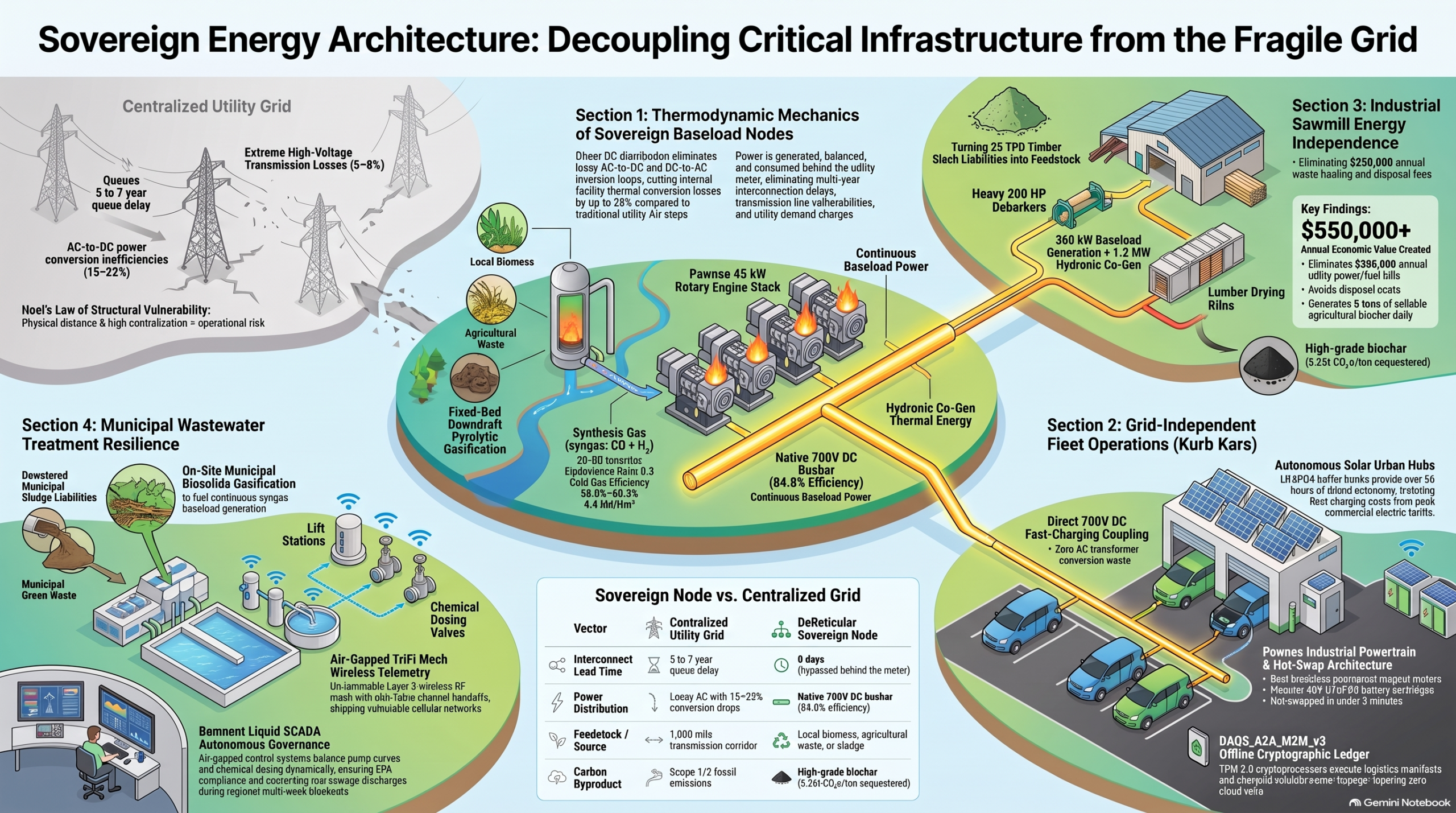
The structural risk of relying on centralized utility grids is mathematically defined by Noel’s Law of Structural Vulnerability:
\text{Vulnerability} \propto \frac{\text{Distance of Dependency} \times \text{Centralization Factor}}{\text{Local Autonomous Capacity}}
Plain-English Translation: An operation’s structural vulnerability increases directly as its physical distance from critical resources grows and control becomes concentrated in third-party gatekeepers. Conversely, vulnerability drops toward zero as local, self-contained operational capacity expands.
To understand Noel’s Law in practice, consider two manufacturing plants:
- Plant A (High Vulnerability): Draws 5 megawatts from a coal plant 300 miles away over centralized utility lines (Distance of Dependency = 300, Centralization Factor = 1.0) and maintains zero local backup (Local Autonomous Capacity = 0.01). A single fallen transmission line 150 miles away trips the facility, causing catastrophic downtime.
- Plant B (Sovereign Node): Generates its own 5 megawatts on-site using a local microgrid behind its own meter (Distance of Dependency = 0, Centralization Factor = 0). Because its distance of dependency is zero, its mathematical structural vulnerability drops to zero.
The ultimate goal of a Sovereign Node is to achieve sustained Island Mode—a native operational state where an entity continuously generates, balances, and consumes its own energy behind the utility meter, operating with total independence from external grid disruptions.
Moving from this overarching philosophy of infrastructure independence, we must first examine the foundational physical power layer—Layer 1—that generates the local, dispatchable energy necessary to make true operational sovereignty possible.
- Layer 1: Sovereign Energy & Microgrid Architecture
Layer 1 forms the thermodynamic foundation of sovereign infrastructure. While intermittent sources like solar panels and wind turbines provide supplemental energy, a sovereign node requires continuous, dispatchable 24/7/365 baseload power generated directly on-site behind the meter.
2.1 Thermochemical Pyrolytic Gasification
Rather than burning biomass liabilities in polluting boilers, consortium systems engineered by Agra Energy (Agra Dot Energy) utilize fixed-bed downdraft pyrolytic reactors. These reactors process 20 to 30 tons per day (TPD) of dry agricultural residues, timber slash, or organic manufacturing waste into high-density synthesis gas (syngas).
To understand the thermodynamics of this process, three key technical metrics must be understood:
- Equivalence Ratio (ER) of 0.3: The ratio of actual oxygen supplied to the theoretical oxygen required for complete combustion. An ER of 0.3 ensures controlled partial oxidation, turning solid fuel into clean flammable gas rather than burning it directly to ash.
- Cold Gas Efficiency of 58.0%–59.5%: The percentage of raw chemical thermal energy in the original solid biomass that is successfully retained in the resulting syngas output.
- Energy Density of 4.4 \text{MJ/Nm}^3: The caloric heating value contained in each normal cubic meter of output gas, consisting primarily of hydrogen (\text{H}_2) and carbon monoxide (\text{CO}).
Input Feedstocks Primary Output (Energy) Byproduct / Ecological Benefit
Dry agricultural residues, timber slash, sawmill sawdust, municipal solid waste / dried biosolids High-energy synthesis gas (syngas: \text{CO} + \text{H}_2) at 4.4 \text{MJ/Nm}^3 caloric density High-grade carbon-negative biochar (sequestering 3.26 tons of \text{CO}_2 equivalent per ton) and pyroligneous acid (wood vinegar) for organic soil conditioning
2.2 Pawnee Rotary Engine Generation
Standard piston generators quickly choke when running on low-BTU syngas because sticky tar condensates foul intake valves and engine vibrations break mechanical seals. Sovereign energy systems deploy the Pawnee rotary internal combustion engine—a modular 45 kW power plant specifically engineered to combust raw syngas directly without requiring complex pre-scrubbing equipment. Stacked in modular arrays, low-vibration Pawnee engines deliver scalable electrical baseload power while providing integrated hydronic co-generation to capture waste thermal energy for facility heating, lumber kilns, or absorption cooling systems.
2.3 Native 700V DC Microgrid Busbar
Traditional facility power grids rely on Alternating Current (AC), forcing modern electronic hardware through repetitive, lossy energy conversion steps.
- The Inversion Tax: Standard industrial facilities take high-voltage AC from the utility grid, step it down through transformers, invert it to Direct Current (DC) to charge battery banks, invert it back to AC to drive variable-speed motors, and rectify it back to DC to power computers and EV chargers. Every conversion step bleeds 3% to 8% of energy as waste heat, accumulating a total 15–22% thermal loss across the facility.
- Native 700V DC Distribution: A native 700V DC microgrid busbar operates at an efficient 84.8% baseline efficiency by matching the native direct-current operating voltage of modern industrial hardware. Syngas power generated by Pawnee rotary arrays feeds directly into the DC busbar, distributing electricity directly to high-density GPU compute racks, variable-frequency motor drives, and EV fast-chargers without conversion losses, voltage sags, or grid phase imbalances.
Having established continuous, static baseload generation on-site, we can now explore how this direct DC power layer energizes mobile, kinetic assets that operate beyond the static perimeter.
- Layer 2: Kinetic Mobility & Off-Grid Transport
Standard commercial electric vehicles (EVs) suffer from the “Tethered Fleet Fallacy”—the hidden vulnerability wherein fleet electrification merely exchanges liquid fuel for direct dependence on fragile regional utility substations, cloud authorization servers, and public cellular backhauls. Layer 2 kinetic mobility, developed through the Kurb Kars platform, converts vehicles into nomadic, self-contained energy assets.
- Pawnee Powertrain & Energy Storage: Heavy-duty utility chassis utilize dual high-torque brushless permanent magnet motors, native 700V DC fast-charging interfaces, and modular hot-swappable 48V \text{LiFePO}_4 battery cartridges. Depleted battery packs can be manually swapped in under three minutes, while an integrated 120V/240V auxiliary pure-sine inverter allows the vehicle chassis to power external tools, pumps, or medical equipment directly from its energy store without inversion penalties.
- Autonomous Solar Urban Hubs: Standalone canopies equipped with high-efficiency solar arrays and internal \text{LiFePO}_4 buffer storage banks provide direct 700V DC fast-charging. Operating with zero commercial interconnect, these standalone hubs deliver 96+ hours of off-grid island autonomy regardless of regional grid blackouts.
- Offline Cryptographic Settlement (DAOS_A2A_M2M_v3): Rather than relying on cloud billing servers or cellular connections to authorize charging sessions, vehicles run the DAOS_A2A_M2M_v3 protocol—an offline agent-to-agent machine settlement ledger governed by hardware TPM 2.0 cryptoprocessors. Vehicles autonomously verify charging access and execute logistics manifests locally without sending data to external public networks.
- Specialized Pods:
- TriFi Mast Rover: A tactical mobile platform featuring a 30-ft pneumatic telescoping antenna mast that projects an omnidirectional 4.5+ mile tactical RF mesh bubble with sub-16ms channel synchronization.
- Tactical NEMT Pod: An air-gapped non-emergency medical transport platform featuring an ADA-compliant automated hydraulic lift gate, an isolated medical-grade auxiliary power bus, and onboard telematics compliant with 45 CFR Part 160/164 HIPAA standards.
Physical kinetic nodes require wireless connectivity to coordinate and function intelligently across off-grid environments, leading directly into Layer 3 mesh networking and Layer 4 air-gapped processing.
- Layer 3 & Layer 4: Mesh Communications & Air-Gapped Intelligence
Sovereign nodes maintain communication and data processing without routing signals through third-party telecommunications networks or commercial cloud hyperscalers.
4.1 Layer 3: TriFi Wireless Mesh Networks
TriFi wireless mesh networks create a self-healing, un-jammable radio frequency (RF) communications layer. Utilizing 30-foot pneumatic telescoping masts deployed on mobile rovers, TriFi projects a 4.5+ mile line-of-sight communications bubble.
The system operates with a sub-16ms channel handoff—meaning the network switches RF channels or node pathways in under 16 milliseconds (less than one 60Hz power cycle and faster than a human eye blink). This ultra-low latency maintains uninterrupted real-time control loops for emergency response teams, autonomous vehicles, and remote SCADA sensors during complete public cellular or fiber blackouts.
4.2 Layer 4: Remnant Air-Gapped Silicon
Layer 4 replaces cloud-hosted artificial intelligence with local, air-gapped metacognitive compute engines. Utilizing high-density hardware such as the RIOS-CC-1000 compute rack running Remnant AI software, operational logic executes entirely on-premises behind the physical perimeter. Processing intelligence locally eliminates data egress fees, removes network latency, prevents third-party surveillance, and protects critical industrial operations from remote service denial or arbitrary cloud de-platforming.
Centralized Cloud/Telco Models (The Monopoly Model) Layer 3/4 Sovereign Mesh Models (The Island Model)
Network Backhaul: Dependent on public cell towers and shared fiber backbones; highly vulnerable to line cuts, tower battery depletion, and network congestion during emergencies. Network Backhaul: TriFi Layer 3 Mesh featuring a self-healing RF architecture with sub-16ms channel handoff and 4.5+ mile line-of-sight range extensions.
Data & Intelligence Location: Centralized hyperscaler cloud servers (e.g., AWS, Azure) accessed via public internet APIs, creating remote points of failure. Data & Intelligence Location: RIOS-CC-1000 Remnant Silicon executing air-gapped, metacognitive processing locally on site.
Financial Overhead: Perpetual SaaS subscription fees, unpredictable commercial bandwidth charges, and punitive cloud data egress taxes. Financial Overhead: Zero cloud data egress taxes, zero mandatory third-party API fees, and zero recurring bandwidth software rents.
Resilience & Security: Susceptible to regional power blackouts, remote API key revocations, commercial data mining, and lawful intercept access. Resilience & Security: Hardware TPM 2.0 root-of-trust, total air-gapped isolation, zero external cloud dependencies, and un-jammable local operation.
To see how these layered technologies coalesce in practice, we examine real-world industrial deployments where full-stack sovereign architecture replaces fragile centralized dependencies.
- Applied Industrial Blueprints & Operational Matrix
5.1 Real-World Sector Applications
- Municipal Water & Wastewater Treatment: A municipal water reclamation facility eliminates environmental violations by processing 20 to 30 TPD of dewatered municipal sludge and green waste into syngas via Layer 1 Agra Energy gasifiers. The system generates continuous electricity across a native 700V DC bus to power heavy lift pumps. Pumping stations and chemical dosing sensors coordinate over a Layer 3 TriFi wireless mesh, ensuring continuous water treatment and preventing raw sewage spills during extended regional grid failures.
- Edge AI & Defense Bunkers: An enterprise compute facility housing an 800-GPU training cluster requires 2 megawatts of continuous power. Facing a 5-year utility queue and a $3.2 million substation upgrade fee, the operator registers as a Certified Microgrid District under West Virginia Code §5B-2-21. Deploying a 2.5 MW modular Pawnee syngas generation array connected to a 700V DC bus and RIOS-CC-1000 liquid-immersed racks running Remnant AI, the facility achieves a levelized energy cost of $0.038/kWh and becomes fully operational in 120 days.
- Cold-Chain Food & Pharmaceutical Logistics: A 250,000-square-foot distribution facility housing 40 industrial ammonia chillers decouples from the grid. By feeding on-site pyrolytic gasifiers and routing power through a 700V DC busbar, the facility drives variable-speed compressor motors directly. Engine waste heat is passed through absorption chillers to pre-cool low-temperature staging rooms, eliminating the AC voltage sags and rolling brownouts that cause compressor stalls and multi-million-dollar inventory spoilage events.
- Commercial Agriculture & Sawmills: An Appalachian hardwood mill generates 40 TPD of green sawdust and bark liabilities, incurring 35/ton in hauling fees (250,000/year) while its 200 HP head-rig saw triggers $18,000/month in utility demand charges. By deploying an Agra Dot Energy gasifier fed with 25 TPD of dried wood waste, the mill runs a Pawnee rotary array producing 360 kW of continuous electrical power and 1.2 MW of hydronic thermal energy for its lumber kilns. The installation eliminates $300,000 in annual utility energy bills, avoids $250,000 in waste disposal costs, and yields 5 tons per day of biochar for secondary revenue. Similarly, Midwest grain cooperatives gasify corn stover and wheat straw using 20 TPD reactors to deliver 450 kW of power and grain-drying heat, returning biochar to member fields to reduce crop irrigation needs by up to 40%.
- Rural Healthcare & Emergency Operations: A county emergency hub combines multi-fuel biomass gasification, Kurb Kars Tactical NEMT Pods, standalone solar urban hubs, and a spherical TriFi mesh network. The site provides uninterrupted 911 dispatch, trauma care, and HIPAA-compliant patient transit (compliant with 45 CFR Part 160/164) through 96+ hours of total county-wide blackout.
5.2 Master Reference Matrix
The Operational Matrix: Reticular Complex vs. DeReticular Sovereign Node
Operational Vector The Reticular Complex (The Monopoly Model) DeReticular Sovereign Node (The Island Model)
Energy Source 1,000-mile centralized transmission line; highly vulnerable to distant failures and utility rate hikes. Behind-the-meter thermochemical biomass gasification (Agra Energy); 100% produced on-premises.
Grid Interconnect 3- to 7-year administrative interconnect queue; multi-million-dollar substation upgrade fees. Bypassed entirely. Deploys immediately behind the meter in sustained Island Mode.
Power Distribution Lossy, fluctuating 480V/120V AC subject to phase drops, harmonic distortion, and sags. Native 700V DC microgrid busbar (84.8% efficiency); minimal thermal loss, perfectly stable voltage.
Network Backhaul Public telco fiber & cell towers; single point of failure from backhoe cuts or tower battery loss. TriFi Layer 3 Mesh: Self-healing RF network with sub-16ms channel handoffs and mobile masts.
Intelligence Layer Centralized cloud APIs (AWS/Azure); subject to high data egress taxes, network latency, and remote service denial. Remnant Silicon (RIOS-CC-1000): Air-gapped, zero-telemetry metacognitive execution on site.
Blackout Posture Fragile grid dependence; traditional backup diesel generators run out of fuel within 48 to 72 hours. Permanent Island Mode: Indefinite, autonomous self-sufficiency powered by continuous local waste streams.
Translating these operational blueprints into functional facilities requires navigating statutory protections and securing financial mechanisms designed for sovereign infrastructure.
- Regulatory Carve-Outs & Non-Dilutive Financial Frameworks
6.1 Statutory Legal Carve-Outs
Utility monopolies frequently attempt to restrict facilities from generating their own power behind the meter. Sovereign nodes utilize statutory carve-outs designed to defend energy independence, such as Certified Microgrid Districts (exemplified by West Virginia Code §5B-2-21).
Under this legal framework, commercial and industrial operators are statutorily authorized to build and operate autonomous, behind-the-meter microgrids. This legal status allows qualifying facilities to bypass public utility commission franchise monopolies, bypass multi-year transmission interconnect queues, and contract power directly on-site without utility interference.
6.2 Non-Dilutive Capital Stacking
Transitioning an industrial or civic facility to sovereign infrastructure does not require selling equity or taking on dilutive corporate debt. Projects are funded by stacking specialized federal non-dilutive capital mechanisms:
- USDA REAP (Section 9007): The Renewable Energy for America Program provides loan guarantees covering up to 75% of total eligible capital costs and direct grants covering up to 50% of project costs for clean energy deployments in designated rural districts.
- IRA Section 6417 Direct Pay: Allows tax-exempt entities, municipal utility districts, and regional cooperatives to receive 30% to 50% elective cash reimbursements directly from the federal government for clean baseload microgrid investments.
- FEMA BRIC (Building Resilient Infrastructure and Communities): Grants pre-disaster mitigation funding that directly subsidizes the capital expenditures required to establish continuous microgrid islanding capabilities for critical community lifelines.
Ultimately, true operational security and financial stability do not come from negotiating terms with a centralized monopoly. True security comes from owning the local baseload, establishing air-gapped communications, and severing the utility umbilical permanently.


