
FROM THE LINE TO THE SPHERE: A Strategic Framework for Municipal Sovereign Resilience
- The Crisis of “The Line”: A Strategic Re-Evaluation of Municipal Fragility
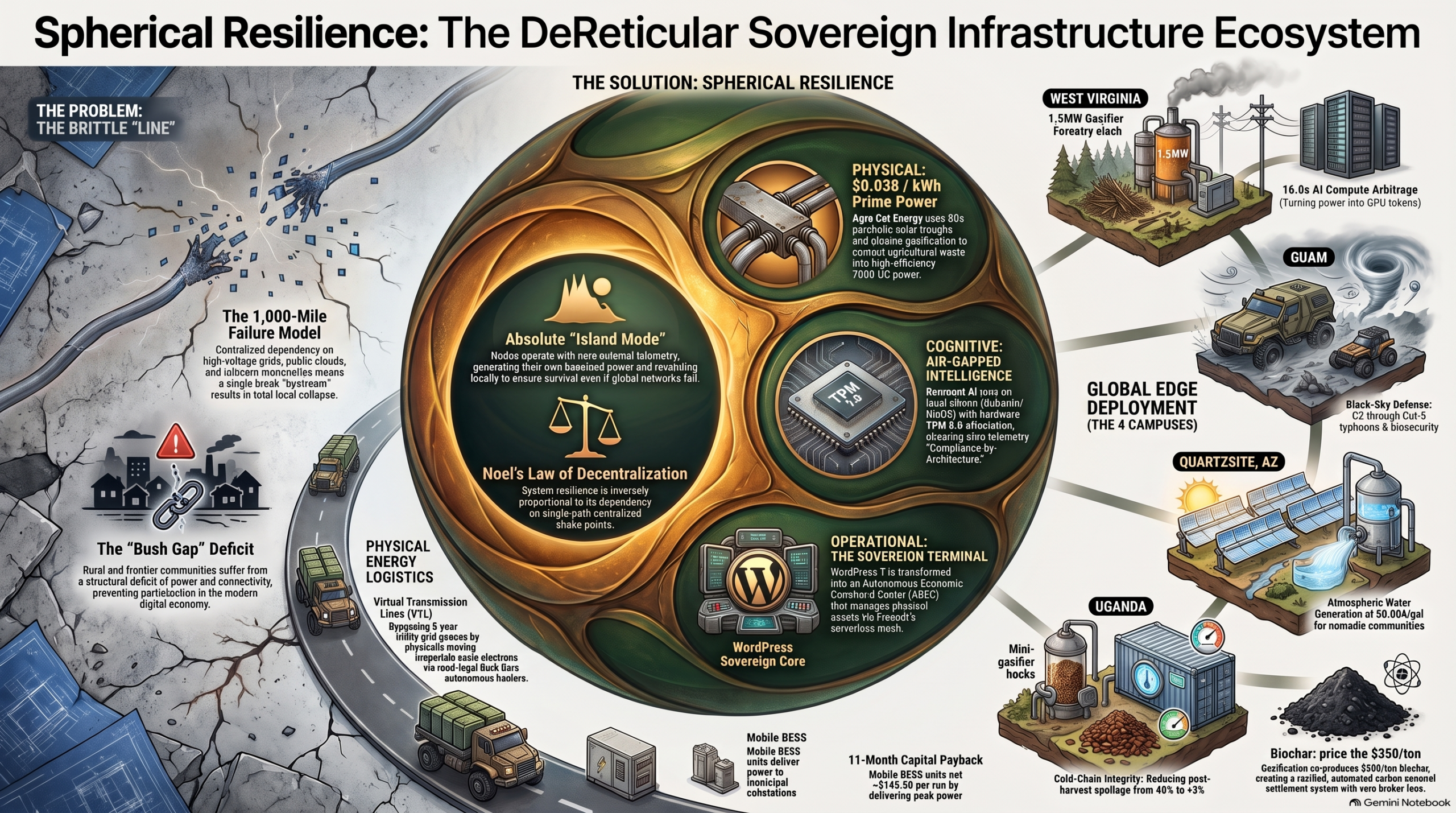
Modern municipalities are currently tethered to “The Line”—a fragile, 1,000-mile failure model defined by hyper-centralized electrical grids, public cloud hyper-scalers, and corporate SaaS dependencies. This linear dependency constitutes a critical systemic risk: a single point of failure at a distal high-voltage substation or a severed undersea fiber-optic cable can trigger a cascading collapse of emergency services, healthcare, and local commerce. For the Sovereign Systems Architect, reliance on these external reticulum networks is a profound vulnerability that invites catastrophic disruption during natural disasters, cyber warfare, or regional grid instability.
In contrast, “Spherical Resilience” represents a fundamental architectural shift toward the DeReticular ecosystem. While Linear Fragility is “fail-deadly”—where local survival is contingent on distant, uncontrollable systems—Spherical Resilience ensures that every municipal node operates in “Island Mode.” This model prioritizes behind-the-meter physical power, on-premises cognitive intelligence, and self-powered communication meshes. By transitioning from a line to a sphere, municipalities establish a defensive perimeter of anti-fragility.
The Reticular Risk Profile
Metric Centralized Infrastructure (The Line) Sovereign Infrastructure (The Sphere)
Power Reliability Dependent on utility grid; 5-7 year interconnection queues. Behind-the-meter prime power; sub-16ms static transfer.
Data Sovereignty PHI/PII stored in third-party clouds; high breach risk. Air-gapped local storage; 45 CFR § 164.312 compliance.
Communication Uptime Vulnerable to carrier fiber cuts and ISP outages. P2P mesh (Reticulum/WISP); zero external telemetry.
Economic Leakage High SaaS fees, utility rates, and middleman cuts. 95% value retention; 16.6x AI compute arbitrage.
This systemic vulnerability necessitates a fundamental architectural shift in municipal governance. Leaders must move away from the fragile status quo and adopt a “Sovereign Stack” that provides total operational continuity regardless of the status of the regional reticulum.
- Defining Spherical Resilience: The Sovereign Infrastructure Stack
Spherical Resilience is operationalized through “Island Mode”—the capacity for a municipal district to function with total local autonomy when disconnected from the global grid. This is achieved through the Sovereign Stack: a vertically integrated suite of hardware and software that replaces external dependencies with local, verifiable systems. By internalizing the means of production, computation, and communication, a municipality effectively exits the “rate-regulated utility trap.”
The Five-Tier Sovereign Stack Mapping
- Energetic Layer: Behind-the-meter prime baseload power generated via Agra Dot Energy gasification, solar-thermal troughs, and rotary or linear generators.
- Compute Layer: On-premises high-density GPU racks (RIOS-CC-1000) that convert local thermal power into “Digital Gold” via AI compute arbitrage.
- OS Layer: Hardened, immutable operating systems (NixOS or Kubuntu LTS) utilizing hardware TPM 2.0 cryptographic modules for a secure root of trust.
- Content & C2 Plane: The Sovereign Terminal (WordPress 7 or PocketBase), acting as the human-machine interface for asset orchestration and diagnostic reasoning.
- Distribution/Mesh Layer: Serverless, peer-to-peer communication protocols (Zenoh, Reticulum, or Freenet) that disseminate telemetry without centralized internet service providers.
This framework is governed by Noel’s Law of Decentralization, which states that system resilience is inversely proportional to its dependency on single-path centralized choke points. As a municipality reduces its external infrastructure dependencies toward zero, its local economic and operational survival approaches a resilience unity of 1.0. This digital nervous system is coordinated by the Rural Infrastructure Operating System (RIOS™).
- The Rural Infrastructure Operating System (RIOS™): The Command Core
RIOS™ serves as the comprehensive hardware and software microkernel for municipal districts. Its primary strategic role is the coordination of island-mode electrical switching, cyber-physical air-gaps, and edge compute arbitration. By acting as a real-time industrial operating system, RIOS™ allows leaders to manage complex physical assets through a single, secure interface, ensuring that power, water, and communication remain operational during “Black-Sky” events.
RIOS™ Procurement Tiers
- Tier I: Tactical Node
- Target Scale: Standalone 911 dispatch, isolated water pump, single telecom mast.
- Typical Budget: $65,000 – $85,000.
- Power Capacity: 65 kW generation / 150 kWh BESS.
- Island-Mode Target: 48 Hours Continuous.
- Compute: Compact Edge SCADA Node.
- Tier II: Municipal Core
- Target Scale: Township core, City Hall, Emergency Services, Clinic.
- Typical Budget: $340,000 – $440,000.
- Power Capacity: 250 kW / 750 kWh Array.
- Island-Mode Target: 96 Hours Standard.
- Compute: Air-Gapped Remnant AI Server.
- Tier III: Sovereign Matrix
- Target Scale: Full municipal district, electric co-op, industrial park.
- Typical Budget: $480,000 – $650,000+.
- Power Capacity: 1 MW+ Multi-Bus Microgrid.
- Island-Mode Target: Continuous / Indefinite.
- Compute: Full MSI Multi-Agent Swarm for autonomous orchestration.
The user-facing heart of this core is the Sovereign Terminal. Utilizing WordPress 7 or PocketBase on hardened NixOS, the terminal acts as an Autonomous Economic Command Center (AECC). It leverages air-gapped Remnant AI to manage physical assets via “Custom Post Types” acting as state ledgers. This ensures physical resource management is as intuitive as publishing a web page, but secured by industrial-grade cryptography. This digital command core is fueled by physical energy generated on-site, bypassing the limitations of the traditional utility model.
- Energy Sovereignty: Behind-the-Meter Prime Baseload and 700V DC Architecture
Municipal autonomy is impossible without behind-the-meter prime power. By generating electricity on-site, municipalities bypass the 5-to-7-year utility interconnection queues and avoid the rising costs of rate-regulated energy. This transforms energy from a volatile external expense into a controlled, local commodity.
The Agra Dot Energy Matrix
The physical foundation of this sovereignty includes:
- High-Temperature Plasma Gasifiers: These units process municipal and agricultural biowaste into clean synthesis gas.
- Prime Movers: The Pawnee 45 kW Rotary GenSets (Wankel geometry) and Mainspring Linear Generators (flameless reaction) achieve 45%+ net electrical efficiency.
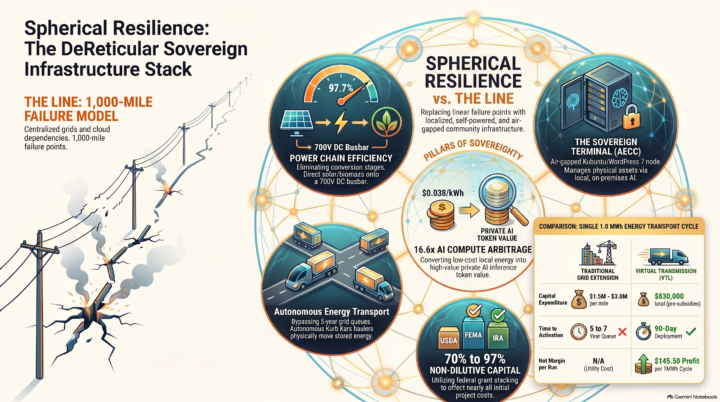
- 700V DC Common Busbar: All local generation and storage rectify directly to a 700V DC busbar. This architecture achieves a 97.7% power chain efficiency by eliminating three distinct DC-to-AC conversion stages.
Through the RIOS™ engine, municipalities solve the Energy Trilemma by optimizing between Baseload Power, Stationary BESS, and Mobile BESS. This optimization drives a 16.6x AI compute arbitrage multiple: while exporting 1 kWh to the grid yields ~0.04, consuming that same kWh locally for air-gapped AI inference generates 0.65 to $1.00 in billable token value. This “Digital Gold” turns surplus energy into high-value economic yield.
- Mobile Energy Logistics: Virtual Transmission and Kurb Kars
When physical grid lines are congested or absent, municipal leaders utilize Virtual Transmission Lines (VTL). This involves moving bulk electrons physically via road corridors using containerized energy storage, bypassing the 1.5M–3M per mile cost of traditional distribution lines.
VTL Specifications and Financials
VTL is executed using Project Octagon Mobile BESS Skids (1.0 MWh containers) mounted on Kurb Kars autonomous electric transport platforms.
The Energy Logistics Protocol:
- Charging: The skid is fast-charged at an Agra node at an internal cost of $0.038/kWh.
- Transit: The Kurb Kar autonomous platform transports the skid to a destination grid hub.
- Settlement: An automated Machine-to-Machine (M2M) handshake validates the energy manifest, and power is injected into the local feeder lines.
Solution Capital Expenditure (CapEx) Net Annual Profit
Traditional Grid Extension (8 miles) $16,000,000 N/A (5-7 Year Delay)
VTL Solution (2 Skids + Kurb Kar) $630,000 $212,430
With a levelized cost of $70.50 per 1.0 MWh run vs. $216.00 in revenue, the VTL model offers an under 11-month payback period. This economic model is supported by specific regulatory frameworks designed to bypass utility monopolies.
- Regulatory & Financial Engineering: Bypassing the Monopoly
Strategic autonomy requires legislative and financial “airlocks”—split-ledger systems that allow municipalities to decouple from rate-regulated traps.
Certified Microgrid Districts
In jurisdictions like West Virginia, H.B. 2014 (The Power Generation and Consumption Act) and W. Va. Code §5B-2-21 and §24-2-21a allow for Certified Microgrid Districts. These districts legally generate and consume power “behind-the-meter,” bypassing Public Service Commission (PSC) oversight and regional grid queues.
The Non-Dilutive Capital Stacking Flywheel
Municipalities can offset the vast majority of CapEx through a tiered grant strategy:
- Layer 1: USDA REAP and FEMA BRIC for baseline infrastructure.
- Layer 2: USDA FPEP (for biochar hardware) and USDOT SMART (for autonomous mobility).
- Layer 3: IRS Section 6417 “Direct Pay” cash refunds for clean energy CapEx (30-50% basis).
Pro-forma Sample (West Virginia Campus): With a 5.2M Gross CapEx, a municipality can achieve a 94.2% non-dilutive offset (2.5M ARC POWER + $1.0M USDA REAP + $1.4M IRA Direct Pay), leaving a net match of only $300k.
- Sector-Specific Deployments: From Clinical Terminals to Subterranean SCADA
The RIOS™ platform treats all physical resources as verifiable cryptographic assets, enabling specialized deployments:
- Sovereign Healthcare: The “Sovereign Clinical Terminal” achieves Compliance-by-Architecture under 45 CFR § 164.312 (HIPAA). Using air-gapped synthesis and Zero-Knowledge Proofs, clinics process patient data with zero cloud egress.
- Frontier Agriculture: The “Bush Gap” model uses biomass gasifiers to power cold-storage lockers and P2P commodity clearing, retaining 94% of trade value within the local cooperative.
- Resource Extraction: Sub-surface SCADA nodes at depths of -1,200m manage autonomous loaders equipped with inline XRF and LIBS sensors, signing ore assay grades directly to an immutable ledger.
- Aviation: Off-grid eVTOL Vertiports utilize Megawatt Charging Systems (MCS) to deliver 1.2 MW of direct DC fast-charging, bypassed utility grid limitations entirely.
- Strategic Implementation Roadmap: The 90-Day Transition to Autonomy
The transition to a resilient sphere is achieved through a phased 90-day cutover designed to maximize sovereign resilience while minimizing operational disruption.
90-Day Municipal Cutover Timeline
- Phase 1 (Days 1-20): Energy Core. Conduct feedstock audits and commission Agra Dot gasifiers and Pawnee GenSets to establish behind-the-meter prime power.
- Phase 2 (Days 21-45): Local Compute. Provision hardened NixOS nodes with TPM 2.0. Load Remnant AI clinical/industrial models onto local GPU arrays for air-gapped reasoning.
- Phase 3 (Days 46-70): C2 & Asset Orchestration. Configure the Sovereign Terminal and integrate SCADA buses (Modbus/CAN bus). Establish encrypted communication rooms.
- Phase 4 (Days 71-90): Island-Mode Commissioning. Deploy WISP-in-a-Box mesh masts. Conduct a “Black-Sky” full grid disconnection test to validate total autonomy.
Long-Term Impact: A 25-bed rural facility achieves $2 million in savings over five years by eliminating SaaS fees, utility rates, and the catastrophic costs of grid outages.
Conclusion: The Choice of the Sphere
Municipal leaders stand at a crossroads between the crumbling fragility of “The Line” and the enduring resilience of “The Sphere.” Choosing the Sphere is a moral and strategic imperative; it is the act of ensuring that a community’s power, health, and economic future are never contingent on a distant, centralized network. By adopting the Sovereign Stack, leaders build an infrastructure that is not just efficient, but truly self-governing.


