Operations Master Plan: The Municipal Triad Sovereign Infrastructure Model
- Executive Doctrine: Noel’s Law and the Sovereign Stack
Traditional centralized utility dependencies represent a “1,000-Mile Failure Model.” This architecture is inherently fragile, relying on distant energy generation, vulnerable transmission bottlenecks, and corporate cloud hyperscalers prone to regional blackouts, supply chain severance, and systemic disruption. The Sovereign Stack serves as the foundational architecture for institutional survival, replacing centralized vulnerability with localized, self-healing nodes designed for absolute operational autonomy.
Operationalizing Doctrine
The transition from passive consumption to autonomous production is governed by Noel’s Law. This operational imperative dictates that municipalities and institutional campuses must cease being captive customers and become sovereign producers of their own energy and compute. This state of operation is defined as “Island Mode”—a condition where a facility operates indefinitely without dependency on public grids or external cloud endpoints. The Sovereign Infrastructure Consortium operates under four foundational axioms:
- Axiom I: The Sovereign Stack: Engineering from the physical layer up.
- Axiom II: The 1,000-Mile Failure Model: Centralized systems are fragile; localized nodes are the cure.
- Axiom III: Noel’s Law: The shift from passive consumer to autonomous producer.
- Axiom IV: The Lean Plugin Rule (SOS-001): High-speed edge performance requires zero-bloat infrastructure. This is a non-negotiable security requirement; zero e-commerce plugins or database bloat are permitted in the stack to ensure sub-second performance and a minimized attack surface.
The Layered Architecture
This framework achieves “Spherical Resilience”—defined as distributed, non-linear node topologies engineered to endure physical kinetic disruption and macro-grid blackouts—through three interdependent layers:
- Physical Layer: The bedrock of baseload power (waste-to-energy), kinetic mobility, and thermal energy.
- Operational Layer: The coordination engine utilizing the Resilient Infrastructure Operating System (RIOS) and carrier-free TriFi mesh telecommunications.
- Cognitive Layer: Air-gapped, wisdom-trained Remnant AI and Metacognitive Swarms (MSI) for autonomous optimization.
This theoretical framework is manifested first through the physical energy bedrock detailed in the next section.
- Physical Layer: Baseload Generation and Kinetic Mobility
Sovereign baseload power is the prerequisite for all higher-level functions. The Municipal Triad model eliminates the intermittency of traditional renewables by focusing on localized waste-to-energy conversion, ensuring 24/7/365 operational readiness.
Thermal and Chemical Synthesis
The system integrates Agra syngas gasification (utilizing agricultural effluent and forestry slash) with parabolic solar-thermal collectors. Parabolic troughs concentrate sunlight to generate 350°C process steam, which is used to preheat the gasifier chambers.
The “So What?”: This specific thermal coupling eliminates the parasitic electrical loads typically required to maintain plasma gasification temperatures. By using solar thermal energy for preheating, the system maximizes net power output and ensures the gasification process remains net-positive even during peak demand.
High-Voltage DC Distribution
To achieve maximum chain efficiency, the system utilizes a 700V DC busbar, rectifying power directly to a high-voltage DC bus to avoid the repeated losses of traditional AC conversion.
Component Traditional AC System Sovereign 700V DC Chain
Power Conversion Multiple DC-to-AC Inversions Direct DC Rectification
Transmission Loss High (Step-up/Step-down) Minimal (High-Voltage DC)
System Efficiency ~80.0% – 85.0% 97.7%
Pawnee Powertrain Integration
Baseload generation is supplemented by Pawnee 45 kW Wankel rotary GenSets. These precision engines provide extreme fuel versatility, operating on syngas, biogas, or propane. These GenSets are integrated into Kurb Kars nomadic nodes and the TriFi Rover Gateway (Model SLG-06). The Rover features a 6-meter pneumatic telescoping mast, projecting a 4.5-mile private data bubble, providing kinetic endurance and “Island Mode” stability for tactical mobile connectivity.
This raw power provides the necessary energy to sustain the intelligent coordination required by the Operational Layer.
- Operational Layer: RIOS and TriFi Mesh Telecommunications
Maintaining a “Private Intelligence Bubble” requires deterministic control and carrier-free communication. This layer ensures that even if macro-grid and public telecom backbones fail, the local infrastructure remains coordinated and secure.
Deterministic Switching with RIOS
The Resilient Infrastructure Operating System (RIOS) acts as the deterministic engine for the stack. Systems architects must configure RIOS for sub-16ms Automatic Transfer Switching (ATS).
The “So What?”: This sub-cycle transition is vital for protecting sensitive AI compute racks and medical equipment. By decoupling from a failing grid in less than 16 milliseconds, the system remains within the ITIC hold-up curve, preventing equipment resets or reboots that would otherwise lead to data corruption or service failure.
Sovereign Mesh Deployment
Sovereign communication is achieved through TriFi Wireless multi-band RF mesh (5.8 GHz and 60 GHz). This system creates 15-mile non-line-of-sight (NLOS) connectivity without any external DNS or public telecom backbones.
Hardware Lineup (SKUs):
- Signal Pro (SKU: TRIFI-SIGPRO-8355): Weatherproof fixed wireless terminal for campus hubs.
- Far X (SKU: TRIFI-FARX-1271): Compact router for rural residences and workshops.
- Rover (SKU: TRIFI-ROVER-SLG06): Portable node with integrated 4,000 mAh battery for tactical mobility.
- WISP-in-a-Box™ Lite (SKU: WISP-BOX-LITE): Turnkey base station including RIOS telemetry agents and lightning surge arrestors. Professional and Command Center tiers are available for high-capacity aggregation.
Telemetry and Resource Arbitration
RIOS acts as the bridge between hardware actuators and cognitive intelligence. It facilitates point-of-need resource arbitration, directing energy and bandwidth based on real-time telemetry from the “Intelligence Bubble,” which operates without public IP routing tables.
While RIOS handles the “how” of operations, complex optimization is managed by the Cognitive Layer.
- Cognitive Layer: Remnant AI and Metacognitive Swarms (MSI)
Dependencies on cloud hyperscalers (OpenAI/AWS) create systemic risks. Sovereign infrastructure requires air-gapped, wisdom-trained foundational models located entirely on local silicon.
Remnant AI Architecture
The Remnant AI engine is a private, on-premises cognitive core. Because it is air-gapped, there is zero telemetry leakage. Hardware-enforced security via TPM 2.0 (Trusted Platform Module) prevents supply-chain poisoning and corporate surveillance, ensuring that the decision-making logic remains sovereign.
Metacognitive Swarms of Intelligences (MSI)
MSI is defined as a multi-agent system that monitors, evaluates, and modifies its own internal decision-making processes. MSI responsibilities include:
- Thermal Dissipation Management: MSI manages the liquid-cooling loops for high-density RIOS-CC-1000 compute clusters, balancing heat flux from the GPUs with the thermal requirements of the Agra gasifier.
- Phase Synchronization: Ensuring electrical stability across multi-bus microgrids.
- Dynamic Cyber-Physical Defense: Isolating compromised nodes and reconfiguring mesh routing upon detecting jamming or intrusions.
The Agentic Web
The A2A (Agent-to-Agent) commerce protocol allows for machine-level settlements via offline cryptographic state channels. This enables nomadic rigs to negotiate Starlink bandwidth and 700V DC fast-charging with zero middleman fees and no internet access.
These technical layers are sustained by the statutory and financial frameworks detailed below.
- Financial and Statutory Engineering
Strategic legal positioning allows municipalities to bypass the “Permitting Wall” and utility interconnection queues that typically last 4 to 7 years.
The West Virginia H.B. 2014 Blueprint
Under W. Va. Code §5B-2-21 & §24-2-21a, facilities can be designated as Certified Microgrid Districts. By co-locating high-density AI compute (RIOS-CC-1000) behind the meter, a facility can achieve an 84.8% captive consumption ratio—well above the 70% threshold. This allows the project to bypass Public Service Commission (PSC) regulations, enabling a 60-to-90-day deployment timeline.
Non-Dilutive Capital Stack
Capitalization leverages federal grants and the IRA Section 6417 Direct Pay provision, which provides 30%–50%+ cash reimbursements to tax-exempt entities and municipalities.
Source Infrastructure Component Benefit
FEMA BRIC Hazard Mitigation & Black-Start Resiliency Funding
USDA REAP Biomass & Solar Thermal 50% Grant Recovery
BEAD TriFi Mesh & Rural Broadband Connectivity Funding
IRA 6417 Clean Microgrid Assets 30%–50%+ Cash Back
Blended Unit Economics
By converting raw syngas electricity into AI compute, the model achieves a 16.6x arbitrage multiple over wholesale grid tariffs. Revenue is stabilized by 120/mo recurring data plans** per node and a **45 staging/fulfillment fee per hardware order. Strategic advisory fees for Municipal Infrastructure Audits range from $25,000 to $75,000.
- Implementation Roadmap: From Audit to Project Octagon
The transition from engineering dossiers to field operations is managed by DeReticular LLC (Commercial Prime) and the Sovereign Infrastructure Education Alliance (SIEA) (501c3).
The 30-Day Operationalization Cycle
- Week 1: AUDIT. Perform Municipal Feasibility Audits (25k–75k) and RIOS Capital Sizer modeling to identify grant eligibility.
- Week 2: KIT. Execute hardware kitting of TriFi transceivers and RF alignment for the local mesh.
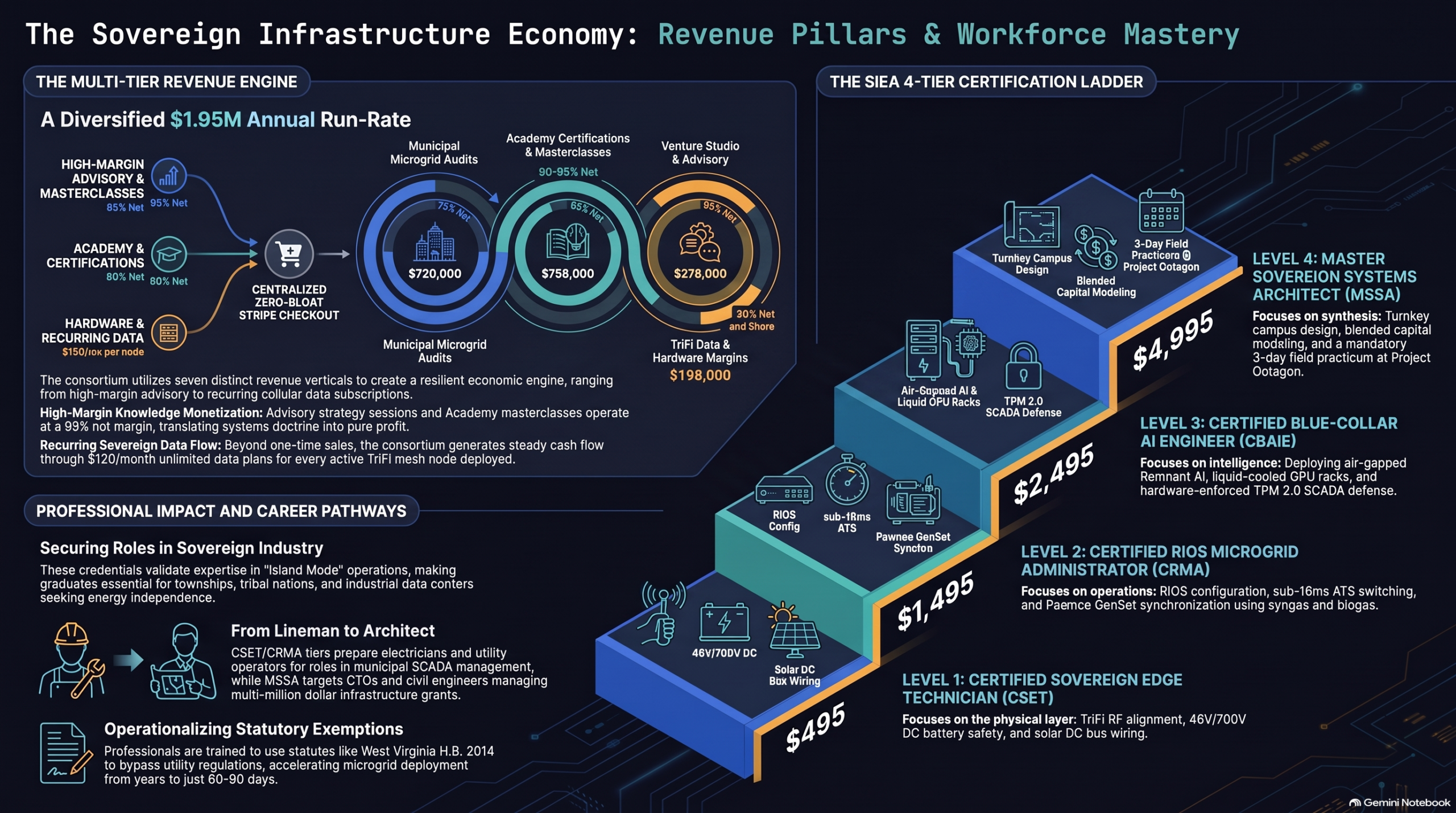
- Week 3: TRAIN. Enroll personnel in the SIEA 4-tier ladder:
- Level 1: CSET (Certified Sovereign Edge Technician)
- Level 2: CRMA (Certified RIOS Microgrid Administrator)
- Level 3: CBAIE (Certified Blue-Collar AI Engineer)
- Level 4: MSSA (Master Sovereign Systems Architect)
- Week 4: DEPLOY. Deploy Project Octagon skids (20ft/40ft containerized microgrids) and VALIDATE sub-cycle “Island Mode” transitions.
Field Practicum Validation
Master Sovereign Systems Architects (MSSA) must complete a 3-day on-site deployment at Project Octagon proving grounds to validate systems against specific environmental stressors:
- Quartzsite, AZ: Desert heat flux and dust resistance testing.
- New River Gorge, WV: Dense timberland and NLOS RF propagation testing.
Final Conclusion
The Municipal Triad Model generates a Total Projected Annualized Revenue of $1,950,000 at maturity per hub. By integrating baseload power, mesh telecommunications, and air-gapped AI, the Sovereign Stack secures the long-term survival of communities through absolute operational sovereignty.


