
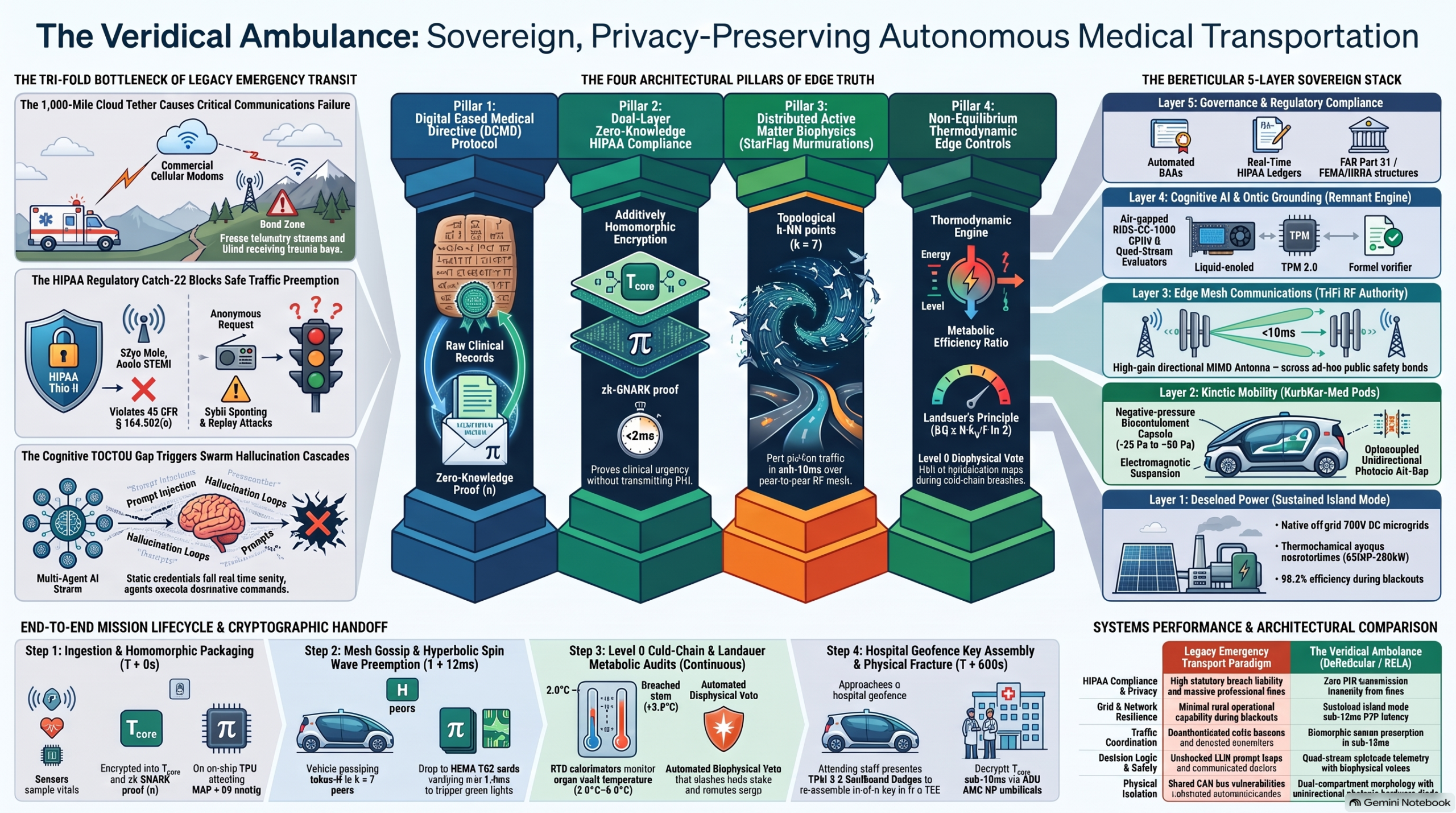
How a 4,000-Year-Old Babylonian Primitive and Bird Physics Are Redefining Autonomous Emergency Medicine
Modern critical healthcare infrastructure rests on a remarkably fragile illusion. When an emergency vehicle carries a decompensating patient through an urban center or rural corridor, its routing, telemetry, and preemption capabilities depend almost entirely on commercial 4G/5G cellular modems linked to centralized cloud servers. This “1,000-Mile Cloud Tether” breaks down precisely when it is needed most—stalling during cellular dead zones, infrastructure blackouts, or electronic interference, while simultaneously risking severe protected health information (PHI) leaks over open airwaves.
A radical alternative to this centralized vulnerability has emerged in the form of the “Veridical Ambulance”—the DeReticular autonomous medical transit system (DERETICULAR-MED-2026-V1). Rather than layering additional software patches onto fragile cloud networks, this architecture grounds high-tech artificial intelligence in ancient history, physical thermodynamics, and biological active matter. By synthesizing Mesopotamian archaeological design patterns with starling flock dynamics, non-equilibrium thermodynamics, and zero-knowledge cryptography, it constructs an off-grid, self-correcting infrastructure for life-critical transit.
By anchoring autonomous agency directly in zero-knowledge proofs, biophysical active matter, and thermodynamic invariants, the Veridical Ambulance replaces fragile cloud dependencies with an unyielding framework for edge truth.
Takeaway 1: Borrowing from 2000 BCE—The Ancient Clay Tablet Solving Modern HIPAA Compliance
To resolve the modern conflict between patient privacy and high-speed emergency routing, systems architects turned to a design pattern from antiquity: the Old Babylonian Cased Tablet (ca. 2000–1600 BCE). In ancient Mesopotamia, high-value credit obligations were inscribed onto an inner clay tablet (T_{\text{core}}), wrapped in a thin outer shell of wet clay (T_{\text{env}}) displaying an abstract summary or seal, and baked. If a legal dispute arose, a magistrate broke open the protective outer envelope in court to verify the unaltered core, while day-to-day transactions relied entirely on the summary sealed on the outer shell.
The DeReticular architecture adapts this analog primitive into the Digital Cased Medical Directive (DCMD) protocol:
- The Invariant Inner Core (T_{\text{core}}): Raw clinical telemetry (such as 12-lead EKG, arterial line waveforms, Glasgow Coma Scale scores, and patient identity) is encrypted inside the vehicle using additively homomorphic encryption (Paillier or Exponential ElGamal) keyed directly to the destination trauma center’s threshold public key K_{\text{pub}}: C = \operatorname{Enc}(M, r) = \left( g^r \pmod{n^2}, ; h^r \cdot g^M \pmod{n^2} \right) Intermediate edge routers, traffic light controllers, and civilian vehicles cannot read or decipher a single byte of this clinical ground truth.
- The Outer Zero-Knowledge Envelope (T_{\text{env}}): An on-chip TPU compiles an arithmetic circuit Zero-Knowledge Succinct Non-Interactive Argument of Knowledge (zk-SNARK) proof (\pi). This outer envelope proves to municipal roadside infrastructure and adjacent vehicles that a certified, life-threatening physiological emergency is occurring, without revealing patient identity, age, or specific clinical diagnoses.
It is profoundly counter-intuitive that modern multi-agent artificial intelligence and advanced zero-knowledge cryptography rely on a 4,000-year-old Mesopotamian legal pattern. Yet, this historic separation between private underlying reality and public verifiable assertion provides the precise architectural key needed to operate in complex, highly regulated physical environments.
“In the Old Babylonian period, high-value credit obligations were inscribed on a clay tablet, wrapped in a thin sheet of wet clay upon which an abstract summary was re-inscribed… modern zk-SNARKs and homomorphic encryption turn federal HIPAA compliance from an administrative liability into an unyielding mathematical guarantee.”
Takeaway 2: Rebuilding Traffic Flow with Starling Physics Instead of Cloud Servers
Conventional autonomous vehicle coordination relies on metric-radius broadcasting—transmitting emergency signals to every device within a fixed geographical distance (e.g., r \le 300\text{ meters}). In dense urban environments, this metric approach creates severe packet storms, radio frequency desensitization, and network gridlock. Furthermore, routing through centralized cloud servers introduces backhaul latencies exceeding 1.5 seconds, creating single points of failure.
More critically, centralized AI swarms running identical foundational weights suffer from the Condorcet Inversion. When homogeneous models encounter an out-of-distribution physical anomaly (such as severe heat mirages or optical sensor blinding), their errors become highly correlated (\operatorname{Cov}(v_i, v_j) > 0). If individual node competence drops below chance (p < 0.5), expanding the swarm mathematically guarantees 100% convergence on collective delusion.
The autonomous fleet eliminates the “1,000-Mile Cloud Tether” and overcomes the Condorcet Inversion by enforcing architectural model family heterogeneity (pairing Vision Transformers with State-Space Models and Lean 4 AST symbolic kernels) and adapting the biophysics of European starling murmurations (Sturnus vulgaris), derived from empirical tracking data from the European StarFlag Project:
- Topological (k \approx 7) Interaction: Vehicles do not communicate across a metric distance. Instead, each autonomous pod interacts strictly with its k \approx 7 nearest topological neighbors (S_i = { j \in \text{Fleet} : \operatorname{rank}(d_{ij}) \le 7 }). This topological attention graph remains invariant whether traffic compresses tightly or expands across highway lanes.
- Hyperbolic Spin Waves: Trajectory changes and evasive maneuvers propagate through surrounding civilian traffic not as slow, stop-and-go diffusive decisions, but as undamped, second-order hyperbolic spin waves (\omega = c \cdot k). The local velocity \mathbf{v}_i and conserved generalized spin \mathbf{s}_i evolve according to gyroscopic spin dynamics: \frac{d\mathbf{v}_i}{dt} = \frac{1}{\chi_0} \mathbf{s}_i \times \mathbf{v}i, \qquad \frac{d\mathbf{s}i}{dt} = \sum{j \in S_i} J{ij} (\mathbf{v}_i \times \mathbf{v}_j) – \frac{\eta_0}{\chi_0} \mathbf{s}i where \chi_0 = 1.42 is rotational inertia, \eta_0 = 0.18 is rotational viscosity, and J{ij} represents inter-vehicle coupling stiffness inversely weighted by peer calibration error.
Because topological k-nearest-neighbor (k-NN) interaction maintains scale-free behavioral correlation (\xi \propto L), civilian vehicles part smoothly in sub-12ms, creating a clear corridor like a starling flock evading a falcon, without a single byte of data touching a central cloud server.
Traditional Cloud-Based V2X Preemption Topological Murmuration Preemption
High & Variable Latency: >1,500\text{ ms} backhaul round-trip delays over commercial cellular LTE/5G networks. Deterministic Sub-12ms Latency: Peer-to-peer directional TriFi RF mesh operating directly at the physical edge.
Centralized Cloud Dependency: Single points of failure via hyperscaler servers and distant dispatch nodes. Zero Cloud Dependency: Operates in Sustained Island Mode via localized k \approx 7 topological peer graphs.
Metric Broadcast Gridlock: Metric-radius broadcasts (r \le 300\text{m}) induce packet storms and radio desensitization. Scale-Free Spin Wave Waves: Decentralized O(N) second-order hyperbolic spin waves (\omega = c \cdot k) part traffic smoothly.
Condorcet Inversion Vulnerability: Homogeneous base weights cause correlated errors (\operatorname{Cov}(v_i, v_j) > 0) and collective hallucination. Heterogeneous Quorum Resilience: Multi-architecture validation (Transformers + SSMs + Symbolic Logic) with Brier-calibrated staking.
Takeaway 3: Breaking the HIPAA Regulatory Catch-22 with Zero-Knowledge Proofs
Autonomous emergency transit faces a strict legal dilemma created by federal administrative law:
- 45 CFR § 164.502(b) (Minimum Necessary Standard): Forbids covered entities from disclosing protected health information (PHI) over public airwaves beyond what is strictly necessary. Transmitting statements like “58-year-old male with Acute STEMI” to municipal traffic lights or civilian cars to clear an intersection breaches federal privacy law.
- 45 CFR § 164.312(e)(1) (Transmission Security): Mandates technical security measures guarding against unauthorized access to electronic PHI traversing public transmission media.
- The Physical Threat (Sybil Spoofing): Conversely, stripping all data and broadcasting an unauthenticated “Clear the lane” request exposes municipal grids to Sybil attacks and replay spoofing, allowing bad actors to manipulate traffic lights and cause gridlock.
The DCMD protocol breaks this regulatory Catch-22 by deploying Groth16 or PLONK zk-SNARKs (\sim 256 bytes) generated on edge hardware and verified in under 2 milliseconds by roadside units and civilian vehicles. Low-cost RISC-V preemption cards installed in municipal NEMA TS2 traffic cabinets evaluate elliptic curve pairings in real time: e(A, B) = e(\alpha, \beta) \cdot e(x \cdot \gamma, \delta) \cdot e(C, \delta)
The proof mathematically confirms public clinical predicates—such as Mean Arterial Pressure instability (\text{MAP} = \frac{P_{\text{sys}} + 2 P_{\text{dia}}}{3} < 65\text{ mmHg}), Glasgow Coma Scale severity (\text{GCS} \le 8), or a critical surgical window (\Delta t \le 180\text{ min})—alongside an authentic hardware signature from a Trusted Platform Module (TPM 2.0). Roadside units verify with 100% mathematical certainty that a real physiological crisis is occurring without learning the patient’s identity, age, diagnosis, or vital history.
This design transforms federal privacy compliance into an immutable mathematical guarantee. Under 45 CFR § 164.402 (Breach Notification Safe Harbor), because intercepted airwaves contain only ciphertext (T_{\text{core}}) and zero-knowledge proofs (\pi), the payload is legally indecipherable, granting fleets absolute immunity from HHS Office for Civil Rights (OCR) public breach disclosures and civil monetary penalties.
Takeaway 4: Enforcing Thermodynamic Limits to Stop AI Delirium
When edge AI models monitor critically ill patients or evaluate high-stress driving conditions, probabilistic reasoning can enter recursive hallucination loops—a state known as Chain-of-Thought “epicycle traps.” Under diagnostic ambiguity, an ungrounded cognitive model may continuously re-evaluate contradictory inputs, burning computational resources while delaying critical physical transport.
To halt AI over-thinking, the system enforces non-equilibrium thermodynamics via Landauer’s Principle (\Delta Q \ge N k_B T \ln 2), which dictates that erasing or overwriting N bits of physical VRAM memory dissipates an irreducible amount of heat energy \Delta Q, where k_B is Boltzmann’s constant and T is ambient temperature in Kelvin.
The vehicle’s Remnant Engine continually evaluates the Metabolic Efficiency Ratio (\mathcal{M}_{\text{ratio}}):
\mathcal{M}{\text{ratio}} = \frac{\Delta F}{\lambda \cdot \Delta Q} = \frac{D{\mathrm{KL}}(q_{\text{new}} \parallel q_{\text{old}})}{\lambda \cdot (N_{\text{bits}} \cdot k_B T \ln 2)}
If the informational gain in Variational Free Energy (\Delta F) does not exceed the thermodynamic heat cost (\Delta Q) of bit erasure scaled by the empirical thermodynamic efficiency multiplier \lambda, the model is burning physical energy without generating actionable clarity. The system triggers an immediate FORCE_ACTION_HALT, terminating recursive inference, freezing supportive care, and directing the physical drive bay to proceed immediately to surgical intervention.
“If the informational gain in Variational Free Energy does not exceed the thermodynamic Landauer heat cost scaled by efficiency, the model triggers an immediate FORCE_ACTION_HALT… binding machine decision-making to the real-world carrying capacity of the physical cosmos.”
This thermodynamic limit is paired at Level 0 with an unyielding Automated Biophysical Veto for cold-chain biologics and donor organ transport. For preservation windows locked between 2.0^\circ\text{C} and 8.0^\circ\text{C}, quad-redundant RTD sensors continuously compute discrepancy S(E_t, \theta) = |T_{\text{measured}} – T_{\text{nominal}}|. If temperature drift exceeds 2.0^\circ\text{C} (S(E_t, \theta) > 2.0^\circ\text{C}), an automated circuit breaker trips: 50% of the transport node’s operational stake is slashed on-chain, the cargo is marked compromised on the BFT ledger, and transit is rerouted before an unviable organ is transplanted into an open recipient.
Takeaway 5: Unidirectional Photonic Diodes—Security at the Hardware Layer
The physical morphology of the transport platform (the KurbKar-Med) enforces security through strict physical compartmentalization, splitting the space-frame chassis into two distinct environments:
- The Kinetic Drive Bay: Controls locomotion, drive-by-wire steering, braking, motors, and road-mesh communications over a native 700V DC bus powered off-grid by Agra.Energy thermochemical syngas microturbines (65kW–250kW) and battery escrow skids. An active electromagnetic suspension cancels pitch, roll, and vibration to maintain a <0.05\text{ g} vibration floor, protecting delicate surgical anastomoses during high-speed transit.
- The Clinical Care Capsule: A hermetically sealed cleanroom operating under negative pressure (-25\text{ Pa} to -50\text{ Pa}) with dual-stage H14 HEPA/UV-C (254 nm) filtration, automated vaporized hydrogen peroxide (VHP) decontamination, Stirling cryogenic refrigeration, and isolated bio-telemetry skids.
Standard automotive architectures share internal software buses (such as CAN or FlexRay), allowing remote telehealth connections to potentially be exploited to inject malicious frames into powertrain actuators.
              PHYSICAL AIR-GAP ISOLATION TOPOLOGY
┌────────────────────────────────────┐    ┌────────────────────────────────────┐
│       CLINICAL CARE CAPSULE        │    │         KINETIC DRIVE BAY          │
│                                    │    │                                    │
│ • Isolated Patient Biometrics Bus  │    │ • Drive-by-Wire Steering / Motors  │
│ • Free-Piston Stirling Cooler      │    │ • Active Electromagnetic Dampers   │
│ • Liquid-Cooled RIOS-CC-1000 Skids │    │ • TriFi Directional RF Radios      │
│ • Negative-Pressure Cell (-35 Pa)  │    │ • Collision-Avoidance Radar/Lidar  │
└─────────────────┬──────────────────┘    └─────────────────▲──────────────────┘
                  │                                         │
                  │    [ UNIDIRECTIONAL PHOTONIC DIODE ]    │
                  └───► GaAs Laser LED ──► PIN Photodiode ──┘
                         (Zero Reverse Electrical Paths)
                         (Unacknowledged Simplex Stream)
The KurbKar-Med eliminates this risk by separating the two bays with an optocoupled unidirectional air-gap. A high-speed gallium-arsenide (GaAs) infrared laser diode emitting at 850nm or 1310nm transmits serialized telemetry pulses across pure optical glass fiber to a silicon PIN photodiode receiver in the Drive Bay. Framing utilizes 8b/10b line encoding for clock recovery and Reed-Solomon (RS(255, 223)) forward error correction with CRC-32 trailers, allowing the Drive Bay to correct bit-errors caused by road vibration without requiring a reverse ACK channel.
When stationary at fleet depots, high-bandwidth maintenance and Lean 4 Abstract Syntax Tree (AST) updates occur through ruggedized ODU AMC® NP Break-Away physical connectors equipped with mechanical gear-lock interlocks that disable ingress while in motion. Because PIN photodiodes cannot emit photons in reverse and contain zero copper conductors across the firewall, reverse data transfer during transit is physically impossible—rendering cyber-physical kinetic hijacking mathematically and physically excluded by electrodynamics.
Conclusion: Grounding Machine Agency in the Physical Cosmos
The architecture of the Veridical Ambulance demonstrates a broader truth for modern engineering: human institutions and synthetic artificial intelligence both succumb to catastrophic failure when their symbolic representations decouple from physical reality. When financial networks treat currency as unbacked fiat, or when multi-agent AI systems treat natural language tokens as ungrounded truth, they inevitably enter destructive, self-referential failure loops.
The blueprint for resilient, self-correcting autonomous agency lies in unifying diverse fields of knowledge. By synthesizing Mesopotamian archaeological insights, European starling flock physics, zero-knowledge proofs, and Landauer thermodynamics, autonomous systems can navigate high-stakes physical environments safely, privately, and without cloud dependency.
When machines are granted the power to make life-and-death decisions at the physical edge, will we continue to trust centralized cloud abstractions, or will we demand systems whose truth is anchored in the unyielding laws of the physical cosmos?


