Infrastructure Deployment Masterplan: Transitioning to Spherical Mesh Resilience
1. The Strategic Mandate: Decoupling from Linear Fragility
Modern infrastructure is defined by an architecture of terminal failure. The “Old World” relies on the 1,000-Mile Failure Model—a fragile, linear dependency on distant power plants and vulnerable fiber-optic lines where a single kinetic disruption or substation glitch causes total systemic paralysis. In environments defined by extreme heat, dust, and supply chain collapse, this model is not merely inefficient; it is obsolete. We are executing a mandatory pivot toward reticular, sovereign architectures. By distributing power and logic across a self-healing mesh of independent nodes, we replace cascading fragility with the unbreakable continuity of Distributed Cognition.
Geometric Paradigms: The Architecture of Sovereignty
| Dimension | Linear/Fragile Model (Old World) | Spherical/Reticular Model (Sovereign Stack) |
| Topology | Linear: Reliance on single, distant supply lines. | Hex-Mesh: Redundant web of interconnected nodes. |
| Connectivity | Centralized: Total dependency on remote data centers. | Redundant: Local-first mesh with satellite backhaul. |
| Failure Impact | Cascading Collapse: One break equals total darkness. | Self-Healing: Continuity maintained if nodes fall. |
| Core Logic | Centralized Cognition: Intelligence in the Cloud. | Distributed Cognition: Intelligence at the Edge. |
The transition to Distributed Cognition ensures that network survivability is no longer tethered to a central switch. By moving edge-logic to independent nodes, the community ceases to be a passive consumer and becomes a self-contained organism. This mandate requires the vertical integration of the Sovereign Stack.
——————————————————————————–
2. Vertical Integration: The Sovereign Stack Framework
The Sovereign Stack is a breathing organism that integrates power, compute, and human capital. Hardware alone is static; a million-dollar compute cluster is merely an expensive space heater if the operator cannot bridge the digital-to-physical gap during a grid-down event. True technical autonomy requires the “Human Operating System”—the elite cadre of technicians who animate the hardware layers to achieve “Island Mode” resilience.
The Three-Tier Vertical Integration
We define the Sovereign Stack through the functional symbiosis of Heart, Brain, and Soul:
- The Heart (Thermodynamics): The Agra Power Core 2X. This provides the energy pulse via waste-to-value gasification, ensuring the node remains powered regardless of external utility status.
- The Brain (Digital Logic): The RIOS-CC-1000 Compute Cluster. A ruggedized edge-intelligence unit that manages local data, secure communications, and AI-augmented governance.
- The Soul (Human Capital): The DeReticular Academy operator. We do not produce students; we incubate Sovereign Nodes by training Blue Collar AI Engineers and Sovereign Systems Architects (SSA) who earn the elite “Black Badge” master status.
The Mandate for Island Mode
Island Mode is the capability of a community to operate its critical infrastructure in total isolation. These layers allow a community to transform from a victim of systemic shocks into an active custodian of its own survival. We bridge “Diesel and Data,” ensuring that autonomous power generation is directly coupled with the high-demand compute required for modern coordination. We do not build machines; we build the capability for civilization to persist.
——————————————————————————–
3. The Heart: Thermodynamic Autonomy via Agra Power Systems
Energy independence is the foundation of the Sovereign Stack and the non-negotiable prerequisite for mission-critical operations. The Agra Power Core 2X provides this foundation by converting local liabilities—refuse and waste—into sovereign assets.
The Molecular Scissor Protocol
The system utilizes high-voltage, 1,500°C plasma gasification to execute the “Molecular Scissor” protocol. This is not combustion; it is the dissociation of molecular bonds within local feedstocks, including tires, HDPE/LDPE plastics, and biomass. To maintain the 1,500°C arc, the system utilizes real-time amperage adjustment, modulating the plasma intensity based on feedstock density to ensure total molecular breakdown without toxic byproducts.
Waste-to-Value Process Outputs
The dissociation process yields two mission-critical assets:
- Base-load Electricity: A constant 60Hz power supply designed to run the RIOS cluster and local microgrids.
- Synthetic Diesel: Excess syngas is condensed via a Micro-GTL (Gas-to-Liquids) refinery into storable fuel for mobility and mechanical reserves.
The Velcro Principle of Thermal Symbiosis
We employ the “Velcro Principle” to turn thermal cost centers into wealth. Waste heat from the plasma reactor and compute blades is harvested for pre-drying feedstock or water distillation. This thermodynamic coupling ensures that the node remains a circular economic asset. The thermodynamic pulse of the node is the heartbeat that enables digital logic.
——————————————————————————–
4. The Brain: Ruggedized Edge Intelligence via RIOS-CC-1000
The RIOS-CC-1000 is a field-deployable survival tool designed for kinetic environments where “Old World” IT fails due to heat, vibration, and dust. It acts as the node’s brain, managing the logic of both digital and physical systems.
Physical Fortification: The Exo-Shell
The unit is protected by an “Exo-Shell,” an IP67-rated aluminum Faraday cage. This architecture provides a dust-tight seal and shields internals from EMPs and solar flares. Crucially, the RIOS-CC-1000 uses no exterior fans, differentiating it from standard ruggedized gear that eventually chokes on external particulates.
The Positive Pressure Cycle
To maintain thermal integrity in ash-heavy environments, the unit utilizes a “Positive Pressure Cycle.” High-velocity internal blowers cause the unit to “exhale” air, maintaining higher internal pressure than the atmosphere to repel contaminants. This extends maintenance windows to 30 days in the harshest conditions. To prevent a “dirty kill” during fuel shortages, the unit runs SCRIPT_Auto_Shutdown.py, which monitors Agra fuel levels and triggers a safe head-parking sequence if levels drop below 10%.
“Scorched Earth” Security Policy
Chassis integrity is managed by the Seal Integrity Light:
- Green: Secure and encrypted.
- Off: Maintenance Mode (Administrative authority verified).
- Red: Unauthorized breach. Triggering the “Scorched Earth” policy, which instantly purges all encryption keys from memory.
Compute Blade Architecture
The system utilizes four NVMe-native blades. We employ a Hot-Swap Protocol for hardware replacement. Architects are mandated to wait for the Solid Blue LED indicator—confirming the write cache is fully flushed—before removing a blade to prevent terminal file system corruption. The internal compute architecture is the fortress; the mesh is its perimeter.
——————————————————————————–
5. The Nerves & The Shield: Watchtower Protocol & Zero-Trust Connectivity
In kinetic environments, software firewalls are insufficient. We establish a “Zero-Trust Bubble” where security is defined by the immutable laws of physics.
Watchtower Protocol and RF Fingerprinting
We identify hardware not by spoofable IP/MAC addresses, but by its unique RF Fingerprint—the radio signature created by microscopic manufacturing imperfections in a device’s hardware. This neutralizes 99.9% of spoofing attacks. Every device in the mesh is further secured by Default Client Isolation, existing in a “quarantine bubble” that prevents the lateral movement of malware within the node.
Device Classification Hierarchy
- Green List (Trusted): Validated hardware with full mesh and Sovereign Cloud access.
- Grey List (Guests): Restricted to internet-only access with zero local visibility.
- Red List (Hostile): Jammers or unauthorized emitters, blocked via Physical Disassociation.
Starlink-First Strategy
The node utilizes “Starlink-First” backhaul, requiring Starlink Bypass Mode. This ensures the RIOS-CC-1000 remains the primary brain and router, preventing third-party telemetry and ensuring absolute perimeter control. We move from the defensive perimeter to the economic model that fuels the node’s growth.
——————————————————————————–
6. Algorithmic Economics: The Spark Spread and The Digital Flywheel
Sovereignty is fueled by economic viability. The “Spark Spread” is the algorithmic heartbeat of node governance, utilizing the AI Decision Node (Remnant) to maximize the Return on Sovereignty (RoS) through real-time arbitrage.
The AI Decision Logic
The node aggressively funds its own survival through three arbitrage options:
- Compute: Burning syngas for AI processing or Bitcoin mining when digital asset values peak.
- Fuel: Condensing syngas into liquid synthetic diesel for local sale when commodity prices are high.
- Storage: Utilizing battery arrays for peak shaving and microgrid stabilization.
The Digital Flywheel
Profits are reinvested into modular hardware upgrades, creating a “Digital Flywheel” effect. By applying the “Velcro Principle,” thermodynamic waste—such as heat for greenhouses—is converted into community wealth. This is not just wealth maximization; it is the funding of the node’s continued existence. Economic theory is useless without the tactile protocols for crisis recovery.
——————————————————————————–
7. Operational Readiness: The Black Start and the 15-Minute Promise
The ultimate test of a Sovereign Systems Architect is the Black Start—the ability to reboot civilization-critical services from total grid collapse using the “Red Card” checklist.
The Black Start Checklist
- Isolate: Disconnect WAN/satellite cables.
- Power: Verify the Agra SPS generator is stable at 60Hz.
- Master Key: Insert the cryptographic USB into Port 0.
- Engage: Hold the physical reset for 10 seconds.
- Heartbeat Listen: Confirm the POST Pass code: 3 short beeps, 1 long.
- Broadcast: Enable the SOS_BEACON SSID.
- Restore: Execute the
rios-phoenix restore --latestcommand.
The 15-Minute Promise SLA
- Phase 1 (0-5 Min): Power Stabilization via Agra SPS.
- Phase 2 (5-10 Min): Boot & File Integrity via Master Key.
- Phase 3 (10-15 Min): Mesh Broadcast & Project Phoenix availability.
Project Phoenix deploys local-first services: Matrix (comms), Nextcloud (medical/map storage), and the Village Ledger (BTC/Lightning), ensuring community coordination in “Total Darkness.”
——————————————————————————–
8. Feasibility & Implementation: 2026 Compliance and Funding
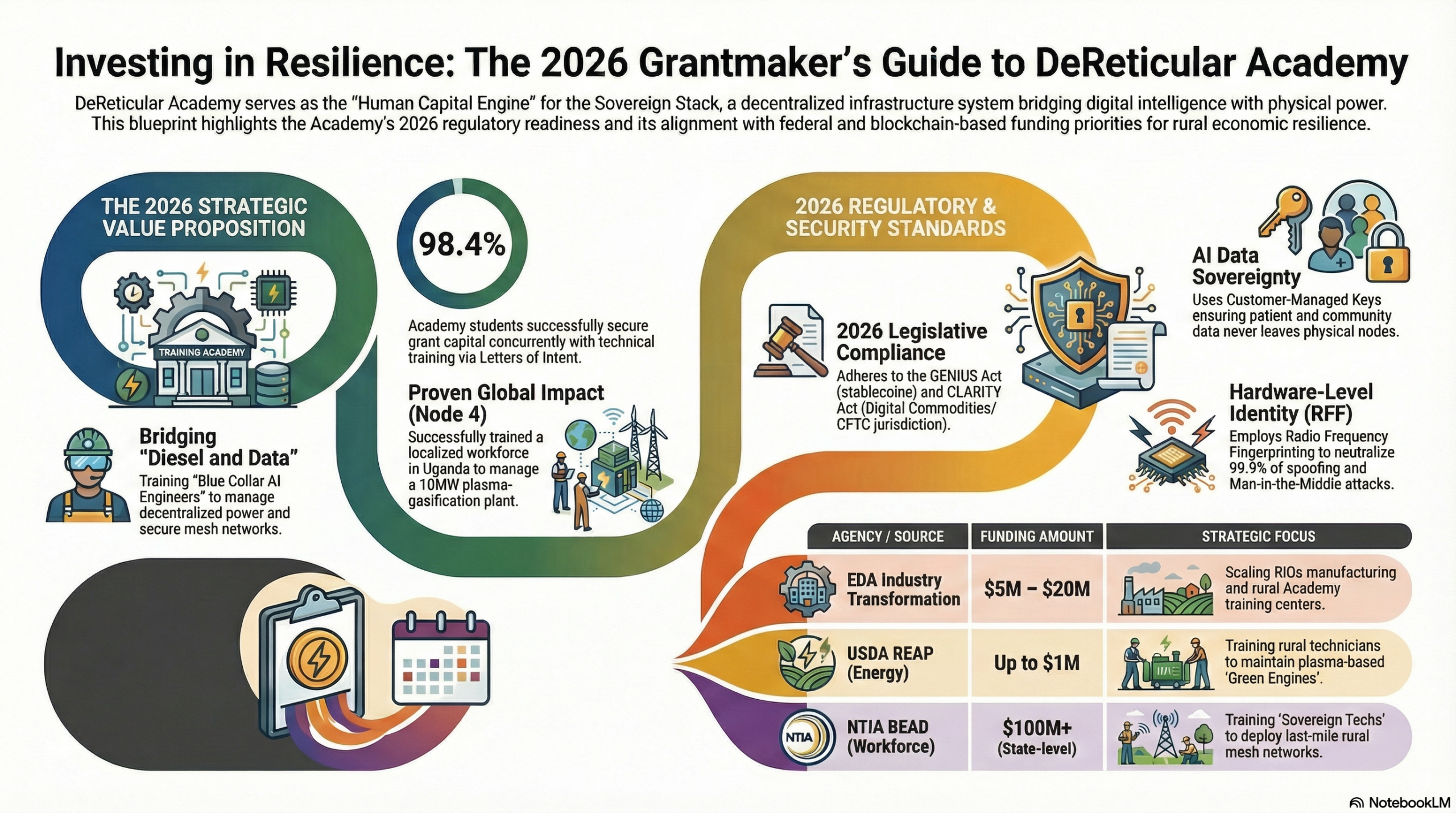
The DeReticular Academy utilizes “Concurrent Acceleration” to bypass traditional debt traps, unlocking capital while students secure their credentials.
2026 Regulatory Compliance
- GENIUS Act: 1:1 stablecoin backing with zero rehypothecation.
- CLARITY Act: Energy credits categorized as Digital Commodities.
- AI Data Sovereignty: Protection via Customer-Managed Keys (CMK).
- Safety Gate: 100% simulation score required to unlock physical hardware permissions.
Concurrent Acceleration and Funding
The Academy maintains a 98.4% success rate for students securing capital. The “Dean’s Letter of Intent” serves as “Proof of Technical Intent” to unlock:
- NTIA BEAD: Workforce funding for “last-mile” mesh deployment.
- USDA REAP: Support for rural energy independence via Agra units.
- EDA Industry Transformation: Scaling RIOS manufacturing and regional hubs.
Sovereign Badges
Competency is verified via Sovereign Badges—NFT-based industrial credentials minted on the RIOS ledger for trustless insurance and liability verification.
Initiation Mandate:
- Identify Site: Anchor your node.
- Enroll: Join the SSA track for Black Badge certification.
- Secure Capital: Use the Letter of Intent to seed your stack.
There are two types of people: those who wait for the lights to come back on, and those who never let them go out. Don’t just survive the future. Blueprint it.


