RIOS-CC-1000 Sovereign Compute Cluster Technical Specification & Survival Blueprint
1. Hardware Mission & Environmental Classification
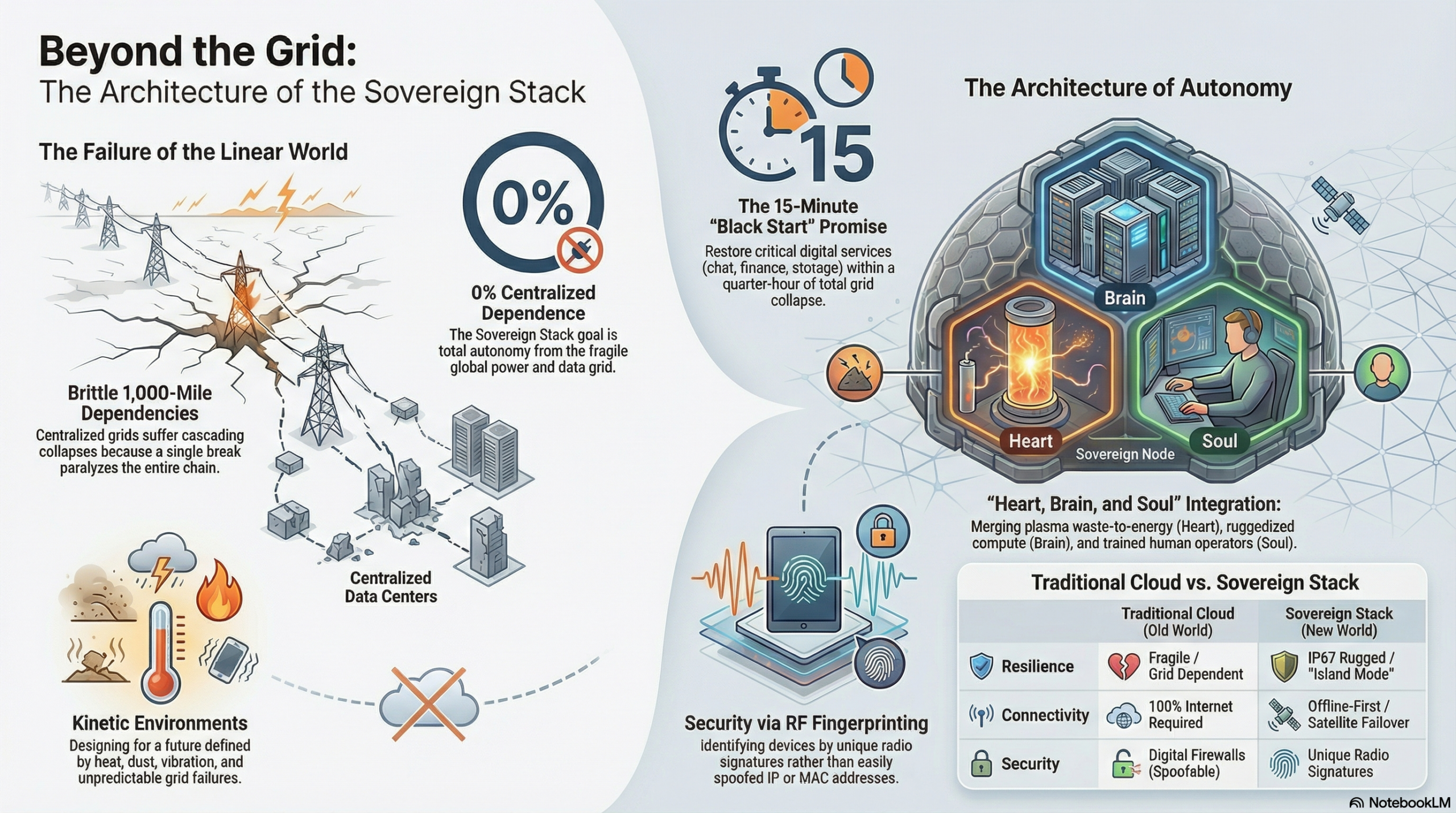
The RIOS-CC-1000 is not a piece of IT equipment; it is a field-deployable asset classified for Kinetic Environments. “Old World” infrastructure is a fragile ecosystem of climate-controlled server racks and surgical HVAC reliance. In our reality—defined by heat, ash, vibration, and total grid failure—that fragility is a death sentence.
Hardware alone cannot maintain sovereignty. In the DeReticular Academy, we recognize that the RIOS unit represents the “Nerves” of the Sovereign Stack, while the Administrator is its “Soul.” Building the machine is half the battle; empowering the human operator to bridge the gap between diesel and data is the war.
Core Mission Statement: “Keeps the lights of civilization on when the world goes dark.”
——————————————————————————–
2. The Exo-Shell: Physical Fortification & EMF Shielding
The unit is housed in a ruggedized “Exo-Shell” composed of IP67-rated aluminum. This isn’t just for aesthetics; it is a tactical bunker for your motherboard. The shell functions as a high-grade Faraday cage, essential for survival against “invisible electrical spikes” from solar flares or localized electromagnetic pulses (EMPs) that would instantly fry standard consumer electronics.
| Engineering Choice | Survival Benefit |
| IP67 Aluminum Shell | Absolute dust-tight seal; survives submersion in 1 meter of water for 30 minutes. |
| Faraday Cage Design | Blocks RF jamming and electromagnetic interference from weapons or solar events. |
| Ruggedized Chassis | Dampens high-vibration environments (vehicle mounts/heavy industrial zones). |
Physical armor is your first line of defense, but it becomes a liability if the system chokes on its own environment. A machine that cannot breathe in a dust storm is just an expensive space heater.
——————————————————————————–
3. Thermal Management: The Positive Pressure Cycle
Standard servers suck air in, dragging dust, sand, and ash directly onto the circuitry. In the field, this particulate matter acts as an insulator, causing heat to build up until the hardware dies. The RIOS-CC-1000 inverts this failure point using the Positive Pressure Cycle. It utilizes a high-velocity internal blower to ensure the unit is constantly “exhaling,” forcing contaminants away from the internals.
The 3-Step Logic of the Positive Pressure Cycle:
- Internal Pressurization: The blower creates a high-pressure zone inside the chassis, ensuring internal pressure is higher than the external atmosphere.
- Active Expulsion: This pressure differential forces air out through the vents, blowing away sand and ash before they can settle.
- Maintenance Cycle: This system extends the maintenance window significantly, requiring a physical intake filter check only every 30 days, even in high-threat environments.
——————————————————————————–
4. Compute Architecture & The Blade System
The “brains” of the cluster consist of four NVMe-native Compute Blades. These are independent nodes that allow for “Hot-Swapping”—the act of replacing the engine while the car is still moving. If a node fails, the cluster rebalances the load, but the physical replacement requires strict adherence to the Blue LED protocol.
The Hot-Swap Protocol:
- [ ] Software Prep: Select “Prepare for Removal” in the administrative dashboard.
- [ ] The Wait: Observe the Blue LED (Storage) light on the blade.
- [ ] Cache Confirmation: Wait for the light to turn Solid Blue. A flashing light indicates an active write to the temporary memory buffer (Write Cache). Pulling a blade during a flash risks total file system corruption.
- [ ] Safe Removal: Once Solid Blue, unlock the cam lever and slide the blade out.
Physical integrity is the floor; data sovereignty is the ceiling. These blades are protected by an aggressive, non-negotiable security layer.
——————————————————————————–
5. Physical Security & Intrusion Detection
The RIOS-CC-1000 employs a “Scorched Earth” policy. The chassis acts as a vault; if the seal is broken by unauthorized hands, the system chooses suicide over compromise.
The Seal Integrity Light Guide:
- Green (Chassis Sealed): The unit is secure and encrypted. DO NOT OPEN.
- Off / Maintenance Mode: Safe for access. This mode must be toggled via the dashboard to prove the operator has administrative authority.
- Red / Intrusion Detected: Unauthorized breach detected. Encryption keys are instantly purged from memory, rendering all data on the 4-blade cluster unreadable.
——————————————————————————–
6. Connectivity & The Zero-Trust Perimeter
We operate on a “Starlink-First” strategy. The RIOS unit must be the primary brain; therefore, the Starlink router must be set to Bypass Mode. This turns the satellite link into a “dumb pipe,” allowing RIOS to manage all local telemetry.
The “Zero-Trust Bubble” is maintained via the Watchtower Protocol, which uses RF Fingerprinting. Think of this as a “Voice Print” for hardware. Because every device has manufacturing imperfections that create a unique radio signature, we identify devices by their physics, not their easily spoofed IP or MAC addresses.
- Traditional Firewalls (IP-Based): Vulnerable to spoofing; stops addresses, not devices.
- Watchtower Protocol (RF Fingerprinting): Irrefutable physical identification.
- Green List: Trusted community hardware.
- Grey List: Guests. Restricted to internet access. Accessing the Finance VLAN (BTC/Lightning) requires physical identity verification (KyC).
- Red List: Hostile jammers or unauthorized devices; permanently banned via Physical Disassociation.
Dean’s Note: I’ll be watching your latency. If it’s over 50ms, we have words.
——————————————————————————–
7. Operational Recovery: The “Black Start” & 15-Minute Promise
The ultimate test of a Sovereign Administrator is the Black Start—rebooting civilization from total system collapse. This is a tactile, high-stress procedure guided by the physical “Red Card” checklist attached to your unit.
The 15-Minute Promise SLA | Timeframe | Phase | Critical Actions | | :— | :— | :— | | 0–5 Minutes | Power Stabilization | Isolate WAN; verify Agra SPS generator is stable at 60Hz. | | 5–10 Minutes | Boot & File Integrity | Insert Master Key USB into Port 0; hold Reset for 10s; listen for the “Heartbeat” POST Pass (3 short beeps, 1 long). | | 10–15 Minutes | Mesh & App Availability | Broadcast Sovereign Mesh; Execute rios-phoenix restore --latest to restore Matrix, Nextcloud, and the Village Ledger. |
The “Soul” of the operation must also monitor the “Heart.” A dedicated Python script, SCRIPT_Auto_Shutdown.py, monitors Agra SPS fuel levels. If fuel drops below 10%, the RIOS triggers a safe shutdown to prevent a “dirty kill” and protect the drive heads.
——————————————————————————–
8. Hardware Health & Maintenance Summary
In a kinetic environment, telemetry is your only early warning system. Use these rios-cli commands to audit your node’s health:
rios-vault status: Verifies storage is LOCKED / ACTIVE (functional and encrypted).rios-app list: Audits active services; remember, you only have 4 blades—manage your overhead.rios-mesh link: Bridges mesh nodes to eliminate dead zones in the field.rios-sync force: Manually forces a mirror of local data to the satellite uplink.rios-sec ban --rf-sig: Executes physical disassociation of hostile hardware.rios-phoenix restore --latest: The final restoration command for a full system rebuild.
You are the line between community resilience and digital darkness. Stand ready.


