Institutional Protocol for Macro-Thermodynamic Risk Management: The RELA Framework
- Executive Protocol Overview: The Epistemic Mandate
Institutional survival in the current epoch is contingent upon the alignment of internal symbolic models with the Ontic Attractor (\Omega^* \in \mathcal{M})—the objective, mind-independent state of physical reality. We have entered a global “Model Crisis” where the divergence between financial ledgers and thermodynamic limits has reached a structural breaking point. Risk management must transition from the observation of price volatility to the management of the Epistemic Dilemma: the catastrophic gap between low-dimensional institutional framing (\mathcal{S} \subset \mathbb{R}^d) and high-dimensional ontic reality (\mathcal{M}).
The Mandate of Materialized Error Reduction Truth is an invariant dynamical attractor reached exclusively through “Materialized Error Reduction”—the systematic, irreversible truncation of false parameter manifolds (Via Negativa). Progress is not measured by the internal coherence of a model, but by the volume of false parameter space permanently foreclosed via unyielding empirical friction.
This protocol provides the diagnostic tools to identify the fracture of an institution’s “symbolic envelope” and the architectural specifications for the transition to resilient, reality-grounded systems.
- Theoretical Foundations: Perspectival Realism and Ontic Friction
All institutional data is “perspectival,” mediated by instrumentation, language, and cognitive limits. However, this perspectivism is not relativism; it is a veridical projection of high-dimensional physical dynamics onto lower-dimensional conceptual manifolds. Ontic Friction—the passive resistance of reality against flawed representations—remains the only valid metric for auditing institutional truth-claims.
Epistemic Architecture Matrix
Primitive System Element Operational Domain Physical/Logical Mechanism Primary Failure State Terminal Correction Vector
Ontic Attractor (\Omega^*) Objective Reality (\mathcal{M}) Thermodynamic conservation laws. Epistemic Inaccessibility. Asymptotic approximation via iterative sampling.
Perspective (\hat{\Pi}_\theta) Cognitive/Instrumental Dimension-reducing projection operators. Ideological Capture (Overfitting). Forced parameter truncation via empirical friction.
Deductive Channel Formal Symbolic Syntax Truth-preserving logical entailment (\vdash). Semantic Drift & Axiomatic Inconsistency. Formalization via Lean 4/Coq; model checking.
Material Ledger Societal Memory Vitrification of silicate; cryptographic chains. Doxastic Decay; unilateral political revision. Physical fracture of envelopes; debt-default resets.
Consensus Engine Intersubjective Validation Distributed Bayesian updating; BFT consensus. Epistemic Cascades; manufactured consent. Exposure to external thermodynamic reality.
The Via Negativa Calculus
To maintain epistemic validity, the volume of an institution’s hypothesis parameter space, denoted as \mu(\Theta), must satisfy the differential constraint of monotonic contraction: \frac{d\mu(\Theta)}{dt} \le 0 Any expansion of complexity to explain away empirical anomalies represents a retreat into unfalsifiable delusion. Understanding these limits is the prerequisite for identifying “Model Drift” within global clearing systems.
- The Kuhn Cycle Diagnostic: Identifying Institutional Model Drift
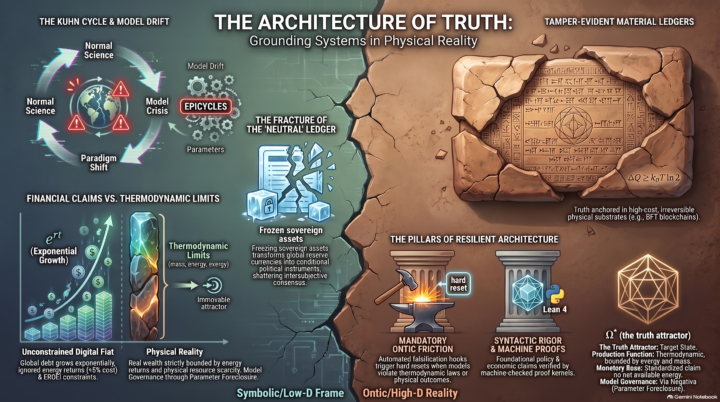
The Kuhn Cycle is an information-theoretic ledger dynamic where institutions ignore accumulating “anomalies” to preserve ideological stability. This induces systemic fragility as the model decouples from reality.
- Normal Science: Stable axiomatic frame where H(\text{Model} \mid \text{Reality}) < \epsilon.
- Model Drift: Anomalies multiply. The institution responds by adding “auxiliary parameters” (Ptolemaic epicycles). Kolmogorov complexity K(\mathcal{H}) escalates while true predictive power stagnates.
- Model Crisis: The “envelope cracks.” \mathcal{L}(\text{Predictions}, \text{Reality}) \to \infty. Institutional authority loses credibility as the ontic delta becomes intolerable.
- Model Revolution: Competing, incommensurable frameworks emerge. Ideological comfort collapses.
- Paradigm Shift: False parameter spaces are permanently foreclosed. A new, realigned ledger is established.
Financial Institutional Model Drift Checklist
Institutions must audit for the following three indicators of impending envelope fracture:
- Hyper-parameterization: Is the institution adding post-hoc rationalizations (e.g., “transitory inflation”) to fit unexpected data without questioning core axioms?
- Complexity Inflation: Is the model’s Kolmogorov complexity increasing solely to preserve institutional comfort?
- Increasing Ontic Delta: Is there a widening gap between symbolic claims (Debt) and real-world results (Energy/Materials)?
- The Macro-Physical Decoupling: Symbolic Claims vs. Biophysical Limits
The “Breaking of the Envelope” is the mathematical reconciliation of exponential financial claims (e^{rt}) with the bounded reality of Energy Return on Investment (EROEI).
The Thermodynamic/Financial Crack
Modern macroeconomics is predicated on the Fatal Axiom of the Disembodied Production Function: Y = A \cdot K^\alpha \cdot L^{1-\alpha} This model treats energy as a minor externality because its cost share is \text{Weight}_{\text{Energy}} \approx 0.05. This is an ontological blind spot; Capital (K) and Labor (L) produce nothing without energy—they are merely energy-directing mechanisms.
- Symbolic Ledger (Debt): Grows exponentially as D(t) = D_0 e^{rt}.
- Real Biophysical Capacity: Constrained by the unyielding floor of EROEI and material limits of copper, lithium, and rare earths.
Historical Decoupling and Warrant Failure
From the Song Dynasty Jiaozi (paper receipts for iron cash) to modern weaponized reserve assets, the decoupling of symbolic ledgers from physical anchors leads to systemic breaks. The 2022 freezing of sovereign reserves was a “warrant failure,” transforming global reserve assets from neutral stores of value into conditional political promises. This breach of ledger neutrality necessitates a shift to Level 2 (cryptographic) and Level 0 (ontic) anchors to prevent total clearing system collapse.
- The RELA Operational Protocol: Transitioning to Resilient Ledgers
The Resilient Epistemic & Thermodynamic Ledger Architecture (RELA) serves as the Single Source of Truth (SSOT) designed to withstand paradigm shifts.
Source-of-Truth Hierarchy
RELA resolves conflicting claims via the following strict precedence:
- Level 0: Ontic Physical Resistance (Highest) – Empirical failure and material fracture (e.g., bridge collapse).
- Level 1: Machine-Checked Deductive Proofs – Formal verifications in Lean 4 that override heuristics.
- Level 2: Immutable Cryptographic Ledgers – Append-only, BFT states on high-entropy substrates.
- Level 3: Symmetric Intersubjective Verification – Peer review under Mertonian CUDOS norms (Communalism, Universalism, Disinterestedness, Organized Skepticism) and Habermasian criteria (Symmetry, Sincerity, Absence of Coercion).
- Level 4: Sovereign Declarative Fiat (Zero Epistemic Weight) – Institutional decrees unsupported by Level 0-3 proofs.
Technical Entity Schemas
Epistemic Ledger Node (ELN)
{
“entity_id”: “UUID-v4”,
“perspective_frame_id”: “SHA-256-Hash”,
“hypothesis_vector”: {
“kolmogorov_complexity_bits”: “UInt64”,
“dimension_k”: “Integer”
},
“cryptographic_proof”: {
“witness_merkle_root”: “SHA-256”,
“formal_verification_ast”: “Lean4-IR-Token”
}
}
Biophysical Balance Register (BBR)
{
“exergy_metrics”: {
“total_input_joules”: “Float64”,
“net_surplus_joules”: “Float64”,
“systemic_eroei”: “Float64”
},
“material_throughput_kg”: {
“copper”: “Float64”,
“lithium”: “Float64”,
“hydrocarbons”: “Float64”
},
“invariant_check”: “Boolean”
}
Universal Invariants (Active Commands)
- Enforce Monotonic Pruning: \frac{d\mu(\Theta)}{dt} \le 0.
- Respect the Landauer Bound: Epistemic clarity requires physical work. Every bit reset dissipates \Delta Q \ge k_B T \ln 2, where k_B = 1.380649 \times 10^{-23} \text{ J/K}.
- Maintain Biophysical-Monetary Equivalence: M_{\text{nominal}}(t) \le \kappa \cdot \int (\text{Exergy}_{\text{net}} \cdot \eta) dt. Nominal claims must never exceed thermodynamic carrying capacity.
- Strategic Mitigation: The Roadmap to Paradigm Convergence
Legacy institutions will resist RELA due to “Inelastic Policy Response” (the inability to print liquidity under physical constraints). However, early adopters leverage “Absolute Ontic Grounding” to survive the inevitable reset.
Three-Phase Remediation Roadmap
- Phase 1: Audit & Parallel Tracking: Stand up shadow BBR engines to track real EROEI inputs and enforce algorithmic parsimony on internal forecasting.
- Phase 2: Pilot Anchoring & Machine Verification: Implement Bilateral Resource-Anchored Settlement for trade blocs requiring neutral assets. Use AI-Accelerated Proof Synthesis to write and verify Lean 4 proofs for policy claims.
- Phase 3: Full Institutional Convergence: Sunset DSGE models. Enforce real-time exergy limits on monetary issuance and hard parameter bounds on all strategic models.
The Asymptotic Horizon
The coming reset is the natural operation of the Kuhn Cycle toward a more durable architecture. By permanently foreclosing the dead parameter space of infinite symbolic illusions and anchoring ledgers in the kiln of physical reality, we bring institutional understanding into alignment with the objective world. Truth remains an infinite horizon, but by systematically eliminating the false, we move with absolute discipline toward the ontic attractor.


