Operational Architecture Plan: Air-Gapped Mesh & Agentic Commerce Protocol
- Strategic Architectural Vision: From Centralized Extraction to Sovereign A2A
The legacy landscape of travel and outdoor commerce is defined by extractive, cloud-dependent aggregators that function as rent-seeking middlemen. In regions like the New River Gorge, these systems impose a double failure: they extract 15% to 30% of gross revenue from local merchants while suffering total operational collapse in “mountain hollows” where cellular and fiber backhaul are non-existent. The strategic transition to an Agent-to-Agent (A2A) model is a technical and economic imperative for regional resilience. By deploying the Pawnee.us Sovereign Stack, we move commerce from centralized silos to a decentralized mesh, ensuring economic retention and persistent availability regardless of public internet status.
Strategic Gap Analysis Matrix
Dimension Legacy Centralized Aggregators Pawnee.us A2A Sovereign Engine
Take Rate / Commission 15% to 30% gross revenue cut extracted from local merchants. 2.5% decentralized protocol micro-fee. Merchant retains 97.5% of transaction value.
Network Connectivity 100% cloud-dependent; fails completely in cellular dead zones. Air-gapped mesh architecture via WISP-in-a-Box; zero internet dependency.
Booking Latency 5 to 15 minutes of manual browsing & state-synchronization lag. < 4 seconds via peer-to-peer AI agent micro-negotiations (OpenClaw kernel).
Hardware Security Vulnerable cloud databases; frequent customer data breaches. Hardware-secured TPM 2.0 silicon oracles; zero-trust, cryptographically signed logs.
Physical Automation None; human phone calls required to confirm assets (shuttles/drones). Direct physical API integration with autonomous Pawnee Buggies & Drone Kitchens.
The “So What?” Layer: Economic & Thermodynamic Integration
Reducing commission fees from 30% to a 2.5% protocol fee is not merely a profit play; it is the catalyst for regional infrastructure sovereignty. This 97.5% retention allows merchants to reinvest in local microgrid hardware. Under West Virginia H.B. 2014, these operations must meet a statutory Captive Power Requirement (\ge 70\%). By utilizing the RIOS Spark Spread AI, the protocol links booking volume directly to behind-the-meter energy production, optimizing the “compute-to-settlement” lifecycle against real-time power costs. This economic shift is technically facilitated by the OpenClaw agentic layer.
- The Agentic Layer: OpenClaw Kernel & Autonomous Negotiation
The OpenClaw kernel is the intelligence layer of the stack, providing a lightweight, edge-optimized execution environment for persistent identity and autonomous decision-making. Unlike legacy systems that rely on centralized cloud logic, OpenClaw enables software agents to represent consumers, local businesses, autonomous vehicles, drones, and microgrids directly at the network edge.
Kernel Capabilities
The OpenClaw kernel is engineered for high-velocity commerce and resilience:
- Cryptographic Identity Management: Maintains sovereign, hardware-attested identities for all network nodes.
- Multi-Attribute Decision Trees: Evaluates price, timing, geographic proximity, and real-time climate data to optimize multi-leg itineraries.
- Sysbox Isolated Container Runtimes: Ensures secure execution of agent logic, hardening the environment against cross-process interference.
- Atomic Smart Contract Execution: Finalizes P2P negotiations and settlements in under four seconds, providing immediate finality without centralized clearinghouses.
The “So What?” Layer: Eliminating HITL Latency
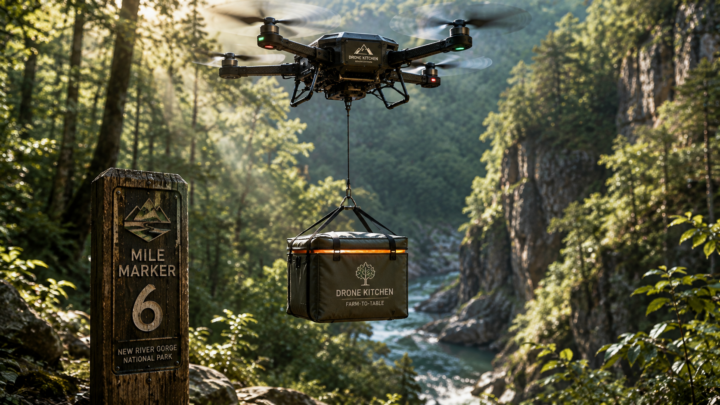
The “negotiation-to-settlement” workflow eliminates human-in-the-loop (HITL) latency and state-synchronization errors—the primary failure points in remote logistics. A single traveler intent can trigger a four-second cascade: securing a kayak slot via a Merchant Agent, dispatching a Fleet Agent (Pawnee Buggy) for trailhead pickup, and scheduling a Kitchen Agent (Drone Kitchen) for a mid-trail delivery. This eliminates double-booking risks and operational friction in remote environments. These software agents require a physical, hardware-secured environment to execute their mandates.
- Hardware Integration: WISP-in-a-Box Gateway Tiering
The WISP-in-a-Box product line (DeReticular Gen 5) serves as the physical anchor for the A2A protocol. These gateways provide the local compute and storage required for air-gapped operations, ensuring that the Sovereign Stack remains operational during regional infrastructure failures.
Hardware Tier Specifications
- WISP-in-a-Box Agentic ($9,997.00): The primary local AI agent server and LLM inference engine. It hosts the OpenClaw kernel and manages complex P2P negotiations.
- WISP-in-a-Box LTE ($5,887.00): Provides dual-WAN failover (Starlink + LTE) for ledger synchronization across regional nodes, maintaining state consistency across the mesh.
- WISP-in-a-Box Base ($1,497.00): Facilitates short-range agent handshakes via Bluetooth/Wi-Fi at trailheads and merchant storefronts for guest wearables.
The “So What?” Layer: Physical Resilience & H.B. 2014
Deploying local gateways ensures that commerce remains functional even during total fiber or cellular backhaul failure. This architecture fulfills the H.B. 2014 mandate for microgrid independence; by embedding agentic gateways within microgrids powered by Pawnee Power GenSets, we satisfy the statutory requirement that the energy and commerce infrastructure remain vertically integrated and locally controlled. Physical nodes are further secured via silicon-level trust.
- Security Architecture: TPM 2.0 Silicon Oracles
In a decentralized physical infrastructure (DePIN), trust is established through the Trusted Platform Module (TPM 2.0). These silicon oracles create a “zero-trust” environment where every agent action is verified at the hardware level, preventing the spoofing and data manipulation common in centralized cloud databases.
Cryptographic Signing Protocol
All transactions and state changes are verified via a silicon root-of-trust using the following signature formula:
\text{Signature}{\text{A2A}} = \text{Sign}{\text{TPM_PrivateKey}}\Big(\text{Agent_ID} \,|\, \text{Service_Timestamp} \,|\, \text{Price} \,|\, \text{GPS_Location}\Big)
Verification Breakdown:
- Agent_ID: Authenticates the specific node (traveler, vehicle, or merchant).
- Service_Timestamp: Prevents replay attacks in asynchronous mesh environments.
- Price: Hardens the financial terms of the P2P negotiation.
- GPS_Location: Provides hardware-verified proof of presence, ensuring services are rendered at the correct physical coordinates.
The “So What?” Layer: Hardware-Grade Confidence
By utilizing Sysbox isolated container runtimes and TPM 2.0 signatures, the protocol isolates transaction data from the underlying OS. This provides merchants and travelers with hardware-grade security that legacy cloud databases cannot match. These secured packets are moved across the physical landscape via a resilient mesh network.
- Network Topology: Air-Gapped Mesh & Hyphanet Integration
The Hyphanet/NeoMesh architecture functions as the “digital nervous system” of the corridor. It is designed to operate entirely independently of the public internet, fulfilling the requirements for an air-gapped commerce environment.
Operational Mesh Dynamics
The mesh utilizes a peer-to-peer (P2P) broadcast mechanism. A traveler’s agent broadcasts an “intent” (e.g., shuttle request + meal delivery) which is negotiated and settled across local WISP nodes without ever touching the public internet. This removes the dependency on centralized DNS or cloud-based state management.
The “So What?” Layer: Cellular Dead-Zone Immunity
This architecture makes the network immune to cellular dead zones, which are endemic to the New River Gorge. By making the “Air-Gapped” status a feature rather than a limitation, the protocol facilitates commerce in the deepest mountain hollows where traditional apps fail. The BOM is the physical manifestation of this network topology.
- Deployment Framework: Infrastructure BOM & Roadmap
Realizing this network requires a phased deployment of DeReticular’s Generation 5 commercial products and a strategic partnership with regional academic institutions.
Regional Pilot Bill of Materials (Master BOM)
Gen 5 Product Name [dereticular.com] Unit Qty Unit Price (USD) Total Cost (USD)
1 WISP-in-a-Box Agentic (AI Gateway) 20 $9,997.00 $199,940.00
2 WISP-in-a-Box LTE (Dual-WAN Gateway) 10 $5,887.00 $58,870.00
3 WISP-in-a-Box Base (Sovereign Gateway) 50 $1,497.00 $74,850.00
4 Pawnee Power GenSet (45 kW Rotary) 4 $49,997.00 $199,988.00
5 Pawnee Flagship TAV (Mobile Server Hub) 1 $797,000.00 $797,000.00
6 Pawnee Hybrid Dune Buggy (Testing) 1 $99,000.00 $99,000.00
— Core Server Rack & TPM 2.0 Hardware Lump Sum $185,000.00 $185,000.00
— Security Audit & Protocol Legal Fees Lump Sum $150,000.00 $150,000.00
Total Initial CAPEX $1,764,648.00
Phased Rollout Schedule
- Phase 1 (Y1-Y2): New River Gorge Regional Pilot. Onboard 100+ merchants and deploy 20 Agentic Gateways to demonstrate zero-coverage A2A booking capacity.
- Phase 2 (Y3-Y5): Appalachian & National Expansion. Scaling to 10,000+ outfitters with integration into regional transit and Non-Emergency Medical Transportation (NEMT) systems.
- Phase 3 (Y6-Y10): Global DePIN Standard. Establishing the OpenClaw protocol as the global open-source standard for off-grid autonomous commerce ($20B+ annual volume).
The “So What?” Layer: The RETI Talent Pipeline
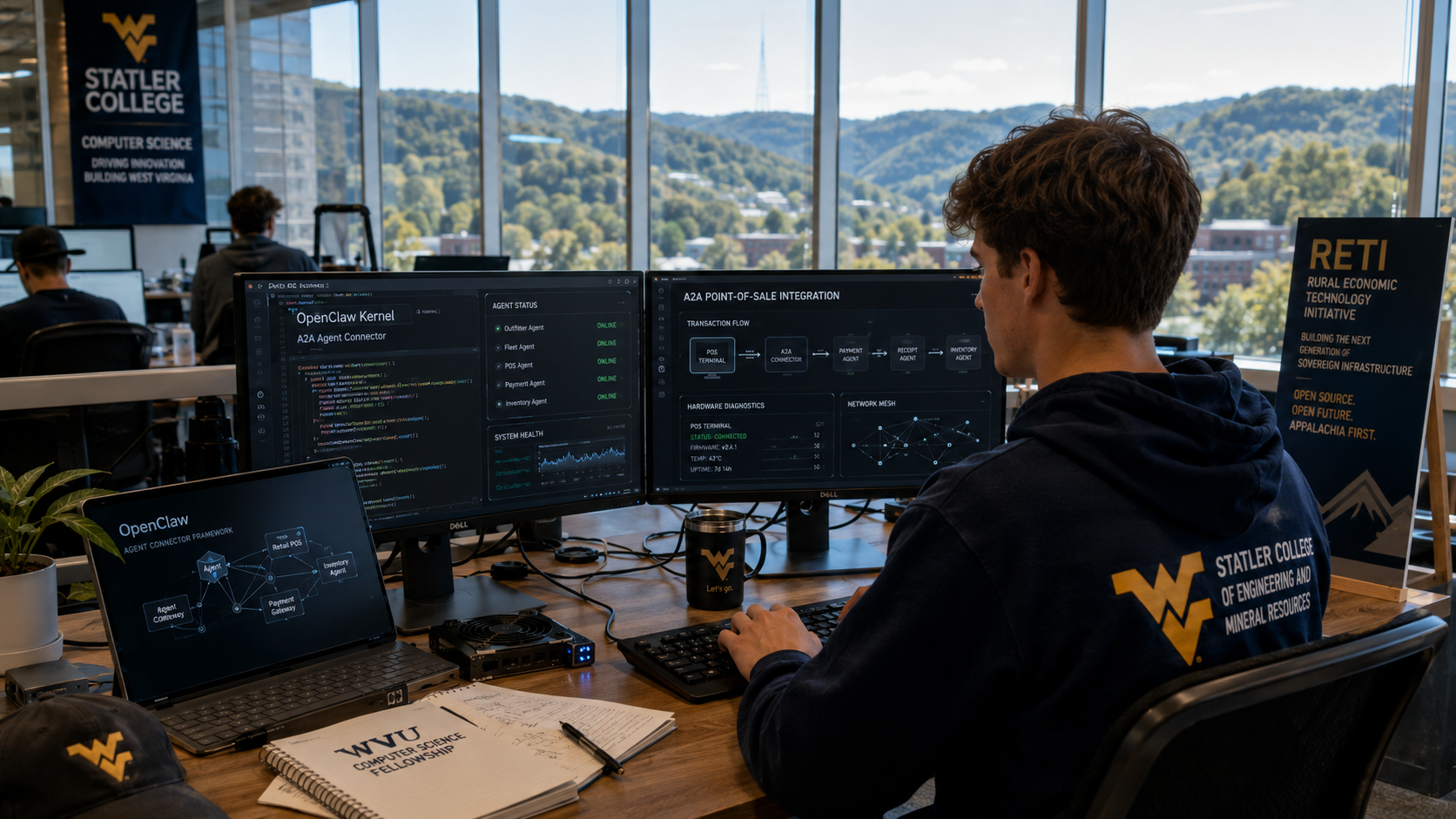
Long-term sustainability is driven by the 321M NSF RETI Consortium and WVU Statler College. By utilizing university fellows to build open-source POS connectors, the protocol lowers onboarding friction. These “Energy Students” earn micro-fees from booking volume, creating a self-sustaining developer ecosystem. The convergence of hardware security, agentic intelligence, and thermodynamic integration via RIOS Spark Spread AI establishes the new standard for autonomous commerce.


