Operational Transition Playbook: From Platform Dependency to Sovereign Rural Hosting

1. The Strategic Inversion: Transitioning to “Above the Line” Value
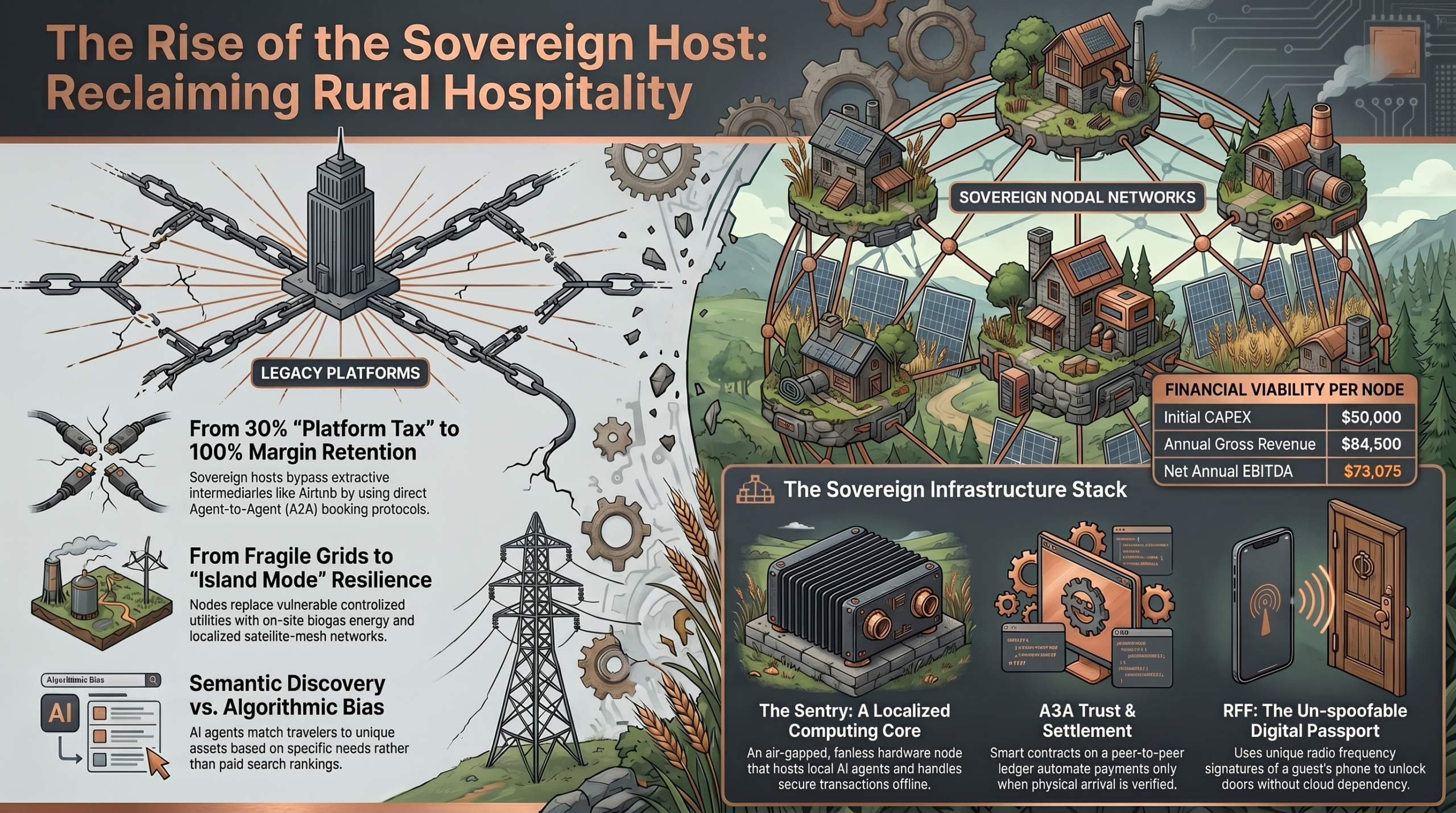
The hospitality industry is currently undergoing a structural inversion, moving from “Platform-Mediated” ecosystems toward “Agent-Orchestrated” sovereignty. For over a decade, extractive gatekeepers like Airbnb and Expedia have exploited centralized structural bottlenecks to impose a 15–30% platform tax. By transitioning to a sovereign nodal model, rural entrepreneurs move “Above the Line,” utilizing Decentralized Physical Infrastructure (DePIN) to bypass the Manual Search Barrier. This shift is technically anchored by the Web Model Context Protocol (Web MCP), which allows property-side agents to expose capabilities directly to traveler agents, reclaiming data ownership and profit margins while transforming unique rural assets into high-value, un-commoditizable destinations.
The Death of the Platform Tax
The transition from Online Travel Agencies (OTAs) to Agent-to-Agent (A2A) models effectively destroys the manual search barrier. In legacy models, hosts are forced into a race to the bottom, dictated by algorithms that sanitize local context. In an A2A ecosystem, Zero-UI Discovery allows a traveler’s personal AI to query an Agent-Readable Manifest directly via Web MCP. This removes the need for lifestyle branding and SEO. Transactions settle on localized ledgers, ensuring that fees typically lost to corporate headquarters remain within the local rural economy as localized capital.
podcast
The “Above the Line” Moat
Standardized luxury is now a commodity. True value resides “Above the Line”—in non-reproducible contextual assets (historic mills, off-grid reliability, verifiable silence). By defining these assets through Granular Attribute Tagging (e.g., #acoustic-silence-90dB), rural properties achieve semantic equality with global luxury brands. Machines do not value brand names; they value mathematical alignment with a traveler’s intent.
Contrasting the Operational Paradigms
| Feature | Platform Era (Legacy) | Sovereign Era (Future) |
| Discovery | Manual Search / SEO-driven | Zero-UI / Agentic Intention Matching (Web MCP) |
| Fees | 15–30% Extractive Tax | 0% Intermediary Fee (P2P Settlement) |
| Data Ownership | Controlled by Platforms | Retained by Sovereign Host (Local Ledger) |
| Infrastructure | Dependent on National Grids | “Island Mode” Microgrids |
| Marketing | Lifestyle Branding / Ad Copy | Machine-Readable Action Spaces / JSON-LD |
| Visibility | Algorithm-dependent | Semantic Logic-driven |
These strategic foundations necessitate a disciplined, four-phase deployment roadmap to convert a physical asset into a resilient, high-yield sovereign node.
——————————————————————————–
2. Phase I: Site Audit & Resource Mapping
The foundation of “Nodal Resilience” is a comprehensive physical site audit to identify “Hidden Value.” You must identify contextual assets that are non-reproducible and convert them into machine-legible logic that personal agents can verify.
Assessing Contextual Assets
Map terrain, historical structures (mills, schoolhouses), and “verifiable silence.” These elements are then encoded into an Agent Card (agent.json) using JSON-LD markup. This ensures that the property is not merely “quiet” in a marketing sense, but is semantically tagged as #acoustic-silence-90dB and #off-grid-biogas-reliable. This machine-readable manifest allows traveler agents to verify the site’s suitability for high-net-worth “digital burnout recovery” with mathematical precision.
Regulatory & Zoning Alignment: The LER Strategy
To neutralize utility and municipal pushback, utilize “Agricultural Integration.” Structure the deployment as a multi-use agricultural-residential model to leverage agricultural easement protections. You must maintain a Land Equivalent Ratio (LER) above 1.2—ensuring the land is used for both energy/hospitality and active farming. This preserves the property’s agricultural zoning status, rendering commercial hospitality bans or utility-based zoning restrictions inapplicable.
Phase 1 Checklist: Structural Readiness
- GIS Terrain Mapping: Utilize Geographic Information Systems to identify natural assets and optimal hardware vaulting locations.
- Water Source Identification: Verify independent, off-grid water access.
- Regulatory Audit: Confirm state-level “Right to Farm” protections and agricultural easement eligibility.
- Hardware Vaulting: Pour a reinforced concrete pad with secondary containment loops for the secure installation of the core hardware stack.
Transitioning from the physical landscape, you must now establish the digital anchorage required to govern it.
——————————————————————————–
3. Phase II: Network Anchorage & Compute Deployment
Operational sovereignty is defined by “Island Mode”—the ability to maintain digital, electrical, and financial independence during macro-network failures. This localized capability is the ultimate luxury for the modern “Sovereign Nomad.”
Architecting the Hardware Stack: The Sovereign Sentry Pro
The node is anchored by the Sovereign Sentry Pro, a fanless, industrial-grade monoblock designed for Hyperconverged Infrastructure (HCI).
- Processor: AMD EPYC Embedded (16 Cores/32 Threads).
- Acceleration: Dual Nvidia L4 GPUs (48GB GDDR6 VRAM) for local AI model inference.
- Virtualization:Proxmox VE (Kernel 6.x), hosting three distinct environments:
- The Gatekeeper: pfSense/OPNsense for deep packet inspection and WAN failover.
- The Ledger: Locutus Ledger daemon for encrypted data shards and smart contract validation.
- The Sandbox: Air-gapped environment for local Large Language Models (LLMs).
Deploying the Private Intranet Canopy
Install Nomad Mesh-Point Routers (RIOS-EXT-01) at high-elevation points. These weather-sealed beacons project a miles-wide canopy using Wi-Fi 6E and 915MHz LoRaWAN. This enables “Vehicle-as-a-Relay” dynamics via Nomad Link kits, where moving machinery caches IoT telemetry and syncs with the Sentry core upon returning to range.
Initializing the Local Logic Layer
System automation is governed by the OpenClaw framework, deploying localized AI agents in the Sandbox:
- The DevOps Sovereign: Local administrator using Llama-3-8B (Quantized Q4_K_M) to parse server logs and self-heal services offline.
- The Field Medic: Automated diagnostic agent (Mistral-7B) for predictive hardware repairs.
- The Industrial Foreman: Agent for agricultural machinery and agrivoltaic sun-tracking.
- The Sovereign Elector: Secure consensus terminal managing DAO voting on the Locutus Ledger.
This digital canopy requires an independent energy backbone to achieve true operational sovereignty.
——————————————————————————–
4. Phase III: Energy Integration & Microgrid Resilience
The “Agra Dot Energy” model treats “verifiable baseload off-grid power” as a premium feature. This guarantees reliability regardless of national grid stability, a prerequisite for high-bandwidth experiences.
Synthesizing Dual-Source Generation
Nodes must utilize a combination of intermittent and non-intermittent sources:
- Vertical Agrivoltaic Arrays: Bifacial solar fences with 7-meter row intervals to accommodate standard agricultural machinery. The Industrial Foreman agent adjusts tilt angles every 15 minutes.
- Modular Anaerobic Biogas Digesters: Process agricultural waste into clean methane for 24/7 non-intermittent baseload power.
- “Spark Spread” Optimization: Surplus energy is converted into synthetic diesel (ASF™) or exported to neighbors, creating secondary revenue.
Establishing “Island Mode” Protocols
When backhauls fail, the node must execute this sequence:
- Nomad Mesh Active: Local intranet remains online for guest communication.
- Locutus State Channels: Transactions are queued locally on the ledger.
- RFF Operational: Local hardware signatures continue to grant physical access.
- Auto-Sync: Upon reconnection, the system batch-syncs the offline queue with the global chain.
Energy reliability is the absolute prerequisite for the high-bandwidth Augmented Reality (AR) experiences that define the traveler’s journey.
——————————————————————————–
5. Phase IV: Experience Logic & A3A Activation
In this phase, traditional marketing is obsolete. “Experience Logic” and “Semantic Interlock” between traveler agents and host agents replace marketing budgets. Hosts define Action Spaces rather than writing ad copy.
A3A (Agent-Web3-Agent) Settlement
The transaction lifecycle moves from A2A discovery to settlement via JSON-RPC 2.0 over the Locutus Ledger:
- Negotiation: The traveler’s agent interacts directly with the Sentry agent’s Agent Card.
- Escrow: Funds are locked in a decentralized smart contract.
- Release: Payment is released only upon verified physical check-in, removing all third-party credit card fees and friction.
Physical Security: Physics over QR Codes
Replace cloud-dependent keys with Radio Frequency Fingerprinting (RFF). The system analyzes the unique electromagnetic transients of a guest’s mobile device antenna to create an un-spoofable hardware signature. This signature unlocks physical assets (cabins, gates) without requiring a password or external internet.
Immersive Spatial Systems
The node serves DAOSRUS AR Trail Maps directly from local edge-servers via the Nomad Mesh. Serving these locally ensures a “Low-Cognitive-Load” environment that functions perfectly without external internet bandwidth, providing guests with high-resolution historical storytelling.
This resilient infrastructure facilitates high-value traveler experiences, leading directly to the economic viability of the deployed node.
——————————————————————————–
6. Financial Architecture & Unit Economics
The sovereign node acts as a “Circular Economic Flywheel,” retaining capital within the rural municipality to prevent the wealth flight typical of platform-led tourism.
Granular CAPEX Breakdown
Converting a site into a Sovereign Node requires an initial investment of $50,000.
| Component | Cost (USD) |
| Sovereign Sentry Pro Node (AMD EPYC + Dual L4 GPUs) | $8,500 |
| Nomad Mesh Beacons (5x Beacons) | $4,500 |
| Agra Dot Microgrid (Biogas + 15kW Vertical Agrivoltaics) | $32,000 |
| RFF Physical Access Controllers | $2,000 |
| DAOSRUS AR & Software Setup | $3,000 |
| Total Initial CAPEX | $50,000 |
Multi-Vertical Revenue Streams
- A3A Lodging: $59,250/yr (Based on $250/night at 65% occupancy; 0% fees).
- Edge Compute Leases: $6,000/yr (Leasing GPU cycles for regional AI inference).
- Mesh Access: $12,000/yr (High-speed mesh subscriptions for neighbors).
- Energy Arbitrage: $7,250/yr (Surplus power/ASF™ fuel exports).
- Total Annual Gross: $84,500
Proforma Performance Summary
A 10-year scaling trajectory to 500 nodes projects a 58.3% IRR and a $36.5M NPV (at a 10% discount rate). This demonstrates the scalability of DePIN-backed rural assets compared to legacy hospitality.
Financial yields are high, but realization depends on overcoming specific regulatory and capital hurdles.
——————————————————————————–
7. Governance, Risk, & Scaling Mitigation
Strategic defense of the node requires decentralized governance via the DAOSRUS DAO to protect the network from corporate co-option.
Remediating the Capital Gap
The $50k CAPEX barrier is bridged through Revenue-Based Financing (RBF). The joint venture covers installation costs in exchange for a 35–40% revenue share of compute and lodging yields until 1.5x of the CAPEX is repaid. Additionally, utilize programmatic software to auto-capture USDA REAP grants, covering up to 50% of the hardware stack.
Navigating Regulatory Blockades
Bypass utility lobbies and municipal restrictions by insisting on Private Mesh Easements. All power and data transfers must remain peer-to-peer on private property easements registered on-chain. Maintain the LER above 1.2 to ensure the node is classified as an agricultural asset, rendering hospitality bans inapplicable.
Supply Chain & Obsolescence Strategy
Sentry nodes utilize a modular architecture with hot-swappable MXM GPU cards. This allows for modular hardware updates in under 15 minutes, mitigating the risks of silicon obsolescence and ensuring the node remains profitable through the “Physical AI Supercycle.”
Transition today from being a consumer of legacy platforms to being a developer of the sovereign frontier. Reclaim your economic and resource independence.


