Deployment Specification: Sovereign Robotic Infrastructure Network (RIN) Transition Roadmap
- Strategic Rationale: The Shift to Island Mode
The landscape of industrial security has undergone a fundamental transformation, necessitating a move from the vulnerable “thin client” edge robotics model to the “Island Mode” paradigm. This strategic shift was catalyzed by the 2026 OpenClaw Security Crisis, a systemic failure that shattered the “Trusted Environment Fallacy.” This event proved that relying on third-party, cloud-dependent APIs for physical systems is a critical vulnerability; once an agent is granted deep system access, administrative rules are insufficient to protect data. Absolute physical and data sovereignty is no longer a preference—it is a security mandate.
To achieve this, we employ the philosophy of “Spherical Resilience.” Traditional linear security models, which protect local networks while remaining dependent on upstream cloud connections, are inherently brittle. Spherical Resilience creates a self-healing geometry of end-to-end local ownership, where each robotic node functions as an independent, secure unit. By wrapping compute, storage, power, and physical action within the local physical shell of the machine, we ensure absolute computational self-reliance even if regional satellite constellations or cellular grids are compromised. This foundation begins with the total neutralization of external dependencies at the hardware level.
- The PCB Sanitization Protocol (“Brainwashing”)
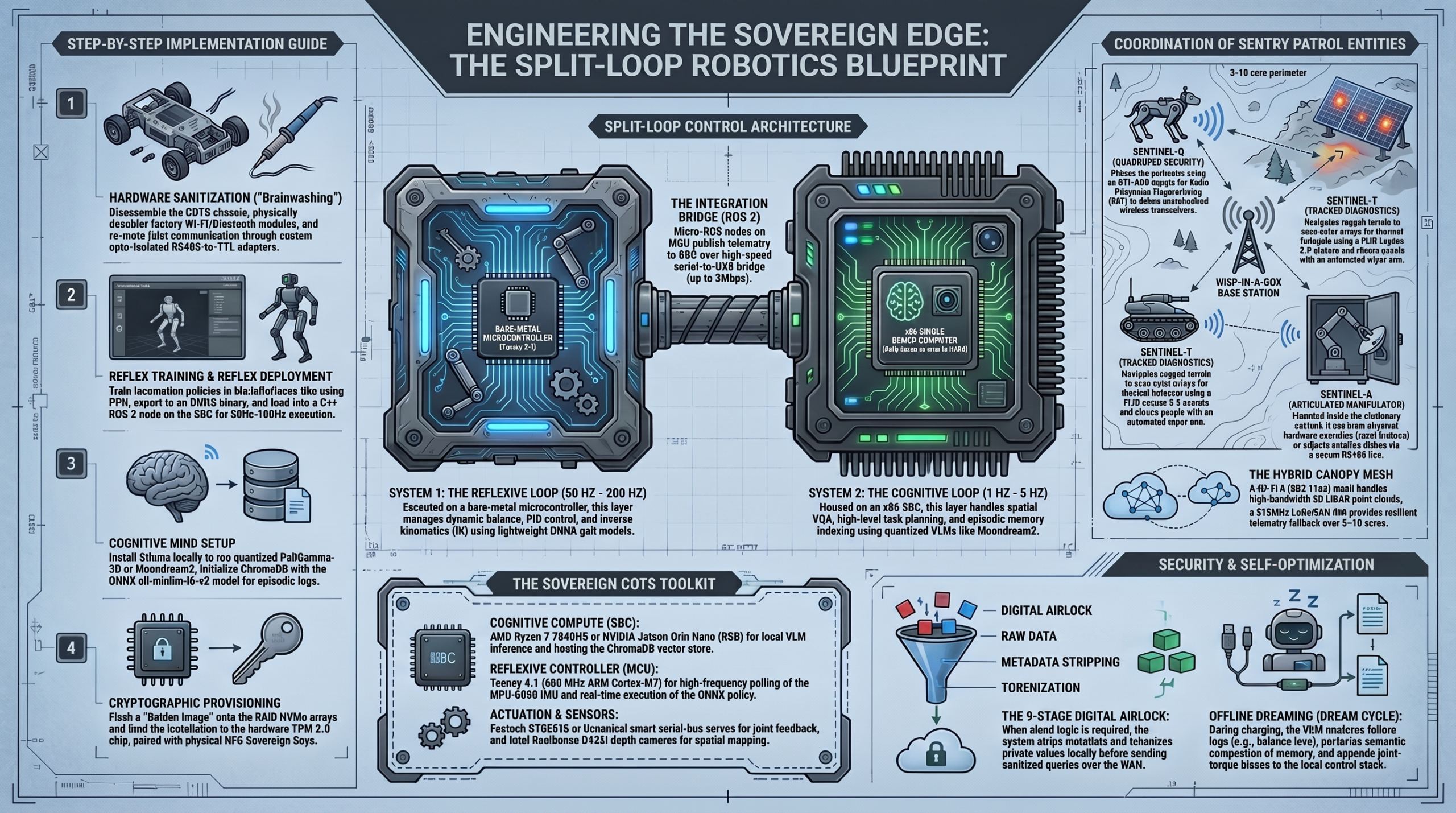
Hardware-level sanitization is the mandatory first step in establishing a verifiably air-gapped sovereign perimeter. Common Off-the-Shelf (COTS) robotic frames and smart actuators frequently arrive with proprietary firmware containing hidden telemetry trackers that default to pinging remote servers. Sovereignty requires an uncompromising “Brainwashing” protocol to neutralize these backdoors before the system is ever introduced to the local loop.
Hardware Sanitization Checklist
- Physical Teardown: Disassemble COTS chassis—such as Unitree quadrupedal frames or industrial manipulators—down to raw structural components, electric motors, and joint encoders. Structural components should be reinforced or replaced with PETG or ABS filament to ensure superior impact resistance.
- RF Module Removal & Isolation: Physically desolder and remove all integrated factory Wi-Fi, Bluetooth, and cellular modems from the original circuit boards. To protect the core logic, mount the Inertial Measurement Unit (IMU) on dampening silicone pads to isolate it from direct motor vibrations.
- Bus Retrofitting: Install custom, opto-isolated RS485-to-TTL serial adapters. These adapters re-route actuator communication lines, ensuring joints communicate exclusively via a wired serial loop controlled by the local microcontroller, making the hardware “deaf and blind” to any external network.
This protocol bolsters supply chain independence by allowing us to leverage Shenzhen-sourced hardware for its mechanical value while maintaining a verifiably secure “Golden Image.” This image is cryptographically bound to a local TPM 2.0 chip, ensuring the machine operates only on audited software. With the hardware neutralized, we transition to the computational architecture required for autonomous action.
- Split-Loop Control Architecture: System 1 and System 2
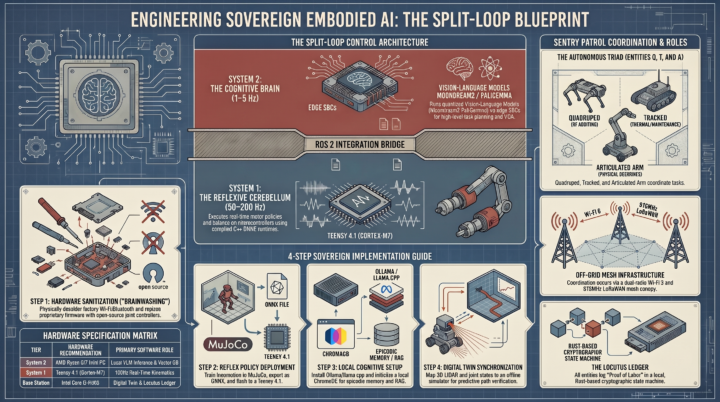
The RIN architecture utilizes a biological inspiration to solve the trade-off between reasoning depth and control latency. Much like the human nervous system separates the prefrontal cortex from the cerebellum, this split-loop architecture ensures high-level intelligence does not compromise physical stability.
Feature System 1 (Reflexive) System 2 (Cognitive)
Hardware Location Teensy 4.1 Microcontroller AMD Ryzen 7 7840HS/8840HS or Jetson Orin Nano
Primary Tasks PID, Kinematics, Dynamic Balance Spatial VQA, Planning, Memory Indexing
Frequency 100.00 Hz 1.00–5.00 Hz
Software Stack ONNX Runtime / FreeRTOS llama.cpp / Ollama / ROS 2 Humble
Massive Vision-Language-Action (VLA) models, such as the 55B parameter PaLI-X used in RT-2, suffer from an “Autoregressive Bottleneck” that limits control frequency to a dangerous 1–3 Hz. The RIN architecture bypasses this by running compiled ONNX gait policies locally on-chip at 100 Hz (System 1). While System 2 handles semantic reasoning using quantized 1.6B–3B models (such as Moondream2 or PaliGemma-3B), System 1 maintains reflexive physical integrity. This dual-speed approach provides the stability needed for stationary infrastructure to coordinate the mobile entities.
- Infrastructure Anchor: The WISP-in-a-Box (SKU: RIOS-KIT-WISP)
The Sentry Pro Command Core serves as the digital and physical anchor for the facility’s security perimeter. It manages the local network via pfSense and Suricata for Deep Packet Inspection (DPI), ensuring no unauthorized RF or MAC-address signatures enter the fabric.
Technical Hardware Summary: Sovereign Sentry Pro
- Compute Core: Intel i3-N305 (8-Core), 32GB RAM, 2TB RAID-1 NVMe SSD.
- Wireless Canopy (SKU: RIOS-EXT-01): Two IP67-rated Mesh Beacons (Qualcomm IPQ5018) providing Wi-Fi 6 for point-clouds and 915MHz LoRaWAN for resilient telemetry fallback across 10 acres.
- Nomad Link Failover (SKU: RIOS-NL-01): A battery-less 4G LTE failover bridge designed for absolute off-grid resilience.
The Nomad Link utilizes high-grade capacitors instead of volatile lithium cells, allowing for safe operation in extreme temperatures ranging from -40°C to 85°C. Similarly, the Battery Energy Storage System (BESS) provides a 1.5 kWh LiFePO4 bank stable from -20°C to 60°C. Primary backhaul is managed through Starlink Business provisioned via TriFi Wireless. This stationary core provides the intelligence and power necessary to manage specialized autonomous entities.
- Autonomous Entities: Operational Profiles for Sentinel Q, T, and A
The RIN operates through multi-agent delegation, where specialized physical forms execute distinct diagnostic and security missions coordinated by a local Digital Twin Engine.
- Sentinel-Q (Quadruped):
- Brain: AMD Ryzen 5 SBC.
- Mission: Perimeter patrol and RF Fingerprinting. It uses an RTL-SDR spectrum analyzer to detect and catalog wireless transceivers by their unique physical radio frequency signatures, distinguishing them from spoofable software IDs.
- Sentinel-T (Tracked):
- Brain: Intel N100 SBC.
- Mission: Thermal diagnostics and panel maintenance. It utilizes a FLIR Lepton 3.5 sensor to identify solar panel micro-fractures and a mechanical wiper to clear debris.
- Sentinel-A (Articulated):
- Brain: Sentry Pro (via isolated RS485).
- Mission: Physical server rack overrides. Built on the SOV-ROBO-HAND footprint, it performs manual cable patching and master resets in the event of software lockups.
The Digital Twin Engine (MuJoCo/Webots) pre-simulates and cryptographically verifies kinematic paths, detecting collision risks or physical failures before they occur in the real world. This ensures that the logs generated by these agents are grounded in verifiably safe physical execution.
- The Locutus Ledger & The Digital Airlock Protocol
Accountability is maintained through the Locutus Ledger, a decentralized, Rust-based local state machine. This ensures every action is immutable and auditable without cloud telemetry. During standby, the units perform an “Offline Dreaming” routine, conducting semantic compaction and failure analysis (e.g., appending joint-torque biases to compensate for physical weight imbalances).
When external resources are required, the system employs the 9-stage Digital Airlock Protocol:
- Intercept: Outbound payloads are captured at the edge node.
- Metadata Stripping: Raw visual and spatial coordinates are removed.
- Tokenization: Private values are replaced with randomized IDs.
- Local Encryption: Original context is logged to the local ledger (“The Bank”).
- Airlock Sanitization: The request is converted to anonymous metadata.
- Secure Gateway: Sanitized request is sent via the pfSense/Suricata bridge.
- Cloud Computation: External AI processes the logic query.
- Inbound Inspection: Response is audited for malicious code at the edge.
- Local Re-integration: Logic is synced with local context for execution.
This process, governed by Wasm contracts, provides “Proof of Labor” logs that prevent unauthorized command injections, securing the deployment from fulfillment to daily operation.
- Deployment Logistics, Fulfillment, and BOM
Transitioning to a sovereign state requires a shift from procurement to rigorous provisioning. The following Bill of Materials (BOM) reflects the granular costing required for a complete RIN deployment.
Master Bill of Materials (SKU: RIOS-KIT-SPATROL) | Component Group | Itemized Components | Unit Cost (USD) | Group Total | | :— | :— | :— | :— | | Base Infrastructure | Sovereign Sentry Pro (i3-N305) | $450.00 | | | | Mesh Beacons (x2) (RIOS-EXT-01) | $160.00 | | | | Nomad Link Failover (RIOS-NL-01) | $65.00 | | | | 1kW Solar PV Array | $250.00 | | | | 1.5 kWh LiFePO4 BESS | $350.00 | | | | NEMA-4X Node Enclosure | 120.00 | 1,395.00 | | Robotic Fleet | Sentinel-Q (Full Retrofit & Sensors) | $1,895.00 | | | | Sentinel-T (Full Retrofit & Sensors) | $970.00 | | | | Sentinel-A (Manipulator & Interface) | 570.00 | 3,435.00 | | Total BOM Cost | | | 4,830.00** |
| Suggested MSRP | | | **9,499.00 |
Fulfillment Labor Requirements (12.5 Total Hours)
- Sanitization Technician (4.0 hrs): Hardware teardown, RF stripping, and RS485 soldering.
- Firmware/Crypto Engineer (2.5 hrs): Flashing ONNX models and TPM 2.0 binding.
- Mechanical Assembly (3.0 hrs): Payload mounting and BESS enclosure builds.
- QA/Sim-Calibration (2.0 hrs): Digital Twin synchronization and sensor calibration.
- Logistics Coordinator (1.0 hr): Battery safety packing and final serial registry.
- Strategic Gap Analysis & Operational Roadmap
While RIN provides absolute independence, edge-native physical AI faces technical challenges that define our development roadmap.
- Gap 1: Semantic Reaction Latency: VLM reasoning at 1–5 Hz is too slow for dynamic hazards.
- Bridging Strategy: Implement a hybrid neural-network cache where high-priority safety templates (humans, fire, blockages) are stored in the fast System 1 runtime.
- Gap 2: Mobile Power Density: Edge compute draw limits continuous mobile runtime to 1.5–3 hours.
- Bridging Strategy: Deploy autonomous charging docks and optimize model footprints by transitioning to dedicated NPUs.
SWOT Summary
- Strengths: Complete data sovereignty; split-loop physical resilience; no recurring cloud fees.
- Weaknesses: Labor-intensive sanitization; edge-compute power draw; quantization loss.
- Opportunities: Post-OpenClaw trust gap; industrial reshoring; microgrid expansion.
- Threats: Silicon supply chain chokepoints; evolving autonomous safety regulations.
The directive remains absolute: operational independence is achieved by decoupling physical assets from the centralized “silicon minds” of foreign data centers. This local-first architecture is the only viable path to a resilient and secure industrial future.


