Technical Primer Mastering the Sovereign Stack
1. The Paradigm Shift: Fragility vs. Resilience
To command the Sovereign Stack, you must first discard “Old World” assumptions. Traditional infrastructure is built for comfort—steady power, climate control, and constant high-speed fiber. In kinetic environments, these systems are not just inefficient; they are liabilities. Dust, heat, vibration, and total power loss are the standard operating conditions of the field.
The RIOS-CC-1000 is not a server; it is a survival tool. It shifts the “cloud” from a distant, vulnerable data center to a rugged, field-deployable asset that provides digital sovereignty where it is needed most.
| Feature | Old World Infrastructure | The Sovereign Stack |
| Environment | Climate-controlled dependency. | Kinetic-ready (IP67, EMP-resistant). |
| Connectivity | Grid-reliant (Fiber/Local ISP). | Independent (Starlink/5G/Satellite). |
| Resilience | Fragile; single point of failure. | Resilient; self-healing architecture. |
| Philosophy | Cloud-dependent (Remote-first). | Local-first (Sovereign). |
Traditional computing is built for stability; the Sovereign Stack is built for survival. When the grid goes dark or the local network is compromised, a survival-focused architecture is the only path to community continuity and data integrity.
2. The Anatomy of the RIOS-CC-1000: Built for the Kinetic World
The RIOS-CC-1000 is a field-deployable compute cluster engineered to survive environments that destroy standard hardware.
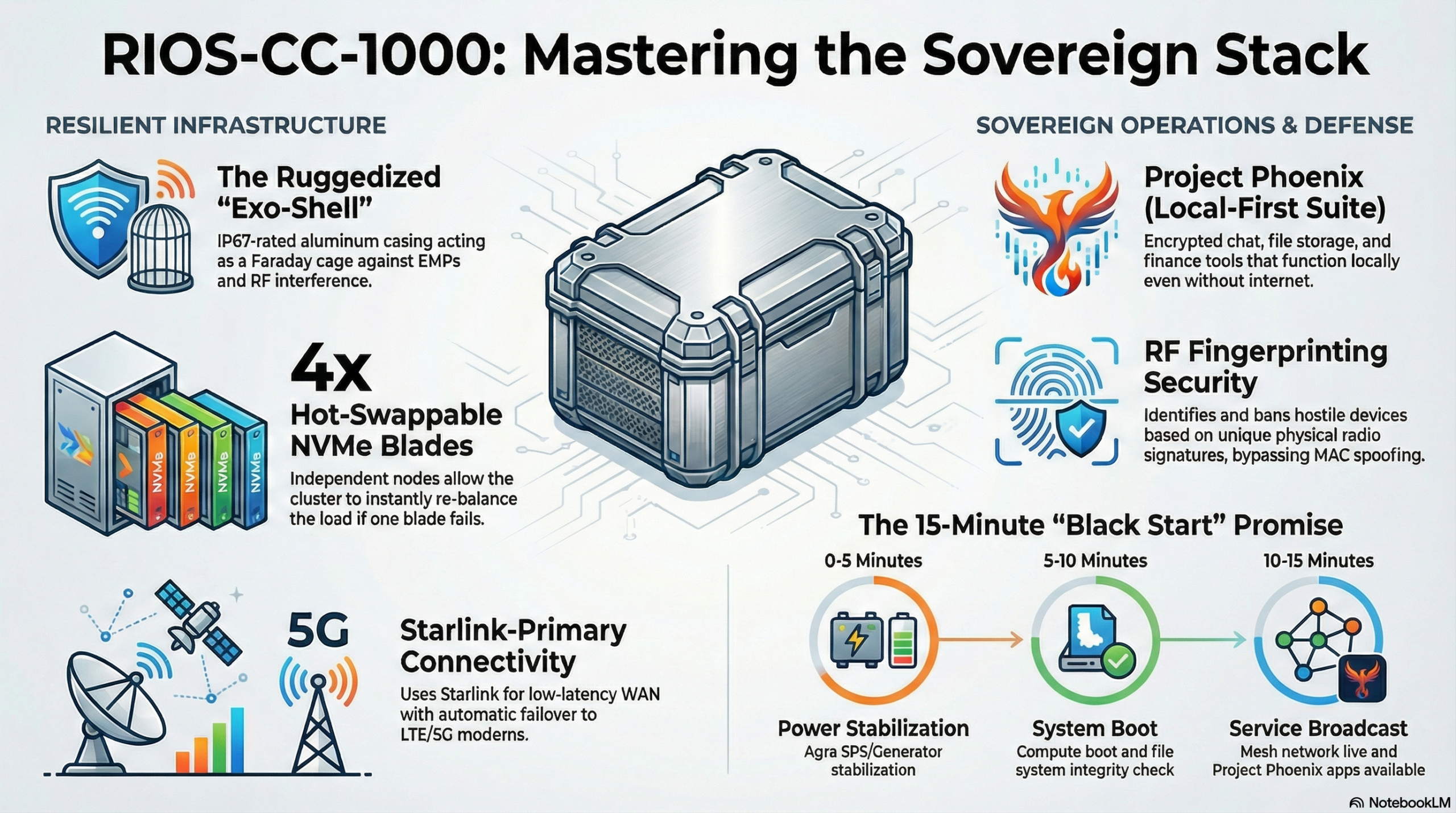
- The Exo-Shell: An IP67-rated aluminum casing that acts as a Faraday cage, shielding internal components from light EMPs and Radio Frequency (RF) interference.
- 4x Hot-Swappable Compute Blades: The unit houses four independent NVMe-native nodes. This architecture ensures that physical failure does not mean system failure.
- Positive Pressure Thermal Management: To prevent contaminants from entering, the RIOS uses a positive pressure cycle to push air out. Action Required: Intake filters must be checked and cleaned every 30 days to maintain airflow integrity.
- Power Source: Primarily driven by the Agra Dot Energy Generator, ensuring the stack remains online regardless of the local power grid status.
⚠️ CRITICAL HARDWARE WARNING
Never open the chassis while the “Seal Integrity” light is Green. Opening the unit without engaging “Maintenance Mode” via the dashboard triggers an internal intrusion detection system that immediately locks all encryption keys.
SOP-HW-01: Hot-Swap Procedure
When a telemetry alert indicates a drive failure (e.g., “Blade 2 Drive Failure”), follow this protocol:
- Log in to the RIOS Dashboard and navigate to Hardware > [Blade ID] > Storage.
- Select “Prepare for Removal.”
- WAIT for the physical LED on the unit to turn SOLID BLUE. This ensures the data write cache has been flushed to the parity drive. Pulling a drive early causes terminal data corruption.
- Unlock the cam-lever, slide out the sled, and insert the replacement.
3. Connectivity: The Zero-Trust Bubble
The RIOS-CC-1000 establishes a “Zero-Trust Bubble” using a two-tier connectivity model.
Tier 1: The Wide Area Network (WAN)
The system prioritizes Starlink for its low latency and independence. The Starlink router must be in “Bypass Mode” so the RIOS unit can act as the primary router.
- Failover CLI:
rios-cli net configure --primary wan1 --secondary wan2 --mode failover - WAN Port 2 is reserved for LTE/5G failover, providing redundancy if the satellite link is obstructed.
Tier 2: The Sovereign Mesh (LAN)
The RIOS creates a local, self-healing mesh network with a Latency Target of <50ms.
- Self-Healing Routing: Traffic automatically reroutes if a node (e.g., a village school repeater) loses power.
- Client Isolation: This is ON by default. Client devices cannot “see” each other, preventing the lateral movement of malware across the community mesh.
- Grid Independence: The mesh can be extended via mobile repeaters or drones to cover “dead zones” without permanent wiring.
4. Project Phoenix: The “Local-First” Application Layer
In the Sovereign Stack, “The Cloud” is right in front of you. Project Phoenix is a suite of applications hosted directly on the cluster. Use rios-app list to monitor active containers.
The Core Suite
| Service | Application Tool | “Offline-First” Benefit |
| Communication | Matrix / Element | Encrypted chat functioning without internet. |
| Storage | Nextcloud | Local hosting of critical community documents. |
| Finance | BTC / Lightning | Local ledger for trade/credits (rios-app deploy btcpay). |
| Local News | Ghost | Distributed local information and news updates. |
The Sync Concept: When the satellite uplink is active, the system performs encrypted backups to off-site storage. When the internet is down, services continue locally with zero interruption. The uplink is a background luxury; the local cluster is the necessity.
5. Watchtower Protocol: Defense Beyond the Firewall
Traditional firewalls stop IP addresses; RIOS stops physical devices. The Watchtower Protocol uses RF Fingerprinting to identify the unique physical signature of every device, regardless of MAC address spoofing.
The Watchtower Categorization
- Green List: Known, verified community devices.
- Grey List: Unknown/Guest devices. Isolated from the local cloud; internet access only.
- Red List: Hostile devices (Spoofers, Jamming equipment).
Tactical Action: If an intruder is detected, use the “Spectrum View” tool to triangulate the signal source. Once identified, execute the ban: rios-sec ban --rf-sig [ID] --duration permanent
6. The Black Start: Restoring Civilization in 15 Minutes
A “Black Start” is the emergency restoration of the ecosystem from total darkness. This is governed by the Red Card checklist attached to your unit.
The Red Card Checklist
- Isolate: Disconnect all WAN cables.
- Power: Verify Agra SPS (Solar/Power System) is stable at 60Hz.
- Boot: Insert the Master Key USB into Port 0.
- Engage: Hold the Physical Reset Button for 10 seconds.
- Listen: Confirm the “Heartbeat” beep code (3 short, 1 long).
- Broadcast: Wait for the emergency SSID “SOS_BEACON.”
- Restore: Run
rios-phoenix restore --latest.
The “15-Minute Promise” SLA
- 0-5 Minutes: Power stabilization via Agra SPS.
- 5-10 Minutes: System boot and file integrity checks.
- 10-15 Minutes: Mesh network broadcast and local application availability.
7. Summary & Capability Check
As a Certified RIOS Administrator (CRA), you are the guardian of your community’s digital continuity.
Field Scenario 1: The Partial Outage
- Scenario: Matrix chat works locally, but Google is unreachable. WAN Port 1 is flashing Amber.
- Diagnosis: The Local Mesh is functional; the Starlink uplink is obstructed or down.
- Action: Check satellite line-of-sight or verify
rios-clifailover status.
Field Scenario 2: The Intruder
- Scenario: A device “Unknown_Android” is requesting access to the Finance VLAN.
- Diagnosis: Potential unauthorized access attempt.
- Action: Immediately isolate to Grey List. Physically verify the user’s identity (KyC) before granting further access.
Field Scenario 3: Blade Failure
- Scenario: Dashboard reports “Blade 3 Drive Failure.”
- Diagnosis: Physical hardware failure on a compute node.
- Action: Select “Prepare for Removal” in the UI. Do not pull the sled until the LED is Solid Blue. Replace and verify the “Rebuilding Array” status.
The Bottom Line: The RIOS-CC-1000 ensures your community remains connected, secure, and sovereign. In a world of volatile infrastructure, your mastery of this stack is the difference between digital collapse and community survival.


