
The Truth Machine: How 2025’s New Rules are Turning Real-World Assets into Instant Cash
1. Introduction: Crossing the Regulatory Rubicon
In the traditional financial theater, time is the ultimate friction. For decades, the “waiting game”—the agonizing interval required for wire transfers to clear, checks to settle, and legacy ACH windows to process—has acted as a tax on capital. For institutional players, these delays are more than an inconvenience; they represent a systemic vulnerability where uncollateralized risk accumulates while the markets wait for the “plumbing” to catch up.
The year 2025 marked the crossing of the “Regulatory Rubicon.” Through the formalization of the Commodity Futures Trading Commission (CFTC) “Digital Assets Pilot Program” and the enactment of the Guiding and Establishing National Innovation for U.S. Stablecoins (GENIUS) Act on July 18, 2025, the U.S. financial system has moved to integrate digital assets into its core. This shift, a culmination of the “Crypto Sprint” and the pro-innovation agenda championed by the CFTC’s former leadership under Caroline D. Pham, isn’t about the next wave of speculative tokens. It is a fundamental transformation of how global value is collateralized, verified, and moved at the speed of data.
2. Takeaway 1: Tokenization Isn’t a “Magic Wand” for Value
A persistent myth suggests that “tokenizing” an asset—applying a digital veneer to a real-world instrument—automatically imbues it with liquidity or superior quality. The December 8, 2025 guidance (CFTC Letter No. 25-39) provides a necessary correction: technology does not erase fundamental credit or liquidity risk. As the guidance notes:
“[T]he use of digital ledger technology to tokenize an asset need not change the fundamental characteristics of that asset.”
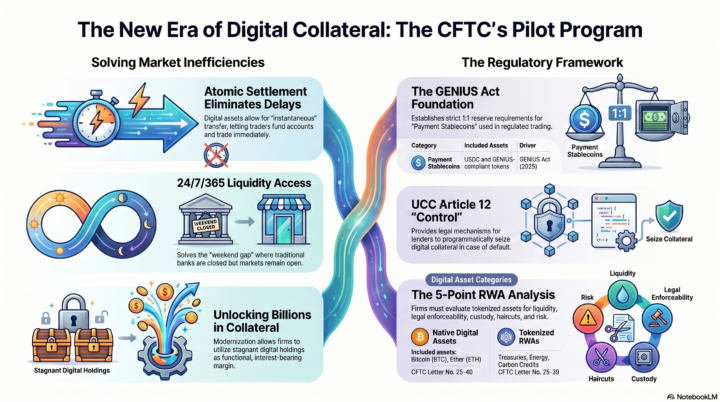
Regulators now require a “case-by-case” analysis of the underlying asset’s liquidity. In many cases, tokenized assets may actually face deeper “haircuts” (valuation reductions) than their traditional counterparts to account for novel operational risks, such as smart contract vulnerabilities and cybersecurity exploits.
However, the path to adoption was cleared by CFTC Letter No. 25-41, which officially withdrew the outdated 2020 constraints (Advisory 20-34), removing the capital charges that previously stifled innovation. To ease the transition for legacy firms, the “Article 8 Solution” now allows these assets to be treated as “financial assets” credited to standard securities accounts, making institutional integration feel like business as usual.
3. Takeaway 2: The Death of the “Banking Weekend”
The legacy banking system’s adherence to business hours created a dangerous mismatch with modern, 24/7/365 derivatives markets. This lag created windows of uncollateralized risk where traders could not post new margin to cover positions during weekends or holidays.
The 2025 framework solves this systemic vulnerability through Atomic Settlement. By allowing market participants to post digital assets—specifically Bitcoin (BTC), Ether (ETH), or payment stablecoins like USDC—instantaneously, the system enables trading to begin the moment an account is funded. Because these assets move on blockchain rails that never close, collateral can be posted at any hour. This ensures margin requirements are met in real-time, effectively killing the “banking weekend” and providing a massive boost to global risk management.
4. Takeaway 3: Turning Ugandan Hemp into a “Sovereign Bank”
The most profound application of this “Truth Machine” is found in the DeReticular “Node 4” project in Kaabong, Uganda. This 7,000-acre eco-industrial park, which converts hemp into carbon-negative energy, successfully bypassed the traditional six-month agricultural payment cycle that typically starves rural projects of cash flow.
Using the Rural Infrastructure Operating System (RIOS), DeReticular captures empirical feasibility data—biomass weight, moisture density, and energy output—via on-site sensors. This data is verified through zkVerify (Zero-Knowledge Proofs), creating a trusted digital record without revealing trade secrets. This verified payload is minted into a “Digital Twin” NFT, recognized under UCC Article 12 as a “Controllable Electronic Record” (CER).
This is a game-changer for lenders. Under Article 12, “perfection by control” replaces the slow process of filing. Lenders gain a legal and technological right to the asset, allowing for programmatic seizure via smart contract in the event of default. This legal certainty enables “Capital Velocity”: the farm can post its RWA NFT to a U.S.-based merchant and borrow stablecoins instantly against its own proven production, effectively acting as its own “Sovereign Bank.”
5. Takeaway 4: The Pivot to “Digital Plumbers”
The “smart money” has shifted its focus from speculative assets to the “Utility Tokens” that serve as the essential rails of this new ecosystem. This pivot is driven largely by a critical gap in the GENIUS Act (Section 4(a)(11)), which prohibits regulated stablecoin issuers from paying interest or yield to holders.
This prohibition has created a massive, legally-sanctioned demand for yield that can only be filled by DeFi infrastructure. Utility tokens are the “digital plumbers” powering the protocols that provide this compliant yield. They are now valued for their function:
- Powering Atomic Settlement: Acting as the fuel for 24/7 collateral transfers.
- Wrapping RWAs: Providing the compliant protocols to digitize U.S. Treasuries.
- Programmatic Custody: Enabling the smart contracts that enforce lender rights under Article 12.
In this landscape, value flows to the tokens that facilitate the movement and management of regulated capital.
6. Takeaway 5: The “Sandbox” Approach—Walking, Not Running
Despite the billions in liquidity being unlocked, the CFTC’s “Digital Assets Pilot Program” remains a controlled experiment with onerous compliance hurdles. Under Letter No. 25-40, participating Futures Commission Merchants (FCMs) must navigate a high-security “protected channel.”
The requirements are strictly enforced:
- Notice of Intent: Mandatory formal filing before participation.
- Weekly Reporting: Constant disclosure of digital asset balances.
- The 24-Hour Rule: Any significant operational or cybersecurity event must be reported to the CFTC within a strict 24-hour window.
- Legal Enforceability Opinions: Rigorous written opinions are required to confirm the validity of security interests across jurisdictions.
This heavy burden ensures that only the most sophisticated institutional players are currently operating, allowing the system to be stress-tested in a “sandbox” environment before broader market expansion.
Conclusion: The Bridge is Built
The regulatory landscape of 2025 has methodically connected the digital ecosystem to tangible economic activity. By establishing clear rules for risk, control, and legal enforceability, the CFTC and the GENIUS Act have built the bridge necessary for institutional capital to flow from speculative ventures into verified collateral.
The financial plumbing is now in place to tokenize and collateralize the real world. As the friction of time and the limitations of the “banking weekend” fade, we must ask: Which legacy industry will be the next to move on-chain?


