• Skip to main content
  • Skip to secondary menu
  • Skip to primary sidebar
  • Skip to footer
  • Homepage
  • About Us
  • Carbon-Consuming Circular Economies (CCCE) V3
  • Contact Us
  • Blog
  • en English
    • ar Arabic
    • zh-CN Chinese (Simplified)
    • nl Dutch
    • en English
    • tl Filipino
    • fi Finnish
    • fr French
    • de German
    • it Italian
    • ko Korean
    • pt Portuguese
    • ru Russian
    • sd Sindhi
    • es Spanish
    • tr Turkish
    • uz Uzbek
    • yi Yiddish
    • yo Yoruba
Biz Builder Mike

Biz Builder Mike

You can't sail today's boat on yesterday's wind

  • Technical White Papers
  • The Fourth Industrial Revolution: The Rise Of The Autonomous Economy
  • Biz Builder Mike 2025 Timeline of Events

Tokenomics is not Economics – Digital CX -The Digital Transformation Chapter 4

Chapter 4 Moving from Pipes to Platforms

Thank you Sangeet Paul Choudary

Tokenomics is not Economics Chapter Four from pipes to platforms.  

In Chapter Three, we established a few things, such as, 

  1. First, it is the miners, who set up the network 
  2. Miners extract economic rents for the lifetime of the platform
  3. In the first Use Case, Local guest service providers are paid in advance 
  4. In the first Use Case Local artists, local restaurant owners, local tour guides, hunting guides, and other local service providers fulfill guest requirements in App, paid in real-time, all networked on an IoT backbone.

Problems solved with this Platform First Approach?

  1. Millions of Tourism Livelihoods Lost
  2. Billions of Trees Burned
  3. The Digital Divide
  4. Rural Bandwidth Provisioning, Last Mile
  5. US GDP Growth

Chapter 4 Moving from Pipes to Platforms with Sangeet Paul Choudary

Successful Platforms= Network of Networks with a Place and a Purpose

Sangeet Paul Choudary shared This idea on the impact of the platform economy in 2016.

Platform businesses scale in a manner that is very different from traditional business models, Platform businesses scale without commensurate effort and costs involved from the business itself. 

Sangeet Paul Choudary

Scalability is also available on the platform, often at or near zero marginal cost. And fundamentally this applies to every industry across the board.

In The Platform Revolution, Sangeet Paul Choudary called the traditional industrial businesses model the pipeline model. And that model works like this, 

– You have somebody creating value from raw materials

– you have someone assembling these raw materials

– you have distribution 
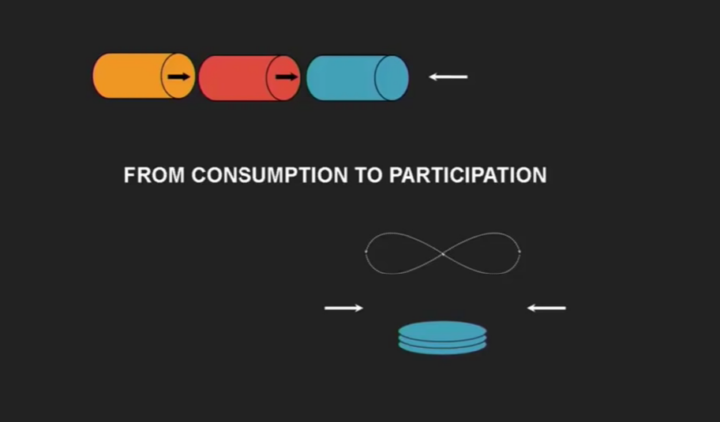
Whether you think of products, whether you think of services, whether you think of media, telecom, or any industry, works in this pipeline model starting at one end and pushing things out the other end. 

The success of this model is to push more out at the minimum cost possible. And that is where the mass distribution mass production model came into being (Ford). But today, the way the world works is changing the business model is not just the pipeline anymore (Printing Automobiles locally).

Three shifts are happening

First of all, things are getting connected everywhere

The second is that every connected thing is becoming intelligent because It sends data, and it gets back intelligence. Connectivity and intelligence are working together. it’s not just connected it is Intelligent.

The third shift is that the means of production are no longer with the big companies anymore

The business acts as infrastructure and enables producers and consumers from outside to come in and interact with each other. 

The business does not create the product itself. 

Think of the iPhone. 

The iPhone is not just an end product, which Apple sells and they are done. You see after the iPhone comes out, all of us personalize the iPhone because of our interactions with developers on the App Store. Without interactions, we used to have the Nokia model, which was two years of research launch 40 Different handsets confuse everybody and then sell 40 Different handsets in the pipeline model. 

The same thing is happening in many different industries. 

If you look at how hotels used to work they used to work in the pipeline model. Airbnb works in this platform-based model and is seeing this happening right now in the car industry, the energy industry, and a lot of different industries that are moving in this direction. 

What’s interesting and important about the platform business model, and I’ll come back to this repeatedly is that the platform model is centered around the code interaction between two participants in the ecosystem (Peer to Peer). The goal of a platform business model is to be an infrastructure on which these interactions happen. 

And the repeated goal is to keep increasing the quality and the quantity of these interactions using the feedback loop. In a platform model, once your customers and your suppliers start interacting with each other, you start improving the quality of those interactions and that is how you scale.
If you think of LinkedIn, LinkedIn started by enabling simple interactions to help professionals to connect and just provided the infrastructure to enable these interactions. 

It also focused on increasing the quantity of these interactions. So it connected with your Outlook, Gmail, Calendar, and all of those things. It had gotten all of this data about different professionals. And it started using this data to connect these professionals with interesting job opportunities. 

And then LinkedIn realized that unlike Facebook and did not have good engagement, so it started with third interaction. It started bringing influencers on the platform to start publishing content. And over time, opened that so that everybody could start publishing their content as well. 

This LinkedIn model or the platform model is to keep the central infrastructure on which more than more people can plug in and keep interacting in new ways. 

And this is where the value of the platform model comes in. 

Because the more interactions you enable, the more opportunity there is for you as a business to capture that value. When we run these businesses, we stop measuring consumers and instead measure participants. 

We don’t just look at who’s buying a product and or how many they buy. 

We look at key performance indicators (KPIs) that show how people are participating in our platform business. We try to start converting our products into services that integrate with our customers. And then we start basing our revenue models on customer success (CX). 

So we start moving from a consumption-driven model to an outcome-driven model. And in the same industry and location, if you have one business selling a consumption-driven model (Nokia), and another business selling an outcome-driven model (iPhone), the outcome-based model will have a better CX across the board (absolute value of 100%).

Remember the S-Curve?

I will use the use cases mentioned earlier in this document to illustrate this process.

Next, up, Chapter 5 Some Sources and Quick Review

Tokenomics is not Economics – Digital CX -The Digital Transformation Chapter 5

Be sure to follow or subscribe so I can let you know when I publish the next in the series. 

Social Media – Please Connect at –

linkedin.com/in/MichaelNoel –

https://BizBuilderMike.com –

youtube.com/@BlockchainWeekly –

https://Twitter.com/BizBuilderMike –

https://www.patreon.com/BizBuilderMike

How can I help?

 eschew obfuscation, espouse elucidation


Primary Sidebar

Briefing: Autonomous Agentic Commerce and Kove SDM Industrial Integration

July 13, 2026 By bizbuildermike

Executive Summary The global digital economy is transitioning from a human-centric "click-and-buy" model toward an autonomous Agentic Commerce (a-commerce) paradigm. By 2030, AI agents are projected to influence between $3 trillion and $5 trillion … [Read More...] about Briefing: Autonomous Agentic Commerce and Kove SDM Industrial Integration

The Digital Flywheel: A Conceptual Guide to Sovereign Infrastructure

July 13, 2026 By bizbuildermike

We are currently tethered to a terminal architecture of failure—linear chains that break under the slightest stress. This is the 1,000-Mile Failure Model, a legacy system of "The Line" where power and data travel across vast, vulnerable distances. In … [Read More...] about The Digital Flywheel: A Conceptual Guide to Sovereign Infrastructure

Strategic Implementation Blueprint: Resolving the ‘Bush Gap’ via the Sovereign Stack

June 26, 2026 By bizbuildermike

In frontier markets, the primary barrier to industrialization is the "Bush Gap"—a systemic deficit in dependable power, connectivity, security, and healthcare that characterizes regions governed by "Linear Fragility." To resolve this, we utilize … [Read More...] about Strategic Implementation Blueprint: Resolving the ‘Bush Gap’ via the Sovereign Stack

The Sovereign Stack Consortium: A Guide to Human-AI Collaboration

June 26, 2026 By bizbuildermike

podcast At the DeReticular Academy, we define our mission by our name: "to move away from the network." In the current landscape of Project Octagon, we recognize that the traditional centralized infrastructure model—historically known as … [Read More...] about The Sovereign Stack Consortium: A Guide to Human-AI Collaboration

White Paper Sovereign Nodes Architectural Specifications for Co-Optimized Energy-Compute Virtual Power Plants

June 24, 2026 By bizbuildermike

Document ID: SN-ARCH-2026-V1Authors: ABSTRACT This paper presents the architectural specifications for the Sovereign Node, aco-optimized, off-grid energy-compute Virtual Power Plant (VPP) designed tooperate under zero-trust, air-gapped … [Read More...] about White Paper Sovereign Nodes Architectural Specifications for Co-Optimized Energy-Compute Virtual Power Plants

Sovereign Nodes: Architectural Specifications for Co-Optimized Energy-Compute Virtual Power Plants

June 24, 2026 By bizbuildermike

Document ID: SN-ARCH-2026-V1Authors: ABSTRACT This paper presents the architectural specifications for the Sovereign Node, aco-optimized, off-grid energy-compute Virtual Power Plant (VPP) designed tooperate under zero-trust, air-gapped … [Read More...] about Sovereign Nodes: Architectural Specifications for Co-Optimized Energy-Compute Virtual Power Plants

Deployment Specification: Sovereign Robotic Infrastructure Network (RIN) Transition Roadmap

June 23, 2026 By bizbuildermike

The landscape of industrial security has undergone a fundamental transformation, necessitating a move from the vulnerable "thin client" edge robotics model to the "Island Mode" paradigm. This strategic shift was catalyzed by the 2026 OpenClaw … [Read More...] about Deployment Specification: Sovereign Robotic Infrastructure Network (RIN) Transition Roadmap

White Paper – The Architecture of Ecological Integrityy A Technical and Strategic White Paper on the Global Carbon Credit Industry and the Sovereign Stack

June 20, 2026 By bizbuildermike

podcast Abstract This white paper analyzes the systemic trust and operational structural gapswithin the global carbon credit market. It outlines a technological blueprint totransition the environmental commodity market from unverified, … [Read More...] about White Paper – The Architecture of Ecological Integrityy A Technical and Strategic White Paper on the Global Carbon Credit Industry and the Sovereign Stack

Conceptual Architecture Primer: From Cloud Fragility to Spherical Resilience

June 18, 2026 By bizbuildermike

1. Introduction: The Paradigm Shift in Global Tracking The global architecture for environmental asset tracking is undergoing a foundational transition from Linear Fragility to Spherical Resilience. Traditional systems operate on a linear … [Read More...] about Conceptual Architecture Primer: From Cloud Fragility to Spherical Resilience

Technical White Paper Bridging the Sovereignty-Scale Divide: The “Digital Airlock” and Split-Ledger Architectures

June 17, 2026 By bizbuildermike

Document Reference: WP-2026-DR-094 Date: May 21, 2026 Authors: Principal Cryptographic Engineer, Chief Information Security Officer (CISO), & Data Privacy Architect, DeReticular Classification: Public Release / Technical White … [Read More...] about Technical White Paper Bridging the Sovereignty-Scale Divide: The “Digital Airlock” and Split-Ledger Architectures

Footer

Get in Touch

🏗️ Build Smarter with Mike

Struggling with Off-Grid Power or UNIDO Compliance?
Get a custom implementation plan for your industrial site.

The Deal: 1 Hour Session. First 15 Minutes are FREE.


Schedule Strategy Session »

Stuff

  • A Confused Mind Always Says No
  • AI-Generated Preamble
  • Cryptocurrency Exchange
  • Find a Growth Hacker for Your Startup
  • Growth Hacking
  • Make Money: Don’t Raise Money
  • Marketing? Well, how hard can that be?
  • Michael Noel
  • Noels Law of decentralization
  • The Fourth Industrial Revolution: The Rise Of The Autonomous Economy
  • The Platform Community
  • THE SECRET WAR
  • The ultimate 3500-word guide in plain English to understand Blockchain

Search

Copyright © 2026 · Magazine Pro on Genesis Framework · WordPress · Log in