Waste to Wealth: A Beginner’s Guide to the Sovereign Farm Revolution
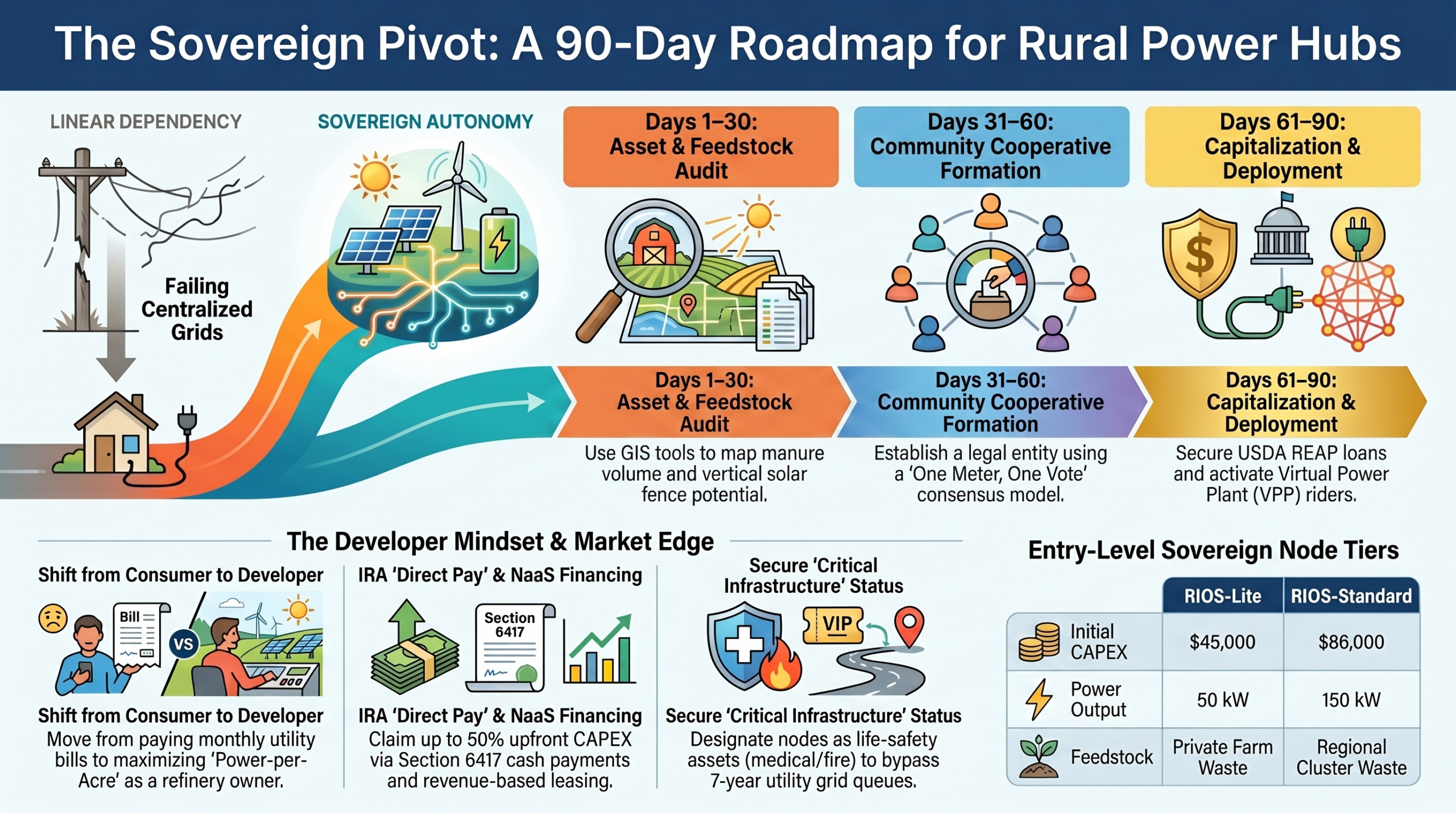
In the traditional industrial model, rural regions are the fragile “tail end” of “The Line”—centralized corridors of power, data, and logistics. This dependency creates structural capital flight and operational vulnerability. The Sovereign Farm Revolution represents a structural inversion: transitioning the farm from a passive consumer into a high-density “Sovereign Node.” By integrating hardware sovereignty with agentic workflows, rural entrepreneurs are reclaiming the “Spark Spread”—the arbitrage between low-cost local production and the volatile rates of centralized utilities.
podcast
1. The Big Shift: From “The Line” to “The Node”
The core philosophy of this revolution is “The Death of the Line.” Modern infrastructure relies on linear systems that fail the moment the chain is broken. In contrast, a Sovereign Node utilizes “Spherical Resilience,” functioning as a self-contained industrial orb. This “Island Mode” capability is not merely a convenience; it is a game-changer for survival, ensuring that irrigation, security, and climate systems remain operational during grid black-start scenarios or global cloud outages.
White Paper
By adopting a “Developer Mindset,” you move “Above the Line,” transforming land into an active asset that bypasses the sclerotic 4–7 year interconnection queues currently paralyzing the utility sector.
Comparison: Linear vs. Nodal Infrastructure
| Feature | Linear / Centralized Model | Nodal / Sovereign Model |
| Operational Logic | Passive Dependency; “Below the Line” | Active Resilience; “Above the Line” |
| Grid Reliance | Fragile utility connection; prone to outages | Island Mode: 24/7 behind-the-meter power |
| Data Ownership | Capital flight to Big Tech clouds | Sovereign Vault: Air-gapped local data |
| Revenue Stream | Thin-margin raw commodities | High-margin Inference Density and Fuel |
| Deployment Time | 4–10 year utility wait times | Grid-Bypass: Functional in 6–12 months |
The journey from a passive location to a resilient refinery begins with the transformation of the physical feedstock.
Video
2. The Resource Loop: Turning Liabilities into Assets
In a traditional operation, manure, crop scraps, and even scrap tires are “negative-cost liabilities”—waste products that drain capital. The “Resource Loop” flips this equation, utilizing circular efficiency to power the very sensors and machinery that manage the farm. This transformation creates a “Contextual Moat” that large utilities cannot replicate because they lack your physical presence in the soil.
The loop produces three primary high-value outputs:
- Baseload Power: Non-intermittent, 24/7 electricity that serves as the foundation for on-site industrial activity.
- ASF™ Synthetic Fuel: High-grade synthetic diesel or jet fuel produced at the source, ensuring local mobility independent of oil market volatility.
- Edge Compute: Local AI processing power (Inference Density) that serves as the high-margin revenue engine of the node.
Before this waste can be converted into wealth, the “Biological Brain” of the system must decode its potential.
3. The Brainy Intake: NIR Spectroscopy and Predictive Intelligence
Messy biological waste is a chemical variable that traditional utilities struggle to manage. Sovereign Nodes solve this via NIR (Near-Infrared) Spectroscopy. Sensors at the intake scan incoming feedstock to analyze molecular composition in real-time.
This “Predictive Intelligence” uses AI-driven Digital Twins to calculate the precise methane yield of a load before it enters the system. While manual methods typically capture only 40–60% of a material’s potential, this smart intake boosts gas output by 30–43%. It turns the unpredictable mess of biology into the exact precision of industrial chemistry.
Once the “Biological Brain” has mapped the feedstock’s potential, the physical transformation begins inside the modular refinery.
4. The Micro-Refinery: Modular Reactors and Plasma Gasification
The heart of the Sovereign Node is the Micro-GTL (Gas-to-Liquids) unit. These units utilize Plasma Gasification—employing temperatures exceeding 1,500°C to achieve molecular dissociation. By breaking down molecular bonds, the reactor transforms biomass into a clean syngas, bypassing the need for traditional, slow utility approvals.
- Electricity: Immediate 24/7 baseload power for critical infrastructure and data centers.
- Agra Synthetic Fuel (ASF™): Condensing syngas into liquid diesel or jet fuel for local use or regional sale.
- Battery Storage: Buffering excess energy in LFP (Lithium Iron Phosphate) units to “time-shift” energy sales for maximum profit.
These modular “Infrastructure in a Suitcase” systems—ranging from the 45,000 RIOS-Lite** to the **86,000 RIOS-Standard—allow farmers to bypass the grid queue entirely, becoming operational in months rather than years. This energy infrastructure provides the foundation for the next layer of the farm: the “Vertical Fence.”
5. Dual Harvesting: Agrivoltaics and the “Vertical Fence”
Agrivoltaics is the strategic integration of solar and agriculture. The Sovereign Node employs a “Vertical Fence” design using bifacial panels that capture ground-reflective light from both sides, increasing winter efficiency by 15% over horizontal systems.
- 7-Meter Spacing: Panels are installed with a minimum 7-meter corridor to ensure full compatibility with standard John Deere 8R/9R series combines and tractors.
- The 15-Minute Shift: AI agents monitor weather data and irradiance every 15 minutes, automatically adjusting panel angles to balance energy harvesting, crop light requirements, and safety (flattening panels to minimize structural load during high winds).
Strategic Insight: This dual-use model achieves a Land Equivalent Ratio (LER) of 1.2 to 1.6. Effectively, every acre does the work of up to 1.6 acres by stacking high-density power production directly on top of traditional crop rows.
This localized energy needs a high-margin destination, leading us to the data refinery.
6. The Data Refinery: Liquid-Cooled AI and Local Compute
In the Sovereign Farm model, energy is often a “by-product.” The true high-margin revenue comes from selling Inference Density. The RIOS-CC-1000 Server Clusters are the “Data Refineries” of the node—GPU-optimized, NPU-enabled hardware submerged in a clear, non-conductive dielectric cooling liquid.
This “Green Compute” setup leverages ground-loop cooling to bypass power-intensive AC units, providing a massive advantage in the “Physical AI Supercycle”:
- Edge Hosting: Keeping proprietary farm data “air-gapped” and local to prevent “Data Capital Flight” to hyperscalers.
- Data Gravity: Establishing your farm as a local hub for regulated industries (healthcare, legal) that cannot risk data transit to the public cloud.
To manage this complex interplay of chemistry, energy, and data, the node utilizes a “Digital Flywheel” of automated intelligence.
7. Sovereign Automation: Your Agentic Workmate
The RIOS (Rural Infrastructure Operating System) manages the node through a suite of specialized AI agents. This follows the 70/30 Rule: agents handle 70% of routine preparatory and maintenance tasks, allowing the owner to focus on 30% critical human judgment.
The Sovereign Agent Suite
| Agent | Strategic Role |
| Field Foreman | Right to Repair Offensive: Manages diagnostics and performs “over-the-air” fixes, bypassing OEM software locks on John Deere and other equipment. |
| Vault Warden | Sovereign Security: Uses LiDAR sensors with 2mm precision to create a 360-degree point-cloud perimeter, protecting physical and digital assets. |
| Locutus Ledger | Joules as Currency: A P2P settlement layer for energy-backed tokens, allowing neighbors to trade fuel and power directly without utility transmission fees. |
This agentic workforce empowers a single owner to manage a mesh of systems that would traditionally require a fleet of specialists.
8. Conclusion: The New Rural Civilization
The journey from “Waste to Wealth” is more than a technical upgrade; it is an identity shift. The rural entrepreneur is no longer a passive producer of raw commodities at the “tail end” of the line; they are the architect of a Digital Refinery. By reclaiming control over energy, fuel, and data, you are building the cornerstone of a new, nodal civilization.
The transition from “Consumer” to “Developer” is the ultimate industrial hedge. The bridge to this future is formed through Financing Innovation—utilizing Node-as-a-Service (NaaS) to bypass bank debt and CAPEX hurdles (45k–86k)—and Specialized Education in agentic orchestration. The farm of the future is the primary power and intelligence hub for the decentralized era.


