The End of the Audit: How “Automated Trust” is Rebuilding Global Trade
1. The Hook: The Hidden Cost of Not Knowing
The global supply chain is currently fractured by a pervasive “Crisis of Trust.” For decades, the movement of high-value commodities has relied on the expensive, periodic, and often fallible snapshots provided by centralized auditors like SGS or Bureau Veritas. In this legacy model, buyers are forced to gamble on producer self-reporting, while producers in remote corridors remain locked out of global markets because they cannot afford the high fees of proving their quality.
As we enter the era of the multi-trillion dollar Real World Asset (RWA) tokenization boom, this crisis has reached a boiling point. Financial markets are hungry to tokenize physical assets, but they are trapped by a “privacy paradox”: regulators like the CFTC and SEC demand strict identity compliance (KYC/AML), while decentralized networks require a level of transparency that often exposes sensitive personal data and proprietary yield history to the public.
DeReticular’s Split-Ledger architecture provides the radical technological escape hatch. By bifurcating data into separate functional layers, DeReticular is moving trade from a model of blind faith to a regime of “Automated Trust.” This isn’t just an incremental improvement in logistics; it is a total reimagining of how the physical world is notarized and financialized.
2. Takeaway 1: The Privacy Paradox Solved (The “Split”)
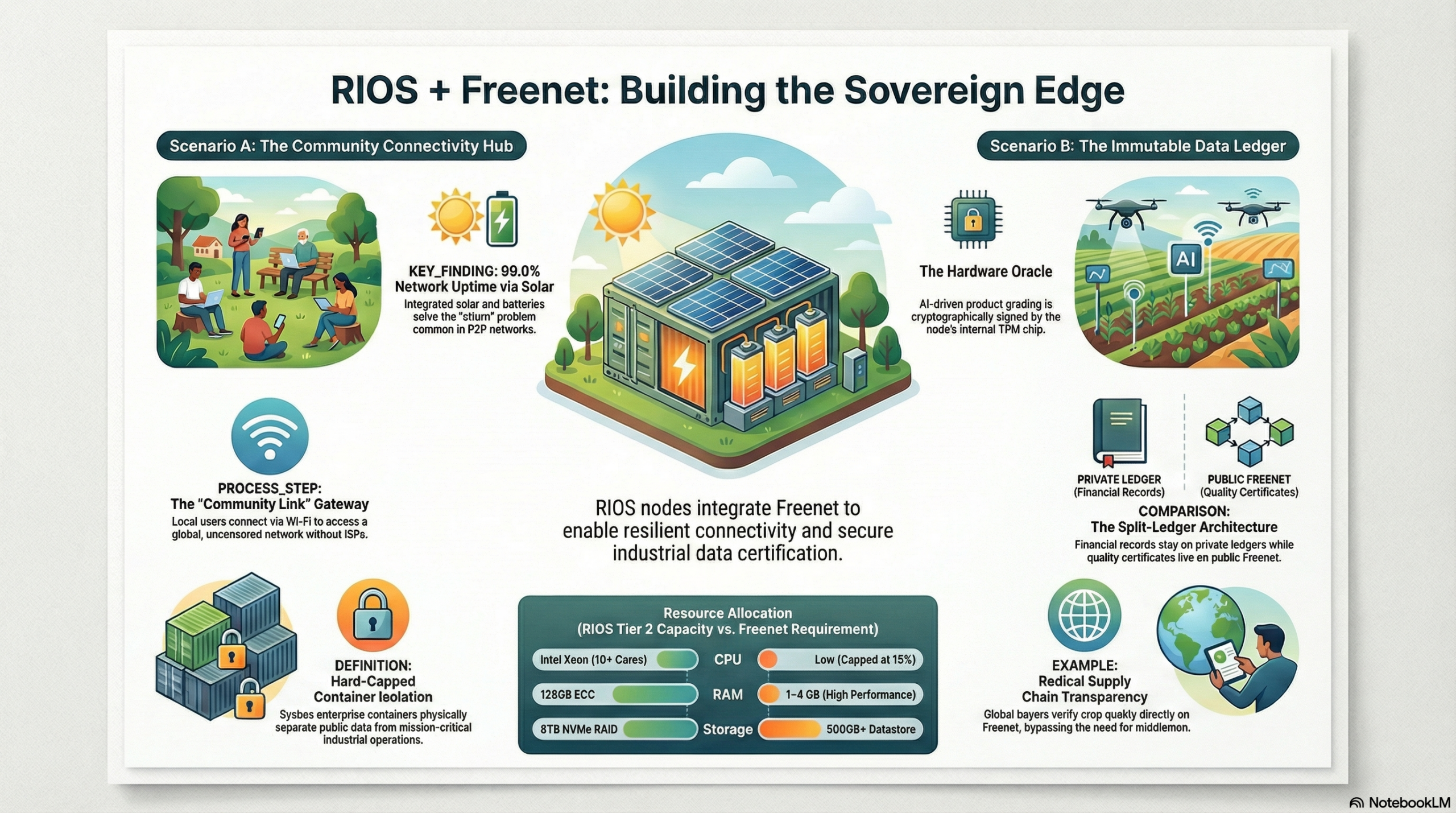
The Split-Ledger architecture is a masterclass in strategic data governance. It acknowledges that in a global trade environment, data serves two distinct masters: the Regulator and the Market. By decoupling these functions, DeReticular creates a “Safe Harbor” for producers. Regulators require oversight of the “Bank” (money and identity), but the market only requires access to the “Library” (physical truth).
- The Private Ledger (The Bank): This permissioned layer handles sensitive financial settlement and identity data. It satisfies GDPR and banking mandates by keeping Personally Identifiable Information (PII) strictly off public networks.
- The Public Ledger (The Library): Powered by Freenet, this layer stores the “Physical Truth”—moisture content, weight, and quality grades—in an immutable, content-addressable format.
This breakthrough allows a producer to offer a “Trustless Commodity” where the quality is mathematically guaranteed for any buyer in the world to see, while their personal bank details and legal contracts remain under lock and key.
“The Split-Ledger Architecture… creates a system where the Value (Money) is regulated, but the Truth (Data) is free.”
3. Takeaway 2: The Rise of the “Hardware Oracle”
To bridge the gap between a physical hemp bale in Uganda and a digital contract in Amsterdam, the RIOS node acts as a “Sovereign Certifier”—a Hardware Oracle that serves as a Notary of the Physical World. In this system, trust is shifted from a bribable human inspector to an unbreakable cryptographic stack.
Inside the RIOS node, the HempGrade AI (utilizing a custom YOLOv8 model running on NVIDIA A2 Tensor Core GPUs) performs real-time computer vision analysis on biomass. The results are handled by the Publisher Bridge, a custom Rust middleware that acts as a secure air gap. It strips away all sensitive identity data and requests a digital signature from the node’s Trusted Platform Module (TPM).
Because the Ed25519 private key is burned into the hardware during manufacturing and never leaves the TPM, the resulting data packet is a mathematically unforgeable attestation that “Node 4 witnessed this specific quality at this specific time.”
4. Takeaway 3: Immutability Without the “Gas” Bill
Traditional blockchains like Ethereum are fundamentally ill-suited for industrial-scale supply chains because of their cost structure. Storing high-fidelity data—such as high-resolution images of crop bales or massive sensor logs—on-chain can cost upwards of $50 per transaction. This “gas fee” friction is a non-starter for low-margin agricultural trade.
DeReticular solves this by utilizing Freenet (formerly Locutus). Unlike traditional blockchains, Freenet is a decentralized data store built on WebAssembly (Wasm) based smart contracts and Small World Routing. It allows for “Infinite Scalability” because it does not charge gas fees for data storage.
This architecture allows RIOS nodes to push “Immutable Clear-Text” history to a global network at near-zero marginal cost. By using Wasm contracts to manage state, DeReticular ensures that data is not just stored, but is verifiable and searchable without the financial burden of a standard transaction-heavy blockchain.
5. Takeaway 4: The “Bus Factor” and Data Sovereignty
In the centralized era, a farmer’s reputation was owned by the company that hosted their data. If that company failed—a scenario known as the “Bus Factor”—the farmer’s history vanished. DeReticular’s integration with Freenet introduces Sovereign Permanence, ensuring that data survives even the regulatory whims of the CFTC or the corporate dissolution of DeReticular itself.
By pushing attestations to the decentralized Freenet swarm, the producer achieves true data sovereignty:
- Ownership of History: Farmers own their permanent, unalterable grading history as a digital asset.
- Global Liquidity: Access to international buyers is granted through a simple Freenet link, bypassing traditional brokerage gatekeepers.
- Intermediary Elimination: The “Hardware Oracle” signature provides sufficient proof for global trade, removing the need for periodic manual audits.
6. Takeaway 5: The Pivot from Hardware to “Trust-as-a-Service”
DeReticular’s financial proforma for Operation Octagon reveals a profound strategic shift. The company is transitioning from a traditional hardware manufacturer to a high-margin (75% by Year 3) “Trust-as-a-Service” provider. This pivot is enabled by the Crypto-Compute Package—a hardware upgrade involving NVMe storage, TPM provisioning, and specialized GPU drivers that transform a solar generator into a Tier-1 Data Infrastructure node.
Revenue is no longer just about the unit sale; it is driven by a Hardware Enablement Fee, recurring SaaS subscriptions for the Publisher Bridge, and per-batch attestation fees. By Year 3, as the software scales infinitely across 250+ nodes, the marginal cost of adding new “Truth” to the network drops to nearly zero, while the value of that trust compounds.
“We are not just selling energy containers; we are selling Automated Trust.”
7. Conclusion: A New Standard for Reality
The rollout of Operation Octagon marks the beginning of a new era in global commerce. By integrating YOLOv8 computer vision with decentralized Wasm contracts and hardware-level security, DeReticular is setting the standard for how physical assets must be verified in a digital-first economy.
In the near future, the inability to provide a cryptographic audit trail for a physical product will be seen as a mark of zero value. As the line between the physical and the digital continues to blur, we must ask ourselves: In a world increasingly dominated by deepfakes and data silos, can we afford to trust anything that isn’t mathematically proven?
In this new landscape, the most valuable commodity isn’t what you produce—it’s the mathematical proof that it’s real.


