
The Sovereign Shield: A Guide to Island Mode and Community Privacy
1. The Core Concept: What is “Island Mode”?
In our current digital landscape, most municipalities function as subordinates to centralized server farms. When a resident sends an email or a clinician accesses a health record, that data must “egress”—traveling across vulnerable third-party infrastructure to a “Big Tech” data center before returning home.
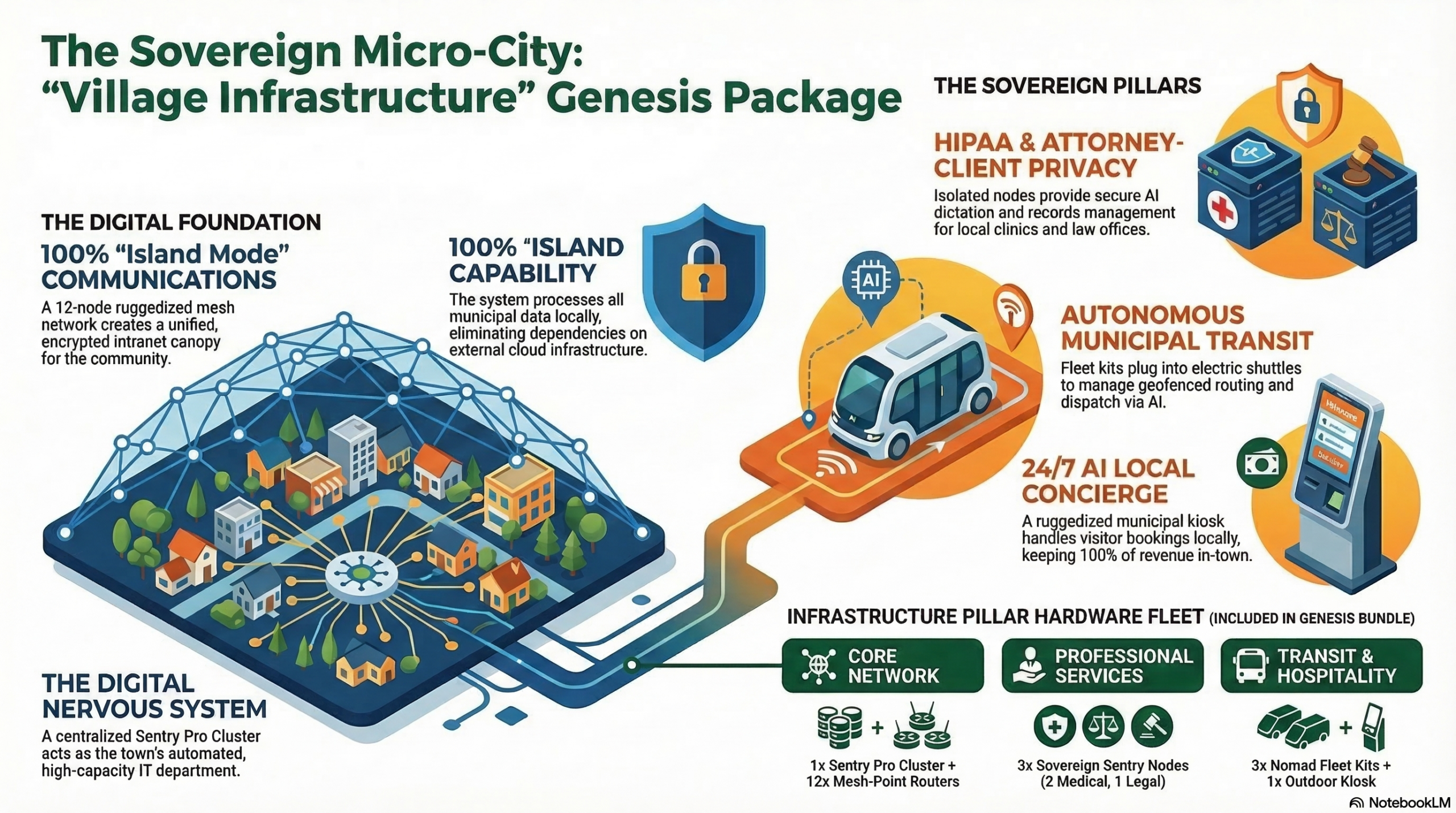
Island Mode represents a paradigm shift. Utilizing the Village Infrastructure Genesis Package, a community transitions from a cloud-dependent model to a localized “Digital Nervous System.” This infrastructure ensures that all vital communications and data processing remain within the physical and digital boundaries of the town, creating a self-contained environment of absolute sovereignty.
Comparing Digital Lifestyles
| Feature | Cloud-Dependent Systems | Island Mode Systems |
| Data Ownership | Data resides on third-party servers; ownership is governed by TOS. | The community maintains 100% ownership of hardware and data. |
| Connectivity | Total reliance on macro-internet fiber; outages halt town services. | Local intranet remains operational even if the global web goes dark. |
| Privacy | Data egresses to the cloud, risking third-party mining or exposure. | Data is cryptographically isolated and never leaves the town mesh. |
Insight: The Right-Sized Sovereign The fundamental value of Island Mode for a micro-town (100–1,000 residents) is the achievement of Right-Sized Sovereignty. This is not merely about autonomy for its own sake; it is about ensuring that a town’s specific digital capacity matches its physical scale, making critical services “un-killable” by removing external points of failure.
Once we understand the digital philosophy of the “Island,” we must examine the physical anatomy of the hardware that casts this protective canopy.
2. The Physical Foundation: The Air-Gapped Mesh Network
To maintain a sovereign perimeter, the town utilizes a specialized hardware fleet that operates independently of traditional cellular towers or external internet providers.
- Sentry Pro Cluster: The “Digital Nervous System’s” brain. This 3-node enterprise cluster runs the DevOps Sovereign (the Deep Admin agent) and hosts the town’s Root Certificate Authority.
- Nomad Mesh-Point Routers: Ruggedized units utilizing Wi-Fi 6E and LoRaWAN frequencies. Twelve of these points are mounted on light poles and rooftops to blanket the town center in a unified, local intranet for VoIP, transit, and scheduling.
- Nomad Fleet Kits: These mobile edge servers run the Industrial Foreman agent. Plugged into municipal electric shuttles, they manage autonomous dispatch, battery load balancing, and geofencing.
Defining “Air-Gapped” Resilience Imagine a town that possesses its own private reservoir and network of pipes. Even if the state’s main water line is severed, every faucet in the town still runs. In this system, “Air-Gapping” means the town mesh remains fully functional if the macro-internet fiber line is cut. Because the Nomad Mesh-Points and Sentry Clusters communicate directly within the community, internal life—from booking a shuttle to medical dictation—continues without interruption.
While these physical nodes cast the canopy, the true security lies in the mathematical armor of cryptography.
3. The Digital Fortress: Cryptographic Segmentation
A sovereign network must be immune to “pivoting”—a tactic where a breach in a low-security area (like a public kiosk) allows an attacker to move into high-security areas (like a law office). Island Mode prevents this through Cryptographic Sub-Netting.
The system utilizes a Root Certificate Authority (CA) to “mint” the town’s identity through a three-phase fulfillment workflow:
- Topology Mapping: Engineers map GPS coordinates to configure LoRaWAN frequencies and shuttle geofences.
- Root CA Minting: The system generates a unique Master SHA-256 Key that serves as the foundation for the town’s entire digital identity.
- Dispatch: An encrypted onboarding dossier is sent to the Town Council, providing the secure credentials needed to initialize the network.
The Master Key Analogy Think of the Root CA as the master key to a secure apartment building. While the town’s “Deep Admin” holds the master key, the individual Segmented CA Certificates are the keys to specific units. Although the Municipal Kiosk and the Law Office share the same “hallway” (the mesh network), the Kiosk’s key cannot open the Law Office’s door. They are mathematically isolated, ensuring that data in one “room” is invisible to the others.
This mathematical segregation ensures that even the most sensitive professional secrets remain locked within their respective sanctuaries.
——————————————————————————–
4. Protecting the Professionals: Medical and Legal Sanctuaries
For healthcare and legal professionals, privacy is a statutory mandate. The Genesis Package deploys dedicated Sovereign Sentry nodes running the Sovereign Executive agent to create these sanctuaries.
Checklist for Professional Privacy
- Zero-Cloud Egress: All PostgreSQL databases are hosted locally; no patient or client data ever touches the external internet.
- Isolated LLM Instances: Localized Whisper AI for medical dictation and OCR for contract generation run on local hardware, ensuring no “training” on sensitive data occurs in the cloud.
- Physical & Cryptographic Separation: “Inter-Clinic Contamination” is prevented by assigning distinct Sentry nodes to each office, enforcing strict VLAN isolation.
The “So What?” for Residents When you visit the local clinic, your doctor’s dictation and medical records are processed by a Sovereign Executive node located right in the office. This data is never sent to a corporate data center. Even if a visitor in the town square attempts to breach the public Municipal Kiosk, there is no digital path for them to “pivot” into your medical files. Your privacy is guaranteed by the laws of mathematics, not just a privacy policy.
Beyond digital isolation, the system must also account for physical integrity and the inevitable demands of community growth.
——————————————————————————–
5. Resilience and Self-Healing: The Vault Warden & Elastic Clustering
The Genesis Package is a “living” system, monitored and healed by the DevOps Sovereign agent. It is designed to adapt to both digital load and physical threats.
Scenario A: The Town Grows
- The Challenge: As the population scales from 100 to 1,000, the network routing demands increase, potentially creating bottlenecks.
- The Solution: Elastic Clustering. Built on Proxmox/RIOS, the core cluster allows the town’s IT to dynamically assign more RAM and CPU power to network daemons, scaling the “brain” of the town without a second of downtime.
Scenario B: Physical Vandalism
- The Challenge: A bad actor attempts to physically break into the Municipal Kiosk to steal the internal server and the data it holds.
- The Solution: Vault Warden. This security agent monitors the kiosk’s physical chassis via LiDAR and volumetric sensors. If a breach is detected, it instantly triggers a “Lockdown,” wiping the local decryption keys and rendering the data useless while simultaneously alerting local authorities across the mesh.
The network does not merely exist; it actively defends its own integrity and adapts to the community’s evolving needs.
——————————————————————————–
6. The Future of Localized Sovereignty
The Village Infrastructure Genesis Package is far more than a hardware bundle; it is a Turnkey Sovereign Micro-City Operating System. It provides the foundational architecture for a local economy that is resilient, private, and entirely self-owned.
Learner’s Summary
- Digital Autonomy: The town functions as a “Digital Island,” eliminating all dependencies on Big Tech for core municipal, medical, and legal services.
- Absolute Privacy: Through the use of the Sovereign Executive and cryptographic sub-netting, sensitive data remains local and mathematically isolated from public-facing nodes.
- Physical Resilience: The combination of an air-gapped mesh network and the Vault Warden security agent ensures the town stays online and secure, even under physical or digital duress.
By deploying this system, community leaders ensure that the heart of the town—its data, wealth, and infrastructure—remains 100% local, keeping the power of the community in the hands of the people who live there.


